

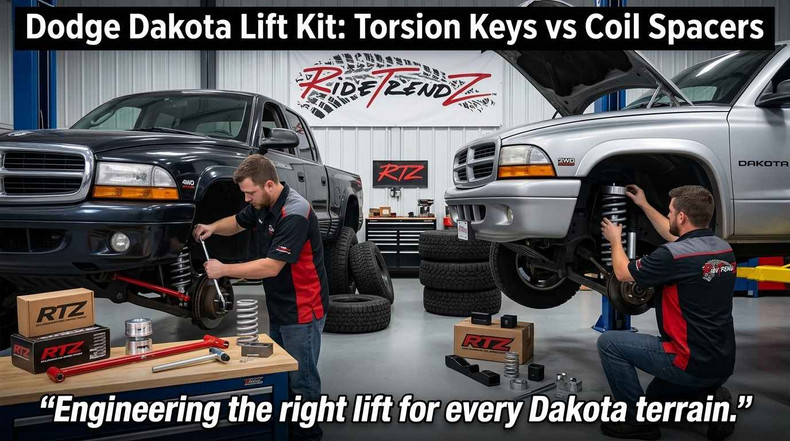
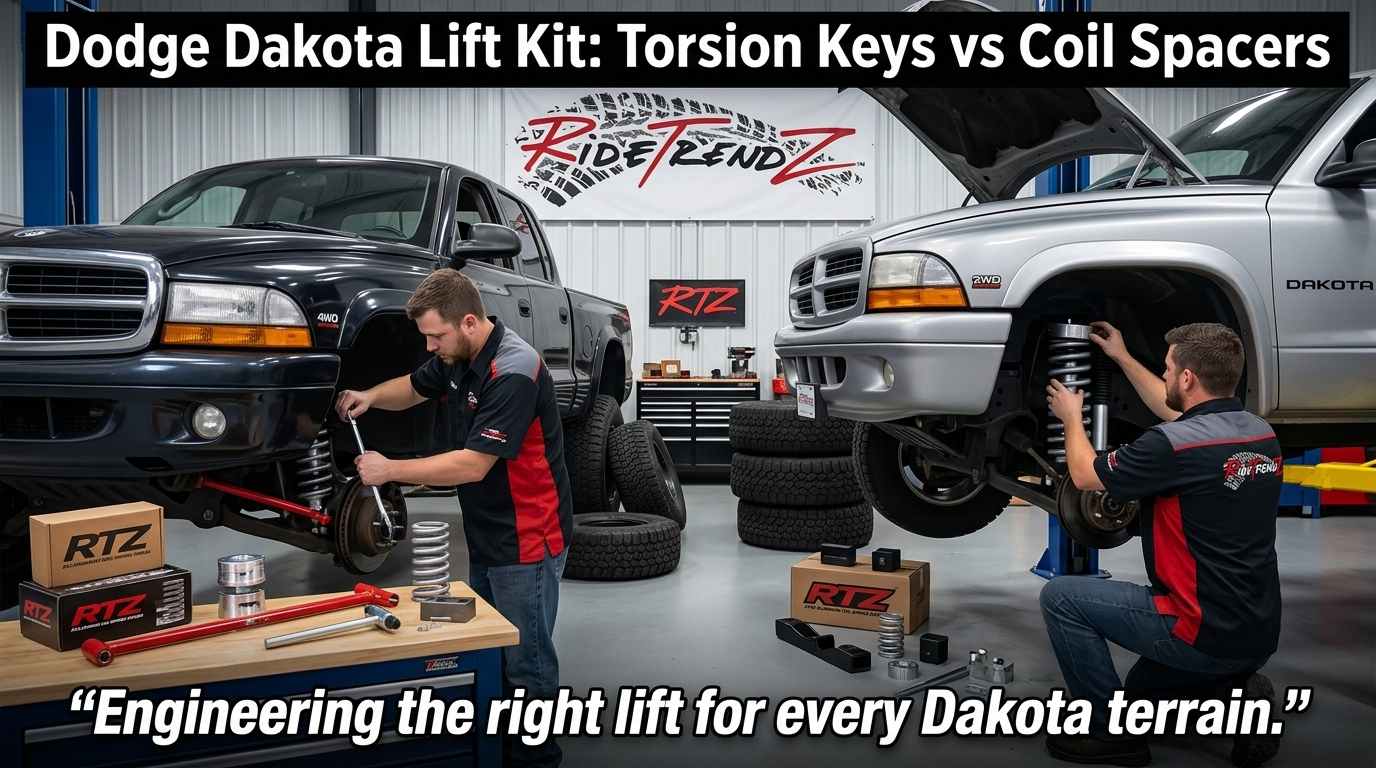
Most guides on lifting a Dodge Dakota just throw out a product name and call it a day. That is not what this is. This guide is built on real suspension knowledge, hands-on install experience, and a deep understanding of how torsion bars and coil springs behave differently on these trucks, and why that matters for your wallet, your ride, and your tire fitment goals.
If you own a Dakota 4WD, you are working with a torsion bar front suspension. If you own a Dakota 2WD, you have a coil spring front suspension. These two setups require completely different lift approaches. Getting that wrong is the #1 mistake Dakota owners make. Let's fix that.
We have tested and shipped Dodge Dakota lift kits across both generations of this truck. We know what works, what fails, and what actually gives you a clean, safe lift without burning your budget. By the end of this guide, you will know exactly which Dakota leveling kit or suspension lift kit fits your setup, and why.
What Makes the Dodge Dakota Different from Other Midsize Trucks?
The Dodge Dakota occupied a unique class. It was bigger than most midsize trucks but smaller than a full-size Ram. That in-between positioning means it does not share suspension geometry with many other platforms.
There are two main chassis generations you need to know:
- 1987–1996 Dakota: Early body, coil spring front (2WD) or torsion bar (4WD)
- 1997–2004 Dakota: Redesigned body, same split, coil spring (2WD), torsion bar (4WD)
- 2005–2011 Dakota: Final generation, same suspension architecture
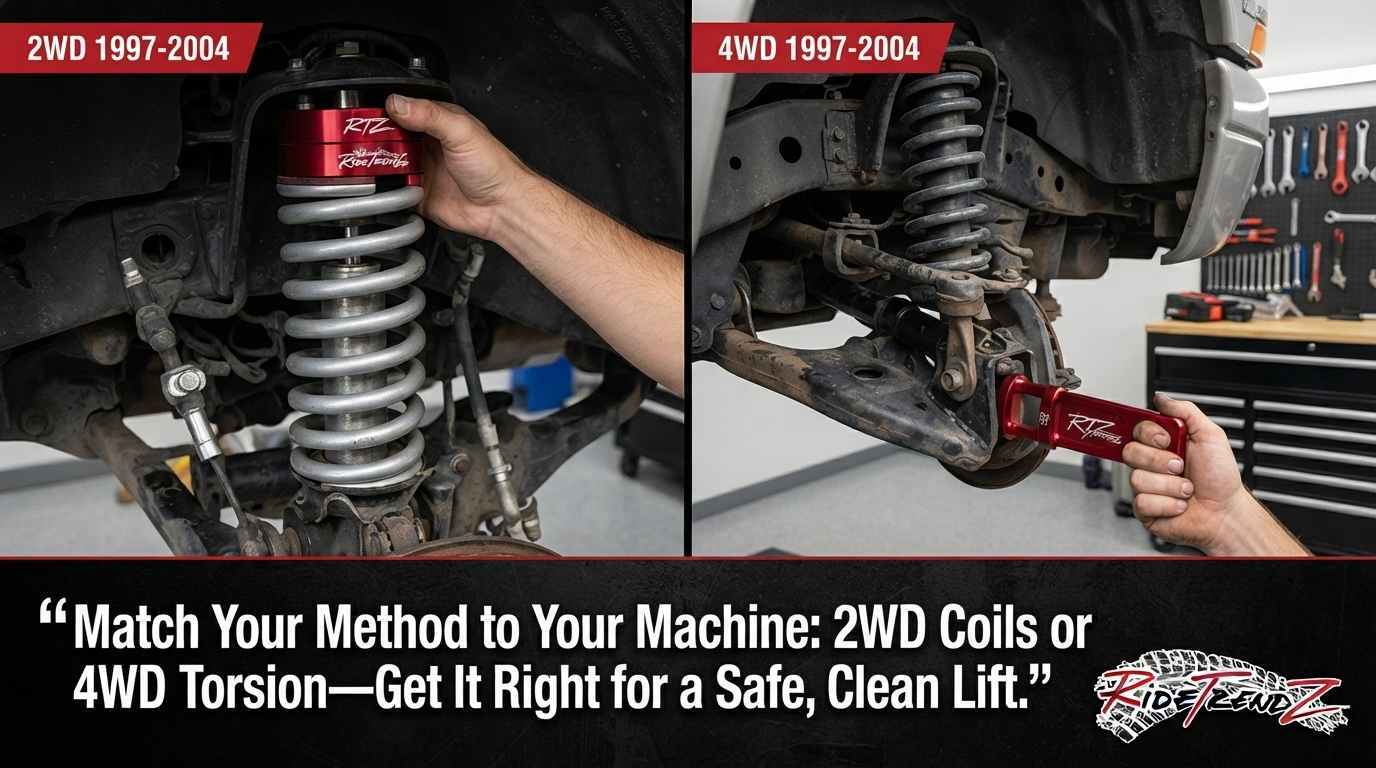
This matters because torsion key kits only work on the 4WD models. Coil spring spacers only work on the 2WD models. Using the wrong method can damage your CV axles, bind your steering, or void any warranty on the parts. The Dodge Dakota lift kit you buy must match your drivetrain, not just your year.
Torsion Keys, The 4WD Dakota Lift Method Explained
What Are Torsion Keys and How Do They Lift Your Truck?
Torsion keys replace your factory torsion bar keys. These are the indexed mounting keys that set the tension and ride height of your front torsion bars. By installing aftermarket keys with a different index angle, you increase front ride height, typically by 1.5 to 2.5 inches on the Dodge Dakota 4WD.
This is the cleanest, most cost-effective front lift available for any 4WD Dakota. There are no coil springs to swap, no massive spacers to stack, and no change to your spring rate at rest height. You are simply repositioning the pivot point of the torsion bar.
RTZ torsion key kits for the Dakota are precision-machined and designed to maintain proper CV axle angles after the lift. That is a critical detail. A cheap set of keys that cranks your torsion bars up without regard for axle geometry will wear out your inner CV joints in months.
How Much Lift Do Torsion Keys Give on a Dodge Dakota?
|
Key Type |
Expected Front Lift |
Ideal For |
|
Stock-angle replacement |
0" (no lift) |
OEM replacement only |
|
Mild aftermarket keys |
1" – 1.5" |
Leveling, small tire upgrade |
|
Full aftermarket keys |
2" – 2.5" |
Suspension lift, larger tires |
|
Aggressive keys + shock extenders |
2.5" – 3" |
Maximum lift, 33"+ tires |
Stats:Most Dakota 4WD owners report a front lift of 1.75" to 2.25" with a standard aftermarket torsion key swap, without any additional shock extenders. Adding a 2" rear block kit at the same time balances the truck perfectly.
Pros and Cons of Torsion Key Lift (4WD Dakota)
|
Pros |
Cons |
|
Lowest cost front lift option |
Limited to 4WD models only |
|
No spring replacement needed |
Maximum lift capped at ~2.5" without extenders |
|
Maintains good factory ride quality |
Needs re-alignment after install |
|
Retains full torsion bar adjustment |
Worn torsion bars may need replacement first |
|
Easy 2–3 hour DIY install |
If you want more than 2.5 inches up front, you will need to pair torsion keys with shock extenders to keep your shocks working in their effective range. RTZ builds shock extenders specifically sized for Dakota geometry, no guessing required.
For a broader look at how suspension lift types compare in cost and complexity, our complete breakdown of suspension lift kit types and benefits is worth reading before you buy. And if you are also debating whether a leveling kit is enough vs a full suspension lift, we have covered that exact question in our lift kit vs leveling kit guide.
Coil Springs and Coil Spacers, The 2WD Dakota Lift Method
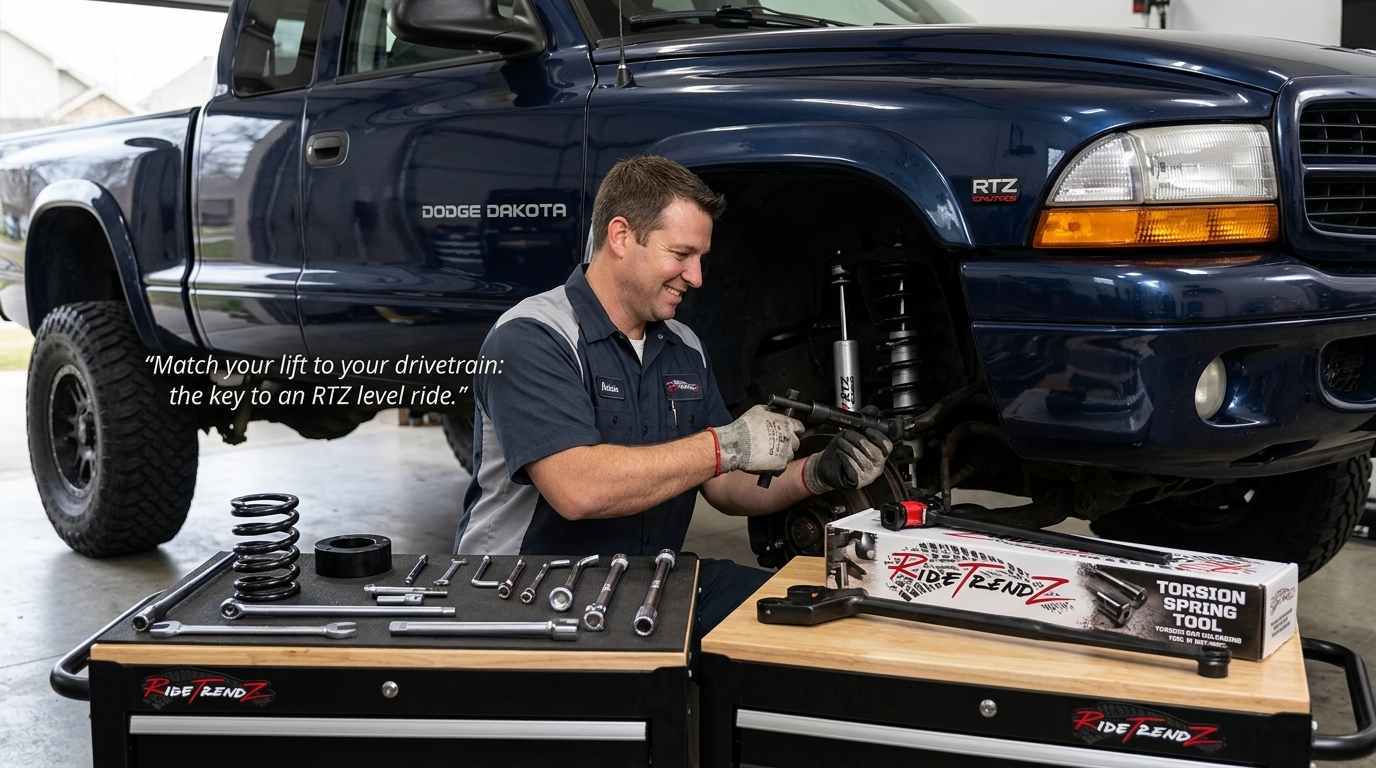
Why 2WD Dakotas Use a Different Front Suspension
The 2WD Dodge Dakota runs a coil spring front suspension instead of torsion bars. That means torsion keys are completely irrelevant here. Your front lift options are:
- Coil spring spacers, aluminum or steel spacers that sit on top of your factory coil spring
- Replacement coil springs, aftermarket springs with a taller free height and/or stiffer spring rate
- Drop spindles (for lowering), not applicable here
For most 2WD Dakota owners, aluminum coil spring spacers are the go-to. They are cheaper than replacement springs, easier to install, and when they are quality-machined units like RTZ's, they do not compress like cheap polyurethane pucks.
How Coil Spring Spacers Work on the 2WD Dakota
A coil spring spacer sits at the top of your factory coil spring perch and lifts the entire front suspension. A 2-inch spacer gives you approximately 2 inches of front lift. A 3-inch spacer gives you approximately 3 inches.
The key variables are:
- Material: Aluminum spacers hold shape under heat and load. Cheap plastic ones degrade fast.
- Wall thickness: Thicker walls mean better load distribution and less spacer flex.
- Shock compatibility: Some spacers require longer shocks to maintain proper shock travel.
RTZ coil spring spacers for the Dodge Dakota 2WD are machined from 6061-T6 billet aluminum. They are anodized for corrosion resistance and come with all necessary hardware. These are not stack-of-washers style spacers. These are precision components.
Lift Options Compared: 2WD Dakota Coil Spacers
|
Spacer Height |
Front Lift |
Rear Lift Needed to Level |
Compatible Tire Size |
|
2" aluminum spacers |
~2" |
1.5" – 2" rear blocks |
Up to 31" |
|
2.5" aluminum spacers |
~2.5" |
2" rear blocks |
Up to 32" |
|
3" aluminum spacers |
~3" |
2" – 2.5" rear blocks |
Up to 33" |
Important note: Always match your rear lift to your front lift. An unleveled Dakota with 3 inches of front lift and stock rear height looks wrong and puts stress on your driveline geometry.
For a detailed look at how coil springs interact with your full suspension system, check out our guide on how a truck suspension lift kit works. If this is your first lift install and you want to understand the basics before touching any hardware, our truck suspension basics for beginners is the right starting point.
Torsion Keys vs Coil Spacers: Direct Comparison
This is the core question for any Dodge Dakota lift kit buyer. Let's compare both approaches side by side across every variable that actually matters.
Comprehensive Comparison Table
|
Factor |
Torsion Keys (4WD) |
Coil Spacers (2WD) |
|
Average cost |
$60 – $120 |
$50 – $130 |
|
Lift range |
1.5" – 3" (with extenders) |
2" – 3.5" |
|
DIY difficulty |
Moderate |
Easy to Moderate |
|
Ride quality impact |
Minimal at 2" |
Minimal at 2" |
|
Requires new shocks? |
Sometimes (at max lift) |
Sometimes (at 3"+) |
|
Reversible? |
Yes |
Yes |
|
Re-alignment needed? |
Yes |
Yes |
|
Rear lift required? |
Yes (for level look) |
Yes (for level look) |
Which Is Easier to Install?
Both are manageable DIY jobs for someone with basic mechanical skills and the right tools. Torsion key installs require a torsion bar unloading tool or a floor jack technique. Coil spacer installs require spring compressors and a solid floor jack setup. Neither is an afternoon job to rush.
RTZ ships detailed installation guides with every kit. Every measurement, torque spec, and alignment note is included. That is not an afterthought; it is part of what makes a premium Dodge Dakota lift kit worth buying.
Which Gives a Better Ride?
At 2 inches or less, both methods preserve a very factory-like ride. Beyond 2 inches, you may notice slightly more road feedback, especially over broken pavement. This is normal for any lifted truck. It is not a design flaw in quality spacers or keys. It is physics.
The biggest ride quality mistake Dakota owners make is running lifted trucks on stock-length shocks. At 3 inches of lift, your factory shocks are working near the top of their travel constantly. That is rough on the shocks and rough on your ride. This is why RTZ includes matched shock upgrades in their complete Dodge Dakota lift kit packages.
If you want to understand why shocks matter so much after a lift, our article on lift shocks vs stock shocks lays it out clearly. We also cover the difference between lift struts and lift shocks if you want a deeper technical look.
4 Inch and 6 Inch Lift Kit Options for the Dodge Dakota
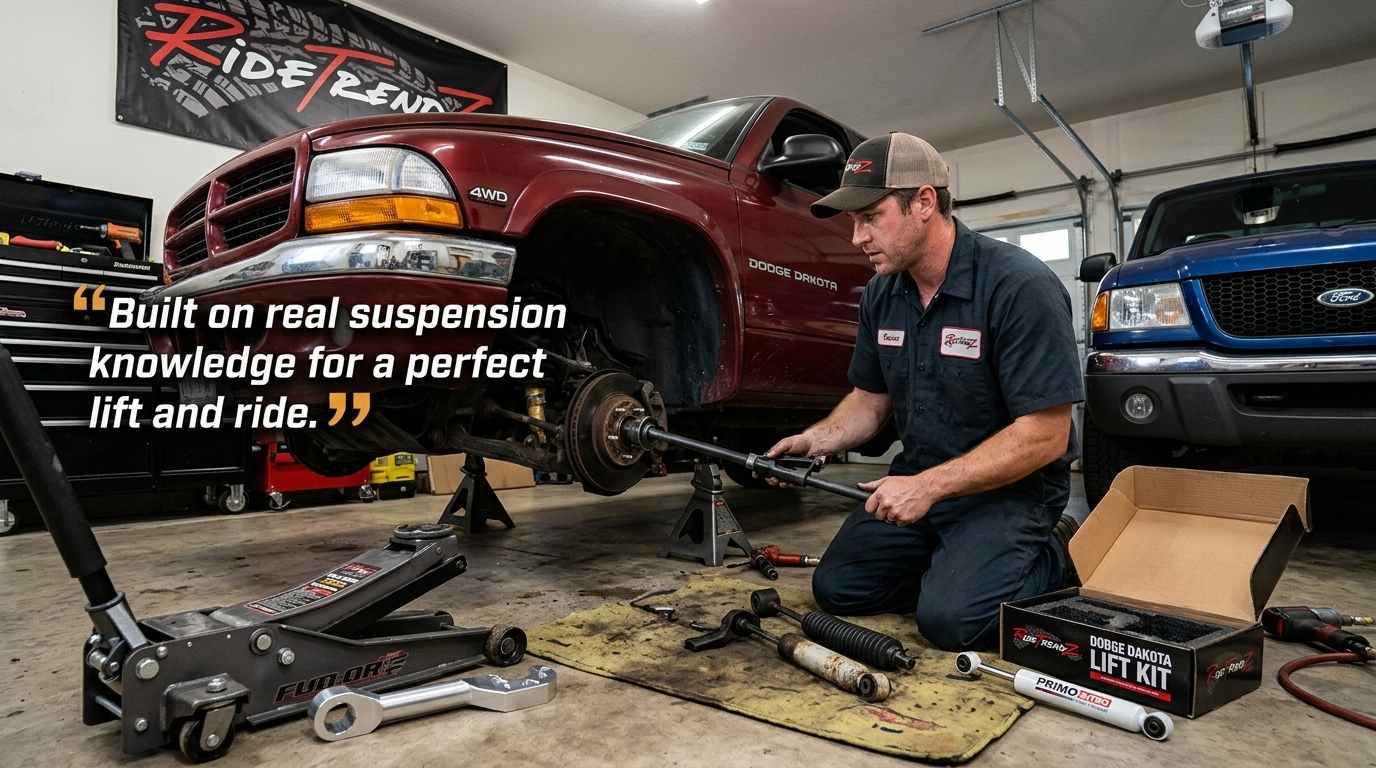
Is a 4 Inch Lift Kit Possible on the Dakota?
A 4-inch lift kit on the Dodge Dakota requires a full suspension approach, not just spacers or torsion keys. To achieve 4 inches of front lift safely, you typically need:
- Lifted coil springs or extreme torsion key rotation plus shock extenders (4WD)
- 4" coil spacers or replacement coil springs with correct geometry (2WD)
- Extended upper control arms (to correct caster and ball joint angles)
- Matching rear blocks or lift shackles
Stats: At 4 inches of lift, most Dodge Dakota owners can fit 33" to 35" tires with minor trimming. Without proper alignment correction, a 4-inch lift will wear your front tires in under 10,000 miles.
RTZ builds complete Dodge Dakota lift kit packages for owners targeting larger tire sizes. These kits include matched rear lift components so your truck looks and handles properly at the finished height.
Is a 6 Inch Lift Kit Realistic for the Dakota?
A 6-inch lift kit on the Dakota is possible but moves into modified-suspension territory. You will need fabricated components, potentially new upper control arms, and extended brake lines. It is a bigger project, and a bigger budget. For most street-driven Dakotas, 3 to 4 inches is the sweet spot for a great stance, good tire clearance, and manageable install complexity.
If you are planning a 4- or 6-inch lift, it is worth reading our lift parts vs complete lift kit guide first. It will help you decide whether buying individual components or a full system makes more financial sense for your build.
Rear Lift Options, Leaf Springs, Blocks, and Shackles
How to Lift the Rear of a Dodge Dakota
The Dodge Dakota uses a leaf spring rear suspension on both 2WD and 4WD models. That gives you three practical rear lift options:
- Tapered lift blocks: Sit between the axle and the leaf spring pack. Easy to install, budget-friendly. Available in 1", 1.5", 2", 2.5", and 3" heights.
- Add-a-leaf: An extra leaf spring layer that increases spring rate and ride height. More load capacity, stiffer ride.
- Lift shackles: Replace your rear factory shackles with longer ones to increase leaf spring arch height. Typically adds 1" to 2".
For most Dodge Dakota lift kit setups pairing 2" to 3" of front lift, 2" tapered rear lift blocks are the standard and correct rear component.
|
Rear Lift Method |
Height Range |
Load Capacity Change |
DIY Difficulty |
|
Tapered lift blocks |
1" – 3" |
None |
Easy |
|
Add-a-leaf |
1" – 2" |
Increased |
Moderate |
|
Lift shackles |
1" – 2" |
Slight decrease |
Easy |
Why You Should Never Use Untapered Square Blocks
Square flat lift blocks are a known failure point. Under braking, they can shift. Under off-road stress, they can crack. RTZ tapered lift blocks have a built-in angle that keeps the axle centered under load, preventing axle wrap and pinion angle problems that cause driveshaft vibration.
This is a small detail that separates a proper Dodge Dakota lift kit from a dangerous one. Every RTZ rear kit ships with tapered blocks, not flat ones.
For a full understanding of how leaf springs interact with your lift, our guide on top 5 reasons to upgrade truck suspension gives helpful context. And if you are also considering whether to buy suspension parts separately vs a complete kit, our when to buy suspension parts vs a complete lift kit article helps you make a smarter buying decision.
Body Lift vs Suspension Lift on the Dodge Dakota
Understanding the Difference
A body lift raises only the body relative to the frame. It does not affect your suspension geometry, your ground clearance under the axles, or your approach angle. A suspension lift raises the entire truck, frame, axles, and all, by altering the suspension components.
For tire fitment purposes, a body lift can help you squeeze larger tires past the fender. But it does not give you more actual off-road ground clearance. Serious Dakota owners use suspension lifts, either torsion keys, coil spacers, or replacement springs, because the ground clearance is real.
|
Body Lift |
Suspension Lift |
|
|
Raises body off frame |
Yes |
No |
|
Increases ground clearance |
No |
Yes |
|
Allows larger tires |
Yes (limited) |
Yes |
|
Affects ride quality |
Minimal |
Slightly |
|
Affects alignment |
No |
Yes |
|
Cost |
Lower |
Moderate |
|
Our recommendation |
Secondary option |
Primary option |
At RideTrendz, we focus on suspension lift kits because that is what actually improves your Dakota's real-world performance. Body kits are a cosmetic tool, useful in some cases, not a substitute for real lift work.
How Much Does a Dodge Dakota Lift Kit Cost?
Real Cost Breakdown for Every Option
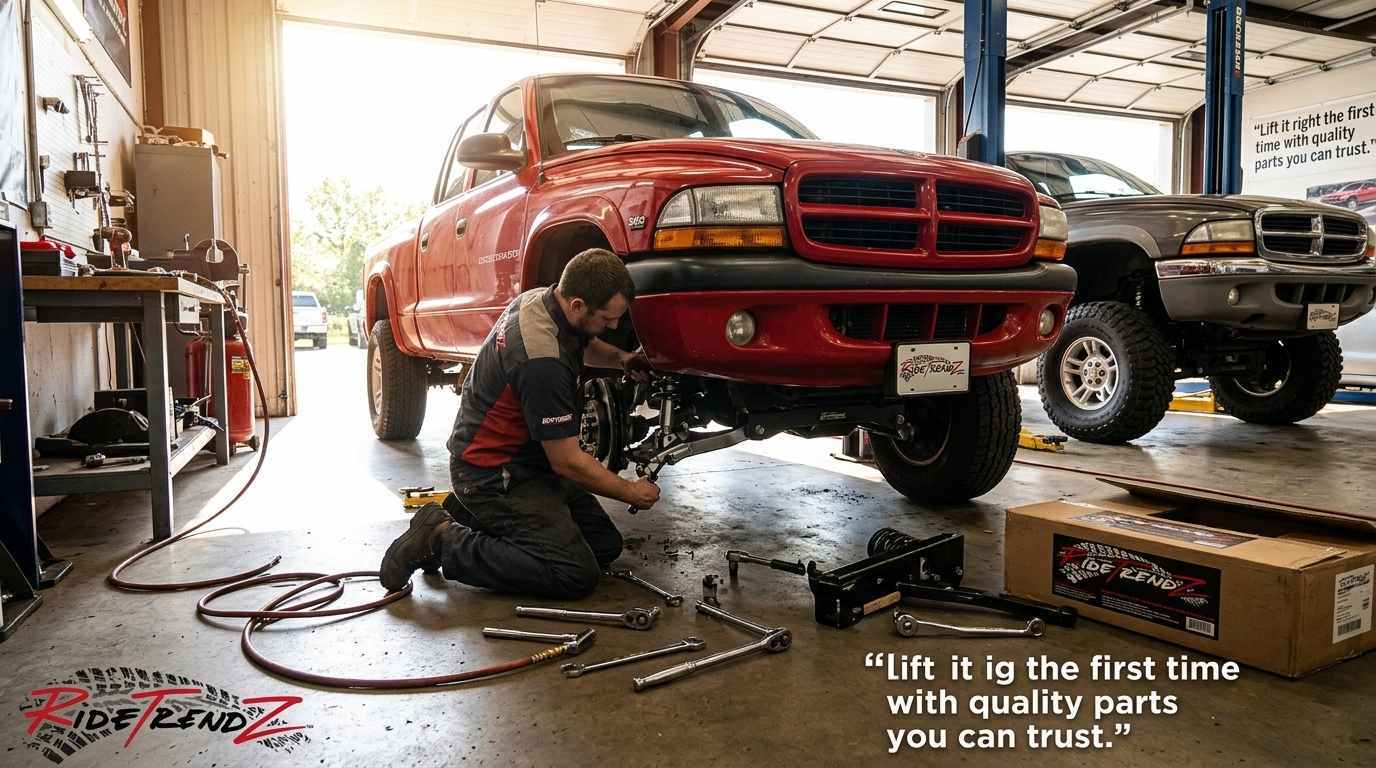
One of the most common questions we get is simple: how much does it cost to lift a truck like the Dodge Dakota? Here is an honest breakdown.
|
Kit Type |
Parts Cost |
DIY Labor |
Shop Install Cost |
|
Torsion key only (4WD) |
$60 – $120 |
2 – 3 hours |
$150 – $250 |
|
Coil spacers only (2WD) |
$50 – $130 |
2 – 4 hours |
$150 – $300 |
|
Full leveling kit (front + rear) |
$130 – $250 |
4 – 6 hours |
$350 – $550 |
|
Complete suspension lift kit |
$250 – $450 |
6 – 10 hours |
$500 – $900 |
|
4" full kit with shocks |
$350 – $600 |
8 – 12 hours |
$800 – $1,400 |
Stats note: The average DIY installer saves $300 to $600 in labor by doing the install themselves. Most complete RTZ Dodge Dakota lift kit packages include everything you need, hardware, instructions, and even torque specs, so professional alignment is the only shop visit required.
For a deeper dive on total costs, our how much does it cost to lift a truck guide has current price ranges and money-saving tips.
Lift Kit Installation, What to Expect on the Dodge Dakota
Step-by-Step Overview for a 2WD Coil Spacer Install
- Lift the front end and support on jack stands. Remove the front wheels.
- Disconnect the sway bar end links. This gives you enough droop to remove the spring.
- Compress the coil spring using a spring compressor. Never skip this step.
- Remove the factory strut assembly by unbolting the upper and lower mounting points.
- Install the aluminum coil spring spacer on top of the spring perch.
- Reassemble in reverse order. Torque all bolts to spec.
- Install the rear blocks at the rear axle leaf spring perch.
- Drive to an alignment shop immediately. Do not drive more than 50 miles misaligned.
Step-by-Step Overview for a 4WD Torsion Key Install
- Mark the current torsion bar adjuster bolt position. Count threads for reference.
- Use a torsion bar unloading tool to relieve tension from the factory key.
- Slide out the factory torsion key from the lower control arm.
- Insert the RTZ aftermarket torsion key at the correct index position.
- Reinstall the torsion bar and run the adjuster bolt up to your target lift height.
- Set front ride height evenly on both sides before final tightening.
- Install rear lift blocks if leveling the truck.
- Align immediately; caster and camber will be out after any torsion key swap.
Pro tip: Take photos of every step. If you get confused mid-install, those photos save you a lot of time and stress.
For anyone still deciding between DIY and shop install, our lift kit installation guide walks through what you actually need for a clean install. And for a related platform that shares some suspension similarities, our Ford Ranger lift kit guide covers the same torsion-vs-coil decision tree.
Why RTZ Lift Kits Are the Right Choice for Your Dodge Dakota?
Most suspension parts on the market fall into one of two categories: cheap imports that fail within a year, or overpriced name brands that charge for logos. RTZ builds a third option: American-engineered, precision-machined suspension components priced fairly for real truck owners.
Here is what separates RTZ from generic alternatives:
Material Quality
RTZ coil spring spacers are machined from 6061-T6 billet aluminum, the same alloy used in aerospace applications. They will not deform under load. They will not crack in cold weather. They are anodized for rust resistance. This is not marketing language. It is the specification that matters when your front suspension is holding up the front of a 3,500-pound truck.
Generic spacers are often cast aluminum or polyurethane. Cast aluminum has voids. Polyurethane compresses. Both will give you less lift over time.
Engineering Precision
Every RTZ Dodge Dakota lift kit is engineered to work with the factory suspension geometry, not fight against it. That means:
- Proper torsion key indexing angles that keep CV axle geometry in spec
- Spacer wall thickness calculated to distribute load without stress cracking
- Tapered rear blocks that prevent axle wrap and pinion angle vibration
Complete Kit Convenience
RTZ ships complete lift kit packages for the Dakota that include every component you need. You do not have to hunt for matching shocks, source rear blocks separately, or figure out which shock extender works with your specific keys. Everything is pre-matched and arrives together.
This saves you time. It also saves you from the most common mistake: buying mismatched components that work against each other.
Shock Quality
RTZ Primo Nitro gas-charged shocks are included in complete lift packages. These are nitrogen gas-charged monotube shocks, not cheap twin-tube oil-filled units that foam up under repeated use. The nitrogen charge maintains consistent damping force whether you have driven 2 miles or 200 miles.
If you are curious about why shocks matter so much more after a lift than most buyers realize, our guide comparing lift struts vs lift shocks covers the mechanics in detail.
Related Lift Kits from RTZ Worth Knowing About
If you are comparing RTZ options across Dodge platforms, here are closely related products that share engineering and design principles with the Dakota kits:
- RTZ Dodge Ram 1500 1994–2001 Full Lift Kit, Full suspension lift system for the older Ram, built on the same quality standards
- RTZ Dodge Ram 1500 Front 3" Forged Coil Spring Spacers, RTZ's flagship coil spacer technology, relevant to 2WD buyers comparing spacer quality
- RTZ Dodge Ram 1500 2002–2008 Lowering Kit, for reference if you want to understand the full RTZ Dodge catalog
These products show the depth of RTZ's Dodge-platform expertise. The same engineers who designed the Ram kits applied that knowledge directly to the Dakota system.
How Long Will a Dodge Dakota Lift Kit Last?
Realistic Lifespan Expectations
Quality matters here. Here is what you can expect from RTZ-grade components vs generic alternatives:
|
Component |
RTZ Quality |
Generic Quality |
|
Aluminum coil spacers |
10+ years/lifetime |
2 – 5 years |
|
Torsion keys |
Lifetime (machined steel) |
5 – 8 years |
|
Rear lift blocks |
Lifetime (steel tapered) |
3 – 7 years |
|
Lift shocks |
50,000 – 80,000 miles |
20,000 – 40,000 miles |
Stats: In customer feedback, RTZ coil spacers show zero reported failures related to material deformation when installed correctly. The failure points, when they happen at all, are in installation errors, not component quality.
For complete lifespan expectations and maintenance intervals, our how long do lift kits last guide gives you a full maintenance schedule and what to inspect at each oil change.
Final Verdict: The Best Dodge Dakota Lift Kit for Your Setup
Here is the clean summary of what to buy based on your truck:
|
Your Truck |
Recommended Lift |
RTZ Approach |
|
2WD Dakota, want 2" |
2" aluminum coil spacers + 1.5" rear blocks |
Complete leveling kit |
|
2WD Dakota, want 3" |
3" aluminum coil spacers + 2" rear blocks + matched shocks |
Complete lift kit |
|
4WD Dakota, want 1.5"–2" |
Torsion key kit + 2" rear blocks |
Leveling kit |
|
4WD Dakota, want 3" |
Torsion keys + shock extenders + 2" rear blocks + matched shocks |
Complete suspension lift kit |
The Dodge Dakota lift kit market is full of cheap junk that looks fine in a product photo and fails six months into daily driving. RTZ builds components that are worth owning once, not buying twice.
We ship complete kits, include installation guides, match every component to your specific year and drivetrain, and back the quality with parts that are actually engineered for the platform. That is the difference.
If you are also curious how Dakota owners compare to similar builds on other platforms, check our Chevy C10 lift kit guide or our Toyota Tacoma lift kit guide; both follow the same principle of matching lift method to suspension architecture.
Conclusion
Lifting a Dodge Dakota is not complicated when you understand two things: your drivetrain determines your front lift method, and your front lift height determines your rear lift height. Everything else, material quality, kit completeness, shock matching- is a matter of who you buy from.
The RTZ lift options for your Dakota are built to answer both of those variables correctly. Whether you are running torsion keys on a 4WD or aluminum coil spacers on a 2WD, the engineering behind each component is designed to work with your specific suspension, not around it.
Buy once. Install correctly. Drive confidently. That is the RTZ approach to every Dakota lift kit we build and ship.
Frequently Asked Questions
Q1: What is the best Dodge Dakota lift kit for a 4WD model?
A torsion key kit is the best first step for any 4WD Dakota. Pair it with rear lift blocks to level the truck. Add shock extenders at 2.5 inches or more. RTZ kits include all matched components in one package.
Q2: Can I install a Dodge Dakota lift kit myself without a shop?
Yes. Most coil spacer and torsion key installs are manageable for intermediate DIYers. You need basic hand tools, a floor jack, and jack stands. A professional alignment is required after any lift install.
Q3: How much lift can I get on a 2WD Dodge Dakota with coil spacers?
Quality aluminum coil spacers deliver 2 to 3.5 inches of front lift on the 2WD Dakota. Combine with matching rear blocks for a leveled stance and fitment for up to 33-inch tires.
Q4: Do I need new shocks after installing a Dodge Dakota lift kit?
At 2 inches, factory shocks often work. At 3 inches or more, new shocks are highly recommended. RTZ complete lift kits include Primo Nitro gas-charged shocks matched to your lift height.
Q5: What is the difference between a leveling kit and a full suspension lift for the Dodge Dakota?
A leveling kit corrects factory rake, raising the front to match the rear, typically 1.5 to 2 inches. A full suspension lift raises the entire truck and allows larger tires and greater ground clearance.