

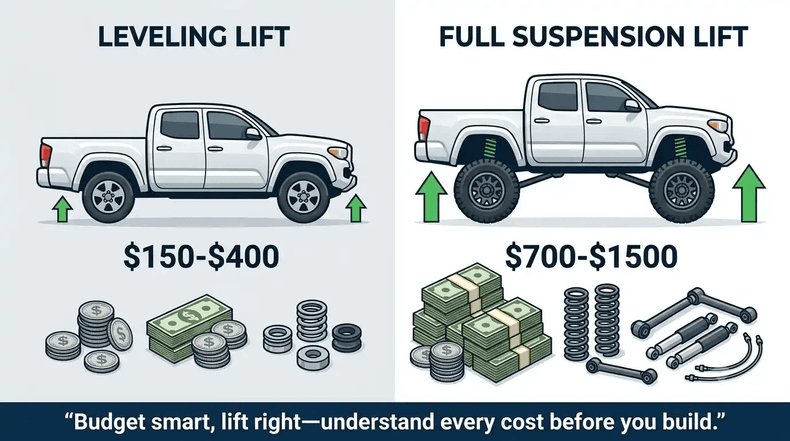
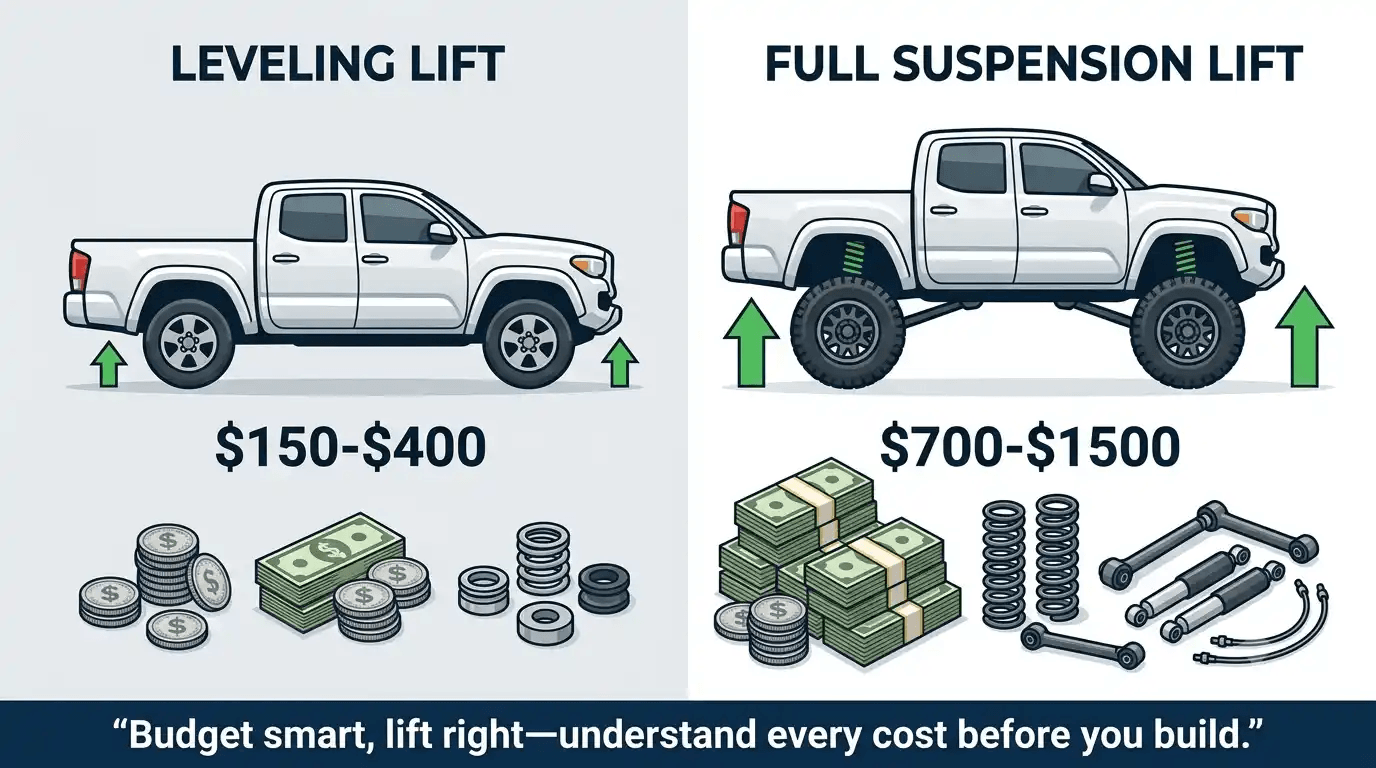
How Much Does It Cost to Lift a Truck? Full Price Breakdown?
If you have typed how much does it cost to lift a truck into a search bar, you are already doing this the smart way. Most truck owners buy a kit first and ask questions later, then end up frustrated when the bill grows past what they expected. This guide breaks every real cost into plain numbers, so you know exactly what you are paying for before you spend a single dollar.
We build and ship suspension kits every single day at RideTrendz, and we hear this question constantly. Budget shoppers ask it. Weekend off-roaders ask it. Daily drivers chasing a better stance ask it too. The honest answer is that lift cost depends on your truck, your goals, and the parts you choose to put under it. Below, we walk through the full picture with real numbers, side-by-side comparisons, and the kind of straight talk you will not get from a generic parts catalog.
Why Lift Cost Varies So Much From Truck to Truck?
Ask ten truck owners how much it costs to lift a truck, and you will get ten different answers. Nobody is wrong here. Lift cost depends on variables that change from one driveway to the next, and understanding those variables is the first step toward an accurate budget.
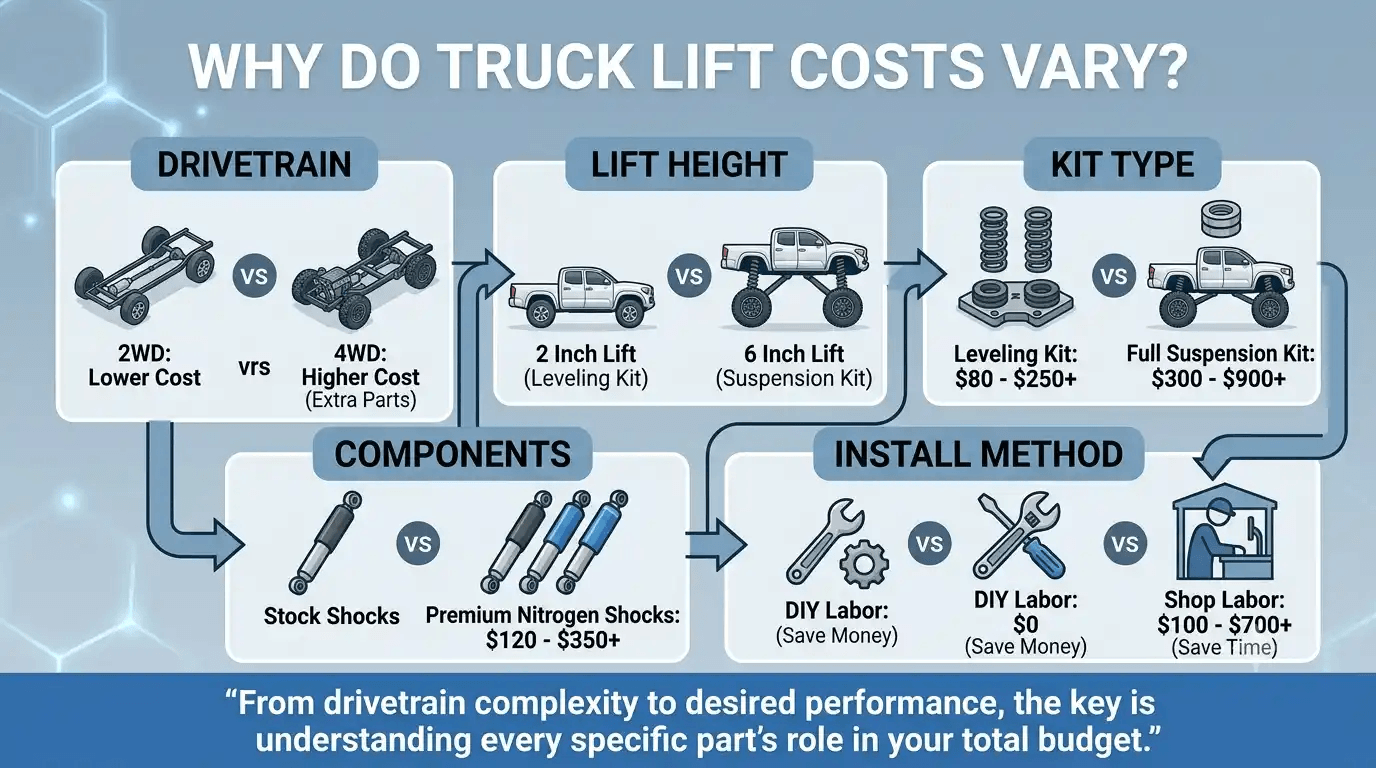
Your truck's drivetrain matters first. A 2WD truck is almost always cheaper to lift than a 4WD truck, because 4WD trucks need extra components like driveshaft spacers and carrier bearing drop kits to keep the drivetrain angle correct after a lift. Your target lift height matters too. A small 2-inch leveling lift costs far less than a 6 inch suspension lift that requires new shocks, extended brake lines, and sometimes new control arms. Then there is your install method. Doing the work yourself in your own garage costs only the price of parts. Paying a shop for installation adds labor on top of that.
We cover this distinction in detail in our guide on lift kit vs leveling kit, which explains why a 2-inch leveling kit and a true 4 inch suspension lift kit are priced so differently even though both raise your truck off the ground.
The Five Biggest Cost Factors
- Lift height: bigger lifts need more parts and more labor hours
- Drivetrain: 4WD trucks generally cost more to lift than 2WD trucks
- Kit type: leveling kits cost less than full suspension lift kits
- Shocks: stock-style shocks cost less than premium nitrogen gas shocks
- Labor: DIY installs save money, while shop installs save time
Knowing these five factors ahead of time turns a vague guess into a real, workable budget. Once you know your drivetrain, your target height, and your install plan, the question of how much does it cost to lift a truck becomes far easier to answer with confidence.
Truck Lift Kit Cost Breakdown by Type
Here is the most direct answer to how much it costs to lift a truck. This table breaks down average parts pricing by lift category, based on the kits we build and sell every day at RideTrendz. Labor is shown separately because it varies by shop, region, and the complexity of your specific application.
|
Lift Type |
Average Parts Cost |
Typical Lift Height |
Avg. Labor Cost |
|
Coil Spring Spacers |
$60 - $150 |
1" - 3" |
$80 - $150 |
|
Leveling Kit |
$80 - $250 |
1.5" - 2.5" |
$100 - $200 |
|
Torsion Key Lift |
$100 - $250 |
1" - 3" |
$100 - $200 |
|
Full Suspension Lift Kit |
$300 - $900 |
3" - 6" |
$300 - $700 |
|
Rear Lift Shackles / Blocks |
$50 - $200 |
1" - 4" |
$80 - $150 |
|
Lift Shocks (Set) |
$120 - $350 |
Matches lift height |
$50 - $100 |
Prices reflect typical aftermarket pricing as of 2026 and will vary by vehicle make, model, and year.
For a real-world example of full kit pricing, our best lift kit for 2002-2008 Dodge Ram 1500 buying guide walks through exact part numbers and price ranges for one of the most popular trucks on the road today. It is a great companion read alongside this truck lift kit cost breakdown.
What You Are Actually Paying For When You Lift a Truck?
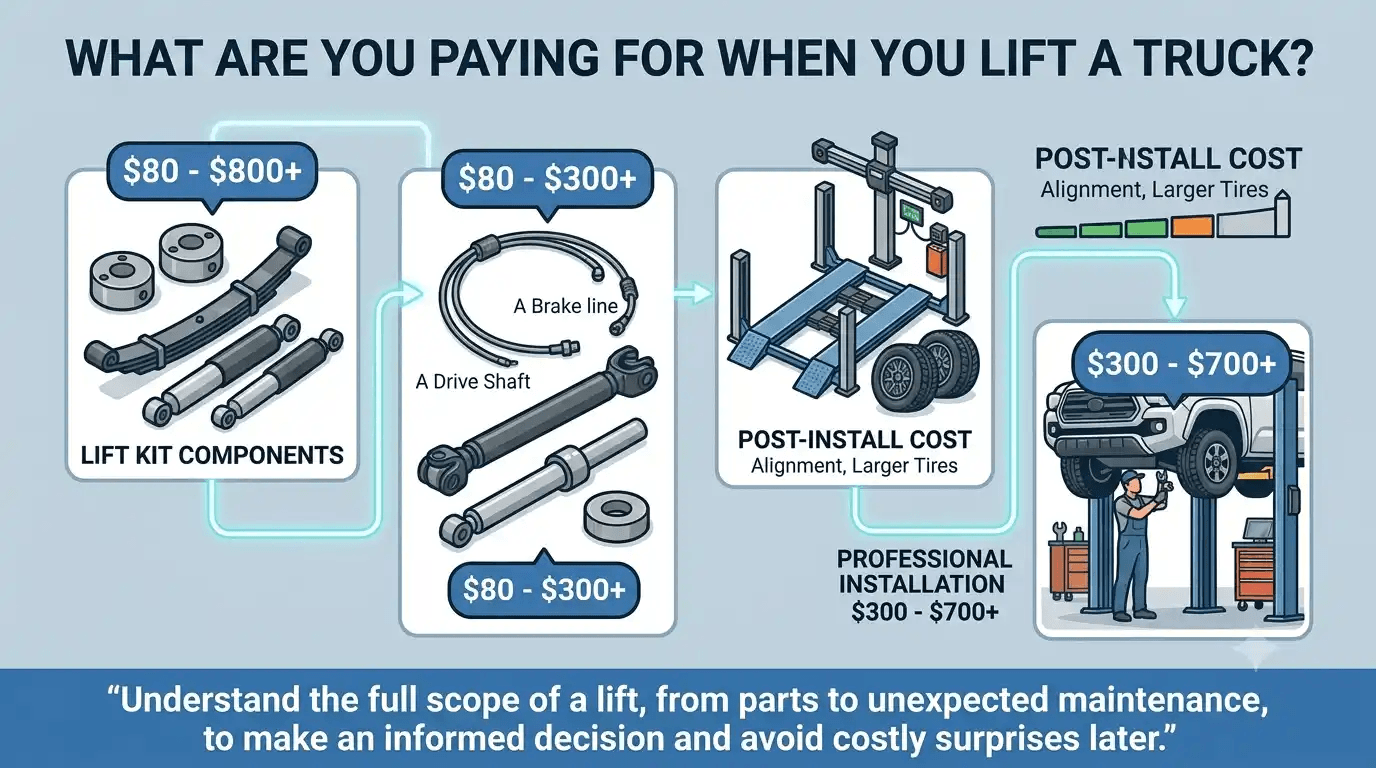
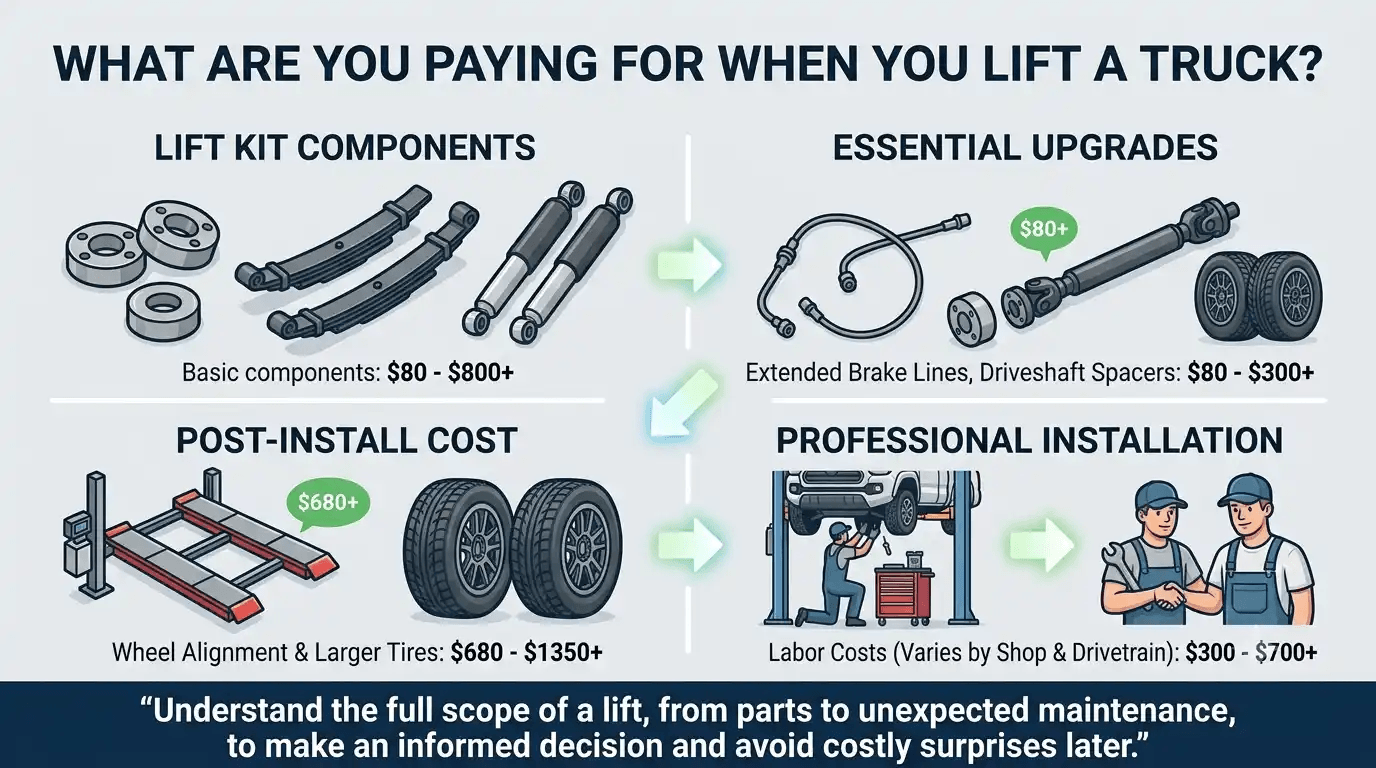
Lift kit pricing is not random. Every dollar goes toward a specific part doing a specific job. Understanding this helps explain why some kits cost $80, and others cost $800, and it helps you avoid overpaying for parts you do not actually need.
A basic lift swaps out factory springs, torsion keys, or shackles for taller versions. A more complete lift kit price guide also accounts for new shocks, mounting brackets, and sometimes control arms. If you want the mechanical side explained in plain language, read our breakdown of how a truck suspension lift kit works. It pairs well with our overview of suspension lift kit types and benefits if you are still deciding which style fits your truck best.
Common Lift Kit Components and Their Role
|
Component |
What It Does |
|
Coil spring spacers |
Raise ride height by adding space above the factory coil spring |
|
Torsion keys |
Adjust torsion bar tension on GM trucks to lift the front end |
|
Lift shackles |
Extend the rear leaf spring mounting point for added rear height |
|
Lift blocks |
Sit between the axle and leaf spring for extra rear lift |
|
Strut spacers |
Raise front strut-based suspension on SUVs and unibody trucks |
|
Nitrogen gas shocks |
Match damping to your new ride height for a controlled, stable ride |
Every one of these parts has a specific job, and skipping the wrong one is how a budget lift turns into a rough ride. This is exactly why a thoughtful truck lift kit cost breakdown matters more than chasing the cheapest listing you can find online. It is also the clearest way to answer how much does it cost to lift a truck without leaving anything out of the math.
DIY Install vs. Shop Install: Which Saves More Money?
One of the biggest swings in how much to lift a truck suspension comes down to who turns the wrench. Here is an honest pros and cons comparison so you can decide which route fits your skill level, your tools, and your schedule.
|
|
Pros |
Cons |
|
DIY Install |
Saves $100-$700 in labor; flexible schedule; learn your truck better |
Takes longer; needs basic tools; mistakes can affect alignment |
|
Shop Install |
Faster turnaround; professional alignment; warranty-backed work |
Adds labor cost; scheduling wait times; shop quality varies |
Most of the kits we sell at RideTrendz are designed for straightforward weekend installs, with clear instructions and hardware that fits the first time correctly. That is one reason so many of our customers choose to install at home and put the labor savings toward better shocks instead of a shop bill.
If you do decide to go the DIY route, plan for an afternoon with basic hand tools, a torque wrench, and a jack with sturdy stands. Most coil spacer or torsion key installs take two to four hours for someone with moderate mechanical experience. Full suspension kits with new control arms can take a full day, especially the first time through.
Real Cost Examples by Popular Truck Model
Numbers are easier to trust when they are tied to real trucks. Here is what a lift kit cost breakdown looks like for some of the most common applications we build for at RideTrendz.
Chevy Silverado / GMC Sierra 1500 (1999-2006)
A torsion key lift with steel tapered blocks for this generation typically runs $150 to $400 in parts, depending on whether you add premium nitrogen gas shocks. Our best lift kits for 1999-2006 Chevy Silverado 1500 buyer's guide breaks this down model year by model year, including which torsion key height pairs best with which shock.
Dodge Ram 1500 (2002-2008)
A front coil spring spacer kit paired with a rear axle flip kit averages $200 to $450 for this generation of Ram. Full details and exact specs are in our best lift kit for 2002-2008 Dodge Ram 1500 buying guide, which also covers V6 versus V8 fitment differences.
Ford Ranger (1983-2013)
Ranger lift costs are some of the most affordable in our catalog, often $90 to $300 for a coil spring or torsion key setup. Our best lift kits for Ford Ranger 1983-2013 guide covers every generation, from the early 4-cylinder trucks to the later Edge and Sport trims.
These three examples show how much how much does it costs to lift a truck shifts based on the platform you are working with. Older, simpler trucks tend to be cheaper to lift because the suspension architecture has fewer moving parts. Newer trucks with independent front suspension or coil-over struts often cost more because the components are more complex.
What About Lowering Instead of Lifting?
Not every truck owner wants more height. Lowering kits follow a similar cost structure, usually $150 to $500 in parts depending on drop height and shock needs. If that is your goal instead, our guide on lowering your truck: benefits, risks, and the right lowering kit to buy and our step-by-step how to lower a Chevy Silverado lowering kit guide are worth reading before you buy.
Lowering and lifting share more in common than people expect. Both change ride height, both can affect alignment, and both benefit from shocks matched to the new geometry. The pricing logic from this lift kit price guide applies almost directly to lowering kits as well.
Hidden Costs People Forget to Budget For
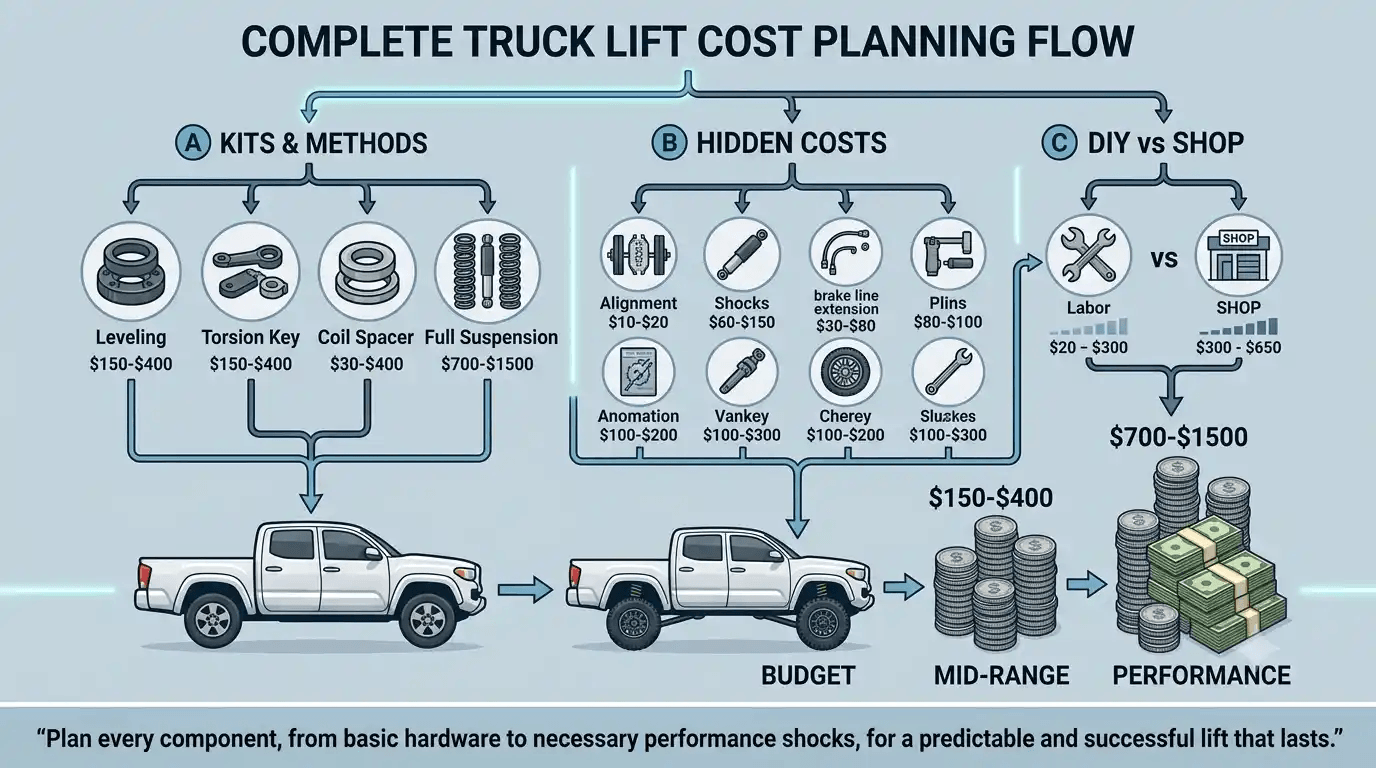
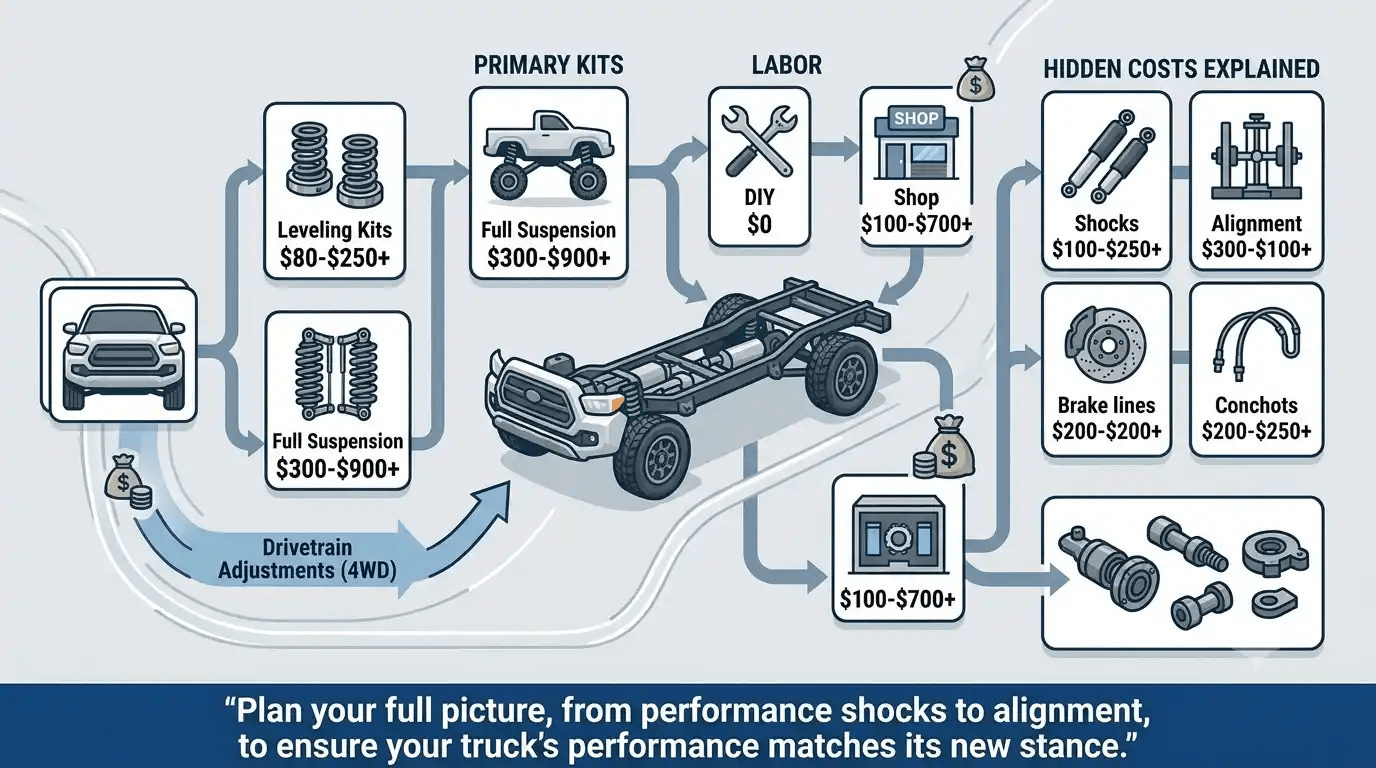
A complete truck lift kit cost breakdown is not finished without the extras. These add-ons are common, and skipping them is the easiest way to end up disappointed with your new ride height.
- Wheel alignment after install: usually $80 to $150
- Extended brake lines for lifts over 3 inches: $30 to $100
- New shocks matched to your lift height: $120 to $350
- Larger tires to fill the new wheel gap: $600 to $1,200 for a set
- Driveshaft spacers or carrier bearing drop kits on 4WD trucks: $50 to $200
- New wheels to clear larger tire sidewalls: $400 to $1,500 for a set
- Re-gearing the differential for very large tires: $400 to $800 per axle
We explain the difference between buying individual parts versus a complete kit in our article on lift parts vs. complete lift kit: which to buy. Buying a matched kit almost always avoids the hidden costs listed above because everything is engineered to work together from the start, rather than being pieced together from different brands.
Budgeting for these extras up front prevents the most common complaint we hear from new lift owners: surprise costs that show up weeks after the install. Planning for tires, alignment, and shocks alongside your initial purchase keeps the total cost predictable from day one.
Do Not Skip the Shocks: A Costly Mistake We See Often
Here is a mistake that costs truck owners more money in the long run: lifting the truck and keeping the factory shocks. Stock shocks are tuned for stock ride height. Once you lift, they run out of usable travel fast and wear out early, which means paying for replacement shocks twice instead of once.
Our guide on lift shocks vs. stock shocks: what you really need after a lift explains this in plain language. It is one of the most useful reads on our site if you want your lift kit price guide to reflect total cost of ownership, not just the upfront sticker price.
Nitrogen gas shocks, like the RTZ Primo and Doetsch Tech lines we build into many of our kits, are tuned specifically for lifted ride heights. They control body roll better, last longer under stress, and protect the rest of your suspension investment. Spending an extra $50 to $100 per shock now is almost always cheaper than replacing worn-out stock shocks twice over the life of your lift.
Lift Cost by the Numbers: A Quick Statistical Snapshot
To put real numbers behind the advice in this article, here is a quick statistical snapshot pulled from typical aftermarket pricing trends across the categories we sell most.
|
Statistic |
Value |
|
Most common lift height purchased |
2" to 3" |
|
Average total spend (parts + labor) |
$350 - $550 |
|
Percentage of buyers who upgrade shocks |
Roughly 70% |
|
Average install time for a basic kit (DIY) |
2 - 4 hours |
|
Average install time for a full suspension kit (shop) |
1 full day |
These figures line up with what we see across thousands of orders. The takeaway is simple: most truck owners land in the mid-range tier, spending a few hundred dollars total once shocks and basic labor are accounted for. Going bigger or smaller from there is mostly a matter of personal goals.
Why Truck Owners Trust RideTrendz for Lift Kits?
We are not a generic parts reseller guessing at fitment. RideTrendz builds suspension kits specifically engineered for the trucks, vans, and SUVs our customers actually drive, with kits covering everything from classic C10 pickups to modern Silverados, Rams, and Rangers.
- Every kit ships as a matched set, so you are not guessing which shocks pair with which springs
- Doetsch Tech and RTZ Primo nitrogen gas shocks are built specifically for lifted and lowered applications
- Clear, model-specific kits remove the guesswork that drives up labor cost at the shop
- Pricing is transparent with no surprise add-ons buried at checkout
- Our blog library answers the real questions truck owners ask before they buy
- Decades of combined product testing back every kit we ship
Browse our full range of truck lift kits to compare options by vehicle, lift height, and shock type. Every kit listing includes exact specs, so the price you see lines up with the parts you actually need, not a vague estimate.
This is the real advantage of buying from a brand that specializes in suspension. We are not splitting attention across a thousand unrelated product categories. Every kit, every shock, and every spacer we sell is built around one goal: getting your truck's stance right the first time, without wasted spending.
Quick Reference: Average Total Lift Cost by Budget Tier
|
Budget Tier |
Total Cost (Parts + DIY Labor) |
Best For |
|
Budget |
$80 - $250 |
Leveling the stance, small visual lift |
|
Mid-Range |
$300 - $600 |
Bigger tires, daily driver lift with new shocks |
|
Performance |
$700 - $1,500 |
Off-road builds, full suspension lift kit setups |
Whichever tier fits your goals, the path to an accurate budget is the same: pick your target height, choose a matched kit, and account for shocks and alignment from the start.
How to Plan Your Lift Budget Step by Step?
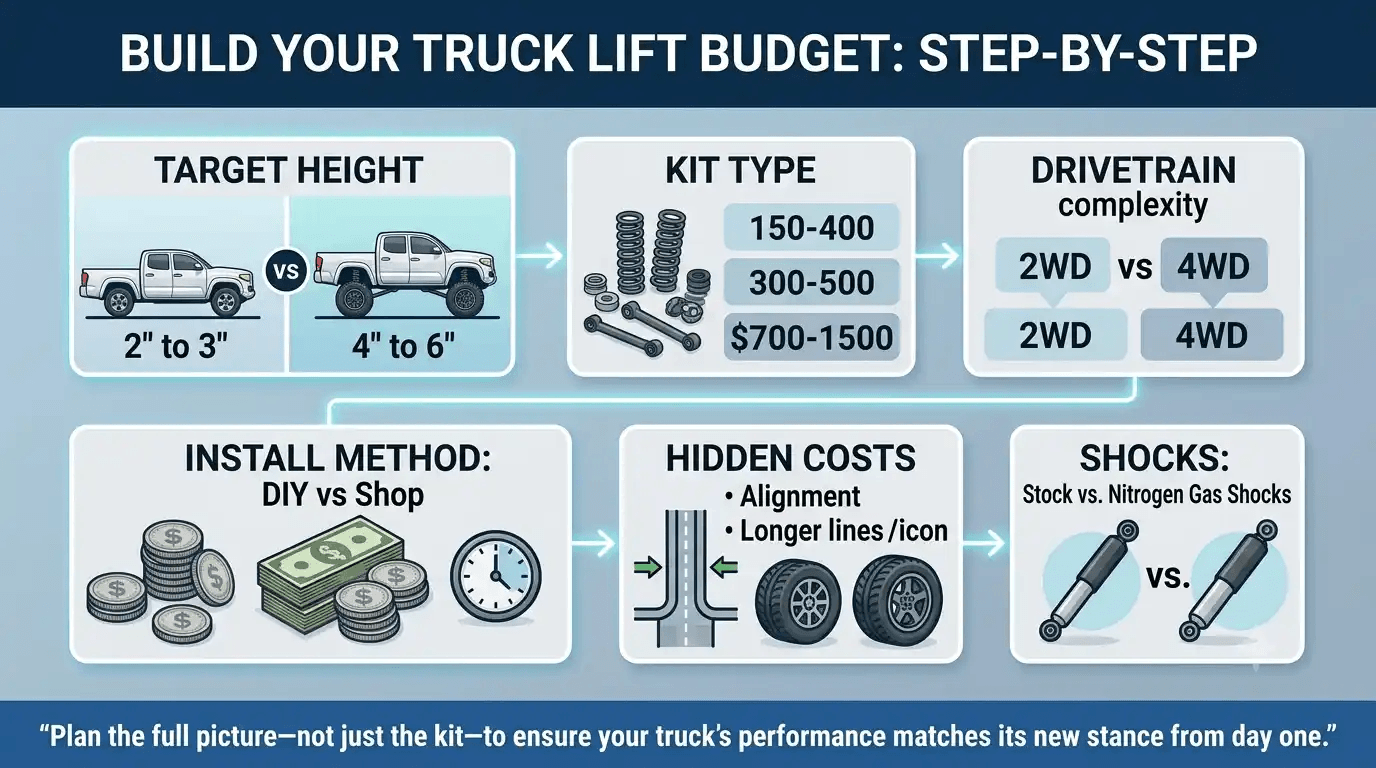
If you want a simple process to follow, use these steps to build an accurate budget before you place an order.
- Decide your target lift height based on tire size goals and daily driving needs
- Choose a kit type that matches that height, using the cost table above as a reference
- Add a matched set of shocks rated for your new ride height
- Budget for alignment, and extended brake lines if your lift exceeds 3 inches
- Decide between DIY and shop installation based on your tools and schedule
- Add tire and wheel costs separately if you plan to size up
Following this order prevents the most common budgeting mistake: buying a lift kit first, then discovering the shocks, alignment, and tires add hundreds more than expected. Planning the full picture up front gives you one accurate number instead of several surprise charges.
Does Location Affect How Much It Costs to Lift a Truck?
Parts pricing is fairly consistent across the country since most kits ship directly from the manufacturer or distributor. Labor pricing is where location makes the biggest difference. Shops in major metro areas often charge more per hour than shops in smaller towns, simply because overhead costs are higher. This is one more reason DIY installation is appealing in expensive markets, since the parts cost stays the same no matter where you live.
Seasonality plays a smaller role but still matters. Spring and early summer tend to be the busiest months for suspension shops, since that is when most off-road and overlanding builds begin. Booking an install in the fall or winter can sometimes mean shorter wait times and occasionally better scheduling flexibility, even if the parts cost itself does not change.
Should You Buy New or Used Lift Kit Parts?
Used lift kits show up often in online marketplaces and seem like an easy way to save money on a lift. In practice, used suspension parts carry real risk. Springs lose tension over time. Shocks lose their gas charge and stop damping properly. Shackles and blocks can develop hairline cracks that are nearly impossible to spot without removing them.
Buying new parts from a brand that builds kits specifically for your truck removes that risk entirely. New kits come with full lift height as advertised, full shock performance from day one, and a clean install with hardware that has never been torqued before. The small premium over a used kit almost always pays for itself in safety and peace of mind.
Common Mistakes That Drive Up Lift Cost
We see the same avoidable mistakes again and again from truck owners who did not plan their budget before buying. Avoiding these mistakes is one of the easiest ways to keep your spending under control.
- Buying a kit before measuring tire clearance needs, then having to buy a second kit
- Skipping shocks to save money upfront, then paying for replacements within a year
- Mixing parts from different brands that were never designed to work together
- Forgetting to budget for a post-install alignment, which can throw off tire wear
- Choosing the cheapest kit available without checking if it matches the exact model year
Every one of these mistakes adds cost later, even though they seem like savings at the moment of purchase. A little research before checkout, using a guide like this lift kit price guide, prevents almost all of them. It is the difference between guessing at how much it costs to lift a truck and actually knowing the number before you click buy.
Does Lifting a Truck Affect Resale Value?
A well-installed lift kit from a respected brand can be a selling point for the right buyer, especially in markets where lifted trucks are popular. A poorly installed lift, mismatched parts, or a setup with worn-out stock shocks can do the opposite and scare off potential buyers during a test drive.
If resale value matters to you, keep your receipts, keep the original parts in case a future buyer wants the stock look back, and choose a kit and shock combination that rides smoothly. Buyers can tell the difference between a thoughtfully built lift and a rushed one within the first few minutes behind the wheel.
Comparing Where You Buy: Specialty Brand vs. Big Box Store
Where you buy your kit affects more than just price. It affects fitment accuracy, the quality of included hardware, and how easy it is to get help if something does not line up during install. Here is how the two most common buying paths compare.
|
Factor |
Specialty Suspension Brand |
General Big Box Store |
|
Fitment accuracy |
Built for specific model years and trims |
Often generic, may require modification |
|
Hardware quality |
Matched, application-specific hardware included |
Sometimes generic bolts and brackets |
|
Support access |
Direct product knowledge from the kit builder |
General customer service, limited product depth |
|
Price transparency |
Clear, itemized kit pricing per vehicle |
Pricing can vary widely by location and stock |
This is exactly the gap RideTrendz was built to close. When you buy from a specialty lift kit catalog built around your exact truck, you remove most of the guesswork that drives up both cost and frustration during install. You know what you are getting before the box even arrives.
Long-Term Maintenance: The Cost Nobody Talks About
Most articles answering how much does it cost to lift a truck stop at the install. They skip the maintenance that comes after. A lifted truck experiences different stress on ball joints, tie rods, and CV joints because of the altered suspension geometry. Over the life of the truck, this can mean slightly earlier replacement of these wear items compared to a stock-height truck.
The good news is that a properly matched kit with quality shocks reduces this extra wear significantly compared to a cheap, mismatched setup. Spending a bit more upfront on a complete, well-engineered kit is consistently the cheaper path once you account for five or ten years of ownership. This is the same logic behind why we recommend matched kits over piecing together parts from multiple sources, a topic covered in more depth in our article on lift parts versus complete kits.
Routine maintenance after a lift is simple: check torque on all suspension bolts after the first 500 miles, inspect shocks annually for leaks, and keep an eye on tire wear patterns that might signal an alignment issue. None of this adds high cost if caught early, which is one more reason a thorough understanding of the full lift kit price guide should include the maintenance picture, not just the purchase price. A small amount of regular attention keeps your investment performing the way it did on day one, year after year.
Key Takeaways Before You Buy
Before you check out, run through this short list. It is the fastest way to confirm your budget actually answers how much it costs to lift a truck for your specific situation, rather than a generic average pulled from somewhere else online.
- Confirm your truck's exact year, trim, and drivetrain before choosing a kit
- Match shocks to your new ride height instead of reusing factory shocks
- Set aside money for alignment and possible brake line extensions
- Decide on DIY or shop installation based on your tools and timeline
- Buy a complete, matched kit instead of mixing parts from different brands
Run through this checklist once, and the number you land on for how much it costs to lift a truck will hold up after the parts arrive, not just at checkout.
Final Thoughts: Budget Smart, Lift Right
So, how much does it cost to lift a truck? For most owners, the honest range lands between $150 and $900 in parts, with labor adding $100 to $700 more depending on the install method. The real cost is not just the kit. It is the shocks, the alignment, and the tires that come with it.
The smartest move is buying a matched kit from a brand that understands your exact truck. That is exactly what we do at RideTrendz. Check out our full lift kit lineup and pair it with our blog library to make sure every dollar you spend goes toward a ride that performs as well as it looks.
Whatever your goal, whether it is a subtle leveling lift or a full off-road build, the answer to how much does it cost to lift a truck is always clearer once you break it into parts, labor, and the extras most people forget. Use this guide as your reference, and lean on our team and our blog whenever you need a second opinion.
Frequently Asked Questions
Here are quick answers to the most common questions we get about how much it costs to lift a truck, gathered from real customer conversations at RideTrendz.
How much does it cost to lift a truck on average?
Most truck owners spend $150 to $900 on parts, plus $100 to $700 on labor if installed at a shop. DIY installs only cost the price of parts.
Is it cheaper to lift a truck myself?
Yes. DIY installs save $100 to $700 in labor costs. Most RideTrendz kits are designed for straightforward home installs with clear instructions.
Do I need new shocks after a lift kit?
Yes, in most cases. Stock shocks run out of travel after a lift and wear out faster. Matched lift shocks protect your ride quality and your wallet.
Does a 4WD truck cost more to lift than a 2WD truck?
Generally yes. 4WD trucks need extra parts like driveshaft spacers or carrier bearing drops, which add $50 to $200 to the total cost.
What is the cheapest way to lift a truck?
Coil spring spacers or leveling kits are the most affordable option, often costing $60 to $250 in parts for a 1 to 2.5 inch lift.