

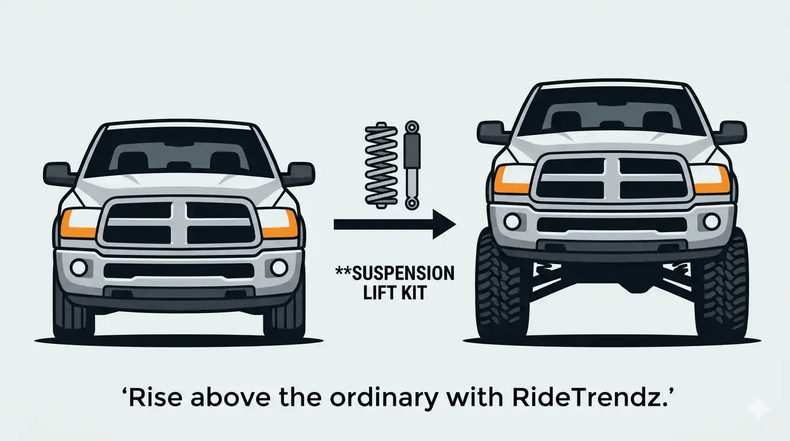
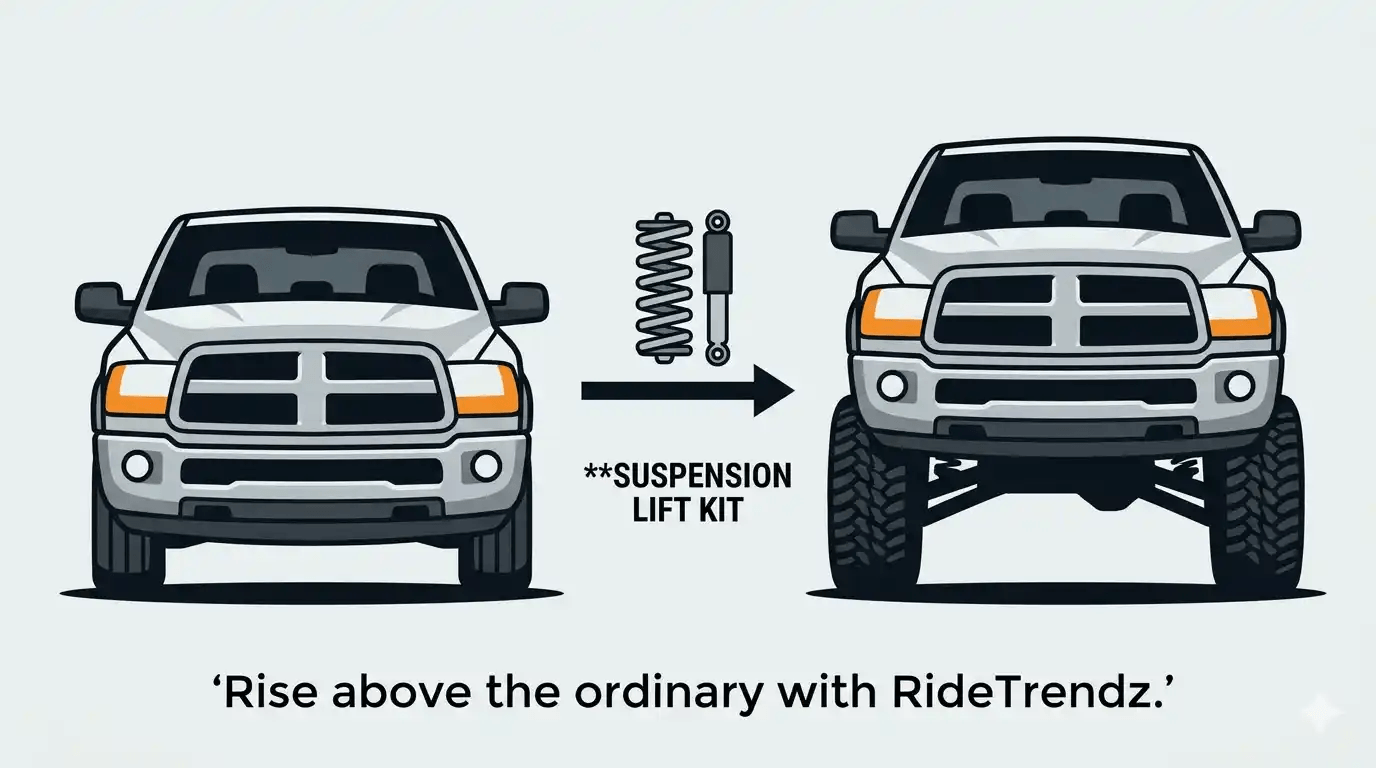
Every serious truck owner asks the same question at some point: what is a suspension lift kit, and is it worth the investment? The short answer is yes. A suspension lift kit raises your vehicle's ride height by replacing or modifying suspension parts like springs, shocks, and control arms. It is the single upgrade that changes how your truck looks, drives, and performs off-road.
At RideTrendz, we build suspension parts for a living, and we have watched thousands of customers transform their daily driver into a trail-ready machine. This guide breaks down exactly what is a suspension lift kit, the types available, the real benefits, and how to pick the right one. We will use facts, comparison tables, and straight answers instead of sales fluff, because that is how we have built trust with our customers for over two decades.
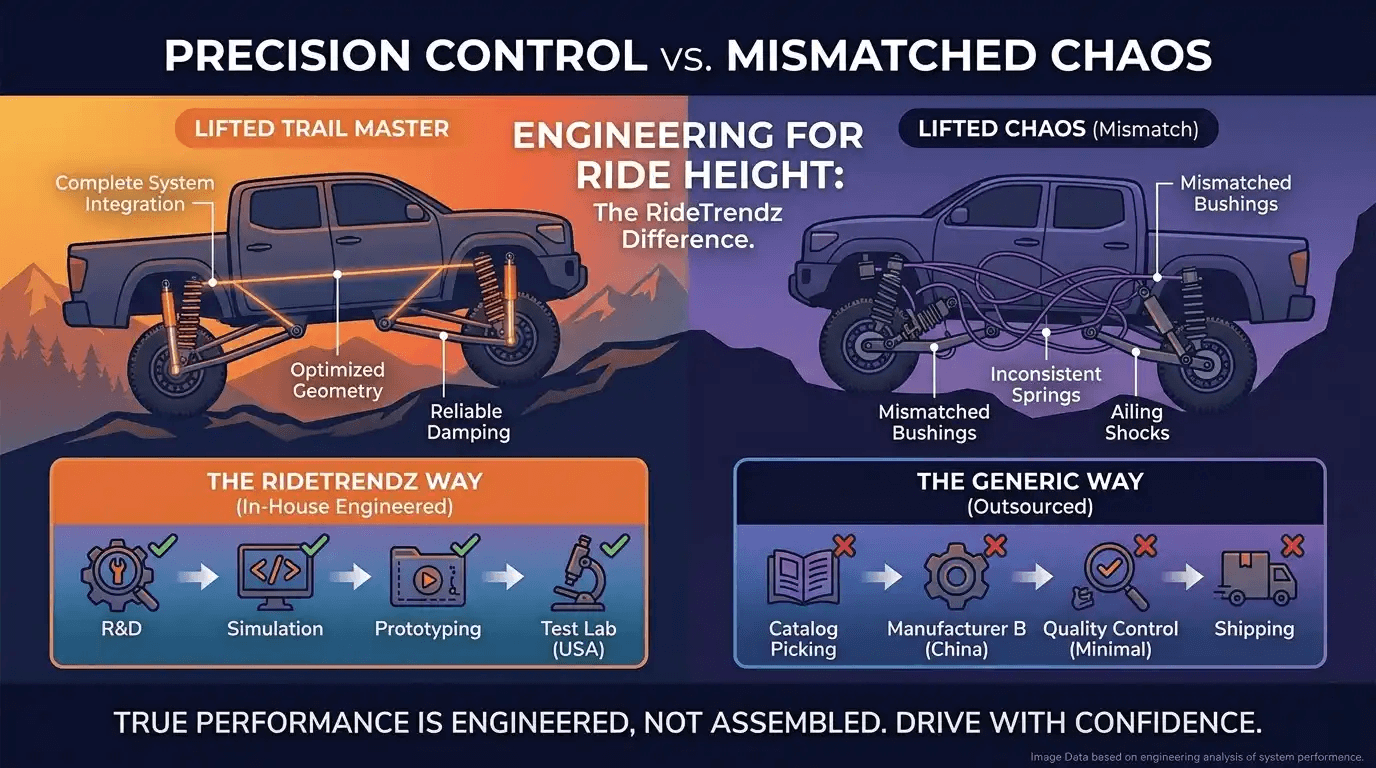
If you only remember one thing from this article, remember this: a properly engineered suspension lift kit from a trusted manufacturer outperforms a cheap, generic kit every time. Quality components protect your truck, your passengers, and your investment. That is the standard we hold ourselves to on every kit we design.
This guide is detailed on purpose. We are covering the full picture: definitions, mechanics, every major category, real costs, installation steps, maintenance habits, and the mistakes that cost people money and time. By the end, you will not just understand what is a suspension lift kit; you will know exactly which kit fits your truck, your goals, and your budget.
A Quick Snapshot Before We Dive In
Here is the short version for readers who want the highlights first. We expand on every row in the sections below.
|
Question |
Quick Answer |
|
What is a suspension lift kit? |
A set of suspension components that raise ride height and ground clearance |
|
How much lift is normal? |
Most owners choose 2 to 4 inches |
|
Does it affect handling? |
Yes, for better or worse, depending on kit quality |
|
Where to buy a reliable one? |
A manufacturer with verified fitment data, like RideTrendz |
What Is a Suspension Lift Kit, Exactly?
To answer what is a suspension lift kit in plain terms: it is a set of components engineered to increase the distance between your vehicle's frame and the ground by reworking the suspension system itself, rather than just adding spacers under the body. A true suspension lift kit typically includes new coil springs or leaf springs, longer shocks, extended control arms, and sometimes new track bars and steering components.
This is different from a body lift, which only raises the body shell off the frame using blocks or spacers. A suspension lift kit actually changes the geometry of the suspension, which is why it delivers real off-road performance instead of just visual height.
The mechanics matter here. On a coil-sprung front end, a suspension lift kit usually swaps in taller coil springs or adds quality spacers above the factory spring, then pairs that change with a longer shock to keep the suspension traveling through its full range. On the rear of a leaf-sprung truck, the kit may use taller leaf packs, add-a-leaf kits, or blocks between the axle and the leaf pack, again matched with longer shocks so the axle does not run out of travel and bottom out the suspension.
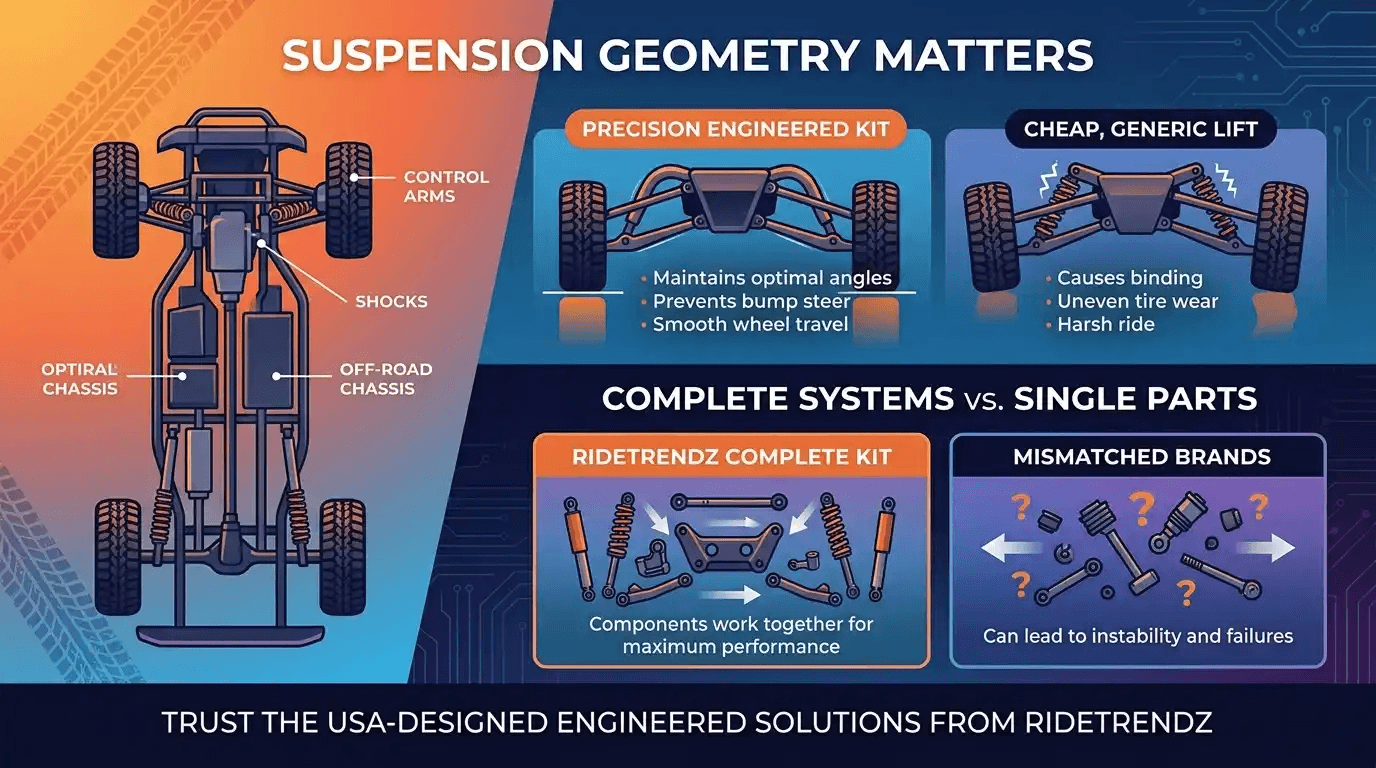
Why does this distinction matter so much? Because the suspension geometry controls how your tires contact the road and the trail. A cheap lift that ignores geometry can cause uneven tire wear, bump steer, or a harsh ride. A properly engineered kit accounts for control arm angles, track bar length, and shock travel together, which is exactly why RideTrendz designs its kits as complete systems rather than a single random spring swapped in isolation.
Why People Search for This Term
Most people researching what a suspension lift kit is fall into one of three groups: weekend off-roaders who want more clearance, truck owners who want a bolder stance, and tow or haul users who need to correct sag from heavy loads. RideTrendz designs kits for all three groups, which is part of why our catalog covers everything from Chevrolet C10s to modern Silverado and Sierra trucks.
There is also a fourth group that is growing fast: owners upgrading older trucks, vans, and SUVs that no longer get factory parts support. Classic C10 owners, vintage Ford F100 owners, and full-size van owners often discover that learning what is a suspension lift kit leads them to the easiest way to modernize ride quality on a vehicle that is otherwise decades old.
Quick Stats Every Truck Owner Should Know
|
Statistic |
What It Means For You |
|
1 to 3 inch lifts |
Cover most leveling and mild off-road needs without major drivetrain changes |
|
3 to 6 inch lifts |
Open up room for 33 to 35 inch tires and serious trail clearance |
|
6+ inch lifts |
Built for dedicated rock crawling and extreme terrain |
|
Most common request |
Customers asking what is a suspension lift kit usually want 2 to 4 inches of lift |
Types of Lift Kits for Trucks
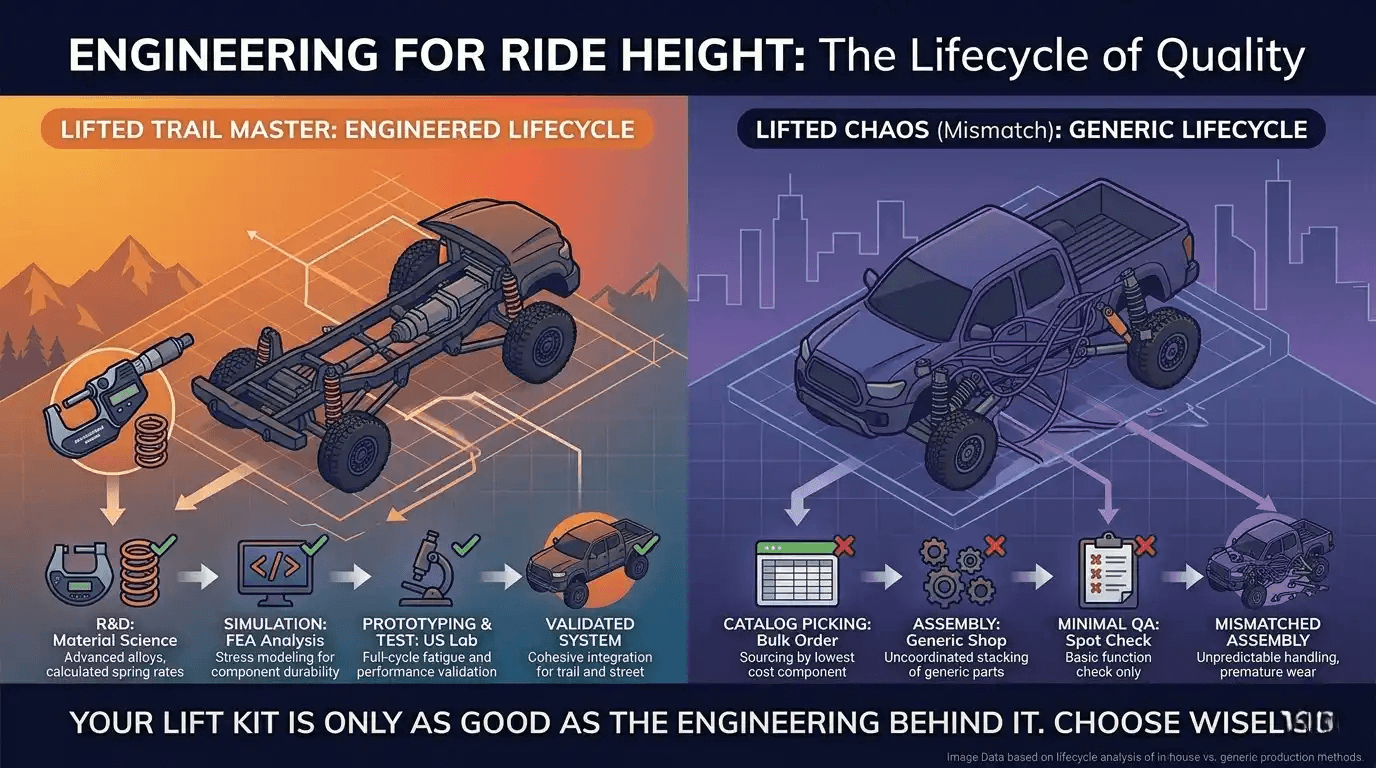
Understanding the types of lift kits for trucks is the next step after learning what is a suspension lift kit. Not every kit is built the same way, and the right choice depends on your truck, your budget, and how you actually plan to drive it. Below we break down each category in detail, because picking the wrong type is the single most common and most expensive mistake truck owners make when they first ask what is a suspension lift kit and jump straight to buying.
1. Suspension Lift Kits
This is the full upgrade. A genuine suspension lift kit replaces springs, shocks, and often control arms to raise ride height while keeping, or improving, handling. RideTrendz suspension lift kits are engineered in the USA specifically for this purpose, which is why our customers see better articulation and a smoother ride than with generic parts.
Within this category there is a further split between basic kits, which mostly swap springs and shocks, and complete kits, which also include upper control arms, track bars, and brake line extensions. Complete kits cost more, but they solve the alignment and binding issues that show up on basic kits once you push past 3 inches of lift.
2. Body Lift Kits
Body lifts use spacer blocks between the body and frame. They are budget-friendly and simple to install, but they do not improve ground clearance under the axles the way a suspension lift kit does. They are best for owners who want bigger tires with minimal mechanical change.
The trade-off with body lifts is that they create a visible gap between the body and the frame, sometimes called the body lift gap. Many owners pair a small body lift with a leveling kit to minimize that gap while still gaining enough tire clearance for a moderately larger tire size.
3. Leveling Kits
Many trucks sit lower in the front than the rear from the factory, a design choice manufacturers make to handle payload. A leveling kit closes that gap, usually adding 1 to 3 inches up front. It is the most affordable entry point among the types of lift kits for trucks, and it is a popular first upgrade before stepping up to a full kit.
Leveling kits are also the easiest type to install correctly without a lift, which makes them attractive to owners who want a clean look without committing to a full suspension overhaul. The downside is that a leveling kit alone usually does not add enough clearance for significantly larger off-road tires.
4. Coil Spring Spacer Kits
These add height using spacers on top of the existing coil springs. They are cost-effective and easy to install, making them a favorite for owners who want a quick lift without replacing the entire suspension. RideTrendz stocks aluminum and forged spacer kits across multiple makes for exactly this purpose.
Spacer kits work best on 2WD and 4WD trucks where the factory shocks still have enough remaining travel after the lift. If you are pushing past 2.5 inches, pairing the spacer kit with extended shocks keeps the ride from feeling harsh over bumps.
5. Long Arm Lift Kits
Long arm kits replace factory control arms with longer aftermarket arms, improving suspension geometry at larger lift heights. These are built for serious off-roaders who push their trucks hard on rough terrain and need the suspension to keep up.
At lift heights beyond 4 to 5 inches, short factory control arms start to bind and lose articulation. A long arm kit corrects the arc the suspension travels through, which restores smoother wheel travel and reduces strain on ball joints and bushings during hard off-road use.
6. Add-a-Leaf and Rear Block Kits
For leaf-sprung rear ends, especially on classic trucks and full-size vans, add-a-leaf kits and lift blocks are common ways to raise rear ride height and correct sag from towing or hauling. They are simple, proven, and widely supported across older Chevrolet, GMC, Dodge, and Ford platforms.
Side-by-Side Comparison of Lift Kit Types
|
Type |
Lift Range |
Best For |
Install Difficulty |
|
Suspension Lift Kit |
2 to 6+ in |
Off-road performance and big tires |
Moderate to High |
|
Body Lift Kit |
1 to 3 in |
Tire clearance on a budget |
Low to Moderate |
|
Leveling Kit |
1 to 3 in |
Fixing factory rake |
Low |
|
Coil Spring Spacer Kit |
1.5 to 3 in |
Quick, affordable height gain |
Low |
|
Long Arm Lift Kit |
4 to 8+ in |
Heavy off-road use |
High |
Benefits of Installing a Suspension Lift Kit
Once you understand what is a suspension lift kit, the next logical question is why it matters. The benefits go well beyond looks, and several of them directly affect safety and long-term vehicle health.
- Better ground clearance: Clear rocks, ruts, and obstacles that would otherwise damage your undercarriage, skid plates, or exhaust system.
- Room for larger tires: A taller stance means you can fit aggressive off-road tires without rubbing the fenders or wheel wells.
- Improved approach and departure angles: Critical for serious trail driving, steep inclines, and crossing uneven terrain without scraping the bumpers.
- A more aggressive stance: Many owners simply love how a lifted truck looks on the road, and a clean stance can boost resale interest among enthusiasts.
- Better visibility: Sitting higher gives you a clearer view of traffic, road hazards, and terrain features ahead.
- Towing and load correction: A quality kit can help level out sag caused by heavy towing setups, restoring proper headlight aim and braking balance.
- Wheel travel and articulation: Upgraded shocks and arms allow the suspension to flex further, keeping more tire contact on uneven trail surfaces.
How Much Difference Does a Few Inches Really Make?
It is easy to underestimate how much a moderate lift changes real-world capability. Even a 2 to 3 inch suspension lift kit paired with appropriately sized tires can meaningfully increase the height of obstacles your truck can clear without contact, while also opening up enough wheel well room to run a more aggressive tread pattern that improves traction in mud, sand, and loose gravel.
Pros and Cons at a Glance
|
Pros |
Cons |
|
Increased ground clearance and off-road capability |
Higher upfront cost than a body lift |
|
Supports larger, more aggressive tires |
May require alignment and recalibration after install |
|
Improves resale appeal for truck enthusiasts |
Cheap, uncertified kits can wear out fast |
|
RideTrendz kits are engineered and tested in the USA |
Skipping professional installation can void warranty |
|
Better wheel articulation on rough terrain |
Slightly higher center of gravity if overdone |
How to Choose the Right Lift Kit
Knowing how to choose the right lift kit comes down to matching the kit to your goals, your vehicle, and your budget. Here is the exact process we recommend to every RideTrendz customer, refined from thousands of fitment conversations over the years.
Step 1: Define Your Primary Use
Are you lifting for looks, for towing correction, or for serious trail use? Your answer narrows the field immediately. A leveling kit suits a daily driver; a full suspension lift kit suits a weekend trail rig. Be honest about how often you actually leave pavement, since that single answer prevents the most common case of overspending on a kit you will never fully use.
Step 2: Match Lift Height to Tire Size
Bigger tires need more clearance. As a rule of thumb, every 2 to 3 inches of lift typically supports roughly 1 to 2 inches of additional tire diameter, though this varies by vehicle, wheel offset, and fender trimming. Going too big on tires without enough lift causes rubbing at full turn and during suspension compression.
Step 3: Check Your Vehicle's Year, Make, and Model
Fitment matters more than almost anything else when deciding how to choose the right lift kit. RideTrendz organizes its full lift kit catalog by manufacturer and model year, so you can find a kit engineered specifically for your truck instead of guessing with a universal part. A kit built for a 1999-2006 Silverado will not necessarily bolt onto a 2007-2016 model, even though both trucks look similar at a glance.
Step 4: Decide Between a Kit and Individual Parts
Some owners prefer to buy a complete kit, while others build their setup piece by piece based on what they already have installed. If you already have a plan, our lift parts selection lets you mix and match shocks, spacers, and brackets to fit your exact build without paying for components you do not need.
Step 5: Pair the Right Shocks With Your New Ride Height
A lift changes the geometry your shocks have to work with. Mismatched shocks lead to a rough ride, premature wear, and reduced damping control over bumps and washboard roads. Check our dedicated lift shocks range, engineered to match common lift heights so the ride quality stays smooth instead of bouncy.
Step 6: Don't Forget the Struts
On strut-based suspension systems, swapping in correctly rated lift struts keeps handling predictable at the new ride height, especially on trucks that see daily highway miles alongside weekend trail time. Struts that are not matched to your lift height can cause excessive body roll or a harsh, jarring ride.
Step 7: Set a Realistic Budget, Including Labor
Parts cost is only part of the picture. Factor in alignment, possible brake line extensions, and professional installation labor if you are not comfortable doing the work yourself. A realistic total budget prevents the frustrating situation of buying a kit and then being unable to finish the install correctly.
Step 8: Buy From a Manufacturer You Can Verify
This is the step people skip, and it is the one that matters most. RideTrendz has over 20 years of experience building suspension parts for trucks and SUVs, and every kit is designed with real ground clearance and handling data behind it, not just marketing photos. That kind of track record is hard to fake and easy to verify through customer reviews and fitment guides.
Decision Table: Matching Your Goal to a Kit
|
Your Goal |
Recommended Type |
Why It Works |
|
Fix factory front-end sag |
Leveling Kit |
Closes the rake gap cheaply and quickly |
|
Fit 33 inch all-terrain tires |
2 to 3 inch Suspension Lift Kit |
Adds clearance without major drivetrain stress |
|
Serious rock crawling |
Long Arm Lift Kit |
Keeps geometry correct at extreme lift heights |
|
Budget-friendly stance upgrade |
Body Lift Kit |
Low cost, straightforward install |
|
Quick weekend upgrade |
Coil Spring Spacer Kit |
Fast install, noticeable height gain |
Why RideTrendz Is the Trusted Source for Lift Kits
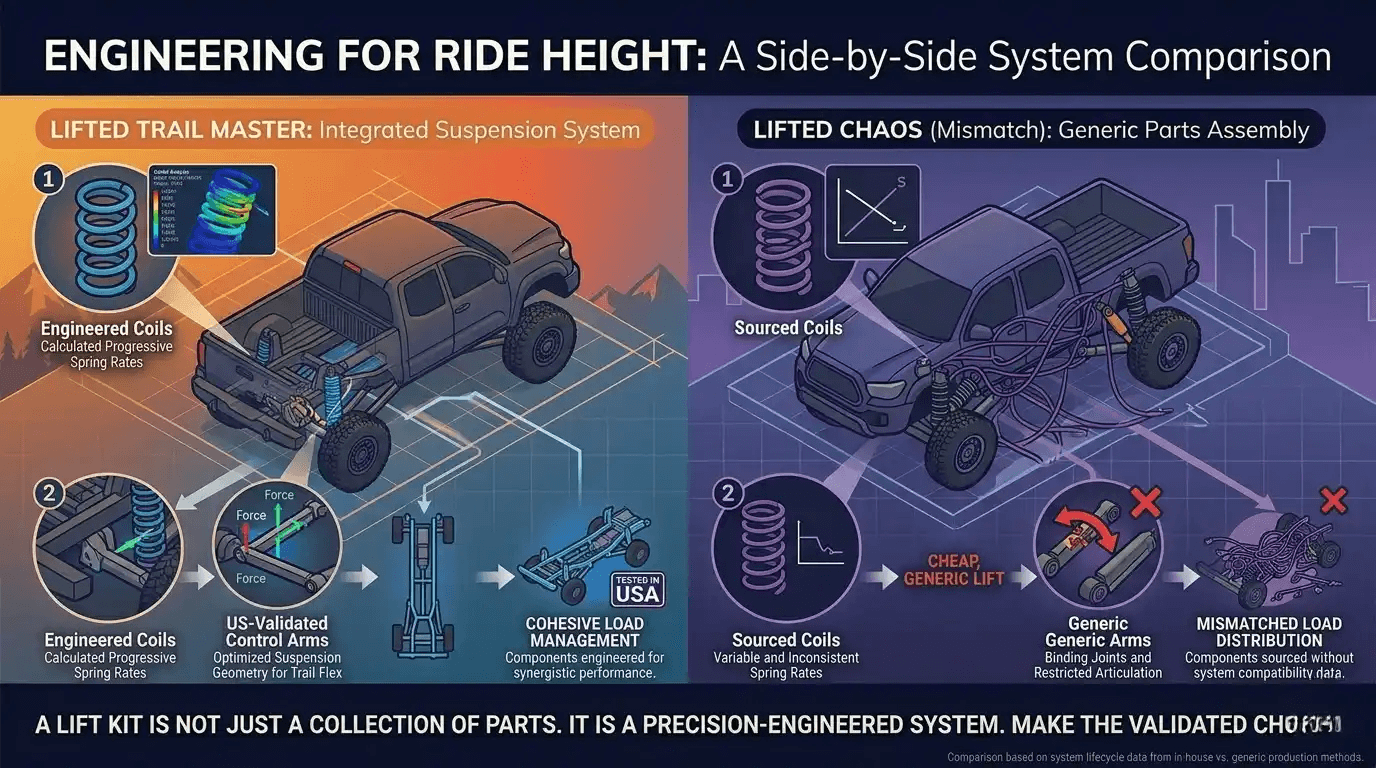
We do not just sell parts. We engineer them. RideTrendz designs lift kits and lowering kits in the USA, backed by over two decades of manufacturing experience across Chevrolet, GMC, Ford, Dodge, Nissan, Toyota, Jeep, and Subaru platforms.
- Built in the USA: Every kit goes through domestic engineering and quality checks before it reaches your driveway.
- 20+ years of experience: We have refined our designs across generations of trucks and SUVs, learning from real-world feedback the entire way.
- Guaranteed quality components: We stand behind the materials and the fitment of every part we ship, from forged spacers to precision-tuned shocks.
- Full catalog coverage: From classic C10s to modern Silverado and Sierra trucks, our fitment guides take the guesswork out of shopping.
- Real customer support: Our team helps you confirm fitment before you buy, not after, which saves you time and avoidable return shipping.
If you already know what a suspension lift kit is and you are ready to move forward, the smartest next step is browsing our complete lift kit lineup organized by vehicle. Every listing includes compatibility details so you order the correct kit on the first try, not the third.
What If You Want the Opposite Look?
Not every customer wants more height. If you are chasing a lowered, aggressive street stance instead, our lowering kit range delivers the same engineering standard in the opposite direction, built for owners who want to live the lowered street culture look rather than the lifted trail look.
Installing a Suspension Lift Kit: What to Expect
Whether you install your own suspension lift kit or hand the job to a professional shop, knowing the general process helps you plan your time and budget correctly.
- Vehicle prep: The truck is raised, wheels removed, and the existing suspension components are inspected for wear before anything new goes on.
- Removing factory components: Old springs, shocks, and any control arms being replaced come out first, along with related hardware.
- Installing new components: New springs or spacers, shocks, and arms go in following torque specifications to keep everything properly secured.
- Reassembly and torque check: Wheels go back on, and every fastener is torqued to spec before the truck comes off the lift.
- Alignment: Front-end alignment is checked and adjusted to account for the new ride height and suspension angles.
- Test drive and inspection: A short test drive followed by a final check ensures nothing is loose, leaking, or rubbing.
Most leveling kits and spacer kits can be installed in a few hours by an experienced DIYer with basic tools. Full suspension lift kit installs with control arm and track bar replacement typically take a full day in a professional shop, especially when an alignment and test drive are included.
What Affects the Cost of a Lift Kit?
Pricing for a suspension lift kit varies widely based on a handful of predictable factors, and this is usually the second question people ask right after what is a suspension lift kit. Understanding these factors helps you budget accurately instead of being surprised at checkout or at the shop counter.
|
Cost Factor |
Why It Changes the Price |
|
Lift height |
Taller lifts need more extensive components and longer shocks |
|
Material quality |
Forged and aluminum components cost more than basic stamped steel |
|
Included hardware |
Complete kits with control arms cost more than basic spring-and-shock kits |
|
Vehicle platform |
Older or less common platforms may have fewer part options |
|
Professional installation |
Labor adds to total cost but reduces fitment risk |
Common Mistakes to Avoid When Lifting Your Truck
- Buying based on price alone: The cheapest kit is rarely the best value once you account for ride quality, component lifespan, and resale impact.
- Ignoring fitment by year and model: A kit that fits one model year may not fit another, even on the same nameplate, due to small frame and suspension changes between generations.
- Skipping shock and strut upgrades: New springs without matching shocks or struts leads to a bouncy, unstable ride and accelerated wear on the new components.
- Overlifting for the intended use: A 6-inch lift on a daily commuter adds cost, complexity, and a higher center of gravity without real benefit for someone who never leaves the highway.
- Not checking alignment after install: Any lift changes suspension angles, so a post-install alignment is essential to prevent uneven tire wear and pulling.
- Forgetting about brake lines and driveline angles: Larger lifts can stretch brake lines and steepen driveline angles, both of which need extensions or adjustments to avoid premature failure.
- Mixing mismatched brands without research: Combining parts from different manufacturers can work, but only if the geometry and travel specs actually align with each other.
Maintaining Your Suspension Lift Kit
A suspension lift kit is a long-term investment, and a little routine maintenance keeps it performing the way it should for years instead of months.
- Inspect bushings and joints every few thousand miles for wear, cracking, or excessive play.
- Re-torque hardware after the first 500 miles post-installation, since components settle in during initial use.
- Check shock and strut condition seasonally, especially before off-road trips or long highway tows.
- Keep an eye on tire wear patterns, which often reveal alignment issues or worn components early.
- Grease and lubricate any serviceable joints according to the manufacturer's recommended interval.
- Rinse off mud and debris after off-road trips to prevent corrosion around fasteners and joints.
Pre-Purchase Checklist
|
Checklist Item |
Why It Matters |
|
Confirm exact year, make, and model |
Prevents ordering a kit that will not fit |
|
Decide on target lift height |
Determines tire size compatibility |
|
Check if shocks are included |
Mismatched shocks hurt ride quality |
|
Verify manufacturer reputation |
Protects your truck and your investment |
|
Plan for alignment after install |
Keeps handling safe and predictable |
Common Myths About Suspension Lift Kits
Before you buy, it helps to clear up a few misconceptions that come up constantly when people first ask what is a suspension lift kit and start researching online. These myths cause real money to be wasted every year.
Myth: Bigger Is Always Better
A taller lift is not automatically a better lift. Beyond a certain height, you start needing extra components like longer driveshafts, extended brake lines, and recalibrated sensors. Matching lift height to your actual use case beats chasing the biggest number you can find.
Myth: All Lift Kits Hurt Fuel Economy the Same Amount
Tire size has a bigger impact on fuel economy than the lift height itself in most cases. A modest lift with stock-sized tires barely changes mileage, while a large lift with aggressive 35-inch tires will have a more noticeable effect.
Myth: A Suspension Lift Kit Is Only for Off-Roading
Plenty of owners install a suspension lift kit purely for the stance and the added visibility in traffic, and never touch a trail. There is nothing wrong with that. The benefits of ground clearance and looks are not mutually exclusive.
Suspension Lift Kit vs. Lowering Kit: How to Decide
Some shoppers land on this guide while still deciding between going up or going down. Here is a simple way to think about it.
|
Factor |
Suspension Lift Kit |
Lowering Kit |
|
Primary goal |
Ground clearance and off-road capability |
Aggressive street stance and sharper handling |
|
Typical buyer |
Off-road and overland enthusiasts |
Street and show truck enthusiasts |
|
Tire compatibility |
Supports larger, taller tires |
Supports wider, lower-profile tires |
|
RideTrendz catalog |
Lift Kit and Lift Parts sections |
Lowering Kit and Lowering Parts sections |
If your goal is clearance, tire size, and trail capability, a suspension lift kit is the right direction. If your goal is a lower, tighter street stance, our lowering parts inventory is built for exactly that look, with the same engineering discipline RideTrendz applies to every product line.
Final Thoughts
So, what is a suspension lift kit? It is the upgrade that gives your truck real ground clearance, room for bigger tires, and the stance you have been picturing, all while keeping handling in check when it is engineered correctly. Among the types of lift kits for trucks, the right pick depends on how you actually drive, and learning how to choose the right lift kit is mostly about matching your goals to the correct category.
RideTrendz has spent over 20 years building exactly these kinds of components, designed and tested in the USA for trucks and SUVs across nearly every major brand. When you are ready to lift your ride the right way, our lift kit catalog is the place to start, backed by two decades of engineering experience and a team that genuinely wants to see you get the fitment right the first time.
Frequently Asked Questions
1. What is a suspension lift kit used for?
If you are wondering what is a suspension lift kit used for, the answer is ground clearance, bigger tires, and improved off-road capability, while also giving trucks a bolder, more aggressive stance on the road.
2. How much does a suspension lift kit cost?
Costs vary by lift height and vehicle, ranging from budget-friendly spacer kits to premium long-arm systems. RideTrendz offers options across that entire range for most major truck brands.
3. Will a lift kit affect my truck's warranty?
It can, depending on your manufacturer and installer. Always confirm fitment and installation standards beforehand, and choose a reputable kit to minimize risk to drivetrain components.
4. What is the difference between a body lift and a suspension lift kit?
A body lift only raises the body using spacers. A suspension lift kit changes the actual suspension geometry, delivering real off-road clearance instead of just visual height.
5. How do I know which lift kit fits my truck?
Check your exact year, make, and model against the manufacturer's fitment guide. RideTrendz organizes its entire catalog this way to remove the guesswork from your purchase.