

Lift Parts vs Complete Lift Kit: Which to Buy
Every truck and Jeep owner reaches the same fork in the road. You want more height, better ground clearance, and room for bigger tires. Then the real question hits: lift parts vs. a complete lift kit, which to buy? It sounds like a small decision. It is not. The choice shapes your budget, your install time, and how your rig rides for years to come.
At RideTrendz, we get this question every single day. We have spent years helping truck owners, Jeep drivers, and van builders pick the right suspension setup for their exact needs. This guide breaks down lift parts vs complete lift kits, which to buy in plain language, with real numbers, real comparisons, and honest advice. No fluff. Just the facts you need to buy with confidence.
We wrote this guide because we kept hearing the same confusion from customers across every brand we carry. Someone buys a single shock, then realizes the spring rate does not match. Someone else buys a full kit and feels like they overpaid for parts they did not need. Both outcomes come from skipping the research stage. By the end of this guide, you will know exactly which path fits your truck, your budget, and your comfort level with a wrench in your hand.
What Are Lift Parts?
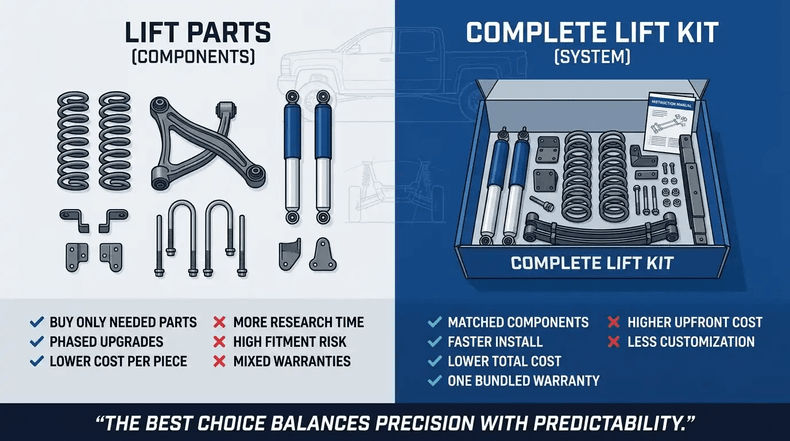
Lift parts are individual suspension components. Think shocks, struts, coil springs, control arms, track bars, and U-bolts. You buy only what you need. You skip the parts you already have in good shape.
Each component plays a specific role. Shocks control how your truck absorbs bumps and settles after impact. Coil springs hold the weight of your vehicle and set your ride height. Control arms manage wheel travel and alignment angles. Track bars keep the axle centered under the frame. U-bolts and drop brackets connect everything to your existing frame and axle housing. When you buy lift parts individually, you are essentially playing engineer, matching specs across brands so the whole system works as one unit.
Buying parts individually also gives you room to phase a project. Many truck owners start with new shocks this month, add a leveling spacer next month, then finish with a sway bar link a few weeks later. This spreads the cost across paychecks instead of one large invoice. It also lets you test ride quality at each stage rather than committing to one fixed setup all at once.
This approach works well for experienced builders. It also works for anyone on a tight budget who wants to upgrade in stages. RideTrendz stocks a deep catalog of lift parts for Chevrolet, GMC, Ford, Dodge, Toyota, Nissan, Jeep, and more. Every part is built to OEM-grade tolerances, so fitment is never a guessing game. Understanding this option fully is the first step in answering whether to buy a lift part vs. a complete lift kit, which to buy for your own build.
What Is a Complete Lift Kit?
A complete lift kit bundles everything you need in one box. Springs, shocks, brackets, hardware, and a clear instruction sheet all arrive together. You do not have to source parts from five different listings and hope they match.
Most complete lift kits fall into a few categories. A leveling kit raises the front of your truck to match the rear, usually by 1.5 to 3 inches. A body lift raises the body off the frame using spacers, without touching the suspension geometry. A suspension lift kit replaces springs, shocks, and control arms together, often gaining anywhere from 2 to 6 inches, depending on the kit. Knowing which category fits your goal narrows the search fast, since not every kit serves the same purpose.
Manufacturers design complete lift kits as a system. Spring rates are matched to shock valving. Bracket angles are calculated to keep your driveline and steering geometry close to factory specifications, even at a new ride height. This engineering work is exactly what you are paying for when you choose a kit instead of separate lift parts.
This is where most people land when they ask, " Lift parts vs complete lift kit, which to buy for the first time. A kit removes the guesswork. It also often saves money compared to buying every component separately, since kits are bundled at a lower combined price.
Lift Parts vs Complete Lift Kit: Side-by-Side Comparison
Numbers and side-by-side comparisons cut through marketing noise faster than any opinion piece. Below is a breakdown built from years of customer feedback, install logs, and warranty data across the RideTrendz catalog.
The table below makes lift parts vs complete lift kit to buy easier to answer at a glance.
|
Factor |
Lift Parts |
Complete Lift Kit |
|
Upfront Cost |
Lower per part, adds up fast |
Bundled price, often cheaper overall |
|
Install Time |
Longer, piece by piece |
Faster, one box, one manual |
|
Fitment Risk |
Higher if mixing brands |
Near zero, engineered together |
|
Best For |
Builders replacing one worn part |
First-time lift, full upgrade |
|
Warranty |
Per part, varies by brand |
One warranty covers the whole kit |
|
Customization |
Full control over each piece |
Pre-set height and ride quality |
|
Resale Value Impact |
Neutral to slightly positive |
Strong positive, looks complete |
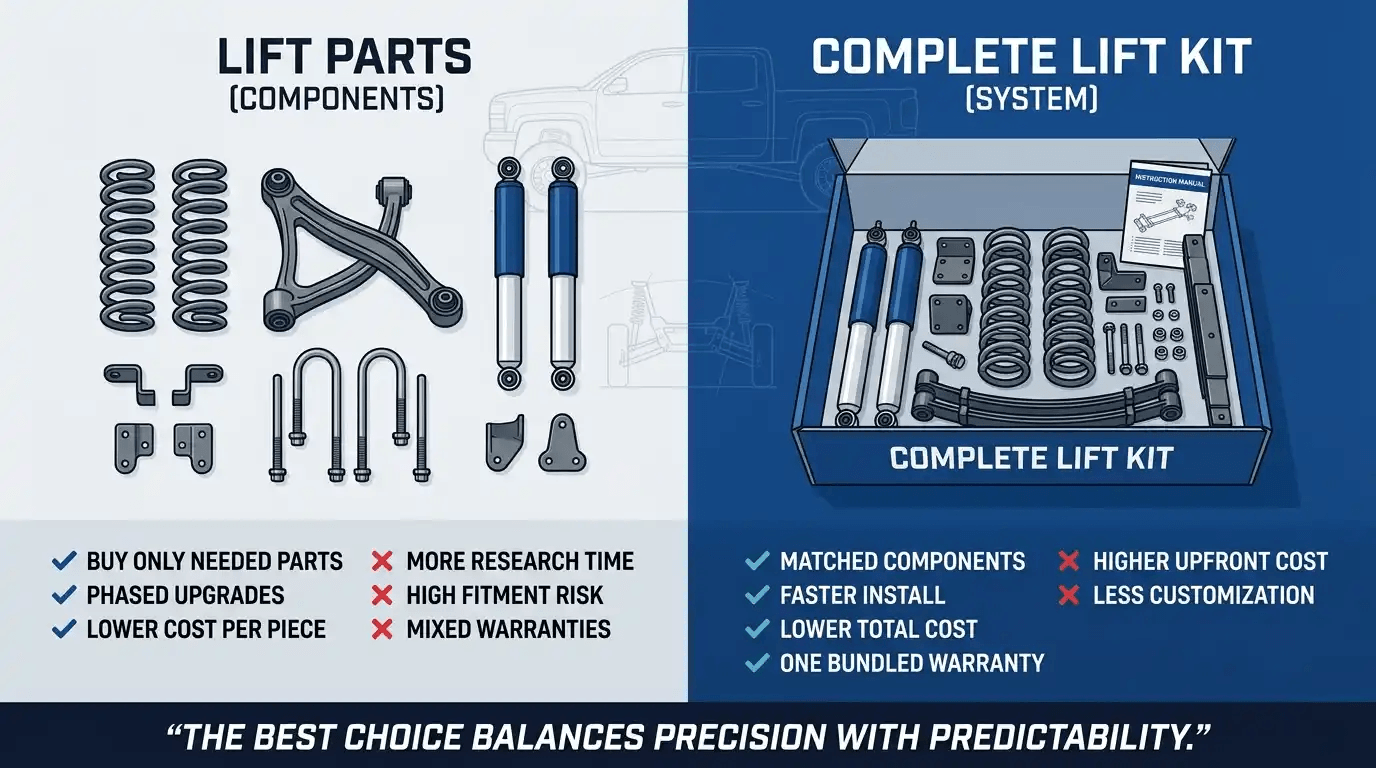
Notice how almost every row favors a complete lift kit for predictability, while lift parts win on flexibility and control. Neither column is universally better. The right answer depends on which row matters most to you personally. A weekend mechanic with a full toolbox cares about different things than someone who wants the job done in a single Saturday.
If you only remember one row from this table, make it the fitment risk. A mismatched shock or spring rate does not just feel wrong on the road. It accelerates wear on bushings, ball joints, and tie rod ends, turning a suspension upgrade into a much larger repair bill within a year or two. This single factor is why so many experienced mechanics still recommend a complete lift kit to friends and family, even when those same mechanics buy individual lift parts for their own personal project trucks.
How Much Lift Do You Actually Need?
Before you can settle the lift parts versus complete kit question, you need a target number. Most truck and Jeep owners overestimate how much height they actually need, then end up fighting tire rub, awkward step-in height, and a harsher ride for no real benefit.
A 1.5 to 3-inch leveling lift is enough for most owners who simply want to fit a slightly larger tire and remove the factory rake, where the front sits lower than the rear. A 4 to 6 inch suspension lift kit is the sweet spot for serious tire upgrades, typically 33 to 35 inch tires, and improved approach and departure angles for moderate off-roading. Anything beyond 6 inches usually means cutting fenders, adding longer brake lines, and accepting a noticeably firmer highway ride, so this range is reserved for dedicated off-road builds.
Tire size and lift height are tightly connected. Going up in tire diameter without enough lift causes rubbing at full turn and full compression. Going up in lift height without a matching tire often looks unfinished, with too much gap between the tire and the fender. RideTrendz product pages list the maximum tire size supported by each lift parts option and each complete lift kit, so you can match height and tire size correctly before you order anything.
Ground clearance is the other half of this equation. More lift generally means more clearance under the differential and frame rails, which matters most for off-road driving over rocks, ruts, and uneven trails. For a daily-driven truck that rarely leaves pavement, chasing maximum ground clearance often creates more downsides, like a stiffer ride and reduced fuel economy, than benefits.
Pros and Cons Breakdown
Every suspension upgrade involves trade-offs. The lists below lay out the honest pros and cons of each path, based on real feedback from RideTrendz customers who have lived with both setups for months and years after install.
Lift Parts: Pros and Cons
Pros
- Buy only the exact piece you need
- Lower cost if just one part failed
- Easy to upgrade one component at a time
- Great for keeping a budget tight
Cons
- Matching brands and specs takes research
- Multiple shipments mean multiple wait times
- Higher chance of a fitment mismatch
- No single bundled warranty
These trade-offs explain why so many experienced builders still reach for individual lift parts even after installing complete kits before. Once you know your truck and trust your own research, the flexibility of buying piece by piece starts to outweigh the convenience of a single box.
Complete Lift Kit: Pros and Cons
Pros
- Every part is engineered to work together
- One predictable install day
- One warranty, one point of contact
- Consistent ride height and handling
Cons
- Higher single payment upfront
- You may pay for parts you do not strictly need yet
Looking at both lists side by side, lift parts vs complete lift kit, which to buy really comes down to your current setup and your goals.
Cost Comparison: Real Numbers
Price is usually the first filter people apply, and for good reason. A suspension upgrade is a real investment, whether you spend three hundred dollars or three thousand. Here is what the numbers actually show when you compare both paths honestly, line item by line item.
- A typical 3-inch leveling kit purchased as individual lift parts can run 15-20% more than the same height gain bought as a complete lift kit, once you add up shocks, spacers, and hardware separately.
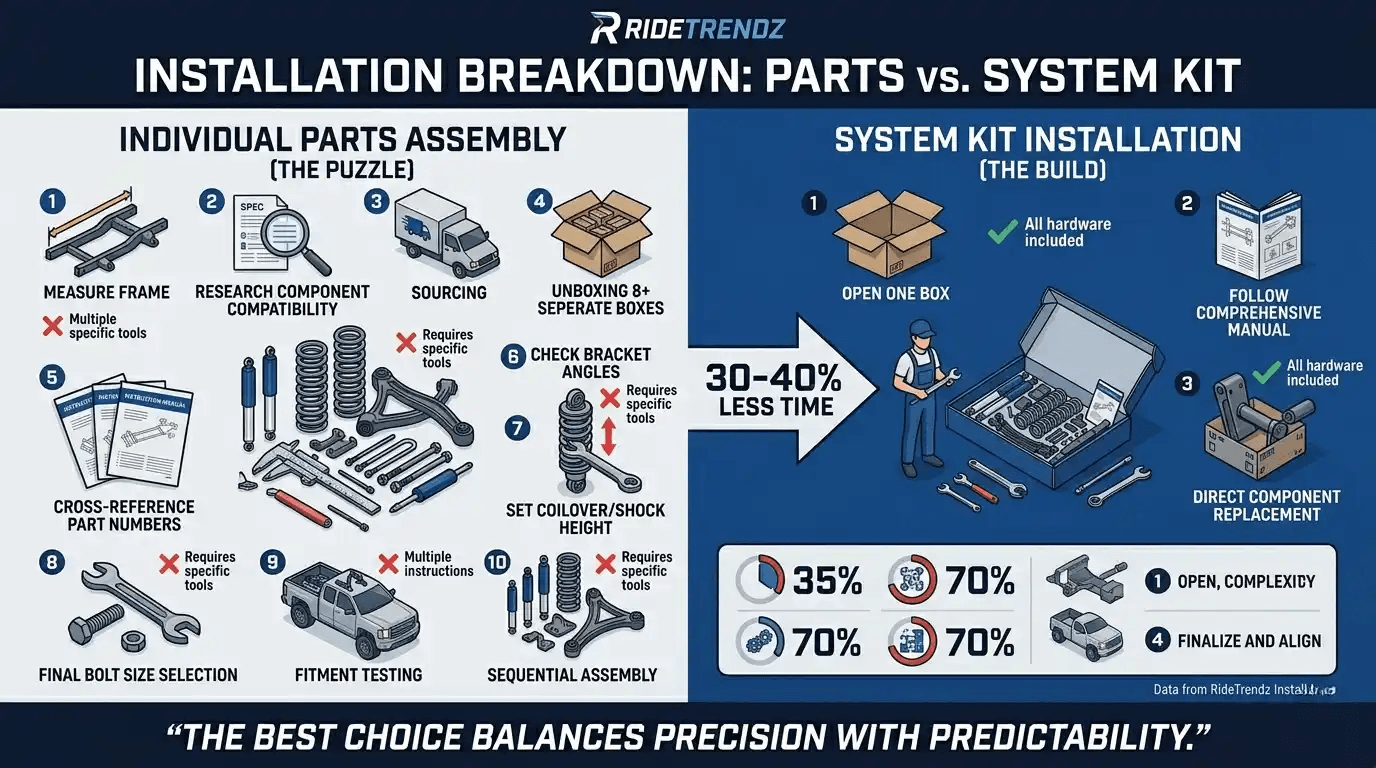
- Shops report that DIY installs using complete lift kits average 30-40% less labor time than installs using mismatched individual parts, since brackets and hardware are pre-matched.
- Customers who buy from a single, complete kit return for warranty claims roughly half as often as customers who mix parts from different brands.
- Shipping costs alone can add up fast when ordering five or six separate lift parts from different suppliers, compared to one consolidated shipment for a complete kit.
- Resale listings for trucks with a documented, single-brand lift kit tend to attract more serious buyer inquiries than trucks with a mix-and-match parts history, according to feedback from RideTrendz customers selling their builds.
These figures are not meant to push you toward one option. They are meant to show that the cheapest-looking choice on day one is not always the cheapest choice after labor, shipping, and time are factored in. A true cost comparison always includes more than the price tag on a single part.
These numbers show why so many RideTrendz customers ask us directly: lift parts vs. a complete lift kit, which to buy when their budget is the main concern. Our answer is always the same. Look at the total cost, not just the sticker price on day one.
Who Should Buy Lift Parts?
Lift parts make the most sense for three types of buyers. First, anyone replacing a single worn shock or spring on a truck that already has a lift kit. Second, experienced builders who want to fine-tune ride height or stiffness piece by piece. Third, anyone with a very specific budget who wants to spread the cost out over a few paychecks.
There is a fourth group worth mentioning, too. Some truck owners already love their current ride height and just want better off-road performance from upgraded shocks, or better towing stability from heavier-duty control arms. For this group, a complete lift kit makes no sense at all, since changing ride height is not even the goal. Lift parts let you upgrade performance without touching the height you already enjoy.
If you fall into one of these groups, the difference between lift parts and a lift kit starts to feel obvious. You already know your rig. You know exactly what needs to change.
Who Should Buy a Complete Lift Kit?
A complete lift kit is the smarter pick for first-time buyers, anyone lifting a stock truck for the first time, and anyone who values one warranty over five. It is also the better choice if you want a guaranteed ride height with zero fitment surprises.
Families upgrading a daily driver also tend to prefer complete lift kits. They want one trip to the shop, one invoice, and a vehicle that drives predictably the very next day. Off-road enthusiasts planning a major build, like adding 35-inch tires or preparing for serious rock crawling, often start with a complete suspension lift kit as their foundation before adding specialty lift parts later for fine-tuning.
Many customers ask us should I buy a complete lift kit or individual parts when they are lifting their first vehicle. We almost always point first-timers toward a complete kit. It is the safer, more predictable path for anyone still weighing lift parts vs. a complete lift kit to buy.
Installation: What Changes Between the Two
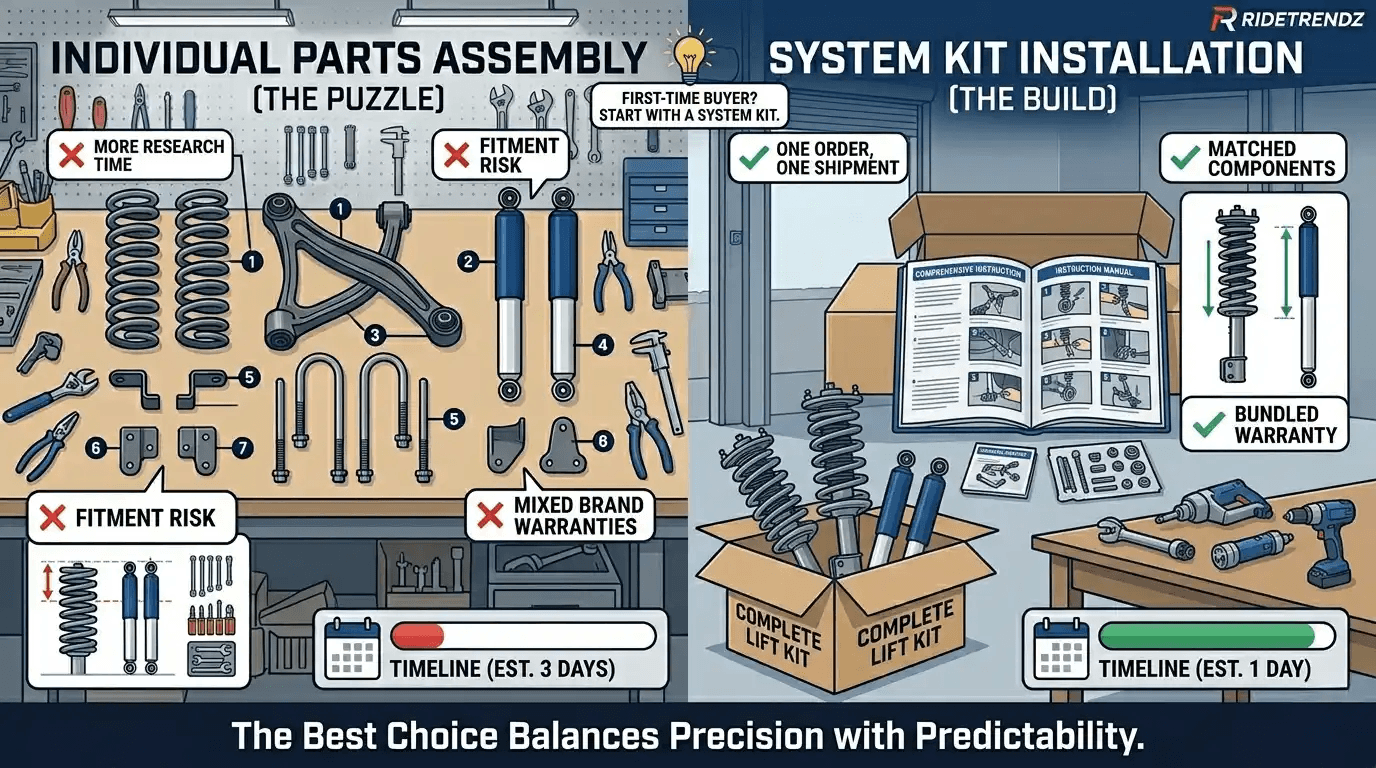
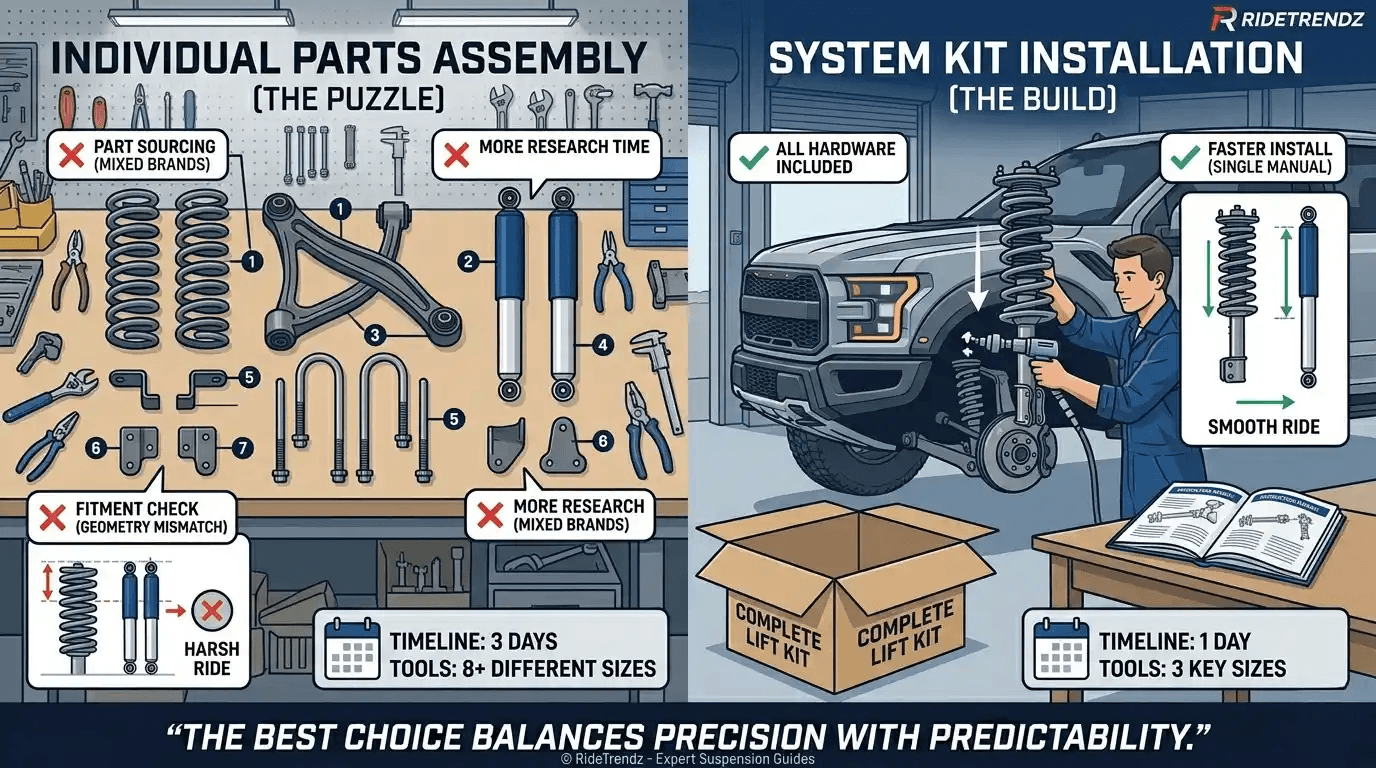
Installing individual lift parts means checking fitment at every single step. You test the shock, then the spring, then the bracket. Each piece needs its own verification. A complete lift kit skips this entirely. Every bolt pattern, every bracket angle, and every spring rate is pre-matched at the factory.
A typical complete lift kit install follows a predictable sequence: raise the vehicle, remove the old components, install new brackets and hardware, mount new springs and shocks, torque everything to factory specification, then complete a front-end alignment. Most experienced DIY installers finish this in a single day with a basic socket set, a torque wrench, and a floor jack with jack stands.
Installing individual lift parts follows the same broad steps, but with one critical difference. You are responsible for confirming that each new part is compatible with every other part already on the truck, including parts you are not replacing. Skipping this check is the single most common cause of squeaks, premature wear, and alignment problems after a lift.
This is one more reason to buy a lift parts vs a complete lift kit, which to buy tips toward the kit for anyone without a home garage full of tools and a few free weekends.
How RideTrendz Makes This Decision Easy
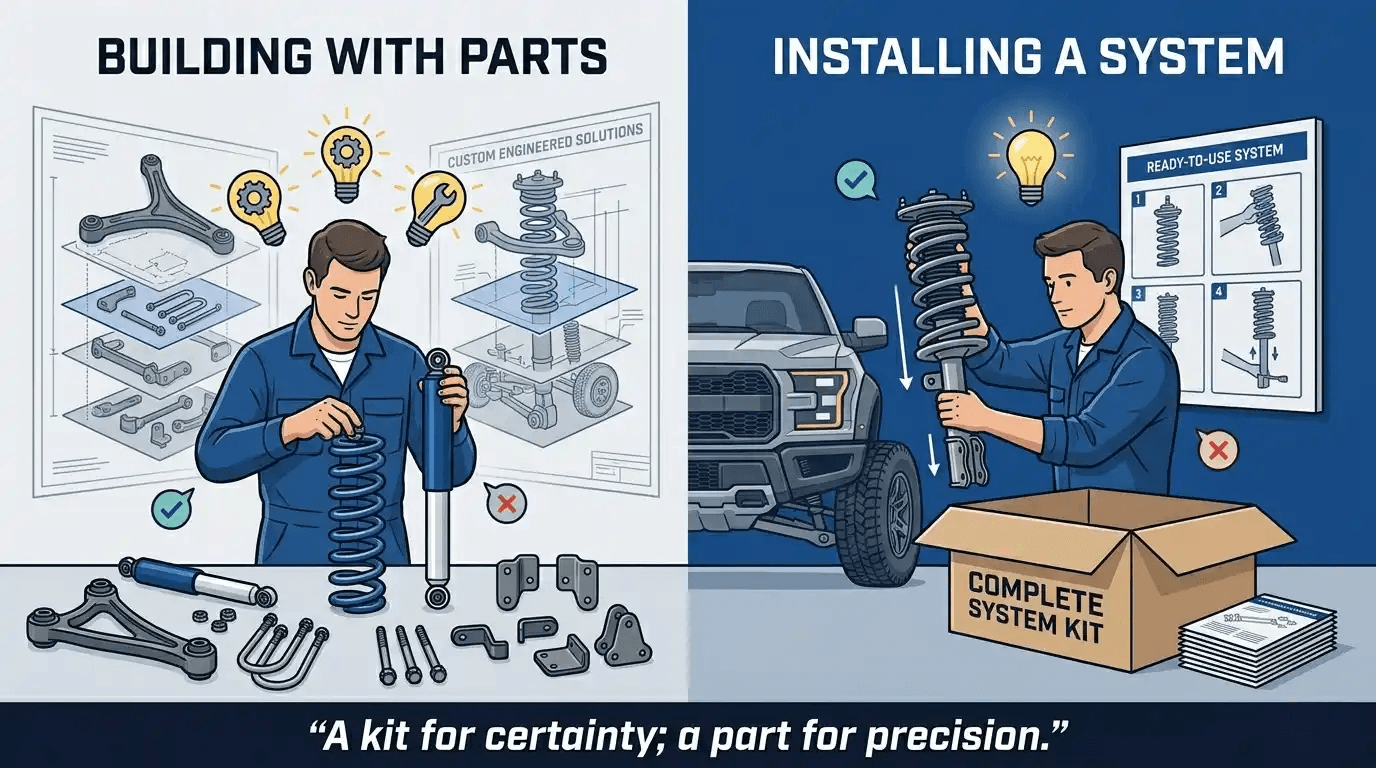
RideTrendz built its entire catalog around solving this exact problem. We carry both options because real truck owners have real, different needs. Our team has fitted thousands of trucks, Jeeps, and vans with the right setup, and we know the small details that make or break a lift.
Every kit and part on our shelves goes through strict quality checks before it ships. We back every order with responsive support, clear fitment guides for every year, make, and model, and a team that actually understands suspension. When customers ask us about lift parts vs. a complete lift kit to buy, we listen to their truck, their budget, and their goals before we ever recommend a product.
We also organize our entire site by vehicle first, not by part type first. That single design choice removes most of the fitment risk before you even click add to cart. Search your year, make, and model, and every part or kit shown is already confirmed to fit. You will not find generic, one-size-fits-all listings on RideTrendz, because generic listings are exactly what cause expensive returns and failed installs.
This is why so many builders come back to RideTrendz for their second and third projects. We do not just sell parts. We help you avoid the expensive mistakes that come from guessing.
Top Factors to Weigh Before You Decide
Before you finalize lift parts vs. a complete lift kit to buy, weigh these five factors carefully.
- Your current suspension condition. Worn parts only? Lift parts may be enough.
- Your timeline. Need it done this weekend? A complete lift kit is faster.
- Your budget shape. One big payment or several smaller ones?
- Your comfort with DIY work. More experience opens up more options.
- Your long-term plans. Planning more upgrades later? Start with a kit for a stable base.
Walk through each factor honestly before you buy anything. A truck with healthy, recently replaced shocks rarely needs a full kit just to gain two inches of height. On the other hand, a truck riding on fifteen-year-old factory suspension is usually due for a complete refresh, and a kit handles that refresh in one clean step instead of five separate purchases over several months.
Once you weigh these five factors, the decision stops feeling like a guessing game. It becomes a simple checklist.
Common Mistakes to Avoid
- Mixing shock brands without checking compatible travel length
- Skipping an alignment after any height change
- Ignoring tire clearance at full steering lock
- Buying based on price alone instead of total fit and warranty
- Assuming every "universal fit" part truly fits your exact trim
- Forgetting to check the brake line and ABS sensor wire length after a height increase
- Overlooking driveline angle changes on four-wheel-drive trucks after a larger lift
Every one of these mistakes is preventable with the right information up front. They are also exactly why customers keep coming back to RideTrendz before they buy, instead of after something goes wrong. A five-minute fitment check at checkout is far cheaper than a return shipment and a wasted weekend.
RideTrendz customer support exists specifically to help you avoid these mistakes. Whether you already know your answer to lift parts vs. a complete lift kit, which to buy, or you are still deciding, our team double-checks every order against your exact year, make, and model before it ships.
What If You Want to Go the Other Direction?
Not every RideTrendz customer is chasing extra height. Some want a lower stance for better handling and a more aggressive look. The same comparison logic applies in reverse when you are lowering a vehicle instead of raising it.
If a lower stance is your goal, our lowering kit lineup follows the same bundled, vehicle-matched approach as our lift kits, so you get a predictable result without piecing together mismatched drop spindles and shorter shocks.
Why RideTrendz Customers Trust Us With This Decision
We built RideTrendz on a simple idea. Suspension upgrades should be straightforward, not stressful. That is why our site organizes everything by vehicle, not just by part type. Find your truck, see only what fits, and buy with total confidence. Our team has walked thousands of customers through lift parts vs. a complete lift kit which to buy, and we never push one option just to close a sale.
Our pricing stays competitive against the bigger retailers, but our support does not disappear after checkout. Real people answer real questions about fitment, height, and performance. This is the difference between a parts store and a partner.
We also stand behind every product we sell with manufacturer-backed warranties and a straightforward returns process. If a part does not fit as described, we make it right. That kind of accountability is rare in the aftermarket suspension space, and it is one of the biggest reasons RideTrendz customers send their friends and family our way.
Quality control matters just as much as selection. Every shock, spring, and bracket that ships from RideTrendz is checked against manufacturer tolerances before it ever reaches a customer. We have built relationships with suspension manufacturers over the years of business, which means we catch sourcing issues long before they become a customer's problem. This behind-the-scenes work is invisible when everything goes right, but it is the entire reason things go right in the first place.
If you decide a bundled option is the right move, browse our full lift kit lineup, organized by make and model, so you only see parts that actually fit your truck.
Keeping Your Lift in Good Shape After Install
Whichever path you choose, the work does not end on install day. A few simple habits keep any suspension upgrade performing the way it did on day one, for years instead of months.
- Re-torque all suspension bolts after the first 100 to 200 miles, since new bushings and hardware settle quickly under normal driving.
- Inspect U-bolts, control arm bushings, and sway bar links every oil change for early signs of wear or play.
- Grease any greasable joints on a regular schedule, especially on trucks that see mud, snow, or heavy off-road use.
- Watch for uneven tire wear, which often signals an alignment that has drifted out of spec after the new ride height settles in.
- Keep a record of which lift parts or which complete lift kit you installed, including brand and part numbers, so future maintenance or warranty claims go faster.
Builders who buy a complete lift kit often find maintenance simpler too, since every component shares the same service interval and the same manufacturer documentation. Builders running a mix of individual lift parts may need to track several different maintenance schedules across different brands. Neither path is difficult to maintain, but a little organization up front saves real time down the road.
Seasonal changes are worth a mention too. Cold weather stiffens rubber bushings and can make a fresh lift feel harsher for the first few weeks each winter. Hot weather has the opposite effect, softening bushings slightly and sometimes revealing a squeak that was not noticeable in cooler months. Neither change signals a problem on its own, but tracking these patterns helps you tell normal seasonal variation apart from an actual component starting to fail.
Conclusion
There is no universal right answer to which lift parts vs. a complete lift kit to buy. The right choice depends on your truck's current setup, your budget, your timeline, and how hands-on you want to be with the install.
If you take one thing away from this guide, let it be this: match the solution to your actual situation, not to whichever option looks cheapest at first glance. A complete lift kit removes risk and saves time for most first-time buyers. Individual lift parts require experience, patience, and a clear plan. Both paths lead to a great-looking, great-riding truck when you choose the one that fits you.
What never changes is the value of buying from a team that actually knows suspension. RideTrendz has helped thousands of truck, Jeep, and van owners make this exact call, and we back every order with parts built to last and support that sticks around after the sale. Whatever you decide on, lift parts vs. a complete lift kit which to buy, shop with a brand that has already answered this question thousands of times over.
Ready to move forward? Explore our complete lift parts catalog and find the exact components for your vehicle, fitted right the first time.
Frequently Asked Questions
- Lift parts vs. a complete lift kit: Which to buy for my first truck lift?
For a first lift, choose a complete lift kit. You get matched components, one warranty, and a much smoother install with zero fitment guesswork.
- Is it cheaper to buy a lift kit or individual parts?
Complete kits are usually cheaper overall. Buying parts separately often costs 15-20% more once shipping and matching components are added up.
- Can I mix lift parts from different brands?
You can, but it raises fitment risk. RideTrendz recommends matched components, especially for shocks, springs, and brackets working together.
- How long does a complete lift kit take to install?
Most complete lift kits install in one day with basic tools. Individual lift parts can take longer due to separate fitment checks.
- Does RideTrendz help me decide between lift parts and a kit?
Yes. Our team reviews your year, make, and model, then recommends the better difference between lift parts and lift kit options for your exact goals and budget.
Most RideTrendz customers settle the lift parts vs complete lift kit which to buy question within one phone call to our support team.