
Quick Summary
- The Ford Ranger (1983–2013) supports both suspension lift kits and body lift kits, with lift heights ranging from 1 inch to 6+ inches.
- Suspension lifts improve off-road ground clearance and performance; body lifts offer a budget-friendly way to fit larger tires without changing suspension geometry.
- The 1983–1997 generation uses Twin Traction Beam (TTB) or solid axle front suspension; 1998–2011 models feature an independent front suspension (IFS) with a torsion bar setup.
- Popular lift brands for the classic Ranger include Rough Country, Skyjacker, Superlift, ProComp, and Zone Offroad.
- Professional installation is strongly recommended for lifts exceeding 2 inches to maintain safe alignment and driveline angles.
Why Lift Your Ford Ranger?
If you've owned a Ford Ranger from the 1983–2013 era, you already know how capable these trucks are right out of the box. They're lightweight, tough, and built for work, but stock ride height leaves a lot of off-road potential sitting on the table. Whether you're tackling weekend trails, crossing muddy paths, or just want that commanding road presence, a lift kit transforms your Ranger from a capable compact pickup into a genuine off-road machine.
The best lift kits for Ford Ranger models give you extra ground clearance, room for bigger tires, and a more aggressive stance, all while keeping your truck street-legal and drivable. But with so many generations, drivetrain variations, and kit types available, choosing the right lift can feel overwhelming. That's exactly why we put together this complete buyer's guide covering everything you need to know about lifting your 1983–2013 Ford Ranger.
Before we go further, if you're curious about how lifting works in the first place, check out our guide on how a truck suspension lift kit works. It breaks down the mechanics in plain language so you can shop with confidence.
Quick Take: The Ford Ranger is one of the most lift-friendly compact trucks ever built. With the right kit matched to your year, model, and drivetrain, you can add anywhere from 1 to 6 inches of clearance without sacrificing daily drivability.
Understanding Ford Ranger Generations (1983–2013)
Before buying any lift kit, you need to know which Ranger generation you own. The suspension design changed significantly across model years, and the wrong kit can cause alignment issues, premature tire wear, or even unsafe handling.
First Generation: 1983–1992
The first-gen Ranger was offered as both 2WD and 4WD. Four-wheel drive models use a Twin Traction Beam (TTB) front axle, a unique independent suspension system exclusive to Ford trucks of this era. The rear runs on a traditional leaf spring setup. This generation responds well to both body lifts and TTB-specific suspension lifts. Many lift kits for this era focus on radius arm drop brackets, replacement leaf springs, and taller torsion bars to achieve the desired height.
Second Generation: 1993–1997
The 1993–1997 Ranger refined the TTB design and introduced the 4.0L OHV V6 engine option. Lift kits for this generation follow a similar pattern to the first gen, with TTB-compatible front lift components and rear leaf spring add-a-leaf or replacement spring packs. Body lifts of 2–3 inches are also popular for this generation as a clean, budget-friendly option.
Third Generation: 1998–2011
This is the most popular Ranger generation for lifted builds. The 4WD model switched from TTB to a torsion bar-based Independent Front Suspension (IFS) with a solid rear axle on leaf springs. This design allows for more straightforward leveling and suspension lift kits. Most major aftermarket brands, Rough Country, Superlift, and Skyjacker, offer dedicated kits for the 1998–2011 Ranger 4x4. Two-wheel-drive models use a coil-spring front suspension that easily accommodates coilover spacer lifts and leveling kits.
Fourth Generation: 2011–2013 (Final North American Year)
The final North American Ranger was mechanically very similar to the 2001–2011 models. Lift options remain largely the same, though parts availability can vary slightly. Many enthusiasts treat 2001–2011 and 2011–2013 kits as interchangeable for this reason.
Quick Take: Knowing your exact year and drivetrain (2WD vs 4WD) before buying is non-negotiable. A lift kit designed for a 1998 4WD Ranger with torsion bars will not work on a 1991 4WD with a TTB axle, and vice versa.
Types of Lift Kits for the Ford Ranger
Understanding the different lift kit categories helps you match the right solution to your goals, budget, and driving habits.
Body Lift Kits
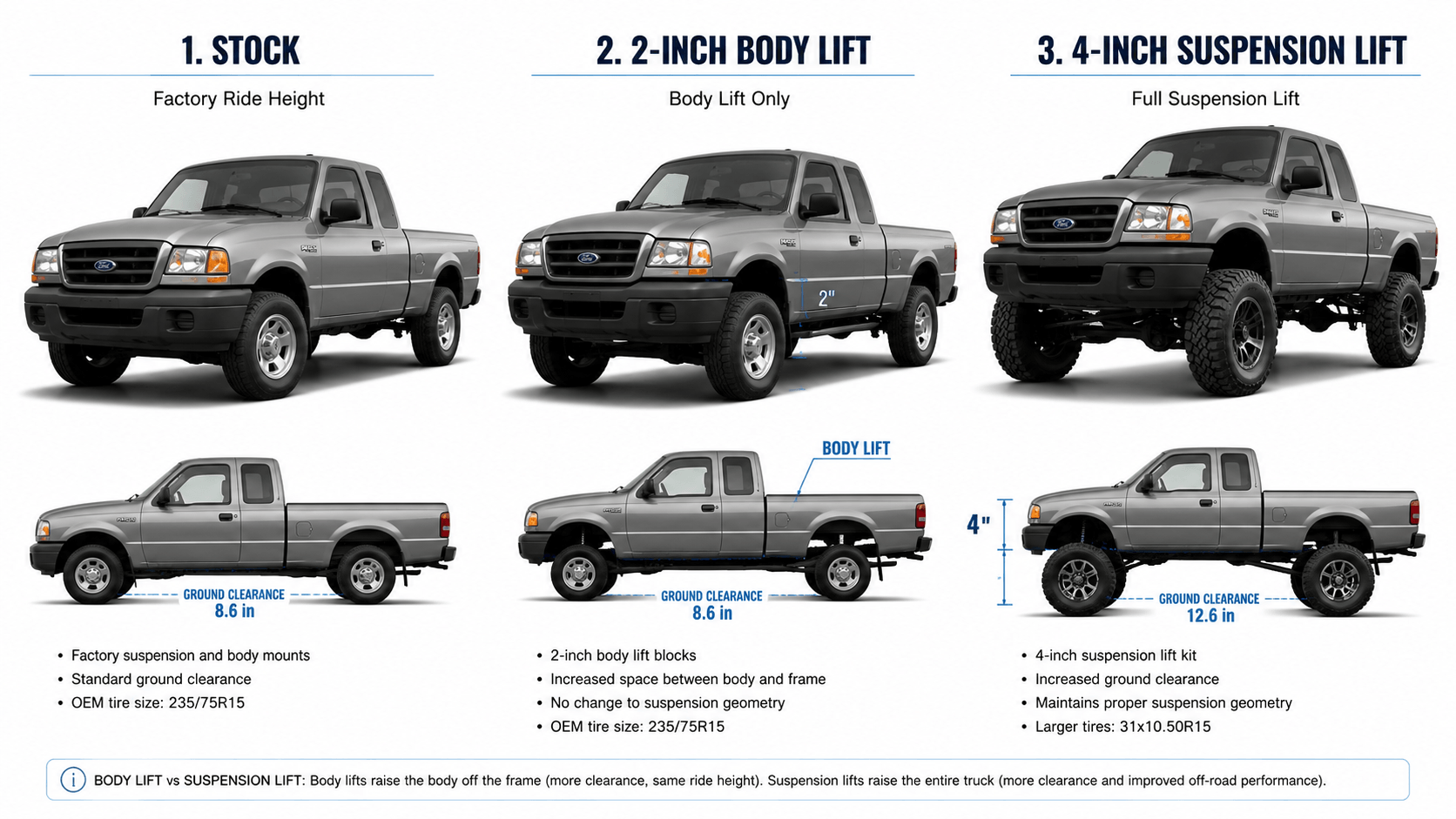
A body lift kit physically raises the truck's body off the frame using polyurethane or nylon spacers, also called body lift blocks. The frame, suspension, and axles stay at their factory height; only the cab and bed rise. This gives you 1 to 3 inches of additional height, which is enough to clear larger tires without touching the suspension geometry.
Pros:
- Most affordable lift option (often $100–$350)
- Preserve factory suspension angles and ride quality
- Easier to install than suspension lifts
- Does not require extended brake lines or driveshaft modifications in most cases
Cons:
- Does not improve actual ground clearance under the axles or differential
- Creates a gap between the body and frame (cosmetically noticeable on some builds)
- Limited to 3 inches maximum
- Not ideal for serious off-road use
Body lifts are best suited for Ranger owners who want a taller, more aggressive look and the ability to run slightly larger tires without the cost and complexity of a full suspension overhaul.
Leveling Kits
The Ford Ranger, like most trucks, sits lower in the front than the rear from the factory. This factory "rake" is designed to compensate for payload weight in the bed. A leveling kit raises the front of the truck 1 to 2.5 inches to match the rear height, creating a level, balanced stance.
Pros:
- Inexpensive (often $80–$250)
- Bolt-on installation in most cases
- Allows slightly larger front tires
- Improves aesthetics without altering driveline angles significantly
Cons:
- Only lifting the front does not increase rear clearance
- Minimal improvement in off-road capability
- Not suitable for serious trail use
For daily drivers who just want a cleaner look and a small tire upgrade, a leveling kit is often the perfect first modification.
Suspension Lift Kits
A suspension lift kit replaces or augments the factory suspension components, including springs, shocks, control arms, and brackets, to raise the entire truck. This is the most comprehensive type of lift and produces the greatest gains in ground clearance, off-road capability, and tire clearance.
For the Ford Ranger, suspension lifts typically range from 2 inches to 6 inches. At 4 inches and beyond, you'll often need extended brake lines, longer driveshafts, and potentially upgraded upper control arms to maintain proper alignment and driveline angles.
Pros:
- Maximum ground clearance improvement
- Dramatically better off-road performance
- Accommodates much larger tires (up to 33" or 35" depending on lift height)
- Improved suspension travel and articulation
Cons:
- Higher cost ($300–$1,500+ depending on brand and lift height)
- More complex installation professional fitting is recommended for 3"+ lifts
- May require additional components (control arms, brake line extensions, driveshaft spacers)
- Can affect on-road ride quality if not matched with quality shocks
If you're serious about off-roading your Ranger, whether rock crawling, overlanding, or trail riding, a full suspension lift kit is the right investment.
Coilover Lift Kits
Coilover kits are the premium tier of suspension lift. Instead of factory-style struts or shocks with spacer blocks, coilovers integrate the spring and shock into one adjustable unit. They offer superior damping performance, adjustable ride height, and longer service life. Coilover setups for the Ford Ranger are less common than for newer vehicles, but aftermarket coilovers from brands like Fox, King, and Icon can be adapted to the 1998–2011 IFS-equipped models. The cost is significantly higher, often $1,500 to $3,000+, but the ride quality and performance improvement are substantial.
Quick Take: For daily driving with occasional off-road use, a body lift or leveling kit delivers the best value. For serious trail use and maximum clearance, invest in a suspension lift from a reputable brand. Coilovers are for performance-focused builds where budget is less of a concern.
How Much Lift Does Your Ford Ranger Need?
One of the most common questions among first-time lift kit buyers is: how many inches do I actually need? The honest answer depends on your goals, not just on what looks the coolest.
1–2 Inch Lift
This range is ideal for:
- Correcting factory rake with a leveling kit
- Running 28"–30" tires on a 2WD Ranger
- Mild off-road use on graded dirt roads
- Maintaining close-to-factory ride quality
At this height, most kits are bolt-on installations that don't require additional suspension components.
2–4 Inch Lift
This is the sweet spot for most Ford Ranger owners. A 2–4-inch suspension lift:
- Provides meaningful ground clearance under the differentials and frame
- Allows 31"–33" tires on most Ranger configurations
- Dramatically improves off-road confidence without making the truck unwieldy on the street
- Usually requires a professional alignment afterward
Most major brands offer dedicated 2.5" and 4" kits for the 1998–2011 Ranger 4x4, making parts availability excellent.
4–6 Inch Lift
A 4–6 inch lift transforms the Ranger into a serious off-road machine. At this height:
- 33"–35" tires become possible
- Extended control arms, brake line extensions, and driveshaft modifications are typically required
- The center of gravity rises significantly, except for changes in cornering behavior
- Professional installation is essential
This level of lift is best suited for dedicated trail trucks, overland builds, or show trucks where maximum visual impact is the goal.
Quick Take: Most street-driven Rangers with occasional trail use are best served by a 2–4-inch suspension lift. It hits the right balance between capability, safety, and daily usability, and it's the most supported lift height in the aftermarket.
Top Lift Kit Brands for the Ford Ranger (1983–2013)
Not all lift kits are created equal. The brand you choose affects not just the price but the quality of the components, the fit accuracy, and the long-term reliability of your suspension. Here are the most respected names in Ford Ranger lift kits.
Rough Country
Rough Country is one of the most popular lift kit manufacturers for budget-conscious Ranger owners. Their kits are known for being affordable, comprehensive, and relatively straightforward to install. Most Rough Country Ford Ranger kits include front lift components, rear add-a-leaf packs or blocks, and their N3 series shocks. While their shocks won't match premium brands in ride quality, Rough Country kits offer an excellent entry point for first-time lift buyers who want solid performance without spending a fortune.
Best for: Budget builds, first lifts, daily drivers with weekend trail use. Typical price range: $200–$600
Superlift
Superlift has a long history of producing lift kits engineered for specific vehicle applications. Their Ford Ranger kits are well-regarded for precise fitment and quality control. Superlift offers both standard lift and leveling options for the Ranger, and its kits often come with premium shocks that deliver a noticeably smoother ride than budget alternatives. For 1998–2011 Ranger 4WD owners, Superlift's 4-inch suspension lift kit is among the highest-rated options on the market.
Best for: Enthusiasts wanting OEM-level quality and precision fitment. Typical price range: $400–$900
Skyjacker
Skyjacker specializes in suspension systems and has dedicated kits for multiple Ford Ranger generations, including the older TTB-equipped first and second-generation models. Their kits are known for impressive off-road performance and long travel capability. Skyjacker's Black MAX and Hydro shocks are particularly praised for their ability to absorb trail impacts while maintaining controlled handling on the street.
Best for: 4WD Ranger owners who split time between trails and roads. Typical price range: $350–$800
ProComp (now part of ReadyLIFT Suspension)
ProComp has long been a go-to brand for compact truck lift kits. Their Ford Ranger lift systems typically include coil spacers, add-a-leaf packs, and their own ES9000 series shocks. While the brand has gone through corporate changes over the years, ProComp/ReadyLIFT kits for the Ranger remain widely available and offer solid value for money.
Best for: Mid-range builds where value and brand recognition matter. Typical price range: $300–$700
Zone Offroad
Zone Offroad is particularly respected for its body lift kits. Their nylon and polyurethane body lift blocks are precision-machined for exact fitment, and each kit includes all necessary hardware, bumper relocation brackets, transfer case lowering bracket if needed, and alignment correction hardware. For Ranger owners who want a clean body lift without the guesswork, Zone delivers.
Best for: Body lift builds, look-focused builds, budget modifications. Typical price range: $150–$400
Lift Kit Comparison Table: Ford Ranger 1983–2013
|
Kit Type |
Lift Height |
Ground Clearance Gain |
Tire Size |
Price Range |
Best For |
|
Leveling Kit |
1"–2.5" |
Front only |
Up to 30" |
$80–$250 |
Daily driver, aesthetics |
|
Body Lift |
1"–3" |
None (body only) |
Up to 31" |
$100–$350 |
Budget, larger tires |
|
Suspension Lift (2") |
2"–2.5" |
Moderate |
Up to 31" |
$200–$450 |
Mild off-road |
|
Suspension Lift (4") |
3.5"–4" |
Significant |
32"–33" |
$400–$900 |
Trail use, overlanding |
|
Suspension Lift (6") |
5.5"–6" |
Maximum |
33"–35" |
$700–$1,500 |
Dedicated off-roader |
|
Coilover Lift |
2"–5"+ |
Significant |
32"–35" |
$1,500–$3,000+ |
Performance builds |
Generation-Specific Lift Kit Recommendations
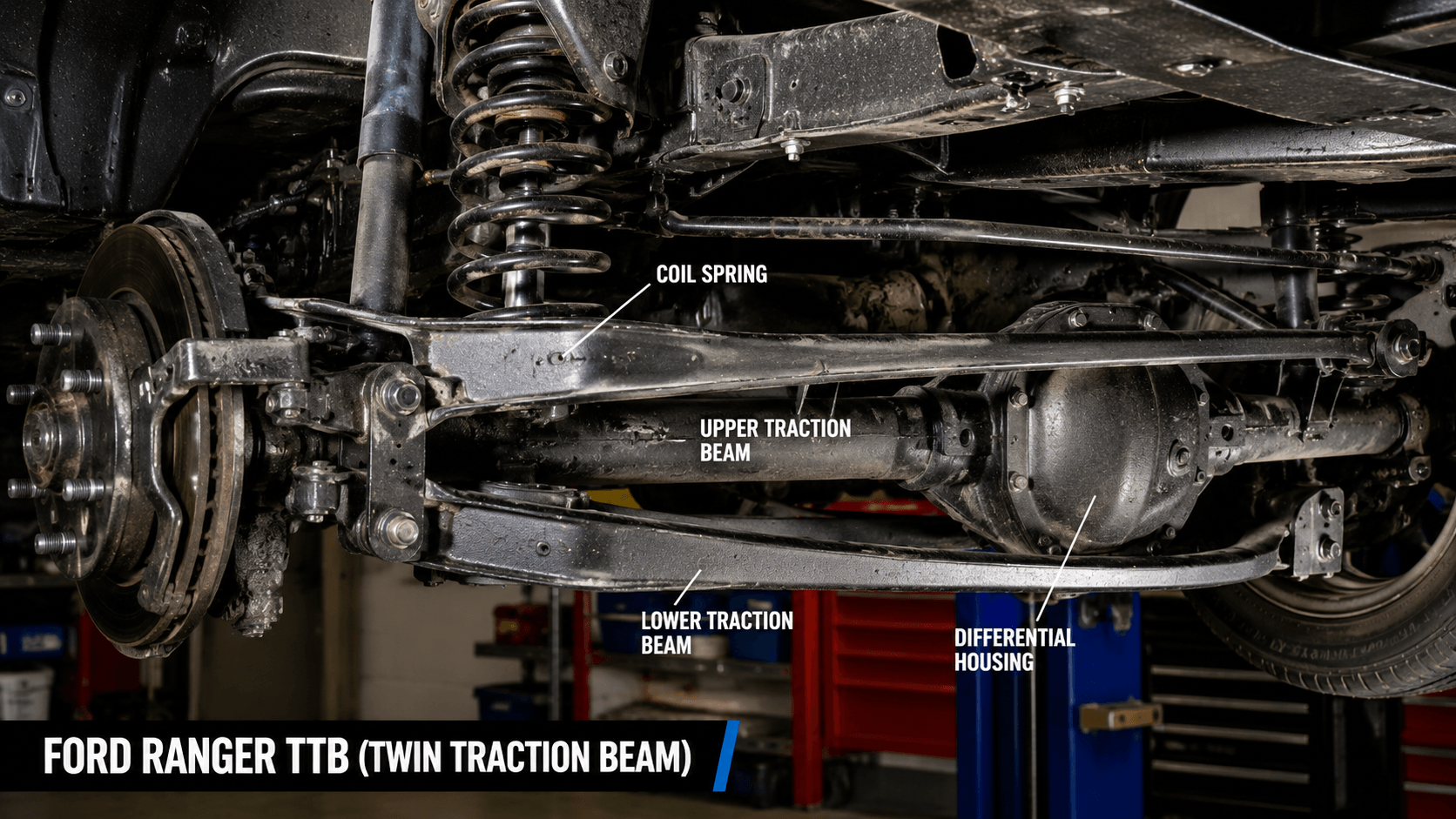
Best Lift Kits for 1983–1992 Ford Ranger (TTB 4WD)
The TTB (Twin Traction Beam) front axle on early 4WD Rangers requires lift kits specifically engineered for this suspension design. Standard IFS lift components will not work. Look for kits that include:
- Radius arm drop brackets to correct geometry after the lift
- Longer coil springs or coil spacers compatible with TTB geometry
- Replacement rear leaf springs or add-a-leaf packs rated for the desired lift height
- Extended shock absorbers to match the new ride height
Top picks for this generation:
- Skyjacker's TTB-specific 4" suspension lift
- Superlift 3" TTB lift kit with Hydro shocks
- Zone Offroad 3" body lift (for a cleaner budget option)
For 2WD first-gen Rangers, a combination of coil spring spacers (front) and add-a-leaf packs (rear) is the most common approach, delivering 2–3 inches of lift without requiring major fabrication.
Best Lift Kits for 1993–1997 Ford Ranger
The 1993–1997 generation follows a very similar lift kit path to the first gen, with TTB-specific kits for 4WD models. Key differences include the 4.0L V6 drivetrain, which can stress components more aggressively during off-road use, so prioritize quality shock absorbers and heavy-duty leaf springs if you plan to push this truck on trails.
Top picks for this generation:
- Rough Country 4" TTB suspension lift
- Superlift 3" kit with N2 series shocks
- Zone Offroad 2" body lift for budget builds
Best Lift Kits for 1998–2011 Ford Ranger (IFS 4WD)
This is the most lift-kit-friendly generation. The torsion bar IFS design is well-supported by nearly every major lift brand, and the aftermarket for this generation is mature and competitive.
Recommended approach for 4WD:
- 2.5"–3" torsion bar crank/spacer kit + rear add-a-leaf or block kit for a budget lift
- Dedicated 4" suspension lift kits from Rough Country, Superlift, or Skyjacker for more serious builds
- Alignment correction is essential after any torsion bar adjustment
For 2WD:
- Coil spring spacers (front) + shackle lift kit or add-a-leaf (rear) for 2–3" of lift
- ProComp/ReadyLIFT coil spacer kits are a popular choice here
Top picks for this generation:
- Rough Country 4" 4WD Suspension Lift one of the best bang-for-buck kits for the 1998–2011 Ranger
- Superlift 4" Suspension Lift with Shocks, premium quality with excellent fitment
- Skyjacker 3.5" Suspension Lift is ideal for those who spend significant time off-road
Best Lift Kits for 2011–2013 Ford Ranger
The final North American Rangers share almost identical suspension geometry with the 2001–2011 models. Most kits listed for the 1998–2011 generation are compatible, but always verify fitment by checking your vehicle's specific sub-model (4WD, 2WD, XL, XLT, Sport, etc.) with the manufacturer before purchasing.
Quick Take: For the 1998–2011 4WD Ranger, a 4-inch suspension lift from Rough Country or Superlift represents the best balance of performance, price, and parts availability. For the older TTB-equipped generations, go with a brand like Skyjacker that specifically engineers kits for that suspension design.
Will a Lift Kit Affect My Ford Ranger's Alignment?
Yes, and this is one of the most important things to understand before you lift your Ranger. Any suspension modification changes the geometry of your front suspension, which in turn affects camber, caster, and toe settings.
For lifts of 1–2 inches, the alignment change is often within the factory adjustment range, meaning a standard alignment shop can correct it. For lifts of 3 inches or more, the suspension geometry moves outside the factory correction range. At this point, you may need aftermarket upper control arms (on IFS-equipped models) or extended radius arm drop brackets (on TTB models) to restore proper alignment angles.
Driving on an improperly aligned lifted truck causes rapid tire wear, pulling to one side, and poor handling, especially at highway speeds. Always factor an alignment into your lift kit budget. A good alignment typically runs $80–$150 and is money well spent.
What Size Tires Can I Run After Lifting My Ford Ranger?
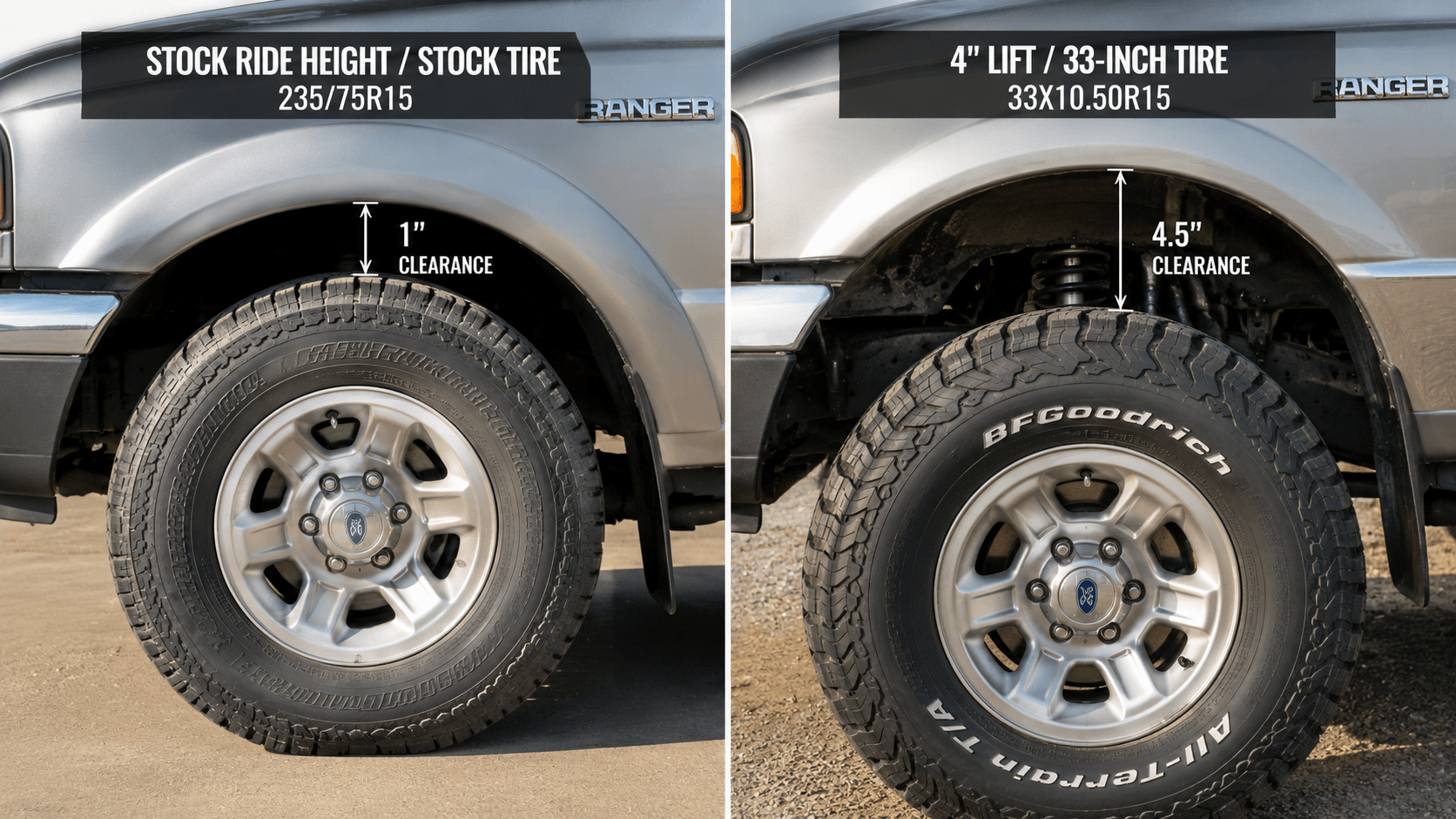
Tire sizing is often the main reason people lift their Rangers in the first place. Here's a practical guide to what you can run at each lift height:
|
Lift Height |
Max Tire Size (Approx.) |
Notes |
|
Stock |
225/75R15 (28") |
Factory fitment |
|
1"–2" Leveling |
245/75R16 (30") |
May need minor trimming |
|
2.5"–3" |
265/75R16 (31") |
Clean fit on most Rangers |
|
4" |
285/75R16 (33") |
May need minor front fender trimming |
|
6" |
315/75R16 (35") |
Wheel spacers or offset wheels are often needed |
Always check with your specific Ranger's wheel well clearance before finalizing tire selection. Fender trimming and wheel spacers are common modifications paired with larger tires on lifted Rangers.
Lift Kits vs. Leveling Kits: Which One Does Your Ranger Actually Need?
This is one of the most searched questions among Ford Ranger owners, and for good reason. If you're confused about the difference, we cover this in depth in our dedicated guide: Lift Kit vs. Leveling Kit — Which One Does Your Truck Actually Need?
The short answer: a leveling kit is the right choice if you want to balance the front-to-rear stance and run slightly larger tires. A lift kit is what you need if you want meaningful ground clearance, serious off-road capability, and room for 31"+ tires. Most Ranger owners who start with a leveling kit eventually upgrade to a full suspension lift within a year or two.
Installation: Can You Install a Ford Ranger Lift Kit Yourself?
Whether DIY installation is realistic depends on the kit type and your mechanical skill level.
Body Lifts - Yes, with Basic Tools
Body lift kits are among the most DIY-friendly modifications you can make to your Ranger. With basic hand tools, a hydraulic floor jack, and a few hours, most mechanically inclined owners can complete a body lift installation successfully. Zone Offroad and Rough Country both provide detailed installation instructions and the hardware needed.
Leveling Kits - Usually Yes
Most leveling kits for the Ford Ranger involve installing coil spring spacers or strut spacers at the front. This is a moderate-difficulty job that requires removing the front strut or torsion bar components, achievable for someone comfortable with suspension work.
Suspension Lifts (3"–6") - Professional Installation Recommended
Full suspension lifts involve removing and replacing springs, shocks, radius arm brackets, and, in many cases, control arms. On TTB-equipped Rangers especially, the job requires specific knowledge of the suspension geometry to avoid creating unsafe driveline angles. For lifts of 3 inches or more, we strongly recommend professional installation by a qualified suspension shop.
Professional installation typically costs $300–$700 on top of the kit price, depending on your location and the complexity of the lift.
Common Questions About Ford Ranger Lift Kits
Does lifting a Ford Ranger void the factory warranty?
For trucks still under warranty (primarily 2011–2013 models), lifting can void warranty coverage on suspension and drivetrain components directly affected by the modification. The Magnuson-Moss Warranty Act protects other vehicle systems, but it's best to check with your dealer before making changes to a warranted truck.
Will a lift kit affect my Ford Ranger's fuel economy?
Yes — any lift kit that allows you to run larger, heavier tires will reduce fuel economy. The lift itself doesn't directly affect mpg, but the larger tires that typically accompany a lift increase rolling resistance and weight, which drops fuel economy by 1–4 mpg depending on tire size.
How long does it take to install a Ford Ranger lift kit?
Body lifts typically take 3–5 hours. Leveling kits average 1–3 hours. Full suspension lifts can take 4–10 hours depending on the kit complexity and whether additional components (like control arms or brake line extensions) are required.
Can I lift a 2WD Ford Ranger?
Absolutely. Two-wheel drive Rangers are lifted regularly, typically with coil spring spacers (front) and shackle lifts or add-a-leaf packs (rear). You won't gain the same off-road capability as a lifted 4WD, but a lifted 2WD Ranger can still clear larger tires and achieve a great visual result.
Is it safe to lift a Ford Ranger?
When installed correctly with quality components and followed by a proper alignment, a lifted Ford Ranger is safe for both highway and off-road driving. The risk comes from poor-quality kits, improper installation, skipping the alignment, or running excessively tall tires that stress the steering and suspension beyond their design limits.
What to Look for When Buying a Ford Ranger Lift Kit
Before clicking "buy," run through this checklist:
- Confirm exact year, model, and drivetrain (2WD or 4WD). This is the single most important factor in fitment. A 4WD kit will not work on a 2WD truck.
- Decide your lift goal (clearance, tires, or looks). Be honest about how you use your Ranger. A 6-inch lift on a daily driver is usually overkill.
- Check what's included in the kit. Some budget kits only include the primary lift component (e.g., coil spacers) and expect you to reuse factory shocks. Kits that include matched shocks or shock extensions give you a more complete, reliable setup.
- Factor in additional costs: Alignment: $80–$150. Extended brake lines (if needed): $50–$150. Upper control arms (for 3"+ IFS lifts): $200–$500.
- Read real-world reviews from Ranger owners. A kit that works flawlessly on a Chevy Silverado may have fitment issues on a Ranger. Look for feedback from owners of your specific generation.
- Choose a brand that offers technical support. Good brands stand behind their products. Superlift, Skyjacker, and Rough Country all offer customer support lines and installation resources.
How Lifting Your Ranger Compares to Lowering
Not everyone wants to go up; some truck enthusiasts prefer the slammed, street-performance look of a lowered truck. If you're on the fence, our guide on lowering your truck: benefits, risks, and the right kit to buy walks through the other side of the equation. For the Ford Ranger, though, the overwhelming majority of aftermarket attention is focused on lifting, and for good reason. The Ranger was born to be lifted.
Ford Ranger Lift Kit: Frequently Asked Questions
Q1: What is the best lift kit for a Ford Ranger?
The best lift kit for a Ford Ranger depends on your year, drivetrain, and goals. For 1998–2011 4WD Rangers, the Rough Country 4-inch Suspension Lift Kit is one of the most popular and well-reviewed options, offering solid off-road performance at a competitive price. For older TTB-equipped models, Skyjacker's TTB-specific kits are widely regarded as the best fitment choice.
Q2: How much does it cost to lift a Ford Ranger?
Total lift costs range from roughly $180 (leveling kit + alignment) to $2,200+ (premium suspension lift with professional installation). A typical 4-inch suspension lift with parts and installation runs $700–$1,200 for most Ford Ranger owners.
Q3: Can I use a Chevy or Toyota lift kit on my Ford Ranger?
No. Lift kits are vehicle-specific and must be engineered for the Ford Ranger's suspension geometry, mounting points, and dimensions. Always purchase a kit specifically designed for your Ranger's year and drivetrain.
Q4: Does a lift kit affect steering on a Ford Ranger?
Yes, in some cases. Larger lifts (3"+ on IFS models) can introduce bump steer, a tendency for the truck to pull to one side over bumps if the steering geometry is not corrected. Quality kits include geometry correction hardware, and some owners add a steering stabilizer to further improve highway tracking.
Q5: What is a TTB suspension on the Ford Ranger?
TTB stands for Twin Traction Beam. It's a type of independent front suspension used on 4WD Ford Rangers from the 1980s through the late 1990s. The TTB design uses two beams that pivot independently, giving 4WD capability with some of the ride quality benefits of IFS. Lift kits for TTB Rangers must specifically account for this design — standard IFS lift kits will not work.
Q6: Is a 4-inch lift too much for a daily driver Ford Ranger?
A 4-inch lift is manageable on a daily-driven Ranger if installed correctly with quality shocks and followed by a proper alignment. You'll notice a higher center of gravity and slightly different handling at highway speeds, but with a reputable kit and matched shock absorbers, the truck remains comfortable and controllable.
Q7: What's the biggest tire I can fit on a stock Ford Ranger?
Stock ground clearance on the 1998–2011 4WD Ranger allows for approximately 28"–29" tires without rubbing. A 2.5-inch lift opens the door to 31" tires, while a 4-inch lift can accommodate 33" tires with minor trimming.
Q8: Do I need new brake lines when lifting my Ford Ranger?
For lifts up to 2.5 inches, factory brake lines are usually adequate. For lifts of 3 inches or more, extended or braided stainless steel brake lines are recommended to prevent the stock lines from stretching taut at full suspension droop, which is a safety hazard.
Final Takeaway: Build the Ranger You've Always Wanted
The Ford Ranger from 1983 to 2013 is one of the most lift-friendly compact trucks in automotive history. From the rugged TTB-equipped first-gen models to the mature IFS platform of the 1998–2011 trucks, there is a proven lift kit solution for every generation, every drivetrain, and every budget.
The key is matching the right kit to your specific year, your driving goals, and your budget, and then committing to a proper installation and alignment. A well-lifted Ranger isn't just a looker; it's a genuinely more capable truck that can go where stock models can't.
Want to understand how suspension lift kits actually work before you buy? Read our detailed breakdown: How Does a Truck Suspension Lift Kit Work?
Or, if you're still weighing your options between a leveling and a full lift kit, our full comparison guide is here: Best Lift Kits for 1999–2006 Chevy Silverado 1500. While Silverado-specific, it covers universal selection principles that apply directly to your Ranger search.
Now get out there, pick the right kit, and lift your Ranger the right way.