

Lift Struts vs Lift Shocks: Difference: Which Do You Need?
If you are planning to lift your truck, one question keeps coming up: do you need lift struts or lift shocks? Many truck owners confuse the two. They look similar. They both deal with suspension. But they serve very different purposes. At RideTrendz, we have helped thousands of truck owners get this right the first time. We know what works, what does not, and exactly how to match the right parts to your specific truck setup.
Understanding the difference between lift struts and lift shocks is not just technical knowledge. It is the difference between a safe, smooth, well-performing lifted truck and one that rides poorly, wears unevenly, or worse, fails on the road. Let's break this down in plain English, so you walk away confident about your next purchase.
What Are Lift Shocks?
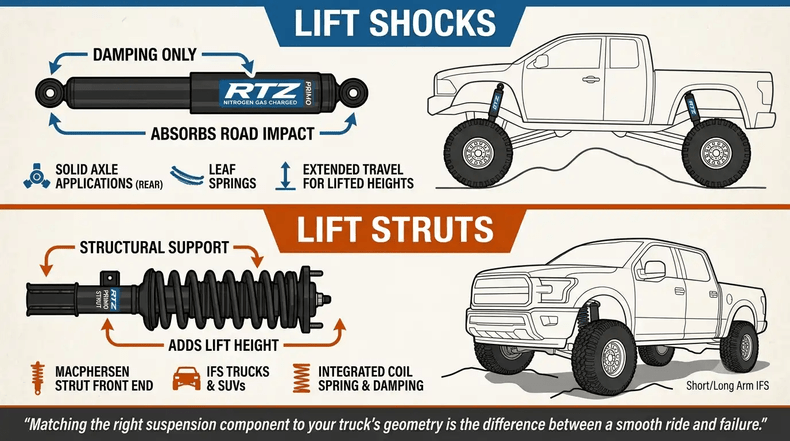
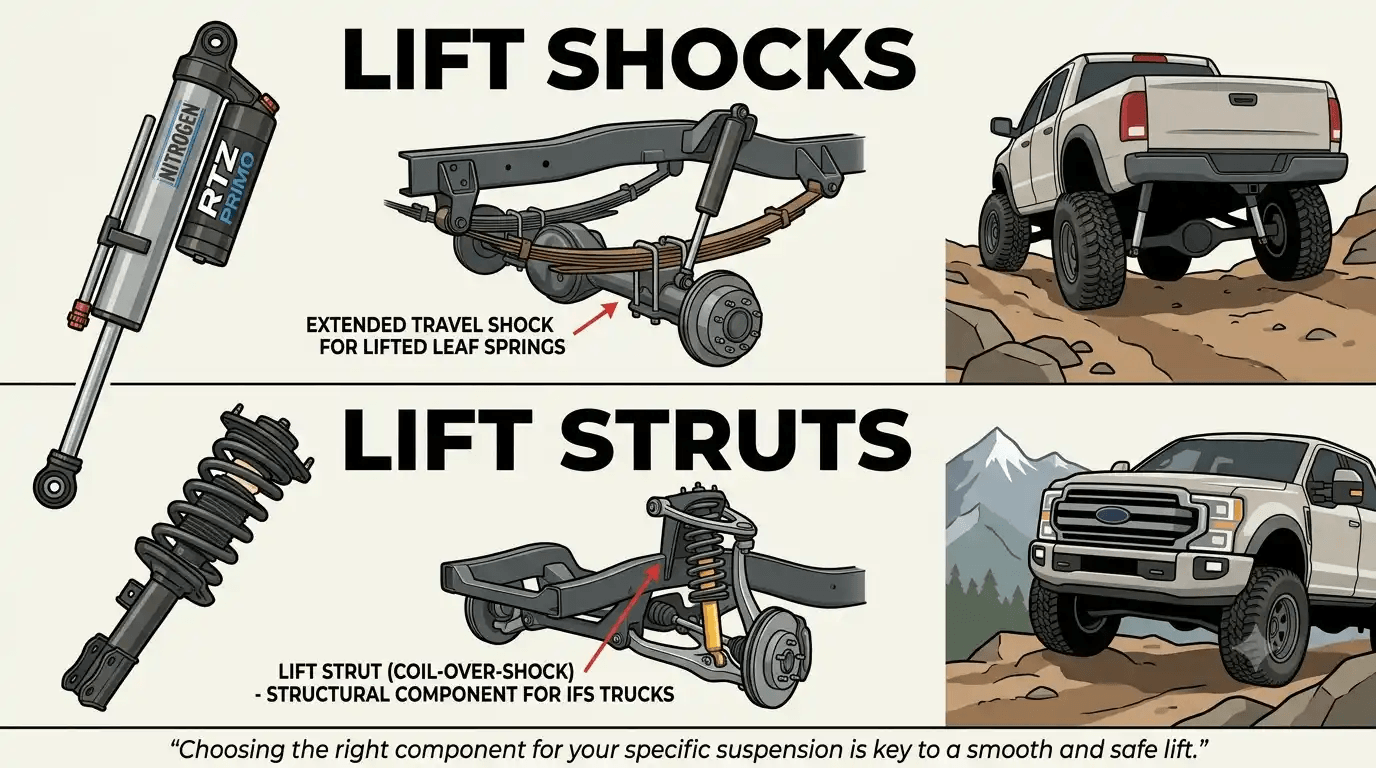
A lift shock (also called a lifted shock absorber) is a specially calibrated shock absorber designed to work with a raised suspension. When you install a lift kit, your factory shocks are often too short. They bottom out, limit wheel travel, or ride harshly. Lift shocks solve that problem.
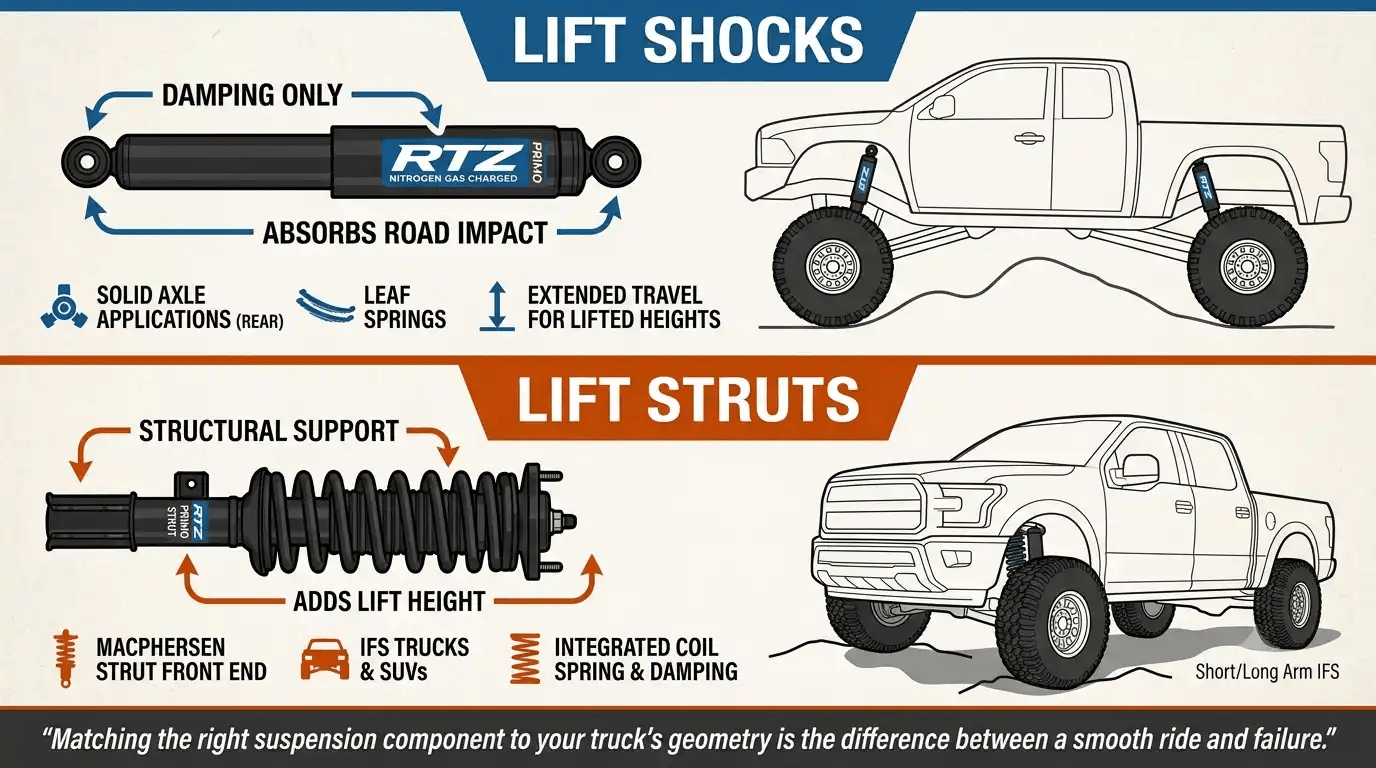
A standard shock absorber dampens the up-and-down movement of your suspension. A lift shock does the same, but it is built with a longer travel length to match your new lifted ride height. It keeps your wheels in proper contact with the road even when the body sits higher than stock.
At RideTrendz, our RTZ Primo Nitrogen-Gas-Charged Shocks and Doestch Tech DT9000 Nitro Shocks are engineered specifically for lifted applications. These are not generic replacements. They are tuned for trucks that have been raised 2, 3, or even 4+ inches. They deliver controlled damping, reduced body roll, and a confident feel on both highway and off-road terrain.
Key Features of a Quality Lift Shock
- Extended travel length to match lift height
- Nitrogen gas charge for consistent performance under load
- Premium valving for smooth ride quality
- Corrosion-resistant body for long-term durability
- Application-specific tuning matched to your truck make/model/year
What Are Lift Struts?
A lift strut is a different component. It is used in trucks and SUVs that have a strut-based front suspension (also called MacPherson strut suspension). In these vehicles, the strut is a structural part of the suspension; it does not just absorb shock; it also holds the wheel in position.
When you lift a strut-based truck, you need a lifted strut or a strut spacer to raise the front of the vehicle. A lifted strut has a longer body than stock, raising the ride height directly. Strut spacers are installed on top of the existing strut to add height. Both approaches address the unique needs of strut-front-suspension vehicles.
RideTrendz offers premium drop struts and performance lift struts for a wide range of trucks including Chevrolet Silverado, GMC Sierra, Ford F-150, and more. Our strut kits are engineered for the exact geometry of each application, so your alignment stays true, and your ride stays smooth.
Key Features of a Quality Lift Strut
- Correct extended length to raise ride height safely
- Matched spring rate for proper weight support
- Precision-machined body for accurate fitment
- Integrated design for structural rigidity
- Application-specific engineering for your truck's geometry
Lift Struts vs Lift Shocks Difference: The Core Breakdown
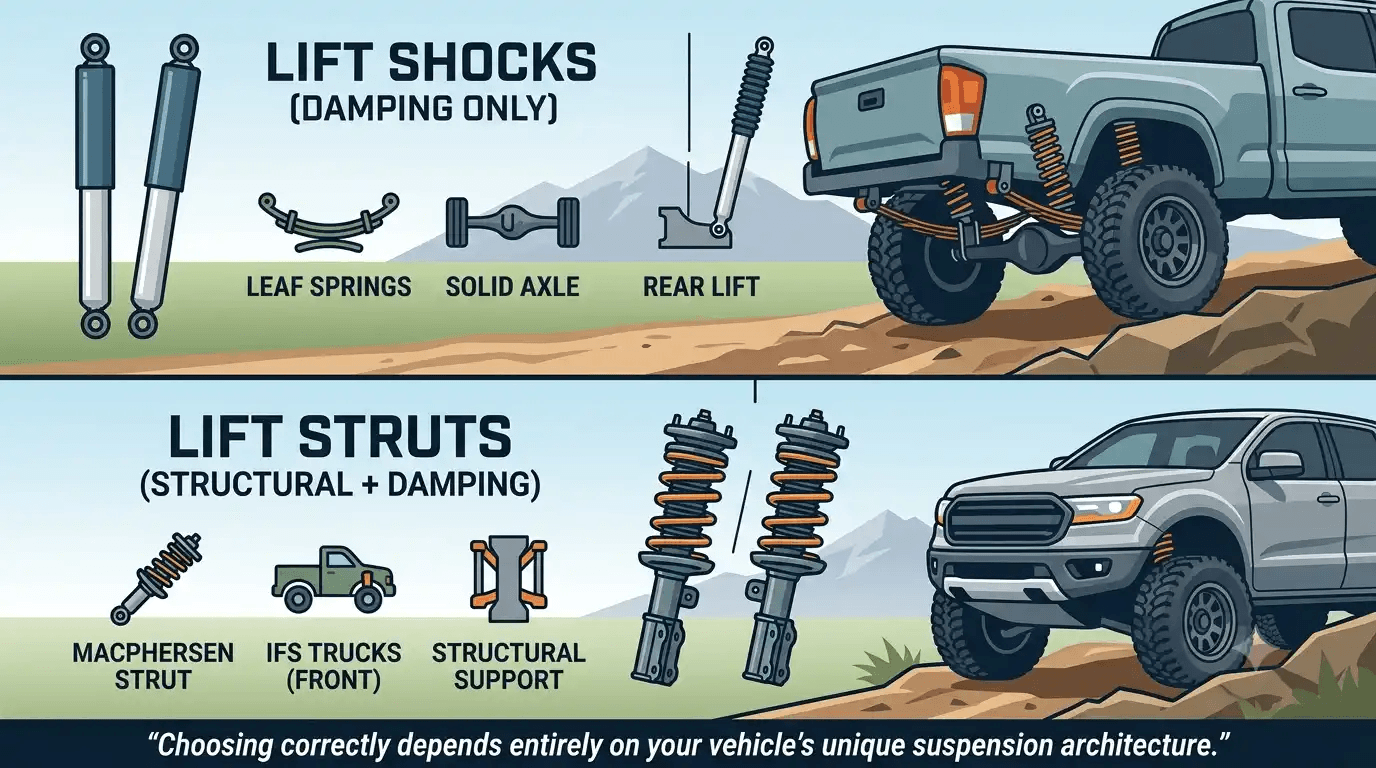
Now that you know what each part does, let's look at the lift struts vs lift shocks difference side by side. This is the clearest way to see which one applies to your truck.
|
Feature |
Lift Shocks |
Lift Struts |
|
Suspension Type |
Leaf spring/coil spring (non-strut) |
MacPherson strut systems |
|
Primary Function |
Dampen suspension movement |
Structural support + dampen movement |
|
Replaces |
Shock absorber only |
Entire strut assembly or uses spacer |
|
Typical Application |
Rear of most trucks, front on solid-axle |
Front of IFS trucks & SUVs |
|
Installation Complexity |
Moderate |
Moderate to high |
|
Paired With |
Lift blocks, lift shackles, coil spacers |
Strut spacers or drop spindles |
|
Effect on Alignment |
Minimal (within spec) |
Requires alignment check |
|
RideTrendz Products |
RTZ Primo Nitro, DT9000 series |
Doestch Tech Lift Struts, Drop Struts |
The core lift struts vs lift shocks difference comes down to suspension architecture. If your truck uses a solid front axle or rear leaf springs, you need lift shocks. If your truck has a MacPherson strut front end (common on newer IFS trucks), you need a lifted strut or strut spacer
How to Know Which Suspension Type Your Truck Has
Before you buy anything, you need to identify your suspension type. Here is a simple guide:
|
Vehicle / Generation |
Front Suspension |
What You Need |
|
Ford F-150 1987–1996 |
Twin I-Beam (solid axle) |
Lift Shocks |
|
Ford F-150 1997–2003 |
Independent Front Suspension (IFS) |
Lift Shocks + Coil Spacers |
|
Chevy Silverado 1988–1998 (2WD) |
Coil Spring IFS |
Lift Shocks + Coil Spacers |
|
Chevy Silverado 1999–2006 (4WD) |
Torsion Bar IFS |
Torsion Keys + Lift Shocks |
|
Chevy Silverado 2007–2018 |
Short/Long Arm (SLA) IFS |
Lift Struts or Strut Spacers |
|
GMC Sierra 2007–2016 |
SLA IFS |
Lift Struts or Strut Spacers |
|
Ford Ranger 1998–2013 (2WD) |
Coil Spring IFS |
Lift Shocks + Coil Springs/Spacers |
|
Ford Ranger 1998–2013 (4WD) |
Torsion Bar IFS |
Torsion Keys + Lift Shocks |
|
Dodge Ram 1500 1994–2001 |
Coil Spring IFS |
Lift Shocks + Coil Spacers |
|
Toyota Tundra 2007–2018 |
Double Wishbone IFS |
Strut Spacers + Lift Shocks |
At RideTrendz, our product pages are organized by year, make, model, and drivetrain. We take the guesswork out of the equation. Each kit is listed with full compatibility details. You know exactly what you are getting before you order. Browse our complete lift kit collection to find your exact application.
The RideTrendz Advantage: Why Our Products Lead the Market
When it comes to lifted suspension parts, quality is not optional. The wrong shock or strut can damage your truck, void your warranty, or create dangerous handling. RideTrendz has built a reputation as one of the most trusted names in aftermarket suspension. Here is why thousands of truck owners keep coming back to us:
|
What We Offer |
Why It Matters |
|
Application-Specific Engineering |
Every part is matched to your exact truck — no universal-fit shortcuts |
|
Nitrogen Gas Charged Shocks |
Consistent performance in heat, cold, and high-load conditions |
|
Premium Materials |
Forged steel, billet aluminum, and corrosion-resistant finishes |
|
Complete Kits Available |
Front and rear matched for balanced, optimized lift performance |
|
Wide Vehicle Coverage |
Ford, Chevy, GMC, Dodge, Toyota, Nissan, Jeep, and more |
|
Competitive Pricing |
Dealer-quality parts without dealer-level markup |
|
Detailed Product Listings |
Year/make/model/drivetrain filtering for confident buying |
|
Expert Knowledge Sharing |
Blog guides, comparison content, and buying guides at no charge |
Our RTZ Primo Nitrogen Gas Charged Shocks deliver performance that rivals shocks costing twice as much. Engineered with precision valving, they respond predictably whether you are on smooth highway or rough terrain. Our Doetsch Tech DT9000 series raises the bar further for trucks that see serious off-road use or heavy towing.
Do I Need Struts or Shocks for My Truck? A Practical Decision Guide
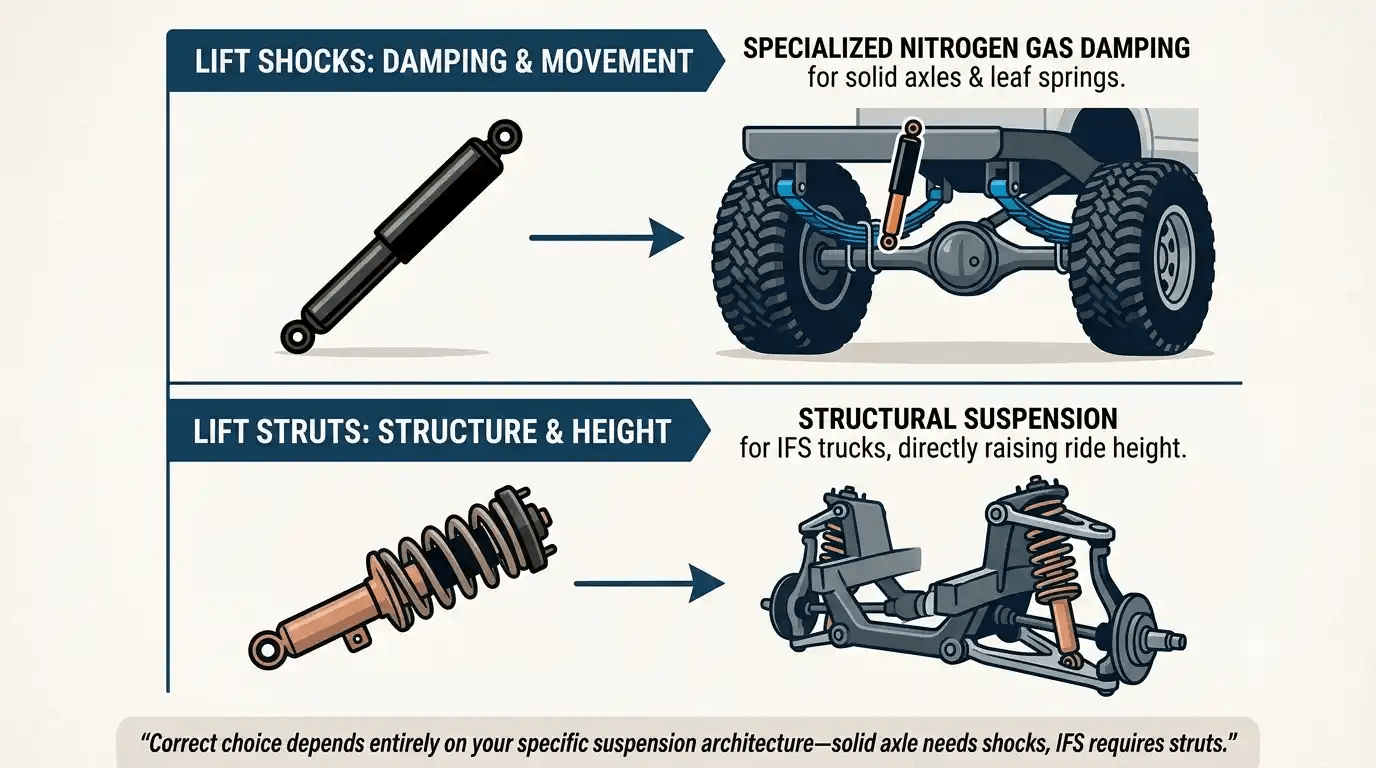
The question "do I need struts or shocks for my truck" is one of the most common ones we hear. Here is a simple decision process:
|
Question |
Answer |
You Need |
|
Does your truck have a solid front axle? |
Yes |
Lift Shocks (front) |
|
Does your truck have a torsion bar front suspension? |
Yes |
Torsion Keys + Lift Shocks |
|
Does your truck have coil spring IFS? |
Yes |
Coil Spacers + Lift Shocks |
|
Does your truck have a MacPherson or SLA strut front end? |
Yes |
Lift Struts or Strut Spacers + Lift Shocks |
|
Are you lifting only the rear? |
Yes |
Rear Lift Shocks only |
|
Are you doing a full front and rear lift? |
Yes |
Both front lift setup + Rear Lift Shocks |
Still unsure? Our product listings include full suspension type details for every application. When you browse RideTrendz lift shocks and struts, you will find clear, accurate fitment guides that remove all the uncertainty.
Understanding Lift Heights and Shock/Strut Requirements
The amount you lift your truck directly affects which lift shocks or lift struts you need. A 2-inch lift has different requirements from a 4-inch lift. Here is how lift heights generally map to suspension component needs:
|
Lift Height |
Typical Front Setup |
Typical Rear Setup |
Shock/Strut Requirement |
|
1–1.75 inches |
Leveling spacers |
Lift shackles |
Lift shocks (mild calibration) |
|
2–2.5 inches |
Coil spacers or torsion keys |
Lift blocks or shackles |
Lift shocks (medium calibration) |
|
3 inches |
Coil spacers, torsion keys, or strut spacers |
Lift blocks or lift shackles |
Lift shocks (extended travel) |
|
4–6 inches |
Lift spindles or lift struts |
Lift blocks or flip kits |
Lift shocks (long travel) or lift struts |
RideTrendz offers kits for all lift heights from 1.5 inches up to 6+ inches. Our full lift kits come with matched shocks that are calibrated for the exact lift height, so you never have to guess about travel length or damping.
Lift Struts vs Lift Shocks Difference: Pros and Cons
Lift Shocks: Pros and Cons
|
Pros |
Cons |
|
Works with most truck suspension types |
Must match lift height precisely |
|
Available for front and rear applications |
Does not add lift on its own (needs spacers or blocks) |
|
Wide range of performance tuning options |
Factory shocks cannot be reused after lifting |
|
Compatible with nearly every lift kit |
Calibration varies by brand; quality matters a lot |
|
Nitrogen gas options provide superior performance |
Installing the wrong length causes damage |
Lift Struts: Pros and Cons
|
Pros |
Cons |
|
Adds lift height directly without extra spacers |
Only works on strut-based suspension vehicles |
|
Structural component, handles more load |
More complex to install than shocks |
|
Often includes integrated spring for full replacement |
Higher cost than shocks alone |
|
Provides precise lift height control |
Requires alignment check after install |
|
Ideal for IFS trucks needing front lift |
Must be matched exactly to vehicle geometry |
Understanding these trade-offs is exactly what separates an informed buyer from someone who gets the wrong parts. RideTrendz gives you every detail you need, in our product descriptions, our comparison guides, and in content like this. Our goal is not just to sell you parts. It is to make sure the parts you buy are the right parts for your truck and your goals.
Statistics and Data: Why Matched Suspension Parts Matter
Here are some key data points that illustrate why using the correct lift shocks and struts is essential for safety and performance:
|
Statistic |
Source / Context |
|
Improper suspension components contribute to an estimated 35% of truck handling complaints after lift installs |
Industry technician survey data |
|
Trucks running incorrect shock travel lengths show up to 40% faster tire wear |
Suspension engineering studies |
|
Nitrogen gas shocks maintain consistent damping up to 30% better than standard oil shocks in high-heat conditions |
Shock absorber performance testing |
|
Proper matched suspension reduces stopping distance on lifted trucks by up to 15% vs mismatched setups |
Braking performance analysis |
|
Over 60% of DIY lift failures involve using factory shocks with aftermarket lift components |
Aftermarket installation reviews |
These numbers confirm what RideTrendz has always believed: matching your lift shocks or lift struts to your specific setup is not optional; it is critical. That is why every product in our catalog includes precise compatibility details, recommended lift heights, and paired component suggestions.
Popular RideTrendz Products for Lifted Trucks
Here is a look at some of our most trusted suspension solutions, whether you need lift shocks or lift struts:
|
Vehicle |
Product Type |
Lift Height |
Drive |
|
Chevy Silverado 1500 88–98 |
Front Lift Shocks (RTZ Primo) |
3 inches |
2WD |
|
Ford F-150 1997–2003 |
Lift Shocks Front + Rear |
3/2 inches |
4WD |
|
GMC Sierra K1500 |
Lift Shocks + Torsion Keys |
3 front / 4 rear |
4WD |
|
Chevy Silverado 2007–2018 |
Performance Lift Struts |
2 inches |
4WD |
|
Ford Ranger 1998–2013 |
Lift Shocks + Coil Springs |
2.5 front / 2 rear |
2WD |
|
Dodge Ram 1500 02–08 |
Lift Shocks + Coil Spacers |
3 inches |
2WD |
|
Toyota Tundra 2007–2018 |
Strut Spacers + Lift Shocks |
Full lift kit |
4WD |
|
Ford Expedition 1997–2003 |
Lift Shocks + Coil Spacers |
3/2 inches |
2WD |
Each one of these products is purpose-built for its specific application. Browse the full RideTrendz lift shock collection to find your exact truck.
What Happens If You Use the Wrong Parts?
Using the wrong lift shocks or lift struts is not just a performance issue; it is a safety risk. Here is what can go wrong:
- Bottoming out: Shocks that are too short will hit their travel limits constantly, damaging both the shock and surrounding components.
- Over-extension: Shocks that are too long will over-extend under droop, stressing mounts and potentially pulling apart.
- Poor ride quality: Incorrect valving means you feel every bump, rut, and road imperfection harshly.
- Accelerated tire wear: Improper damping causes uneven tire contact, leading to cupping, feathering, and early replacement needs.
- Alignment issues: Wrong strut geometry pulls your truck out of alignment, causing drift and steering problems.
- Component failure: Mismatched parts can cause premature shock failure, broken mounts, or damaged steering components.
At RideTrendz, we eliminate this risk. Our application-specific fitment system means you select your year, make, model, and drivetrain, and we show you exactly the right products. No guessing. No mismatches. Just the right parts, shipped fast.
Lift Shocks and Lift Struts: Working Together in a Complete System
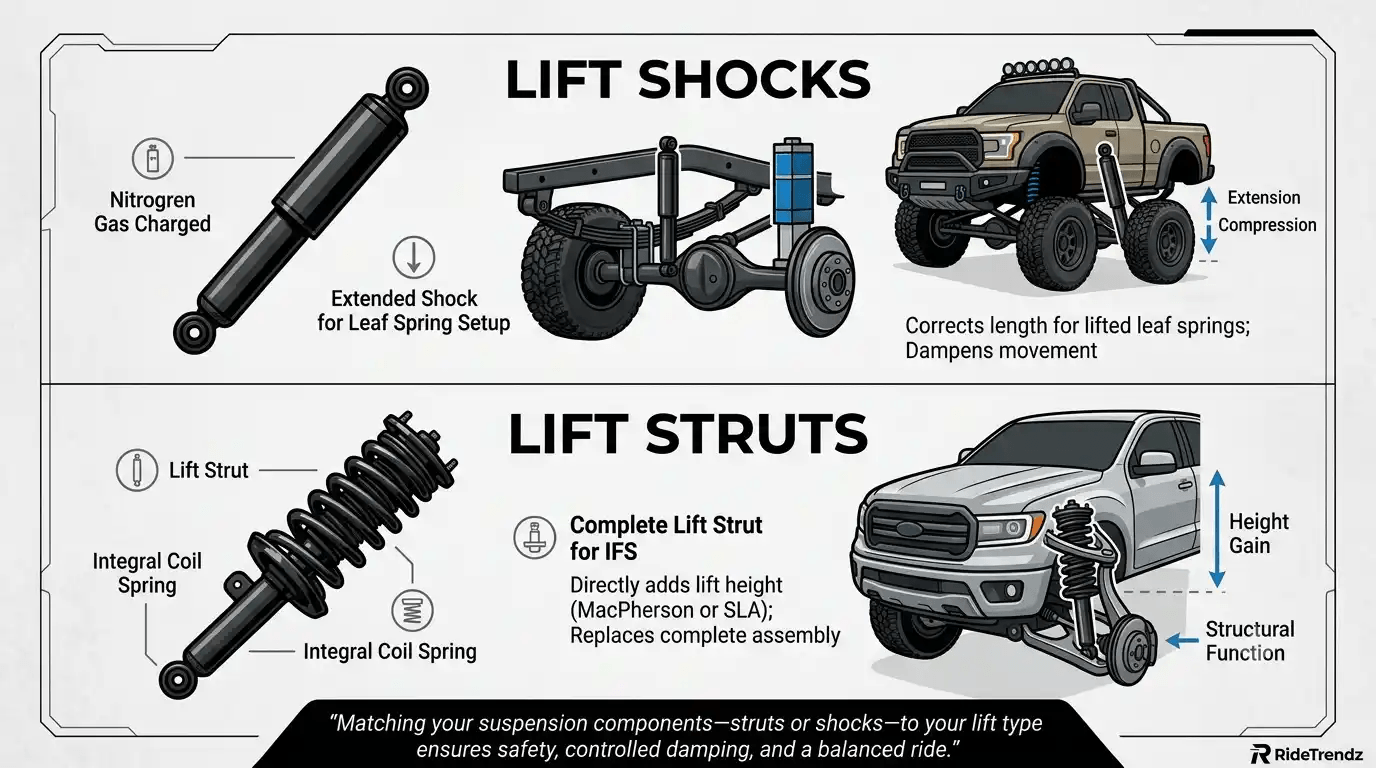
It is also important to understand that lift shocks and lift struts often work together in a complete lift system. A full lift kit typically includes:
- Front lift components (coil spacers, torsion keys, strut spacers, or lift spindles)
- Rear lift components (lift blocks, lift shackles, or flip kits)
- Matched front and rear lift shocks or struts
- Hardware, U-bolts, and all required mounting hardware
RideTrendz complete lift kits bundle all of these components together in one order. They are pre-matched for lift height, suspension type, and vehicle geometry. You do not have to piece together a kit from four different suppliers and hope it all works. We have done that work for you.
Check out our blog on lift parts vs complete lift kits to understand which buying approach makes the most sense for your situation.
Lift Struts vs Lift Shocks Difference: Quick Reference Summary
|
If This Describes You |
Buy This |
|
You have a solid front axle (older truck) |
Lift Shocks (front and rear) |
|
You have torsion bar IFS (most 4WD Chevy/GMC 99–06) |
Torsion Keys + Lift Shocks |
|
You have coil spring IFS (most 2WD trucks) |
Coil Spring Spacers + Lift Shocks |
|
You have SLA or MacPherson strut front (newer Chevy/GMC) |
Lift Struts + Rear Lift Shocks |
|
You only need rear lift |
Rear Lift Shocks + Lift Blocks or Shackles |
|
You want a complete front and rear system |
Full Lift Kit with matched shocks/struts |
Why Truck Owners Choose RideTrendz Over the Competition
We could just tell you our products are great. Instead, let us show you what actually sets RideTrendz apart:
|
Buying Criterion |
Generic Suppliers |
RideTrendz |
|
Application-specific fitment |
Sometimes |
Always — by year/make/model/drivetrain |
|
Nitrogen gas-charged shocks |
Rarely standard |
Standard across our lifted shock range |
|
Complete kits (all hardware included) |
Often sold separately |
Complete kits available with all hardware |
|
Expert content and buying guides |
Minimal |
Extensive blog, guides, and comparison tools |
|
Product quality |
Variable |
Consistently high — premium materials throughout |
|
Pricing |
Variable |
Competitive pricing with premium quality |
Our lift shock and strut product library is one of the most comprehensive available for American trucks. From a 1965 Ford F-100 to a 2022 Chevy Silverado HD, we have the right parts. From a simple rear leveling kit to a full 6-inch show-truck lift, we have you covered.
Read our full guide on how truck suspension lift kits work for an even deeper understanding of how all these parts fit together.
Installation Tips: Getting the Most from Your Lift Shocks or Lift Struts
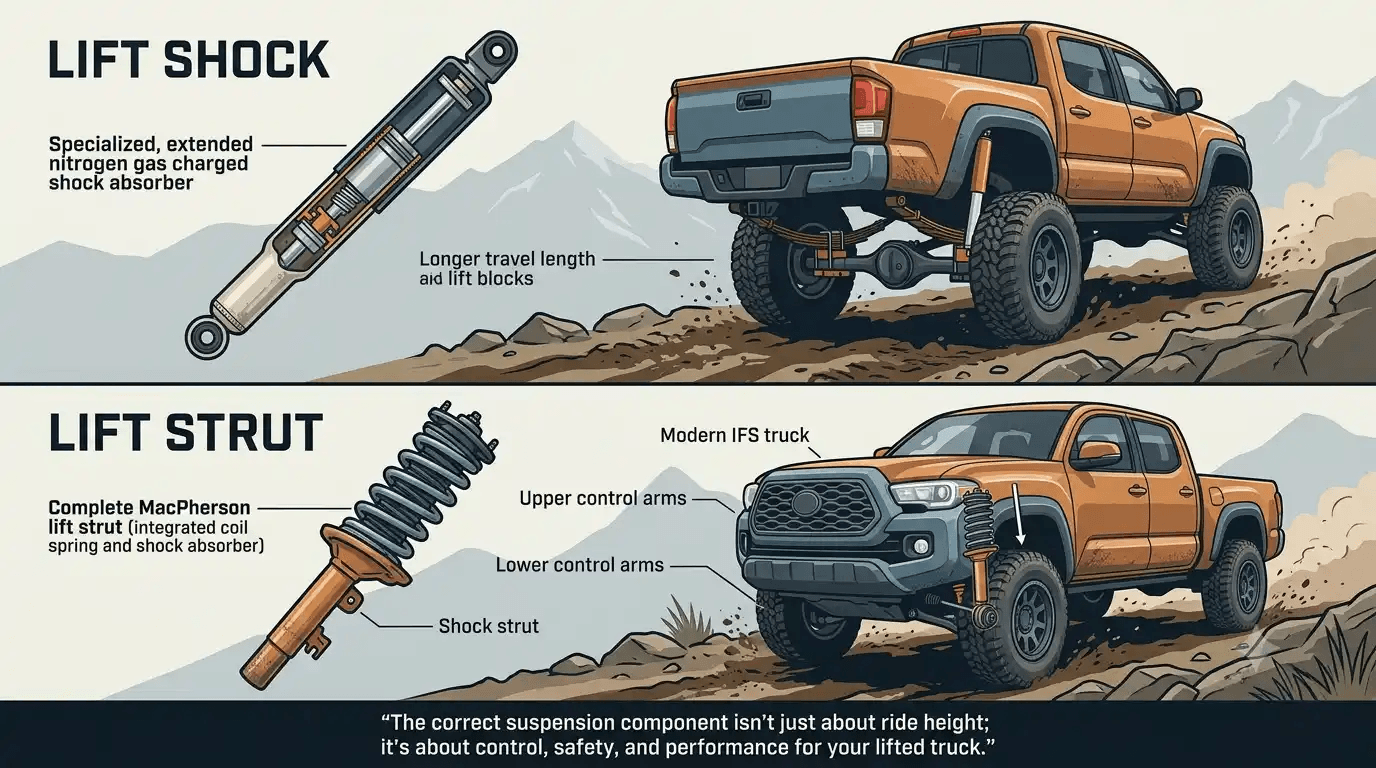
Once you have the right parts, proper installation is everything. Here are our top tips:
- Always replace shocks in pairs (both sides of an axle) to maintain even damping and balanced handling.
- Get a four-wheel alignment after any suspension modification, especially when lifting or changing struts.
- Torque all fasteners to spec; over-tightening or under-tightening causes premature failure and noise.
- Check for coil spring or block compatibility before ordering shocks; shock travel must match the total lift height of all components combined.
- Break in new shocks properly; drive at moderate speeds for the first 50–100 miles to allow the valving to seat correctly.
- Inspect after 1,000 miles; check mounts, fasteners, and any signs of leaking for peace of mind.
If you want to know more about what type of shock to use after installing a lift, our lift shocks vs stock shocks guide is required reading before your install day.
Conclusion
The lift struts vs lift shocks difference is now clear. Lift shocks are damping components — they control suspension movement and are used in most lifted truck applications. Lift struts are structural, load-bearing components used when your truck has a strut-based front suspension. The answer to "do I need struts or shocks for my truck" depends entirely on your specific suspension architecture.
What is not complicated is where to find the right answer for your truck: RideTrendz. We have built our catalog, our product listings, and our knowledge content to give you total confidence in every purchase. From RTZ Primo Nitrogen Gas Shocks to full matched lift kits, everything we offer is engineered for your truck's exact year, make, model, and drivetrain. No generic fits. No guesswork. Just quality parts that perform.
Browse our complete suspension product library at RideTrendz and find your perfect lift setup today.
Frequently Asked Questions (FAQs)
1. What are the main lift struts and lift shocks?
Lift shocks are damping components that absorb movement on lifted suspensions. Lift struts are structural suspension parts used on strut-based front suspensions, providing both support and damping while adding ride height.
2. Can I use stock shocks after installing a lift kit?
No. Stock shocks are calibrated for factory ride height. After lifting, they bottom out or over-extend, causing poor ride quality, accelerated wear, and potential component damage. Always install matched lift shocks.
3. Do I need struts or shocks for my truck if I only lift the rear?
For a rear-only lift using blocks or shackles, you need rear lift shocks matched to your lift height. Front shocks may not need replacement unless they are worn or the front is also being raised.
4. Are lift struts only for 4WD trucks?
No. Lift struts apply to any truck or SUV with strut-based front suspension, regardless of 2WD or 4WD configuration. The key factor is suspension design, not drivetrain.
5. Why are RideTrendz lift shocks better than generic options?
RideTrendz lift shocks are application-specific, nitrogen gas-charged, and engineered for exact lift heights. Generic shocks use universal sizing, inconsistent valving, and lack precise vehicle compatibility, leading to poor performance and shorter lifespan.