

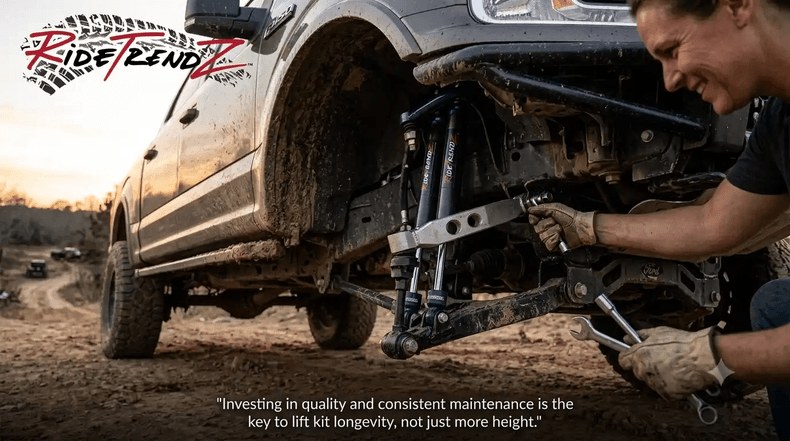
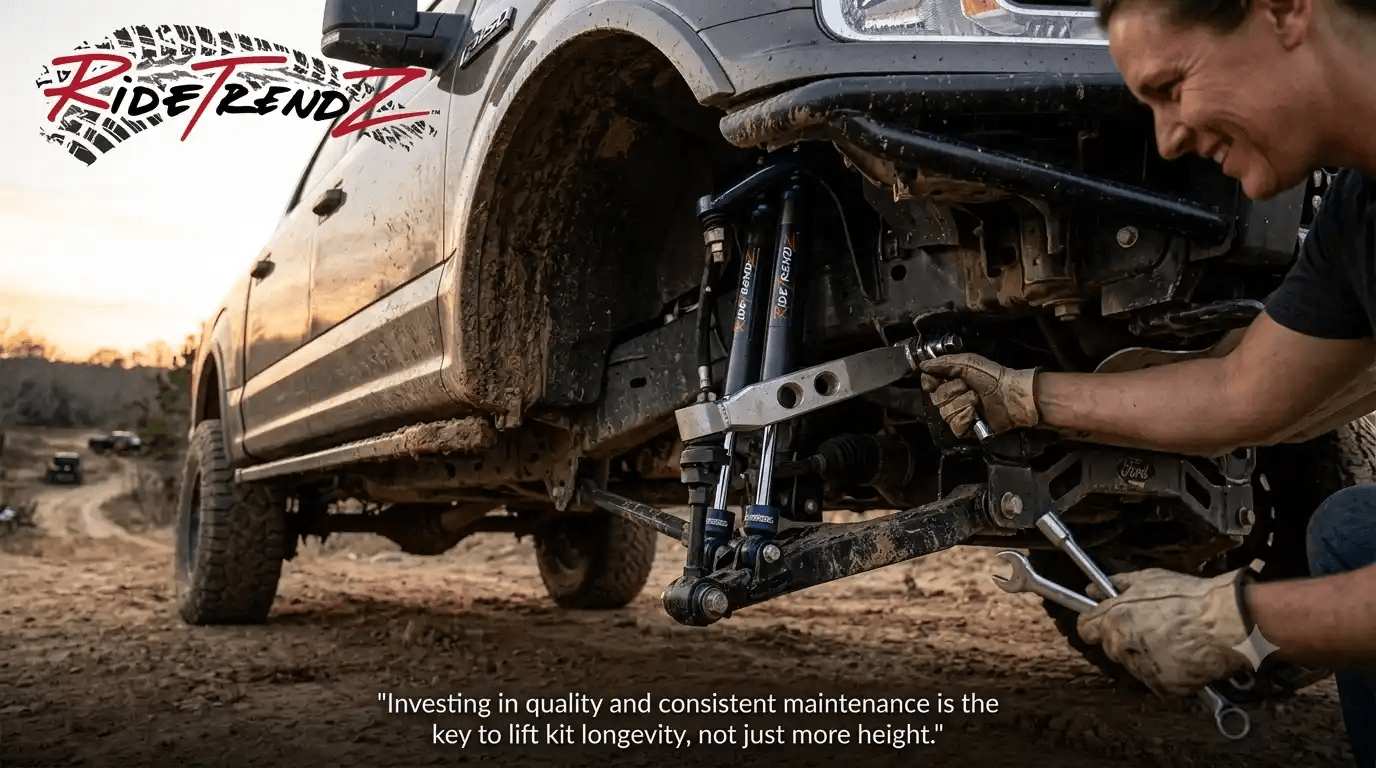
How long do lift kits last is one of the most common questions truck owners ask before upgrading their suspension. A lift kit is a serious investment, and understanding its lifespan helps you plan maintenance, budget for replacements, and get every dollar's worth from your purchase.
At RideTrendz, we have spent years helping truck owners across America choose, install, and maintain high-quality suspension kits. Our catalog spans hundreds of vehicle applications, from classic 1965 Ford F-100s to modern 2022 Dodge Ram 1500s and Chevy Silverados, and it is built on one core belief: give truck owners components that perform reliably for years, not months.
This guide covers how long a lift kit lasts on a truck, the key factors that affect component life, a full lift kit maintenance schedule, warning signs that mean it is time to replace, and why RideTrendz kits consistently outlast the budget alternatives. Whether you run a lifted daily driver or a weekend off-road rig, this guide has what you need.
What Is the Average Lift Kit Lifespan?
The straightforward answer to how long lift kits last is: a well-maintained quality kit lasts 5 to 15 years or more. The range is wide because lifespan depends heavily on kit type, driving conditions, and maintenance habits. Here is a quick reference by component:
|
Component |
Average Lifespan |
Heavy Off-Road Use |
Daily Driver Use |
|
Coil Spring Spacers |
8–15 years |
5–8 years |
10–15 years |
|
Lift Shocks / Struts |
50,000–80,000 mi |
30,000–50,000 mi |
60,000–80,000 mi |
|
Torsion Keys |
10–20 years |
8–12 years |
15–20 years |
|
Steel Lift Blocks |
Indefinite |
Replace if cracked |
Very long lifespan |
|
Lift Shackles |
8–12 years |
5–8 years |
10–12 years |
|
Spindle Lift Kits |
10+ years |
8–10 years |
12+ years |
These figures assume correct installation and regular lift kit maintenance tips are followed. Kits that are neglected can fail in under three years. Kits that are properly maintained often outlast these ranges.
Factors That Affect How Long a Lift Kit Lasts
1. Kit Quality and Materials
This is the single biggest driver of lift kit lifespan. Cheap kits made from cast steel or brittle polyurethane crack and deform far sooner than premium forged and billet alternatives. RideTrendz exclusively carries precision-engineered components, forged steel hardware, aircraft-grade aluminum spacers, and nitrogen-charged shocks, built to handle sustained real-world loads.
Our RTZ lift parts collection covers every major truck platform with application-specific fitment, so you get a kit that works with your geometry, not against it.
2. Driving Conditions
Your driving environment directly affects wear rates across every component:
- Off-road use, rocks, ruts, and trail obstacles put extreme stress on shocks, shackles, and blocks. Expect faster wear and more frequent inspections.
- Highway daily driving, smooth, predictable loads extend component life significantly across the entire kit.
- Towing and hauling, sustained weight beyond the kit's load rating stresses every component. Match your kit to your GVWR.
- Salt and wet roads: road salt accelerates rust on exposed steel. Rust treatment and regular inspection are critical in northern climates.
3. Installation Quality
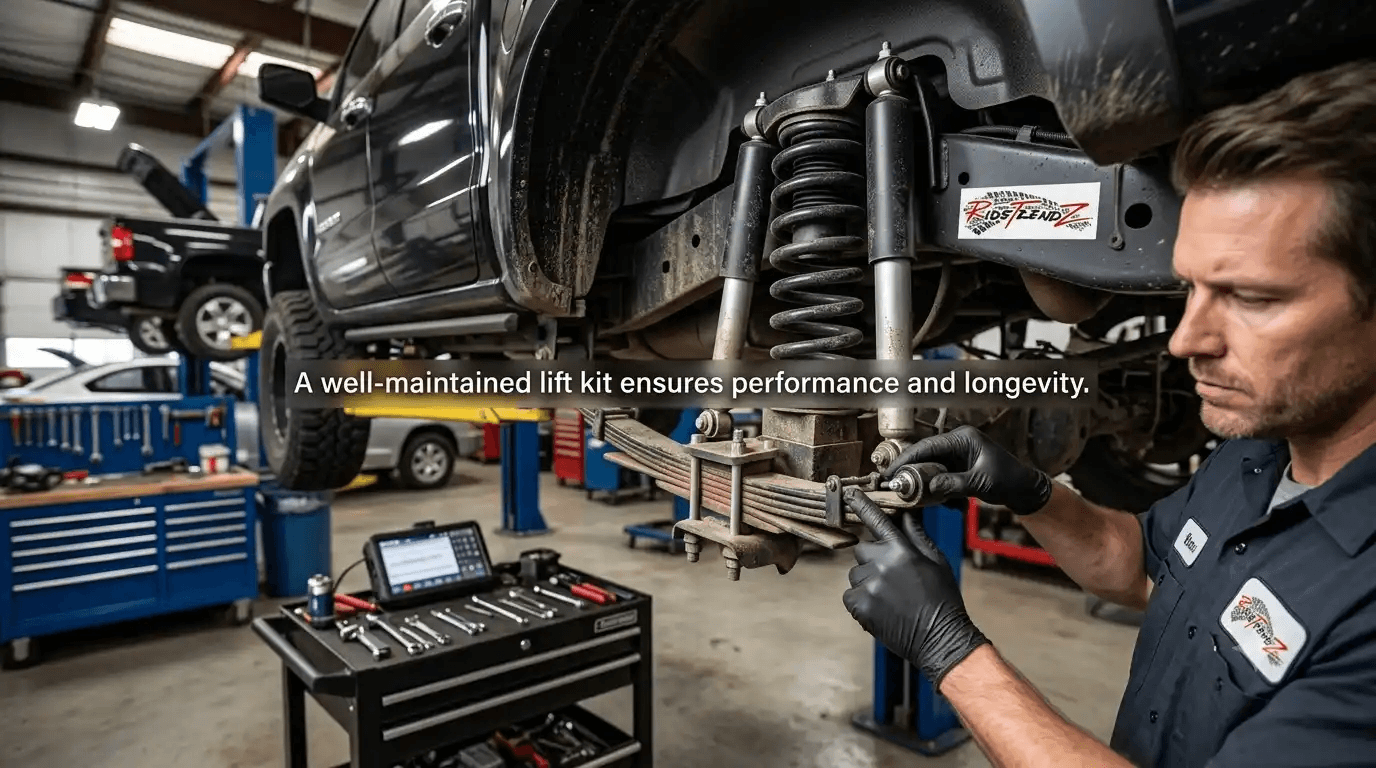
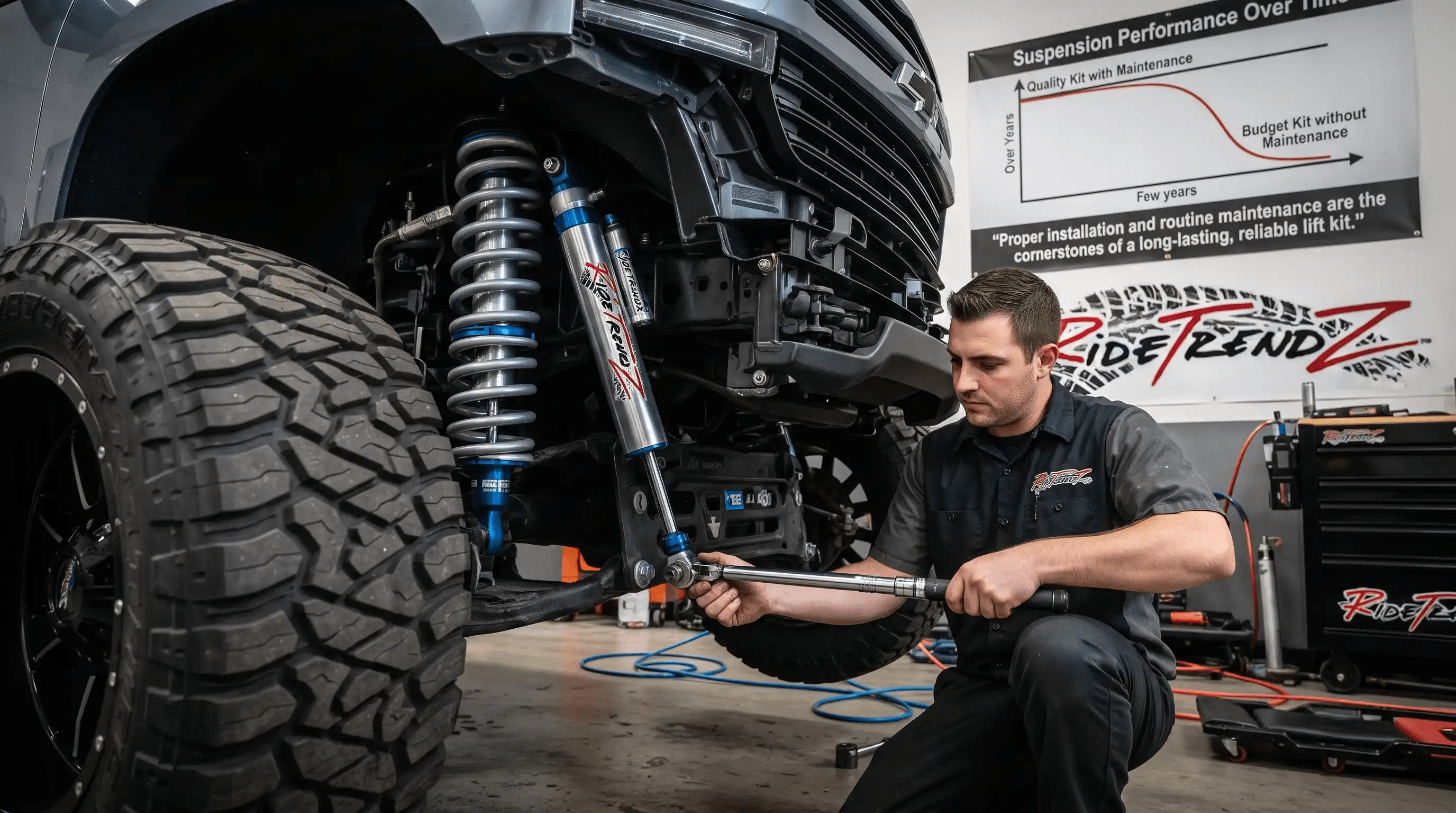
Even a premium kit fails early when installed incorrectly. Torque specs, alignment angles, and hardware seating all matter. Improperly installed components develop stress concentrations at welds and threads, leading to cracking within months. Follow manufacturer torque specifications exactly and get a professional alignment after every installation.
4. Maintenance Frequency
Consistent lift kit maintenance can literally double service life. The difference between a kit that lasts 5 years and one that lasts 15 is almost always a matter of maintenance discipline. We cover the full schedule in detail below.
5. Climate and Environment
UV exposure degrades polyurethane bushings. Constant moisture corrodes steel. Extreme cold brittles certain materials. Understanding your local climate tells you which components to prioritize and how aggressively to maintain them.
Lift Kit Maintenance Tips: The Complete Schedule
Consistent lift kit maintenance tips do not need to be complicated, but they do need to happen on a schedule. Here is the routine we recommend for every lifted truck owner:
Every 3,000 Miles (or Every Oil Change)
- Visually inspect all lift components for cracks, corrosion, or loose hardware
- Check shock absorbers for fluid leaks or physical damage
- Look for unusual tire wear patterns that signal alignment problems
- Listen for clunks, rattles, or vibrations during normal driving
Every 6,000 Miles
- Re-torque all lift hardware to manufacturer specifications
- Grease all zerk fittings on shackles and control arms
- Inspect and rotate tires; lifted trucks often see accelerated front wear
- Check alignment angles, especially caster and camber
Annually
- Full visual inspection with the vehicle on a lift
- Clean and treat all exposed steel components with rust inhibitor
- Bounce test each corner to confirm shock damping performance
- Inspect all bushings for cracking or compression set
- Verify leaf spring clamps and U-bolts for tightness
Trucks used for off-road, towing, or heavy hauling should run this schedule on a compressed timeline, roughly every 2,500 miles or after any significant off-road session.
Pros and Cons, Lift Kit Longevity by Type
Different kit types age differently. Here is a direct comparison:
|
Kit Type |
Longevity Pros |
Longevity Cons |
Typical Life |
|
Coil Spring Spacers |
Simple design, fewer failure points, aluminum resists rust |
Shifts some stress to OEM springs below |
8–15 years |
|
Lift Shackles |
Few moving parts, strong steel construction |
Can loosen over time, need regular re-torquing |
8–12 years |
|
Torsion Keys |
Forged steel, adjustable, exceptionally durable |
Incorrect adjustment accelerates CV joint wear |
10–20 years |
|
Spindle Lift Kits |
No additional stress on OEM springs or CV angles |
More complex install, higher upfront cost |
10+ years |
|
Full Lift Kits |
Purpose-built for lifted suspension geometry |
Shocks need replacing every 50K–80K miles |
5–15 years combined |
RideTrendz carries every type on this list. Our team helps you match the right kit to your specific driving profile so you get the maximum lift kit lifespan from your investment. Browse our complete selection at ridetrendz.com/lift-parts/.
When to Replace a Lift Kit, 7 Warning Signs
Knowing when to replace a lift kit protects both your truck and your safety. These are the warning signs that mean it is time to act:
1. Visible Cracks or Deformation
Any crack in a lift block, spacer, or shackle is an immediate safety issue. Stop driving and replace the component. Steel that shows bending or warping has been overloaded and must be replaced.
2. Leaking or Blown Shocks
Leaking shocks cause poor ride quality, extended stopping distances, and dangerous handling, especially critical on a lifted truck with a raised center of gravity. If your truck bounces more than once after a bump, your shocks need replacing. This is the most common when to replace a lift kit scenario we encounter.
3. Excessive Body Roll
A lifted truck that leans aggressively in corners has lost suspension control. Worn shocks and compromised bushings are the usual causes.
4. Clunking or Banging Over Bumps
Metallic clunks signal loose or cracked hardware. This can be a loose bolt or a cracked lift block shifting under load. Either way, inspect it immediately, and do not drive on it until you know what it is.
5. Severe or Uneven Tire Wear
Lifted trucks running outside their alignment specification eat tires fast. If you rotate regularly and still see cupping, feathering, or one-sided wear, your suspension geometry is off. Our lift kit vs leveling kit guide explains how geometry directly affects tire life.
6. Significant Lift Height Loss
If your truck sits noticeably lower than post-installation, your springs have fatigued, or spacers have compressed. This affects your entire suspension geometry and must be corrected.
7. Failed Safety or Emissions Inspection
In many states, a lifted truck with defective suspension components cannot legally return to the road until repaired. Do not wait for inspection day; check your components now.
Component-by-Component: How Long Each Part Lasts
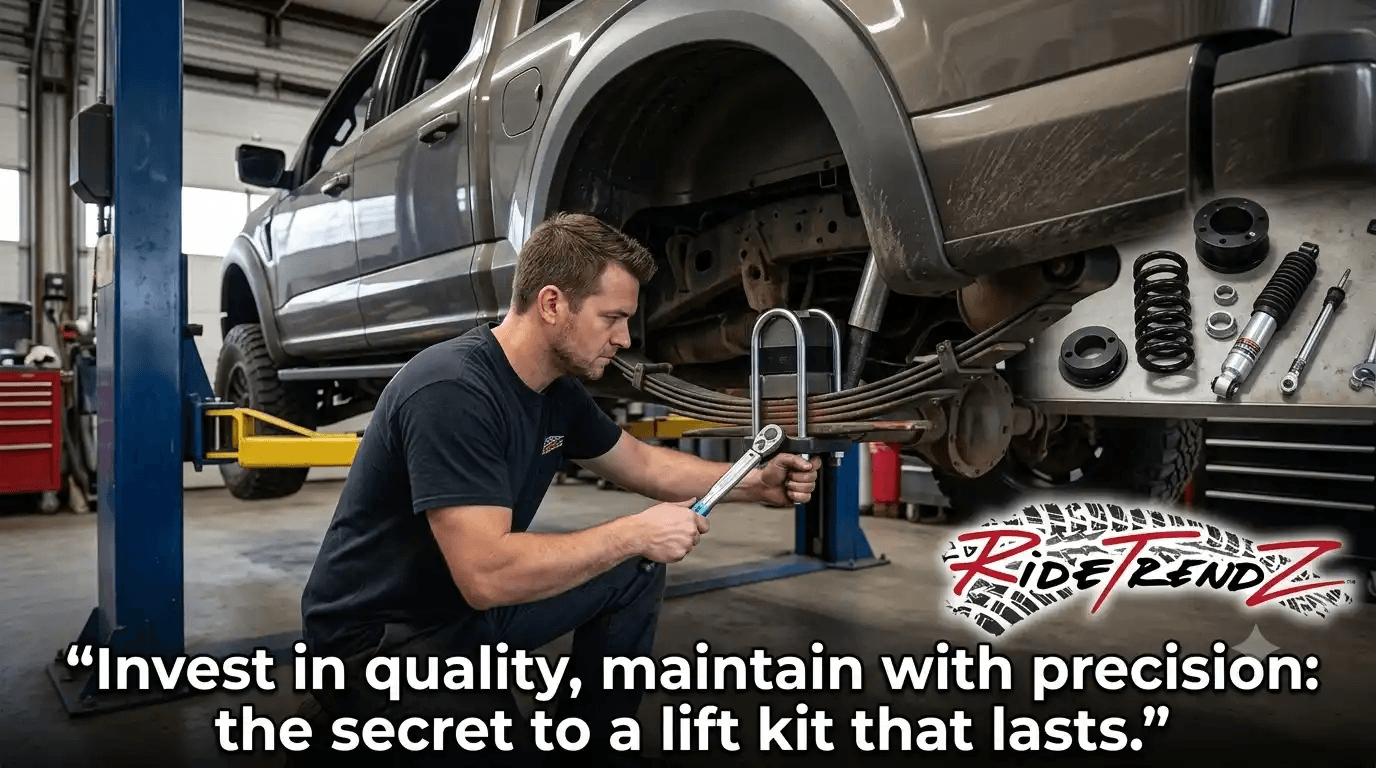
Lift Shocks and Struts
How long a lift kit lasts on a truck often comes down to the shocks. Standard shocks on a lifted application typically last 50,000 to 80,000 miles under normal use. Off-road use cuts that to 30,000 to 50,000 miles. RideTrendz stocks Doestch-Tech DT9000 nitrogen gas shocks engineered specifically for lifted geometry, delivering longer service life and better damping than standard shocks repurposed for lifted applications.
Coil Spring Spacers
Quality forged aluminum coil spring spacers are among the most durable components in any lift kit. A precision-machined spacer installed on an undamaged OEM spring can last 10 to 15 years without measurable degradation. Our spacers are anodized for corrosion resistance and machined to eliminate the stress concentrations that cause premature cracking in cheaper alternatives.
Torsion Keys
Adjustable forged torsion keys are essentially indefinitely durable as hardware. The real concern is not the key itself but the CV joint angles it creates. Keys adjusted too high put CV joints at steep angles that cause rapid wear. Our adjustable torsion keys include clear height adjustment guidance that keeps your geometry within safe CV joint angle limits, protecting your drivetrain at the same time.
Lift Blocks
Tapered steel lift blocks are the simplest and most durable components in any rear lift kit. A quality steel block installed correctly will outlast most other components in the kit. The main failure mode is improper installation: blocks not fully seated on the axle pad, or U-bolts that are undertightened, can crack from lateral load. We include precise installation notes with every kit to prevent this.
Lift Shackles
Lift shackles see constant flex and exposure to road spray and debris. Quality thick-wall powder-coated shackles last 10 to 12 years. Budget thin-wall shackles with painted finishes may show rust and fatigue inside three to five years. Every shackle in the RideTrendz catalog meets wall-thickness minimums established through real-world load testing.
Statistics: Lift Kit Lifespan at a Glance
Here is a data summary that puts how long lift kits last in concrete terms:
|
Metric |
Stat |
Context |
|
Avg shock lifespan, daily driver |
60,000–80,000 miles |
Highway use, proper kit rating |
|
Avg shock lifespan, off-road use |
30,000–50,000 miles |
Regular trail or dirt road exposure |
|
Coil spacer lifespan, quality alloy |
10–15 years |
Correct OEM spring condition required |
|
Torsion key lifespan |
10–20 years |
With safe height adjustment |
|
Truck owners who re-torque at 500 miles |
Less than 35% |
Top cause of early hardware failure |
|
Lift kits inspected annually |
Under 25% of lifted trucks |
Regular inspection roughly doubles lifespan |
|
Nitro shock service life vs standard |
Up to 40% longer |
Based on internal damper construction data |
The pattern is clear: the gap between a 5-year kit and a 15-year kit is almost entirely quality and maintenance. Both are in your control.
Why RideTrendz Lift Kits Outlast the Competition?
We hear this often: why buy from RideTrendz when cheaper kits are available elsewhere? The answer is what goes into every component we sell and the lift kit maintenance knowledge we share with every purchase.
- Material standards: Forged steel hardware, aircraft-grade aluminum spacers, and nitrogen gas shocks, not the cast or stamped steel alternatives that fail under load.
- Application-specific engineering: Every kit is matched to its vehicle's exact suspension geometry. We do not retrofit generic hardware across incompatible applications.
- Vehicle coverage breadth: From 1960s Ford trucks to 2020s Ram 1500s, we cover more applications than virtually any competitor. You get a kit that actually fits, not one that "probably will."
- Expert product knowledge: Our team understands suspension engineering, so the advice we give is grounded in real mechanical knowledge, not catalog sales talk.
- Complete transparency: Every listing tells you exactly what is included, what vehicle it fits, and what lift height to expect. No guessing, no surprises after delivery.
When you understand how long lift kits last and what drives that lifespan, buying quality becomes an obvious financial decision. Saving $80 on a kit that fails in two years costs far more than buying right the first time.
Lift Kit Replacement: What to Expect
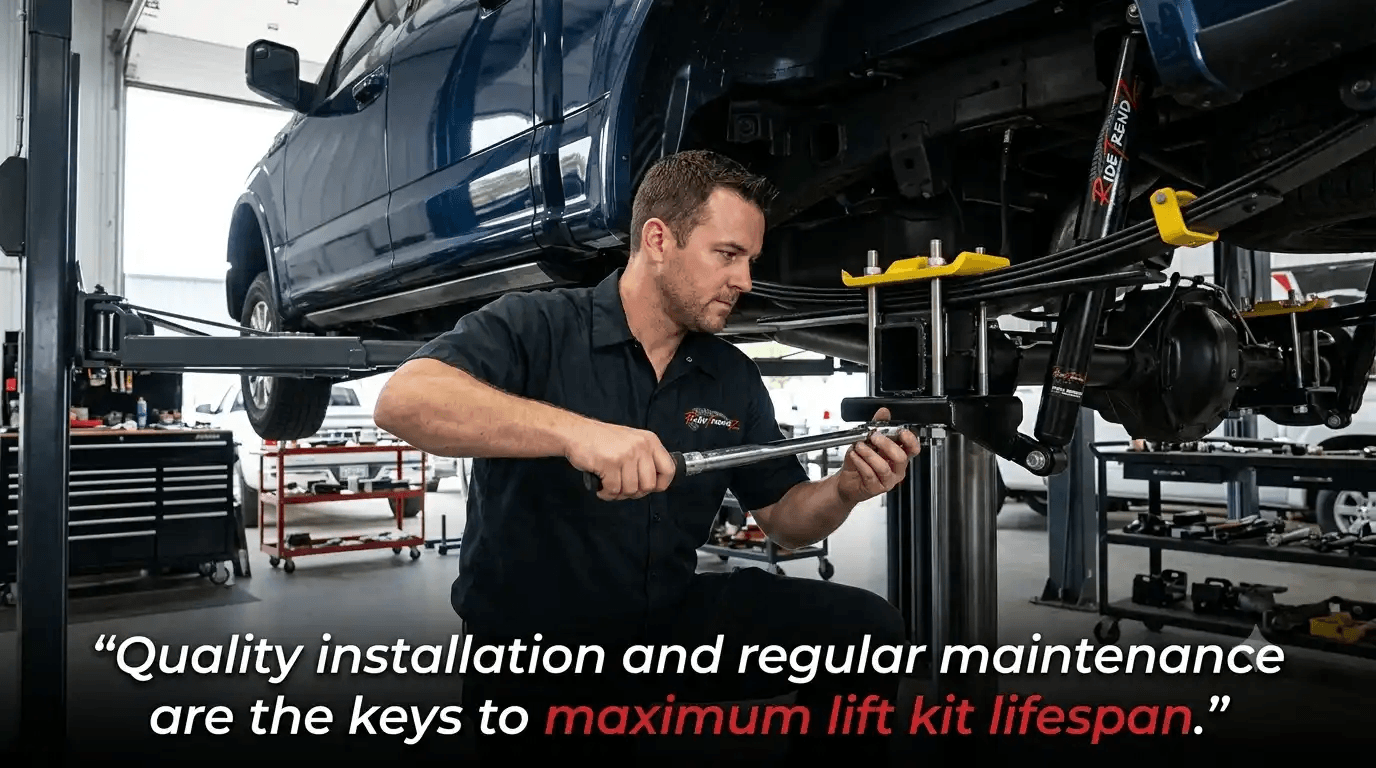
When replacement time arrives, knowing when to replace a lift kit is only half the process. Here is what to expect:
Partial vs Full Replacement
Not every component wears at the same rate. Shocks typically wear first. Spacers and blocks often outlast two full sets of shocks. Assess each component independently before deciding what needs replacing.
Alignment After Replacement
Whenever you replace suspension components, get a professional alignment immediately after. Even parts that bolt into the identical position can shift alignment angles enough to cause rapid tire wear.
Matching New and Old Components
When doing a partial replacement, ensure new shocks are rated for your existing lift height. Mismatched components create geometry problems that accelerate wear across the entire suspension.
Use Replacement as an Upgrade
Replacement is also an opportunity to upgrade. If your original kit was a budget option, replacing with higher-spec RideTrendz components gives you better performance and a longer service life the second time around. Our suspension lift kit types and benefits guide covers all the upgrade options worth considering when it is time to replace.
Lift Kit Maintenance Quick-Reference Checklist
Keep this checklist in your glove box:
|
Task |
Frequency |
Why It Matters |
|
Visual inspection |
Every 3,000 miles |
Catches cracks and corrosion early |
|
Re-torque lift hardware |
Every 6,000 miles |
Prevents loosening and fatigue failure |
|
Grease shackle and arm fittings |
Every 6,000 miles |
Prevents metal-on-metal wear |
|
Check alignment angles |
Every 6,000 miles |
Prevents uneven and accelerated tire wear |
|
Inspect shock absorbers |
Every oil change |
Identifies fluid leaks and damping loss |
|
Rotate tires |
Every 5,000–7,500 miles |
Compensates for lifted geometry wear |
|
Full undercarriage inspection |
Annually |
Finds rust, cracked welds, worn bushings |
|
Rust treatment on steel parts |
Annually |
Extends life in salt and wet climates |
|
Shock bounce test |
Annually |
Confirms damping is still effective |
Match Your Driving Style to the Right Kit
One of the most effective lift kit maintenance tips is buying the right kit from the start. Here is a guide by use case:
- Daily driver, light trails: Coil spring spacers with nitro gas shocks. Maximum lifespan, minimum complexity.
- Regular off-road use: Full lift kit with adjustable shocks rated for your exact lift height. Plan for shock replacement at 30,000–50,000 miles.
- Heavy towing: Lift blocks and torsion keys matched to your GVWR. Spacer kits alone may not support heavy tongue weight.
- Show truck: Spindle kits for geometry-correct lift with maximum tire clearance and minimal stress on OEM components.
Not sure which kit fits your build? Browse our catalog at RideTrendz or read our lift shocks vs stock shocks guide to understand how shock selection affects total lift kit lifespan.
The RideTrendz Difference: Quality You Can Trust
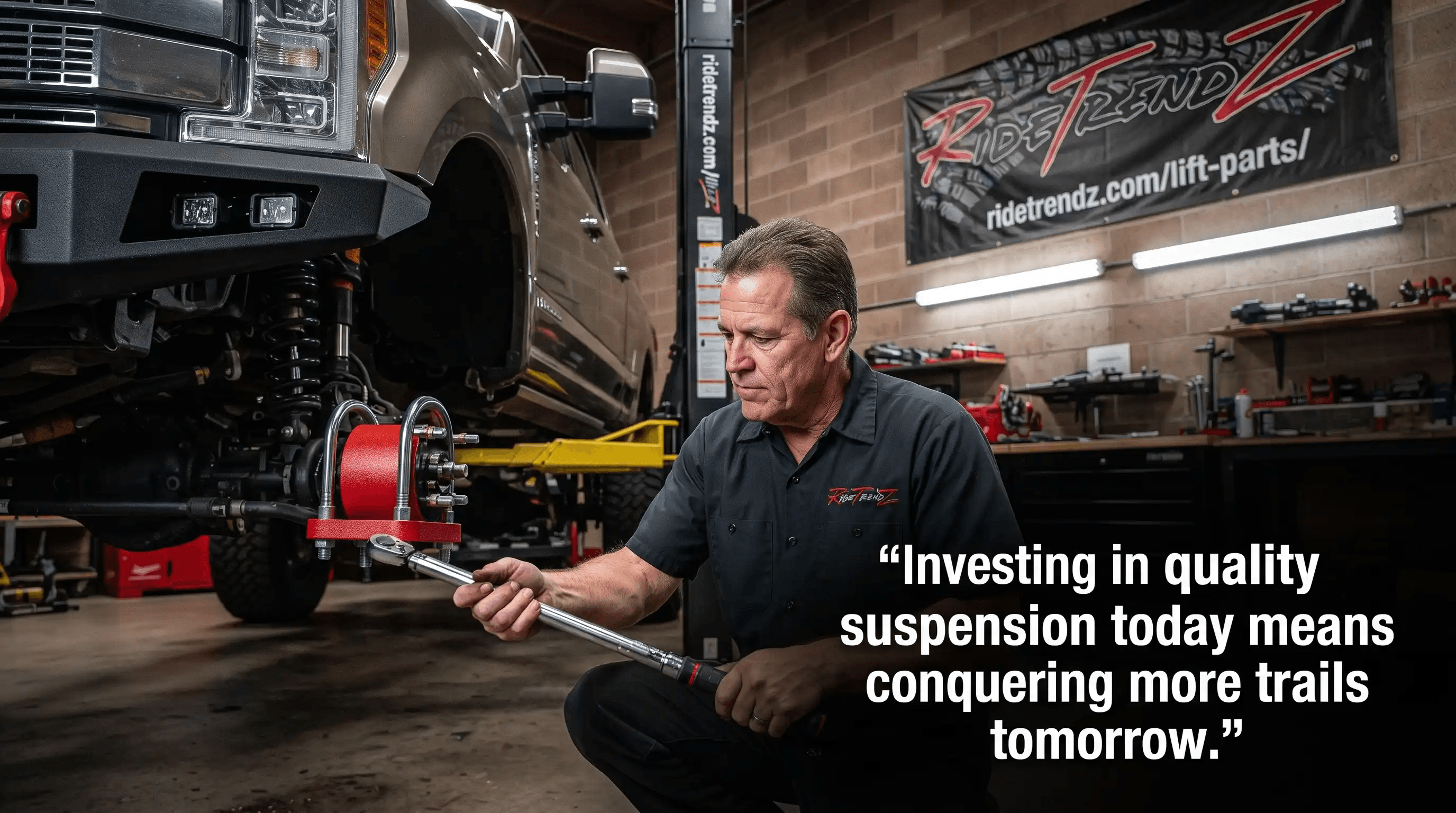
When truck owners ask how long a lift kit lasts on a truck, our honest answer is always the same: it depends on what you bought and how you maintain it. The kits in our catalog are engineered to reach the high end of the lifespan range, but that requires your commitment to consistent lift kit maintenance as well.
What sets our product range apart:
- Forged torsion keys, precision CNC machined, adjustable within safe geometry limits, built to last two decades of daily use
- Doestch-Tech DT9000 nitrogen gas shocks, consistent damping over tens of thousands of miles, with heat-resistant internal construction for sustained off-road performance
- Aircraft-grade aluminum coil spring spacers, anodized for corrosion resistance, machined to tight tolerances, and dimensionally matched to OEM spring specs
- Thick-wall powder-coated shackles, durable finish that resists chipping, rust, and UV degradation far longer than standard painted steel
- Tapered steel lift blocks, engineered with a precise taper angle that corrects pinion angle during lifting, preventing driveline vibration that accelerates U-joint wear.
These are not marketing claims. They are engineering decisions that produce fewer premature failures and measurably longer kit lifespan in real-world use.
Conclusion
So, how long do lift kits last? Anywhere from 3 years on a cheap neglected kit to 15-plus years on quality components that are properly maintained. That gap is almost entirely in your hands.
RideTrendz exists to help you reach the top of that range. Our product selection, material standards, and commitment to engineering quality mean that when you buy from us, you are buying suspension hardware designed to serve you for years. Follow the lift kit maintenance tips in this guide, watch for the warning signs we outlined, and do not hesitate when something looks wrong.
When the time to replace a lift kit finally arrives, and eventually it does, we will be here with the right components, the right fitment, and the same quality you got the first time. That is what RideTrendz is built on.
Frequently Asked Questions
1. How long do lift kits last on average?
How long lift kits last depends on kit quality, driving conditions, and maintenance. Quality kits from reputable brands like RideTrendz last 5 to 15 years or more when properly maintained and regularly inspected throughout their life.
2. When should I replace my lift kit shocks?
Replace lift kit shocks when you notice bouncing, fluid leaks, or degraded ride quality. Quality nitrogen gas shocks last 50,000 to 80,000 miles on daily drivers and 30,000 to 50,000 miles on trucks used regularly for off-road driving.
3. What are the most important lift kit maintenance tips?
The top lift kit maintenance tips are: re-torque all hardware every 6,000 miles, grease all fittings regularly, check alignment every 6,000 miles, inspect shocks at every oil change, and do a full undercarriage inspection annually.
4. How long does a lift kit last on a truck used for towing?
How long does a lift kit last on a truck that tows regularly? Plan on more frequent shock replacement, every 30,000 to 50,000 miles, and annual hardware inspections. Use blocks and keys rated for your full towing GVWR rating.
5. Can I extend my lift kit lifespan without a mechanic?
Yes. Most lift kit maintenance tasks, visual checks, re-torquing hardware, greasing fittings, and bounce tests are straightforward DIY work. Annual undercarriage inspections and alignment checks benefit from professional equipment and expertise.