

Most guides on the Nissan Frontier Lift Kit list parts and call it a day. That's not what this is.
This guide breaks down exactly what changes when you add a lift kit to a 2WD or 4WD Nissan Frontier. We cover the hardware differences, the cost, the installation process, and how to choose the right kit for your truck. If you own a Frontier and want more clearance, better stance, or an aggressive look, read this before you buy anything.
The Nissan Frontier Lift Kit: 2WD vs 4WD question is more than just a product question. It's a suspension engineering question. And we'll answer it the right way, with data, comparisons, and real advice from people who know truck suspension inside out.
What Is a Suspension Lift Kit and Why Does It Matter?
A suspension lift kit raises the body and frame of your truck by modifying or replacing suspension components. This gives you more ground clearance, lets you run larger tires, and improves off-road capability.
There are two main types of lift kits,
- Suspension lift kit, raises the truck by modifying actual suspension geometry (springs, struts, shocks, control arms)
- Body lift, uses spacers between the body and frame to create height without touching the suspension
For the Nissan Frontier, a suspension lift kit is almost always the better choice. It delivers real off-road performance, not just visual height. To understand the full picture, check out our detailed guide on what is a suspension lift kit, types and benefits, it covers every lift style available today.
|
Lift Type |
Ground Clearance Gain |
Driveability Impact |
Avg Cost |
|
Leveling Kit |
1–2 inches |
Minimal |
50–200 |
|
2-inch Lift Kit |
2 inches |
Low |
150–400 |
|
4-inch Lift Kit |
4 inches |
Moderate |
400–900 |
|
6-inch Lift Kit |
6 inches |
High |
700–1,800+ |
Understanding your goals, whether it's looks, clearance, or trail performance, determines which route makes sense.
Nissan Frontier, 2WD vs 4WD, The Core Differences
Before we talk about lift kits, you need to understand why the drivetrain matters.
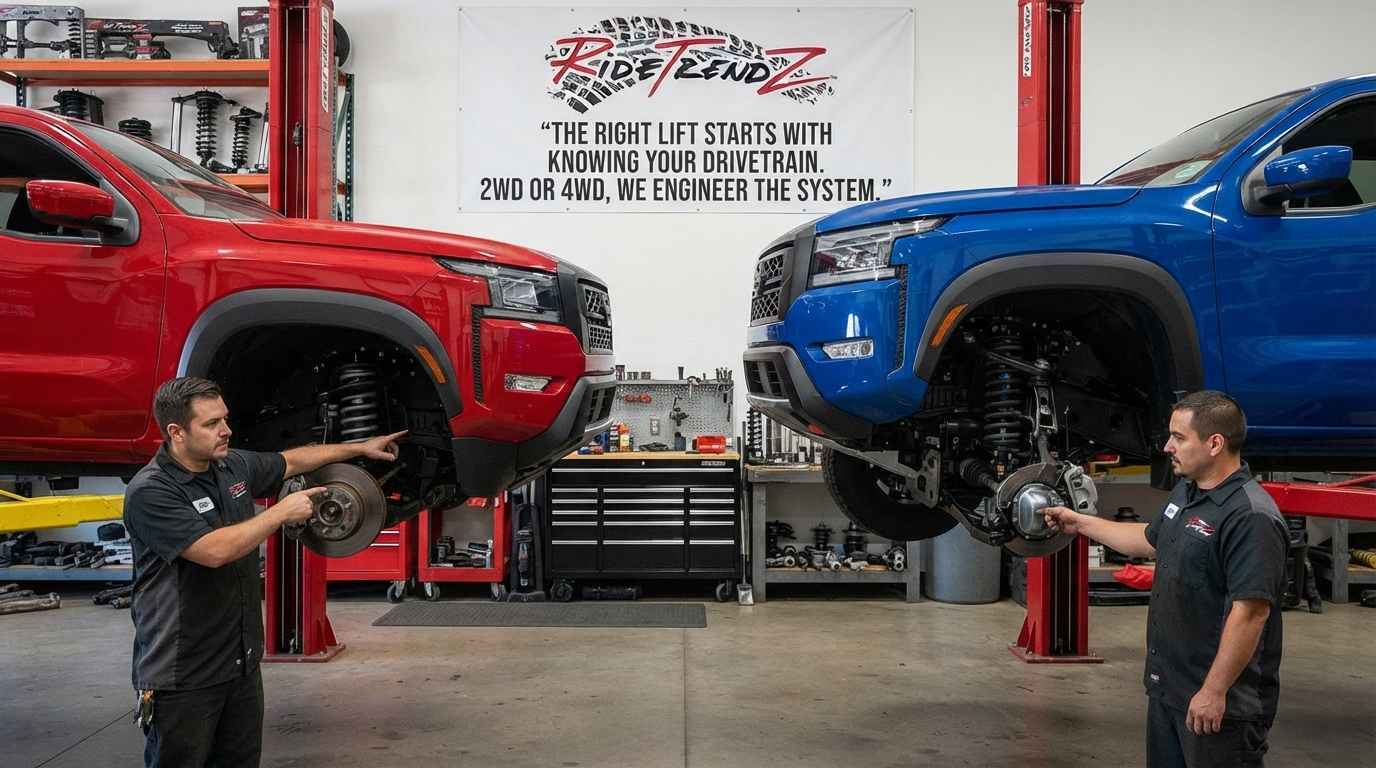
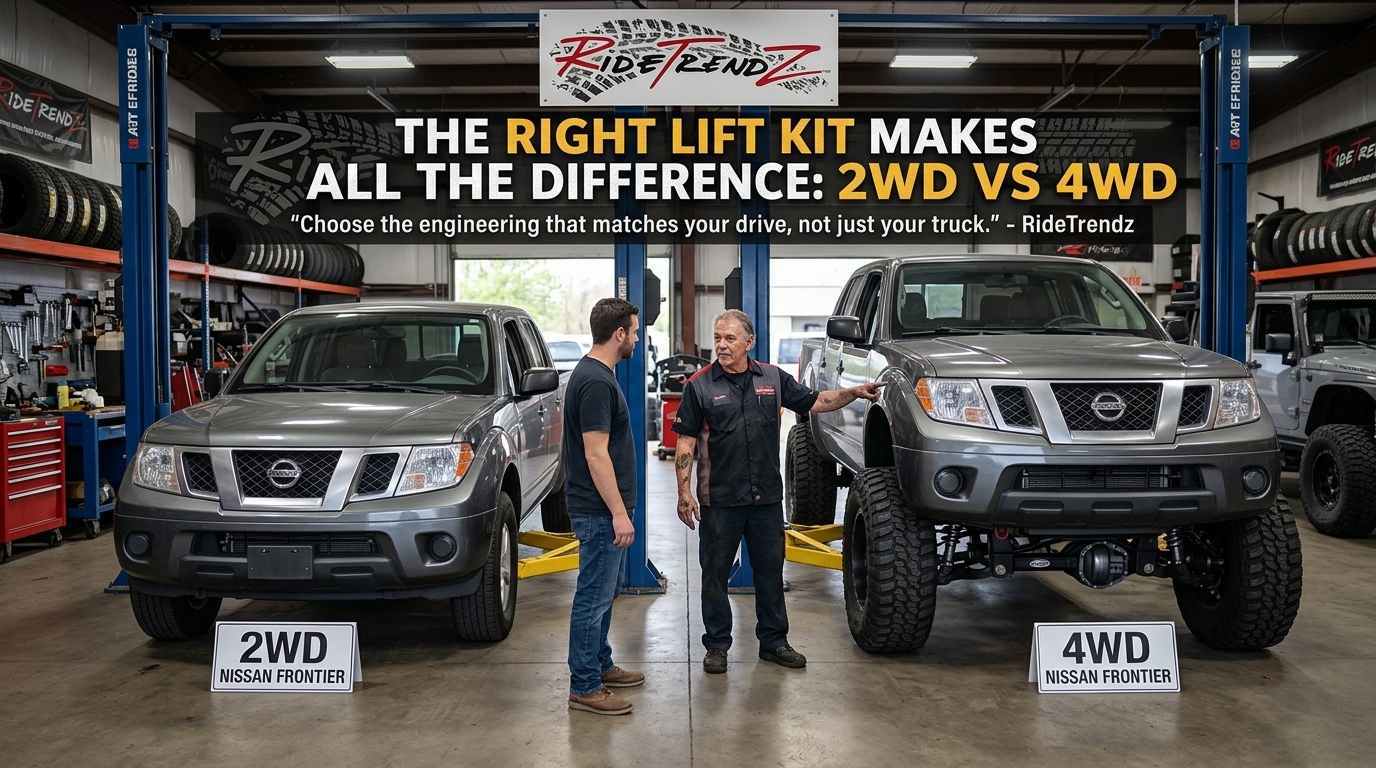
A 2WD Frontier (rear-wheel drive) has a simpler front suspension setup. Most 2WD Frontiers use a coil spring or torsion bar setup up front with no front axle differential.
A 4WD Frontier (four-wheel drive) has a front differential, CV axles, and often a more complex front suspension. This directly affects how a Nissan Frontier Lift Kit must be designed and installed.
Key Structural Differences
|
Feature |
2WD Frontier |
4WD Frontier |
|
Front Suspension Type |
Coil spring / torsion bar |
Coil spring (IFS) |
|
Front Axle |
None (no front diff) |
Front differential + CV axles |
|
Lift Kit Complexity |
Lower |
Higher |
|
Compatible Lift Height |
2–4 inches typical |
2–6 inches possible |
|
Risk of CV Boot Damage |
None |
Present at higher lifts |
|
Alignment Sensitivity |
Moderate |
High |
This is why the Nissan Frontier Lift Kit: 2WD vs 4WD difference matters so much at the purchase stage, the wrong kit can cause immediate mechanical issues.
2WD Nissan Frontier Lift Kit, What You Need to Know?
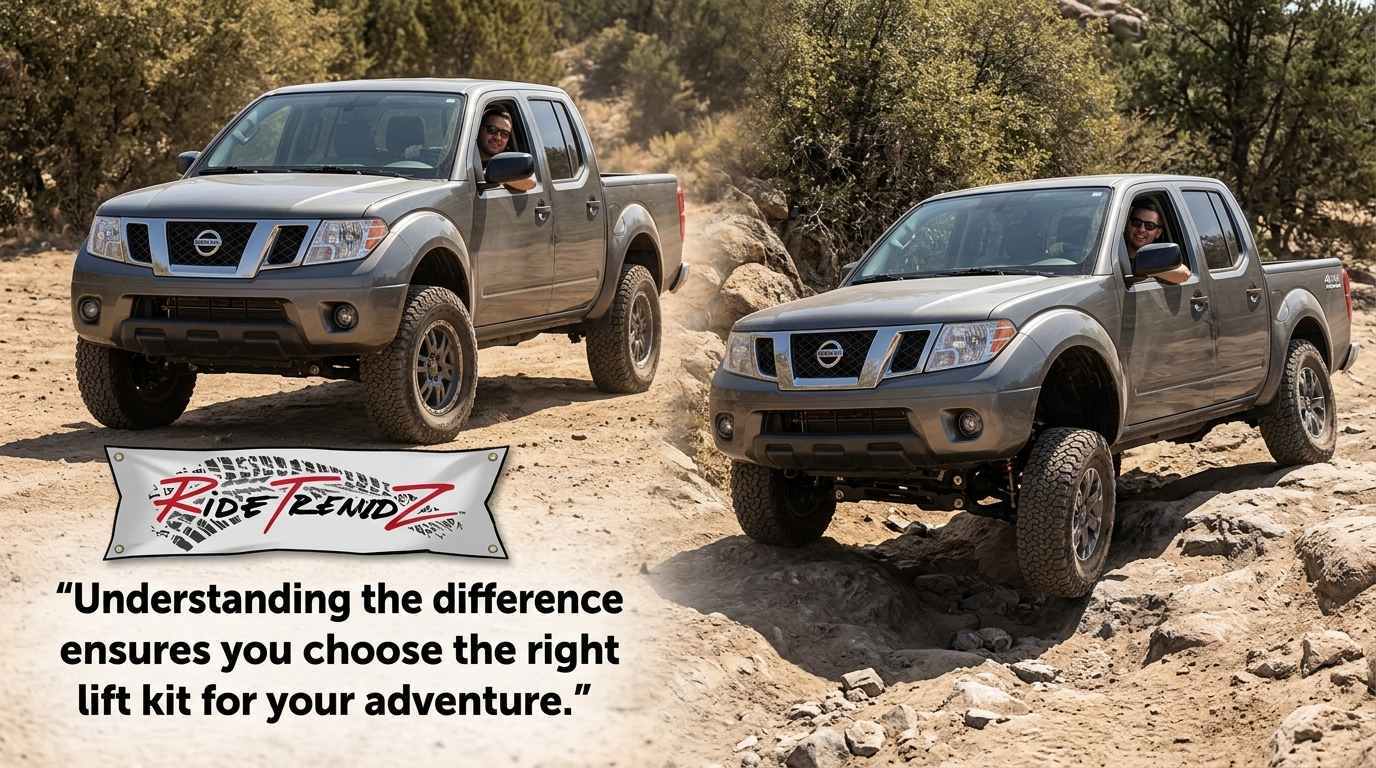
A Nissan Frontier Lift Kit for 2WD trucks is generally simpler and less expensive to install. Because there's no front axle to work around, you have more flexibility in lift height without worrying about CV joint angles.
Best Lift Options for 2WD Frontier
- Leveling Kit A leveling kit adds 1–2 inches to the front of the truck to match the rear height. This is the most popular entry-level option. It corrects the factory rake and allows a slightly larger tire without significant mechanical changes.
- 2-Inch Lift Kit A 2-inch lift kit is the sweet spot for 2WD Frontier owners who want a lifted look without changing their driving character significantly. It usually uses coil spring spacers or new springs.
- 4-Inch Lift Kit A 4 inch lift kit on a 2WD Frontier delivers serious height and opens up 32–33-inch tire options. At this point, you'll want to pair it with proper suspension springs and matching shocks.
2WD Lift Kit Pros and Cons
|
Pros |
Cons |
|
Lower installation cost |
Less off-road traction vs. 4WD |
|
Simpler hardware |
Still needs alignment post-install |
|
Less risk of drivetrain damage |
May need extended brake lines at 4 inches |
|
Wide choice of kits available |
Limited to 2WD performance |
4WD Nissan Frontier Lift Kit, What Changes?
A Nissan Frontier Lift Kit for 4WD trucks requires more care. The front differential and CV axles create angle limits. Push a 4 inch lift kit or 6 inch lift kit beyond those limits and you'll wear out CV boots and joints prematurely.
Critical Factors for 4WD Lift Kits
CV Angle Management On a 4WD Frontier, every inch of lift increases the downward angle of the CV axles. At 2–3 inches, most OEM CV boots handle it fine. At 4+ inches, you need extended upper control arms or cam bolts to compensate.
Differential Drop Brackets Many quality 4WD Nissan Frontier Lift Kits include differential drop brackets. These lower the front differential slightly to restore proper CV angles after lifting.
Coil Spring Selection The coil spring in a 4WD kit must be rated for the heavier front-end weight (including the differential). This is why 4WD lift kits cost more, the suspension springs must be stronger and more precisely engineered.
4WD Lift Kit Pros and Cons
|
Pros |
Cons |
|
True off-road capability |
Higher installation cost |
|
More tire clearance options |
CV angle management required |
|
Better approach and departure angles |
More alignment sensitivity |
|
Can run a 6-inch lift with proper components |
Requires more precise installation |
Body Lift vs Suspension Lift for the Nissan Frontier
This is a common debate among Frontier owners. Here's the honest breakdown:
Body lift vs suspension lift comes down to purpose.
- A body lift adds spacers between the truck body and the frame. It's cheaper (often 100–300) but it doesn't improve ground clearance under the differential, axles, or frame. You also get a visible gap between the body and bumper.
- A suspension lift kit raises everything; the frame, axles, and body all go up together. You gain actual trail clearance and better geometry.
For the Nissan Frontier, we recommend a suspension lift kit in almost every case. The exception is if you purely want a cosmetic lift on a 2WD truck used only on pavement, then a body lift saves money.
|
Comparison |
Body Lift |
Suspension Lift |
|
Price |
100–300 |
200–1,800+ |
|
Ground Clearance Gain |
Cosmetic only |
Real clearance |
|
Off-Road Performance |
No improvement |
Significant gain |
|
Installation Difficulty |
Easy |
Moderate–Advanced |
|
CV Angle Risk |
None |
Present on 4WD kits |
|
Recommended For |
Cosmetic builds |
Off-road and daily drivers |
Want to go deeper on this? Our guide on lift kit vs leveling kit, which one does your truck actually need explains every scenario in detail.
Suspension Lift Kit Components, What's Inside the Box?
When you buy a quality Nissan Frontier Lift Kit, here's what to expect in the package depending on the lift height:
Standard 2-Inch Kit Components
- Coil spring spacers (front), aluminum or polyurethane
- Rear block kit or shackle spacers
- Grade-8 hardware
- Installation guide
Complete 3–4-Inch Kit Components
- New coil springs (front pair), heavier rated for lifted geometry
- Rear lift blocks (tapered, to prevent axle wrap)
- Extended shocks (or shock extenders), nitrogen gas charged
- Differential drop brackets (4WD kits)
- All hardware and mounting bolts
6-Inch Lift Kit Components
- Long travel coil springs
- Extended upper control arms
- Differential drop brackets
- Full rear block kit with u-bolts
- Matching lifted shocks (front and rear)
- Extended brake lines (often required at this height)
- Alignment cams
At RideTrendz, every kit is engineered as a system, components are matched to work together, not sourced from three different brands. That's what separates a true suspension kit from a parts pile.
How Much Does It Cost to Lift a Nissan Frontier?
This is one of the most searched questions about truck suspension. Here's a realistic breakdown:
|
Lift Height |
Parts Cost |
Professional Install |
DIY Total |
|
1.5-inch leveling kit |
60–150 |
150–250 |
60–150 |
|
2-inch lift kit |
150–350 |
200–400 |
150–350 |
|
3-inch lift kit |
300–600 |
300–500 |
300–600 |
|
4-inch lift kit |
500–900 |
400–700 |
500–900 |
|
6-inch lift kit |
800–1,800 |
600–1,200 |
800–1,800 |
Pro Tip: Always budget for an alignment after any Nissan Frontier Lift Kit installation. Expect 80–150 for a professional 4-wheel alignment. Skip it and your tires will wear unevenly within weeks.
For a full cost breakdown across different truck types, visit our guide: how much does it cost to lift a truck, price guide.
Lift Kit Installation, Step-by-Step Overview
lift kit installation on a Nissan Frontier varies by kit type. Here's a simplified overview of what the process looks like for a 2-inch front leveling kit on a 2WD Frontier:
Steps for a 2-Inch Coil Spring Spacer Kit (2WD)
- Lift and secure the truck, use a quality floor jack and jack stands rated for truck weight
- Remove the front wheel, break the lug nuts before lifting
- Compress the coil spring, use a proper spring compressor tool (never skip this step, it's a safety critical step)
- Remove the strut assembly, unbolt from the upper strut mount and lower control arm
- Disassemble the strut, remove the top mount nut carefully with the spring compressed
- Install the coil spring spacer, slide it over the strut shaft between the top mount and the spring
- Reassemble and reinstall, torque all bolts to spec
- Repeat on the other side, always do both sides at the same time
- Install rear components, rear shackles, lift blocks, or spacers depending on the kit
- Get an alignment, mandatory after any lift work
For 4WD kits at 3 inches or more, the process adds differential drop bracket installation and CV angle inspection. We strongly recommend professional installation for 4 inch lift kit or 6 inch lift kit setups on 4WD trucks.
Our full guide on how does a truck suspension lift kit work walks through the mechanics in plain language.
Shocks, What Happens After You Lift?
One of the most overlooked parts of a Nissan Frontier Lift Kit is shocks. Most factory shocks are designed for stock ride height. After lifting, the shock travel range shifts, and stock shocks either top out or bottom out at the wrong points.
You Need Lifted Shocks If,
- You're doing a 2-inch or larger lift
- Your ride feels bouncy or unpredictable after installation
- You're adding a 4 inch lift kit or higher
At RideTrendz, we offer nitrogen gas-charged Doestch Tech DT9000 Nitro Shocks and RTZ Primo Nitro Gas Shocks that are valved specifically for lifted applications. They're not generic, they're spec'd for the actual lift height.
Our article on lift shocks vs stock shocks, what you really need after a lift covers this topic in full detail.
Leveling Kit vs Lift Kit for the Nissan Frontier
Here's a quick stat that most people find surprising: over 60% of Nissan Frontier owners who lift their trucks choose a leveling kit or 2-inch lift kit, not a massive lift. Here's why:
- The stock Frontier already has decent ground clearance
- A leveling kit corrects the factory nose-down rake and looks great
- A 2-inch lift opens up 31-inch tires on most trim levels
- Insurance and legality concerns limit lift height in many states
When to choose a leveling kit:
- You want a leveled, clean stance
- You're keeping stock or slightly larger tires
- Budget is a priority
When to choose a full suspension lift:
- You're building for off-road trails
- You want 33-inch or larger tires
- You want maximum approach angle and articulation
RideTrendz Lift Kits, Why We're Different?
Most suspension brands source cheap castings and put their name on the box. At RideTrendz, we engineer every suspension lift kit from the ground up. Here's what makes our kits stand out:
What Sets RideTrendz Apart?
|
Feature |
Generic Brand |
RideTrendz |
|
Material |
Cheap cast steel |
Aircraft-grade aluminum or forged steel |
|
Shock compatibility |
Generic fitment |
Matched to lift height |
|
Hardware |
Standard bolts |
Grade-8 hardware throughout |
|
Differential drop |
Often missing |
Included in 4WD kits |
|
Customer support |
Slow or none |
US-based technical support |
|
Warranty |
30–90 days |
Industry-leading coverage |
|
Fitment testing |
Claimed |
Vehicle-specific tested |
We don't sell kits that just look good on paper. Every RTZ lift kit is tested on the actual vehicle it's spec'd for. That's how we back our claim that our products work, not with marketing copy, but with engineering precision.
We also educate our customers. Our suspension basics for beginners resource is one of the most complete beginner guides available.
Why Buy USA-Made Suspension Parts?
This matters more than most buyers realize.
When you buy a suspension lift kit from a domestic manufacturer or a brand that specs domestically, you get:
- Tighter quality control on material grades
- Faster shipping and support
- Accountability, if something fails, the brand is reachable
- Parts that actually match the spec sheet
Generic imported kits often fail fitment testing. We've seen aluminum spacers that crack at load, shackles that bend at the weld, and lift blocks that shift under hard braking.
Our guide on why buy USA-made suspension parts vs generic brands digs into exactly why material origin matters.
Statistics, Truck Lift Kit Market and Nissan Frontier Trends
Here are some industry insights worth knowing before you buy:
|
Metric |
Data Point |
|
% of Nissan Frontier owners who modify suspension |
~38% (within 3 years of purchase) |
|
Most popular lift height for Frontier |
2 inches (leveling range) |
|
Average time for DIY 2-inch install |
3–5 hours |
|
Average time for professional 4-inch install |
5–8 hours |
|
% of buyers who also replace shocks after lifting |
~65% |
|
Tire size unlocked by 2-inch lift |
31–32 inch |
|
Tire size unlocked by 4-inch lift |
33–35 inch |
|
Alignment needed after install |
Yes, 100% of cases |
These numbers confirm what experienced builders know: most Frontier owners don't need a massive lift. A well-executed 2-inch lift with matched shocks and a proper alignment delivers 90% of what most daily drivers need.
How Long Does a Lift Kit Last?
A quality Nissan Frontier Lift Kit should last 50,000 to 100,000+ miles if installed correctly and maintained. Here's what affects lifespan:
- Material quality, aluminum spacers outlast cast steel; forged steel outperforms stamped
- Shock condition, worn shocks reduce kit effectiveness fast
- Installation torque, bolts not torqued to spec back out over time
- Driving conditions, heavy off-road use accelerates wear
Signs your lift kit needs inspection:
- Clunking or popping from the front end
- Uneven tire wear
- Vehicle pulls to one side
- Noticeable drop in ride height on one corner
For a full maintenance breakdown, read our guide on how long do lift kits last, lifespan and maintenance.
Top 5 Reasons to Upgrade Your Nissan Frontier's Suspension
- More ground clearance, protect your undercarriage on trails and rough roads
- Larger tires, run 31–35-inch tires depending on lift height
- Better off-road angles, improved approach, departure, and breakover angles
- Stance and appearance, a lifted Frontier commands attention and looks purpose-built
- Resale value, quality lift installs with maintained alignment typically hold or add value
Our full breakdown of top 5 reasons to upgrade truck suspension in 2025 covers these in more depth, with data from actual truck owners.
Compatible RideTrendz Products for Your Frontier
While our product catalog is built around specific vehicle fitments, here are the kit categories that apply to Frontier builds. We recommend browsing our full RTZ product line for current inventory:
- Coil spring spacer kits (1.5-inch to 3-inch), ideal for 2WD Frontiers
- Full suspension lift kits, complete front and rear systems for 4WD Frontiers
- RTZ Primo Nitro Gas Shocks, matched to lift height, nitrogen charged
- Rear shackle and hanger kits, for proper rear lift geometry
- Tapered lift blocks, prevent axle wrap at the rear
Our related lift kit products for similar platforms (for reference on kit structure):
- RTZ Toyota Tundra 2007–2018 Complete Lift Kit
- RTZ Toyota Tundra 3-Inch Front Polyurethane Leveling Lift Kit
- RTZ Compatible with Toyota Tacoma 95–04 Full Lift Kit
These kits share engineering principles with Frontier applications and show the build quality standard we hold across all RTZ products.
Common Mistakes When Buying a Nissan Frontier Lift Kit
Avoid these errors before you spend a dollar:
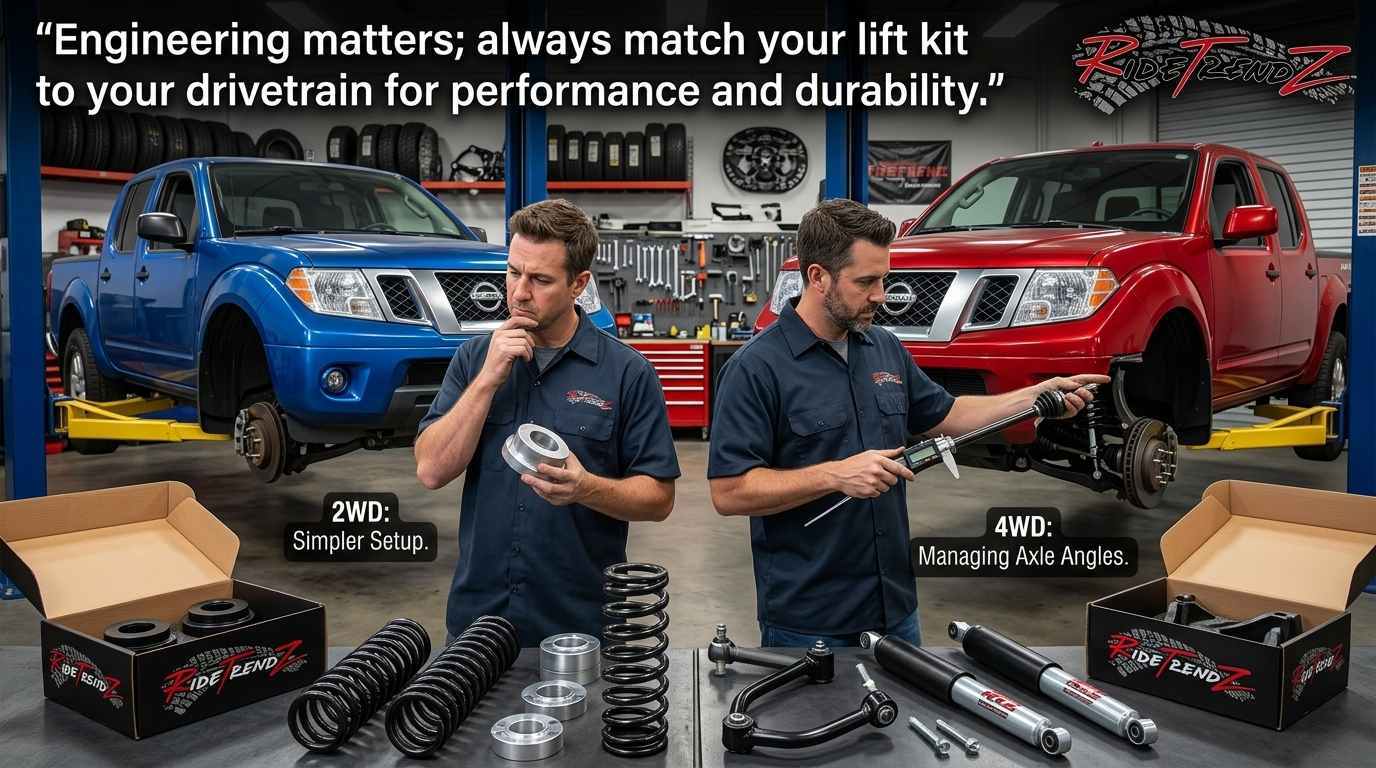
- Buying a 2WD kit for a 4WD truck (or vice versa) This is the most common mistake. Always confirm your drivetrain before purchasing. The wrong kit will not install correctly and can damage your front suspension.
- Skipping the alignment Every single Nissan Frontier Lift Kit installation, even a 1.5-inch leveling kit, requires a post-install alignment. Skipping it costs you tires within months.
- Mixing kit components from different brands Lift blocks, springs, and shocks are engineered as systems. Mixing brands creates geometry mismatches. Buy complete kits.
- Not upgrading shocks If your shocks are stock and you're lifting 2 inches or more, you need lifted shocks. Stock shocks lose effectiveness quickly at lifted ride heights.
- Buying based on price alone A $49 spacer kit from an unknown brand may be made from cast pot metal. It will crack. Cheap kits cost more in the long run when you're buying twice.
Conclusion
The Nissan Frontier Lift Kit: 2WD vs 4WD question has a clear answer: the kits are fundamentally different, and choosing the wrong one creates mechanical problems from day one.
For 2WD Frontiers, you have simpler hardware options, lower cost, and easy installation for kits up to 4 inches. For 4WD Frontiers, you need a kit that manages CV angles, includes differential drops, and uses stronger coil springs rated for the front axle load.
At RideTrendz, we build every kit with the vehicle's actual geometry in mind. We don't sell generic parts, we sell engineered systems. Whether you're leveling a 2WD Frontier for looks or building a 4WD Frontier for the trail, we have the right suspension lift kit for your build.
Explore our full range at RideTrendz.com and find the exact Nissan Frontier Lift Kit that matches your truck, your goals, and your budget.
For even more reading before you buy, check out our guide on lift parts vs complete lift kit, which to buy and when to buy suspension parts vs complete lift kit.
Frequently Asked Questions
Q1. What is the best lift height for a Nissan Frontier 2WD?
For most 2WD Frontier owners, a 2-inch lift kit or leveling kit is the ideal starting point. It improves stance, unlocks 31–32-inch tires, and keeps installation simple without requiring major suspension geometry changes.
Q2. Can I put a 4WD lift kit on a 2WD Nissan Frontier?
No. A 4WD Nissan Frontier Lift Kit includes components designed for front differential and CV axle geometry. Installing it on a 2WD truck will result in incorrect fitment and potential hardware damage. Always match the kit to your drivetrain.
Q3. Do I need new shocks after installing a Nissan Frontier Lift Kit?
Yes, in almost every case. Stock shocks are calibrated for factory ride height. After a lift kit installation of 2 inches or more, matched lifted shocks are strongly recommended for proper ride quality and shock absorber longevity.
Q4. How long does it take to install a Nissan Frontier Lift Kit?
A basic leveling kit takes 2–4 hours for a DIY install. A 4-inch lift kit on a 4WD Frontier typically takes 5–8 hours at a shop. Always budget extra time for the mandatory alignment afterward.
Q5. Will a Nissan Frontier Lift Kit void my factory warranty?
Potentially. Under the Magnuson-Moss Warranty Act, a dealer must prove the lift kit caused a specific failure to deny a warranty claim, not just that a suspension lift kit was installed. Consult your dealer and keep all installation records.