

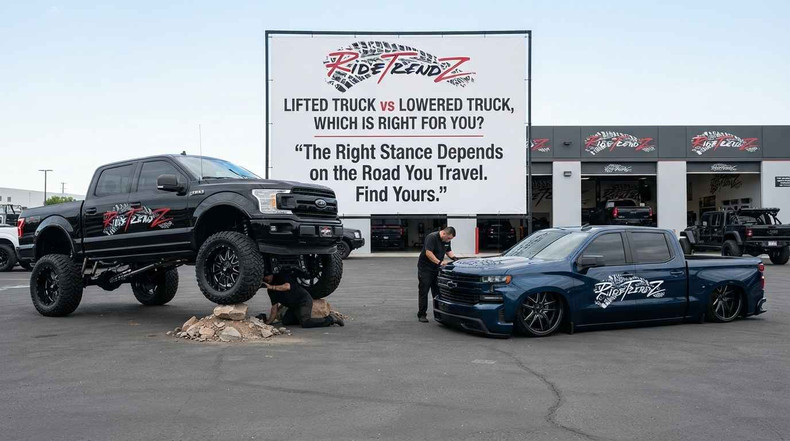
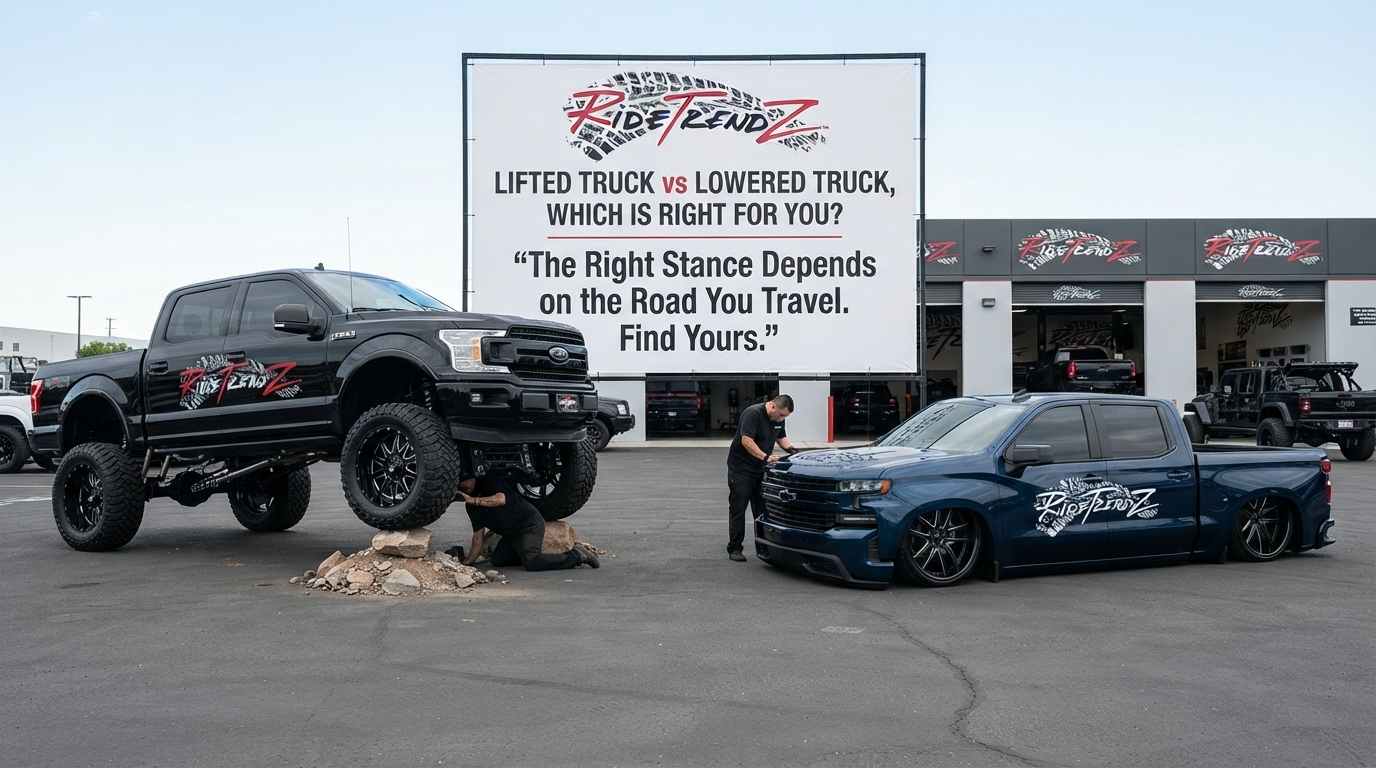
Most guides on the lifted truck vs lowered truck debate throw around opinion and call it advice. You'll find one person saying lifted is always better, another swearing by slammed builds, and neither one explaining what actually matters: your use case, your budget, and your road conditions.
That's not what this guide is.
At RideTrendz, we have spent years helping truck owners across the country choose the right suspension setup. We carry one of the most complete catalogs of lift kits for trucks, truck lowering kits, coil springs, shackles, torsion keys, and nitrogen gas shocks, all tested, rated, and built for real roads.
Whether you're drawn to custom lifted trucks for weekend trails or slammed trucks for show-car style, this guide gives you the full picture, including what nobody else tells you about costs, legality, and ride quality trade-offs.
Let's cut through the noise.
What Does "Lifted" and "Lowered" Actually Mean?
Before we compare, let's define the terms clearly.
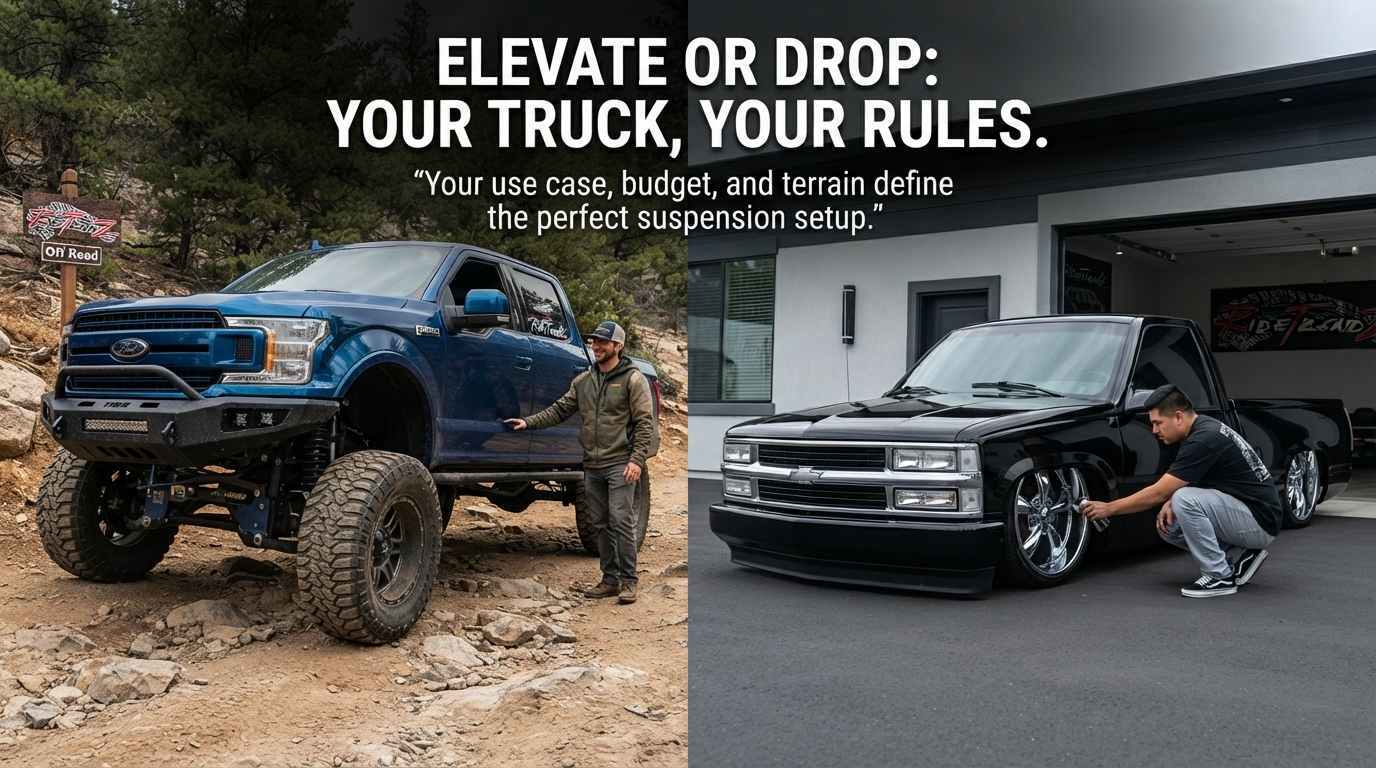
Lifted trucks have a suspension system that raises the chassis and body higher off the ground than factory spec. This is done with a suspension lift for a truck, body lift, leveling kit, or a combination of all three. The result is greater ground clearance and space for larger tires.
Lowered trucks, also called dropped trucks, drop trucks, or slammed trucks, use a truck lowering kit to bring the body closer to the road. This typically involves lowering springs, drop spindles, flip kits, or adjustable shackles.
Both modifications change how your truck behaves, looks, and performs. The right choice comes down to what you actually do with your truck.
Lifted Truck vs Lowered Truck, The Core Comparison
Here's the head-to-head snapshot before we go deep on each:
|
Factor |
Lifted Truck |
Lowered Truck |
|
Ground Clearance |
High, ideal for off-road |
Low, not suitable for rough terrain |
|
Ride Quality (On-Road) |
Stiffer, higher center of gravity |
Smoother, more planted feel |
|
Lowered truck ride quality |
Not applicable |
Noticeably improved on highways |
|
Gas Mileage |
Reduced, more drag, heavier setup |
Slightly improved in some cases |
|
Lifted truck gas mileage |
Drops 1–3 MPG with larger tires |
— |
|
Towing Capacity |
Maintained or improved |
May be reduced depending on drop |
|
Aesthetic |
Aggressive, tall, commanding |
Clean, sleek, show-car style |
|
Legal Compliance |
State-dependent height restrictions |
State-dependent floor clearance rules |
|
Average Kit Cost |
$400–$2,500+ depending on type |
$300–$1,800+ depending on system |
|
Maintenance Cost |
Moderate to high (CV joints, alignment) |
Moderate (springs, shocks) |
Lifted Trucks, Pros, Cons, and Everything In Between
What Is a Lifted Truck?
A lifted truck uses components, coil spring spacers, torsion keys, lift blocks, or full suspension systems to increase ride height. At RideTrendz, our best lift kit for truck options include everything from budget-friendly aluminum coil spring spacers to premium complete kits with DDoetschTech nitrogen gas shocks.
Lift heights typically fall into three ranges:
- 1"–2": Leveling kits, mostly cosmetic, minimal handling change
- 2"–4": Mid-range lift, adds clearance, fits larger tires
- 4"+: Serious off-road capability, may require additional modifications
For reference, our Chevy Silverado K2500/K3500 Full Lift Kit includes front forged torsion keys and rear tapered steel lift blocks paired with premium DT9000 shocks, a complete system built for real demands, not just looks.
Lifted Truck Pros and Cons
Pros of a Lifted Truck:
- Greater ground clearance, essential for off-road, mud, snow, and rocky terrain
- Larger tire fitment, gives that commanding stance and improved traction in rough conditions
- Improved visibility, sit higher, see further ahead in traffic
- Better approach and departure angles, critical for trail driving and obstacle clearance
- Resale appeal, custom lifted trucks often hold strong value in the used truck market
- Towing presence, lifted setups can improve departure angle when pulling trailers off-road
Cons of a Lifted Truck:
- Reduced lifted truck gas mileage, larger tires and higher drag drop MPG by 1–3 miles per gallon on average
- Higher center of gravity, increases rollover risk in sharp turns if not managed correctly
- CV joint and driveshaft strain; more acute angles can accelerate wear
- Alignment costs, lifted setups often require re-alignment after install, adding cost
- Entry/exit difficulty, climbing in and out becomes a challenge without steps or bars
Stat: A University of Tennessee study found that raising a truck 4 inches can increase the chance of rollover in sharp maneuvers by up to 28% if proper sway bars and shocks are not installed.
Truck Suspension Lift vs Body Lift, What's the Difference?
This is one of the most commonly misunderstood topics in the truck lift world. Here's the plain-language breakdown:
|
Type |
What It Does |
Best For |
|
Suspension lift for truck |
Raises the entire suspension system, allows bigger tires, more clearance |
Off-road, towing, performance |
|
Body lift |
Raises only the body off the frame with spacers |
Purely cosmetic, tire clearance doesn't improve |
|
Leveling kit |
Raises the front to match the rear's stock height |
Cosmetic leveling, minor tire clearance gain |
For anyone serious about performance or off-road use, a full suspension lift for the truck is the right call. Body lifts are cheaper but offer none of the real-world benefits. Our complete lift kit for Chevy/GMC Sierra Silverado 1500 4WD gives you a true suspension solution with front and rear components designed to work as a system.
Lowered Trucks, Pros, Cons, and the Real Story
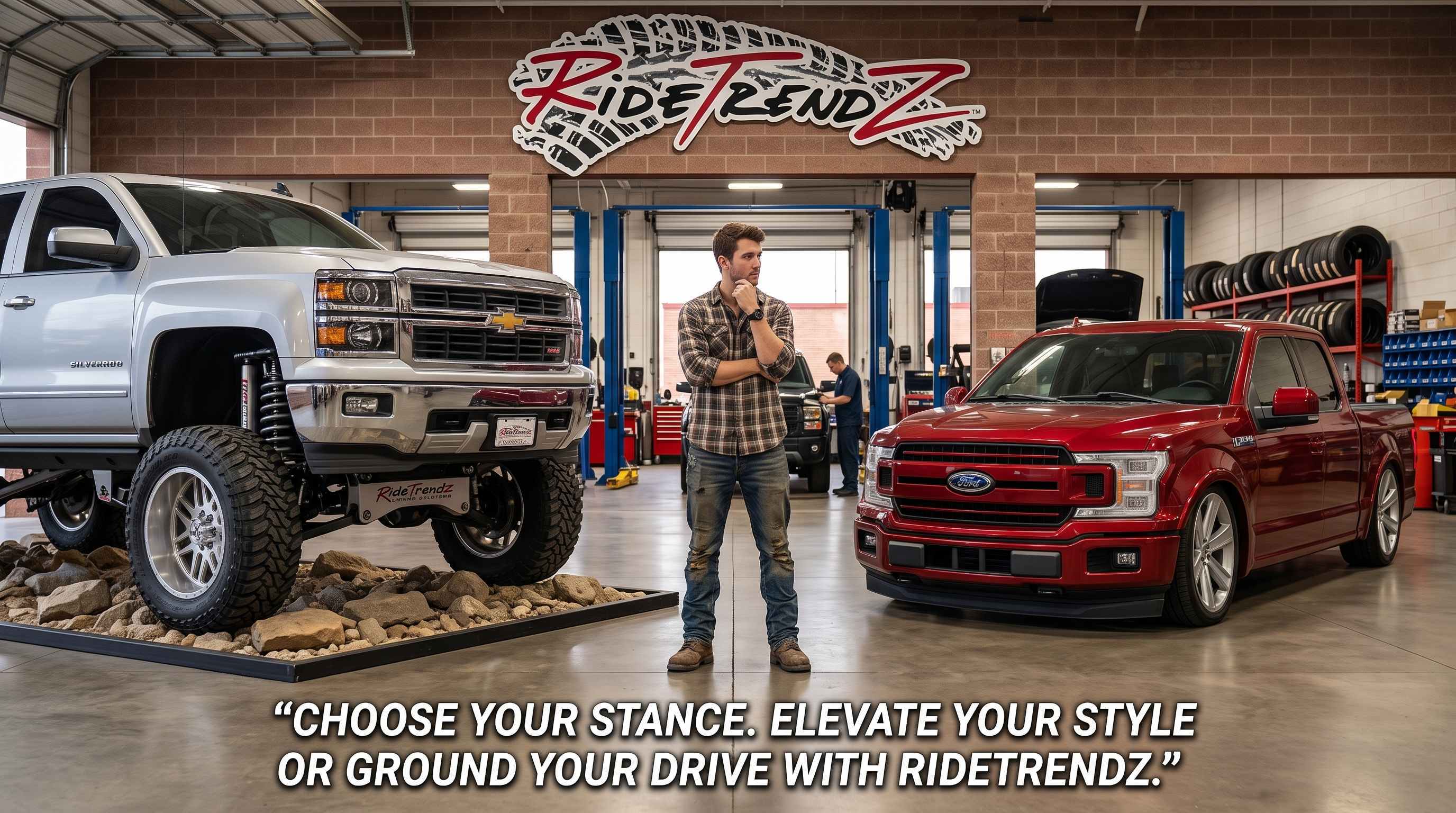
What Is a Lowered Truck?
A lowered truck, also called a lowrider truck, dropped truck, or in extreme cases a slammed truck, sits closer to the road than factory height. This is achieved using lowering springs, drop spindles, flip kits, lowering hangers, or adjustable shackle kits.
At RideTrendz, our truck lowering kits are engineered with precision drop coil springs, rear flip kits, and nitrogen gas shocks that compensate for the new geometry. We don't just sell hardware; we match the right shock travel to the drop depth so your truck still rides the way it should.
A good example is our Dodge Ram 1500 2002–2008 Lowering Kit with 3" front drop coil springs and 5" rear axle flip kit; it includes RTZ Primo nitrogen gas-charged shocks calibrated specifically for the lowered geometry.
Lowered Truck Pros and Cons
Pros of a Lowered Truck:
- Improved lowered truck ride quality on paved roads; lower center of gravity means less body roll and a more planted feel
- Better aerodynamics; reduced air gap under the chassis can improve fuel economy slightly at highway speeds
- Aggressive, clean aesthetic, the lowrider truck look is iconic in custom truck culture
- Improved cornering stability, less lean in turns, especially at highway speeds
- Show-worthy appearance, slammed trucks and low trucks dominate custom truck shows for a reason
Cons of a Lowered Truck:
- Zero off-road capability, speed bumps, gravel driveways, and steep driveway angles become real problems
- Reduced ground clearance; potholes and road debris can make contact with the undercarriage
- Reduced towing capacity: some lowering setups change the rear geometry in ways that affect hitch angle
- Legal restrictions: Are lowered trucks legal? The answer depends on your state. Several states have minimum ground clearance laws (Virginia, for example, enforces clearance rules for lowered vehicles)
- Tire wear: Incorrect camber from a drop can cause uneven tread wear if alignment is skipped.
Stat: According to aftermarket suspension industry data, lowering a truck 2–3 inches can reduce aerodynamic drag by approximately 5–8% at highway speeds, but only when paired with properly matched shocks that prevent excessive bottoming out.
How Much Does It Cost to Lower a Truck?
How much does it cost to lower a truck? Here's a realistic range:
|
Component |
Cost Range |
|
Drop coil springs (pair) |
$80–$250 |
|
Rear flip kit |
$120–$350 |
|
Drop shackles (rear) |
$60–$180 |
|
Drop spindles (front) |
$200–$600 |
|
Matching shocks |
$150–$500 |
|
Full complete kit (with shocks) |
$400–$1,800 |
|
Professional install |
$200–$600 labor |
RideTrendz complete truck lowering kits include springs, blocks or flip kits, and matched shocks in one bundle, so you're not hunting down parts from three different sellers or guessing about compatibility.
Is It Better to Lift or Lower a Truck? The Honest Answer
Is it better to lift or lower a truck? There is no universal answer. The right choice depends on four things:
1. How You Use Your Truck
|
Use Case |
Best Suspension Choice |
|
Off-road trails, mud, rocks |
Lifted truck, ground clearance is non-negotiable |
|
Highway commuting, daily driving |
Lowered truck, ride quality and fuel economy improve |
|
Towing and hauling on paved roads |
Either, depends on your drop/lift height |
|
Car shows and custom builds |
Lowered truck, the slammedtruck'ss aesthetic is unmatched |
|
Farm or work truck |
Lifted truck, versatility and durability under load |
|
Weekend warrior + daily combo |
Leveling kit, middle ground without extreme trade-offs |
2. Where You Live and Drive
If you live in a northern state with brutal winters, a lifted truck with clearance for snow is a practical choice. If you're in a flat urban environment with smooth highways, a lowered truck gives you better handling and a lower profile.
3. Your Budget for Long-Term Maintenance
A lifted truck costs more to maintain over time. Here's why:
- CV joints wear faster at steeper angles
- Alignment is needed more frequently
- Larger tires cost more to replace
- Shock absorbers work harder over rough terrain
Lowered trucks are gentler on driveline components but are more vulnerable to road surface damage.
4. Legal Compliance in Your State
Are lowered trucks legal? Most states allow lowered trucks as long as they meet minimum ground clearance requirements (usually 3–4 inches). Lifted trucks must stay under state maximum height laws for headlights and bumper heights.
Always check your state's DMV or vehicle code before modifying. RideTrendz products are designed for street use and comply with general federal safety guidelines.
RideTrendz, Why Our Suspension Kits Set the Standard
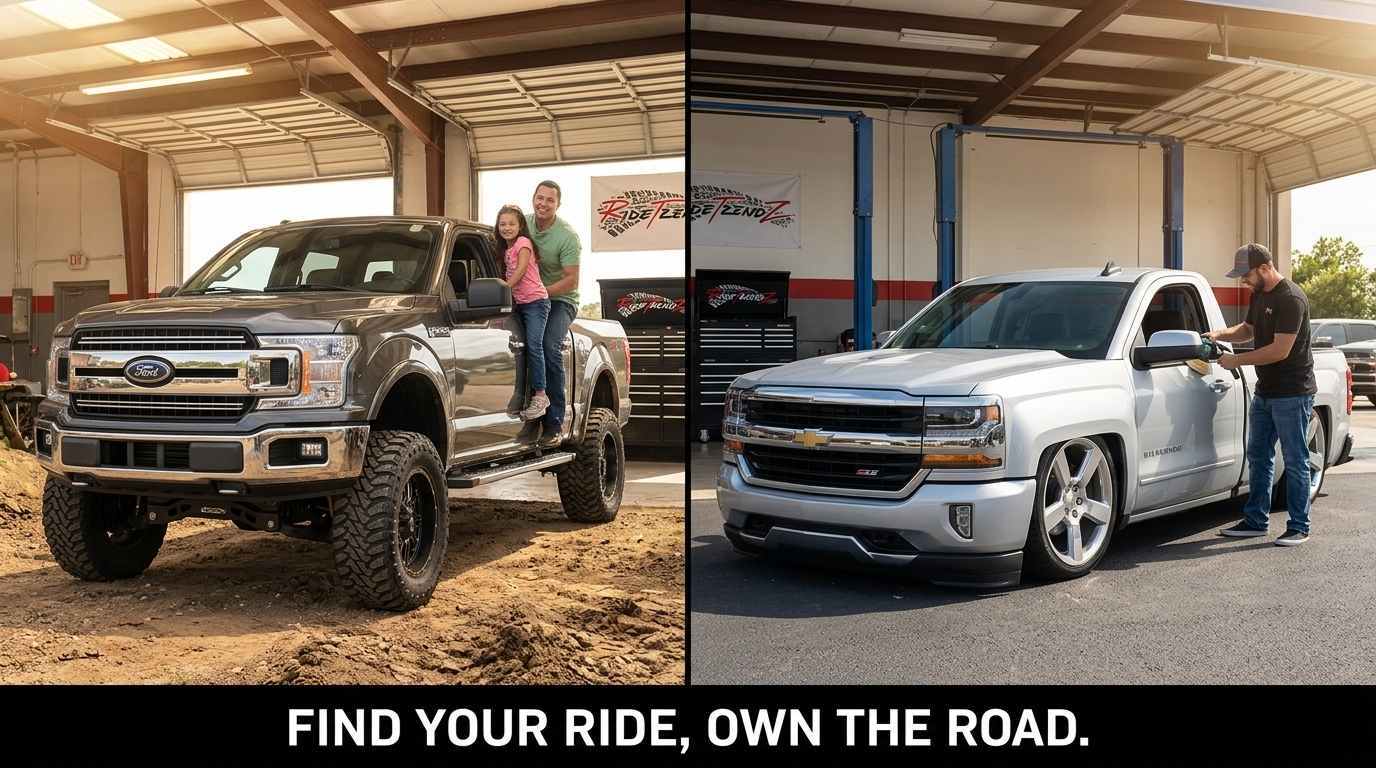
This is where we stop talking about theory and get specific about what separates a quality suspension kit from a parts-bin gamble.
Built for Real Trucks, Not Just Photos
Every kit we sell at RideTrendz is engineered for a specific vehicle make, model, year, and drivetrain. We don't sell one-size-fits-all spacers and call it a lift kit. Our Ford F-150 Lowering Kit listings are broken down by engine type (V6 vs V8), drivetrain (2WD vs 4WD), and even leaf spring width, because fit matters.
RTZ Primo Nitrogen Gas Charged Shocks
One thing you'll notice across our product lineup: we include RTZ Primo nitrogen-gas-charged shocks with most complete kits. Why does this matter?
- Nitrogen gas resists heat and foaming that standard hydraulic fluid develops under repeated compression.
- Mono-tube design means more consistent damping across the stroke
- Pre-calibrated travel length matches your specific lift or drop height
You can't pair a standard shock with a 5-inch flip kit and expect a smooth ride. Our matched shock packs are calibrated to the exact drop or lift depth in each kit; that's the difference between a build that feels factory-smooth and one that bounces down every road.
Doestch Tech DT9000 Shocks, Premium Upgrade Option
For customers who want the best of the best in our lineup, we offer kits with Doestch Tech DT9000 nitrogen gas-charged shocks. These are our premium shock option, included in select complete lift kits for trucks like:
- GMC Sierra K1500 Complete Lift Kit, 3" Torsion Keys + Rear Blocks
- Ford Ranger Full Lift Kit 1998–2013 with DT9000s
These are not repacked generic shocks. They are calibrated specifically for the weight and travel demands of each vehicle.
Forged Steel and Aluminum, Not Pot Metal
Our torsion keys are forged, not cast. Our aluminum coil spring spacers are billet-machined, not injection-molded plastic. The difference shows up not at the time of install, but six months later when a cast piece cracks under load and a forged one doesn't.
This matters especially for 4WD lifted trucks where torsion bar-based front suspension puts significant lateral stress on the lift key at full droop.
USA-Made Components and Quality Standards
Many of the components in our kits are manufactured to meet or exceed OEM specs. We source from suppliers who maintain ISO and quality control standards. When you're running a truck suspension lift under a vehicle that hauls family, cargo, or tows trailers, that standard matters.
Lifted Truck Gas Mileage: What to Realistically Expect?
One of the most-asked questions: how much does a lift hurt fuel economy?
Here's the honest breakdown based on industry data and customer feedback:
|
Lift Height |
Tire Size Increase |
Estimated MPG Loss |
|
1"–2" (leveling) |
0"–1" larger |
0–0.5 MPG |
|
2"–3" |
1"–2" larger |
0.5–1.5 MPG |
|
3"–4" |
2"–3" larger |
1.5–2.5 MPG |
|
4"–6" |
3"+ larger |
2–4 MPG |
The MPG loss comes from two sources: increased aerodynamic drag from the taller profile and higher rolling resistance from larger, heavier tires. The lift kit itself doesn't directly reduce fuel economy; the tires do.
If you want the lifted look without the fuel economy hit, a leveling kit with minimal tire upsizing is the most fuel-friendly path. Our Chevy Silverado 1988–2006 2.5" Leveling Kit gives you a leveled stance without a major tire upgrade requirement.
How Much Does a Lift Kit Cost? Full Price Breakdown
How much does a lift kit cost? Here is a realistic breakdown of what to budget:
|
Kit Type |
Entry Range |
Mid Range |
Premium |
|
Leveling Kit (spacers only) |
$50–$150 |
$150–$300 |
$300+ |
|
2"–3" Lift Kit (spacers + shackles) |
$200–$500 |
$500–$900 |
$900+ |
|
3"–4" Full Kit (with shocks) |
$350–$700 |
$700–$1,200 |
$1,200–$2,000 |
|
4"–6" Complete Kit (spindles, blocks, shocks) |
$600–$1,200 |
$1,200–$2,000 |
$2,000–$3,500+ |
|
Professional Installation (labor) |
$200–$400 |
$400–$700 |
$700–$1,200+ |
How much is a lift kit for a truck at RideTrendz? Our complete kits, the ones that include shocks, start under $400 and go up to premium packages around $1,200–$1,800 for complex 4WD builds. You can check our full range in our product catalog linked above.
Lift Kit vs Leveling Kit, Which One Do You Actually Need?
This is one of the most common questions we get. Here's the truth:
Choose a leveling kit if:
- Your truck sits nose-down from the factory
- You want to run slightly larger tires
- You care about aesthetics more than off-road performance
- Your budget is under $300
Choose a full lift kit if:
- You regularly drive off-road
- You want to fit tires 33"+
- You need serious ground clearance for mud, rocks, or snow
- You tow in varied terrain and need departure angle
Our blog post on lift kit vs leveling kit breaks this down in even more detail, including a vehicle-by-vehicle recommendation guide that saves a lot of guesswork.
Popular Truck Models, Lift vs Lower Recommendations
Ford F-150
The F-150 is one of the most commonly modified trucks in America. For lifting, our 2007–2016 F-150 Lift Kit covers the most popular generation. For lowering, our Ford F-150 Lowering Kit guide walks you through the drop options by year.
Best for lifting: 2WD and 4WD F-150 owners who use the truck for work or weekend off-road. Best for lowering: 2WD F-150 owners on pavement who want a show-ready stance
Chevy Silverado / GMC Sierra 1500
One of the most flexible platforms for both modifications. We carry both the complete lift kit for Silverado 1500 88–98 and a full range of lowering kits for the 1999–2006 Silverado.
Best for lifting:4WD K1500/K2500 owners, farm or work trucks Best for lowering: 2WD C1500 owners, the classic lowered chevy look is iconic
Dodge Ram 1500
The Ram 1500 is popular in both cultures. Our Dodge Ram 1500 Lowering Kit guide covers the 2009–2017 generation in depth. For lifted builds, we carry forged coil spring spacer kits and full torsion-key setups.
Ford Ranger
The Ranger is a favorite for compact lifted builds. Our Ford Ranger lift kit guide (1983–2013) details every generation's options. For lowering, our Ranger Lowering Kit guide is equally comprehensive.
Toyota Tacoma
The Tacoma is practically built for lifting. With 6-lug and 5-lug variants across generations, we carry rear shackle kits and complete lift systems,s including our Toyota Tacoma full lift kit.
Lift Shocks vs Stock Shocks, Don't Skip This Step
One of the biggest mistakes truck owners make after a truck suspension lift: keeping the stock shocks.
Stock shocks are calibrated for stock ride height. When you lift a truck 3 inches, the shock is now operating at a different travel range. It runs out of compression travel faster and causes a harsh, bouncy ride, and wears out in a fraction of the time.
Our blog on lift shocks vs stock shocks covers this in detail. The short version: always run matched shocks with any lift over 1.5 inches.
The same applies to lowered trucks. A stock shock paired with a 4-inch flip kit bottoms out repeatedly and destroys itself. Our lowering kits include matched, calibrated shocks because we won't let your build fail over a shock mismatch.
Truck Suspension Basics, For Those Starting From Scratch
If you're new to suspension modifications, it helps to understand what you're changing before you order anything. Our truck suspension basics guide walks through:
- How coil spring suspensions work
- Torsion bar front suspension (common on GM and some Fords)
- Leaf spring rear systems and how shackles change geometry
- What happens to driveshaft angles when you lift or lower
This isn't something you need a mechanic's license to understand, but having the baseline knowledge helps you pick the right kit and install it correctly.
How Long Do Lift Kits Last?
A well-installed lift kit on a well-maintained truck will last 5–10 years under normal conditions. A premium kit with forged components and quality shocks can outlast that significantly.
Here are the factors that shorten lifespan:
- Off-road use without protective skid plates
- Skipping alignment after install
- Running worn-out shocks that cause coil spacer micro-fractures
- Exceeding towing capacity with an already-stressed drivetrain
Our lift kit lifespan and maintenance guide gives you a full maintenance schedule, when to inspect, when to re-torque, and what to replace first.
How to Install a Lowering Kit on Your Truck?
Many of our customers install their kits themselves. For a standard lowering kit (springs + shackles or blocks), the process typically takes 3–5 hours with basic tools and a lift or floor jack.
Our how to install a lowering kit guide walks through the process step by step, including:
- Safely supporting the vehicle
- Removing the factory coil springs or leaf spring hardware
- Installing drop components
- Re-installing with proper torque specs
- Alignment check after install
We always recommend a professional alignment after any suspension modification, lifted or lowered. It protects your tires, your handling, and your safety.
Top 5 Reasons to Upgrade Your Truck Suspension in 2025
Our top 5 reasons to upgrade truck suspension cover this in detail, but here's the condensed version:
- Performance improvement: factory suspension is a compromise. A matched aftermarket setup is tuned to your actual use.
- Aesthetics: no modification transforms the look of a truck faster than ride height.
- Tire fitment: bigger tires need clearance. Clearance needs a lift.
- Safety: Worn factory shocks decrease braking distance and lane stability. An upgrade fixes that.
- Resale value: quality suspension mods done right increase appeal to buyers who know trucks.
Conclusion
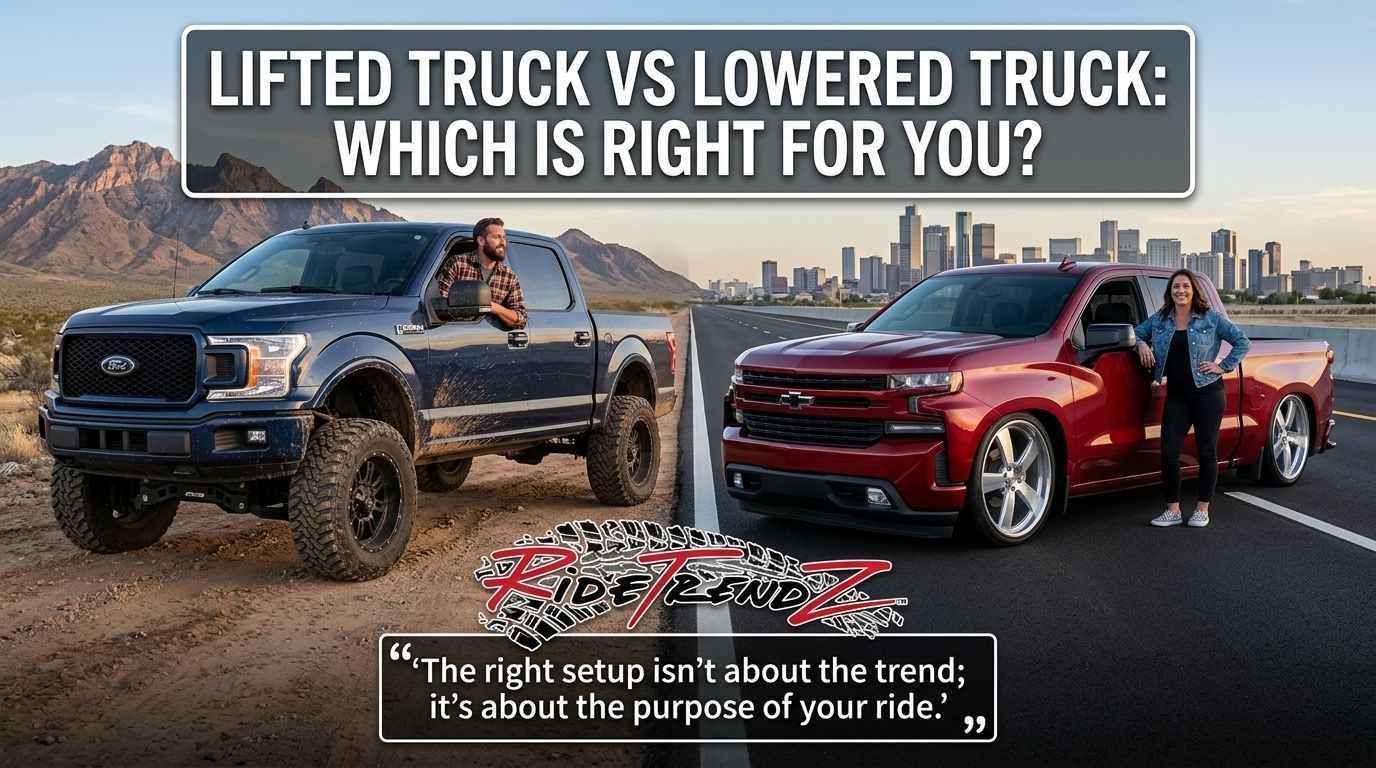
The lifted truck vs lowered truck debate doesn't have one right answer. It has the right answer for you.
Lifted trucks win for off-road capability, ground clearance, towing versatility, and commanding presence. Lowered trucks win for ride quality on paved roads, aerodynamics, clean aesthetics, and show culture appeal.
What both need is quality components installed correctly. Cheap spacers and mismatched shocks turn a great idea into a safety problem. That's exactly why RideTrendz exists: to give truck owners the right parts, matched correctly, with the knowledge to back it all up.
Whether you're building a custom lifted truck, a slammed daily driver, or something in between, our catalog has the kit, the shocks, and the expertise to back it up.
Browse our full suspension catalog at RideTrendz.com and find the exact kit for your make, model, year, and drivetrain.
FAQs
Q1: Is a lifted truck or lowered truck better for daily driving?
A lowered truck offers a smoother, more planted ride on paved roads daily. A lifted truck suits drivers who regularly encounter rough terrain or unpaved roads.
Q2: Does lifting a truck hurt gas mileage significantly?
Yes. A lifted truck gas mileage drop of 1–3 MPG is typical, mainly due to larger tires increasing rolling resistance and aerodynamic drag at highway speeds.
Q3: Are lowered trucks street legal everywhere?
Not always. Whether lowered trucks are legal depends on your state's minimum ground clearance laws. Check local vehicle codes before completing your drop.
Q4: How much does a complete truck suspension lift kit cost?
A complete kit with shocks ranges from $400 for entry-level setups to $2,000+ for premium 4WD systems. Professional install adds $200–$700 in labor costs.
Q5: Can I install a truck lowering kit myself at home?
Yes, most standard truck lowering kits with springs and shackles are DIY-friendly in 3–5 hours. Always follow torque specs and get a professional alignment after install.