

Most truck suspension guides lump every model year together, give you a vague parts list, and call it a day. That's not what this is.
This guide breaks down every major Ford Ranger generation from 1983 to 2025, tells you exactly what Ranger lowering kit components fit each year, and explains, in plain language, why each part matters for a clean, safe drop. We've spent years helping truck owners get their builds right the first time, and that experience is baked into every line below.
Whether you're chasing a street-smooth lowered Ford Ranger or a tucked mini-truck stance, this is the guide you need to read before buying anything.
Why Lower a Ford Ranger? The Real Reasons Trucks Get Dropped
Lowering is not just about looks, though a lowered Ranger does look incredible. Here's what a proper suspension lowering kit actually delivers:
|
Benefit |
Detail |
|
Lower center of gravity |
Reduces body roll in corners by 10–20% |
|
Improved aerodynamics |
Less air under the truck = better fuel economy |
|
Tire contact patch |
More surface contact improves straight-line grip |
|
Visual stance |
Flush wheel fitment, cleaner profile |
|
Ride quality |
Quality lowering springs eliminate factory slop and float |
Pro Tip:A properly installed drop kit does not ruin your ride. A cheap or mismatched kit does. Always match your coil springs, leaf springs, and lowering shocks to your specific model year and drivetrain.
If you want to understand the full case for going low before buying, read our detailed breakdown at Lowering Your Truck: Benefits, Risks & the Right Lowering Kit to Buy.
Ford Ranger Generations: Quick Reference Chart
Before diving into parts, know your generation. The wrong Ranger lowering kit on the wrong year is the most common (and expensive) mistake buyers make.
|
Generation |
Years |
Front Suspension |
Rear Suspension |
Drivetrain |
|
Gen 1 |
1983–1997 |
Coil springs (TTB/Twin Traction Beam) |
Leaf springs |
2WD / 4WD |
|
Gen 2 |
1998–2013 |
Coil springs (SLA / short-long arm) |
Leaf springs |
2WD / 4WD |
|
Gen 3 |
2019–2025 |
Fully independent |
Leaf springs (rear) |
2WD / 4WD |
This matters because the drop spindle options, lowering blocks, and rear flip kit setups are completely different across generations. Read every section that matches your truck.
1983–1997 Ford Ranger Lowering Kit: The Classic Mini-Truck Build
The first-gen Ranger is the original mini-truck platform. Its TTB (Twin Traction Beam) front end is unique, and that uniqueness means you need the right parts, not generic ones.
Front Lowering: Drop Spindles Are Your Best Friend
The cleanest way to drop the front of an 83–97 Ranger is with a Ranger drop spindle kit. A drop spindle works by relocating the wheel hub lower on the spindle body. The suspension geometry stays correct because the control arm angles don't change.
Why this matters:
- No cutting or modifying the frame
- Retains full factory suspension travel
- Works with stock or upgraded brake calipers
- Delivers 2–3 inches of clean front drop
A drop spindle is far superior to lowering springs alone on this platform because the TTB front end does not respond well to spring-only drops. The geometry gets weird fast, and you end up with camber problems and tire wear. Spindles solve all of that.
What to look for in a 1983–1997 Ranger drop spindle:
- Forged or cast iron construction (not stamped)
- Correct bolt pattern for your brake setup
- Compatible with stock ball joints or upgraded units
- Clear drop measurement (2" or 3" are most common)
Rear Lowering: Leaf Springs, Blocks, and Flip Kits
The 83–97 Ranger uses a solid rear axle with leaf springs. You have three main options:
Option 1, Lowering Blocks / Drop Blocks
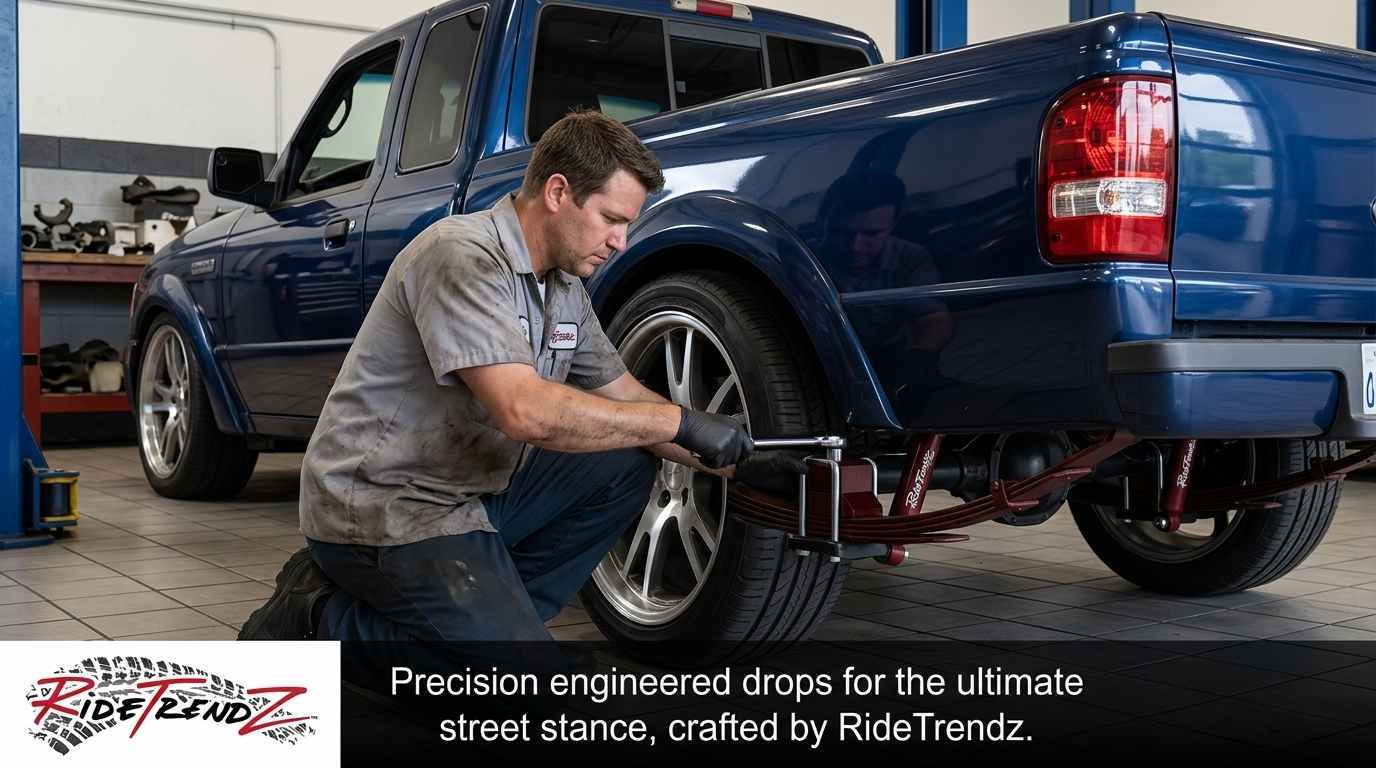
Lowering blocks (also called drop blocks) sit between the axle perch and the leaf spring pack. They lower the axle by raising it relative to the spring, thereby dropping the truck body. Available in 2", 3", and 4" sizes.
- Fast to install
- No spring modification needed
- Best for mild drops (2–3 inches)
- Pair with U-bolts rated for your block size
Option 2, Leaf Spring Lowering Blocks with Tapered Design
Leaf spring lowering blocks with a tapered angle correct for pinion angle as you drop the truck. This is critical. A flat block drops the axle but leaves the driveshaft running at a bad angle, leading to vibration and U-joint wear at highway speeds. Tapered drop blocks prevent that.
Option 3, Rear Flip Kit
A flip kit (also called a Ranger rear flip kit) moves the axle from below the spring pack to above it. This is the most aggressive drop option, delivering 4 to 5+ inches of rear drop in a single move. It's the foundation of any serious drop truck build on this platform.
Flip kit pros and cons:
|
Pros |
Cons |
|
Maximum drop (4–5"+) |
Requires re-indexing pinion angle |
|
Clean look with no visible blocks |
Needs lowered shocks to match |
|
Works with stock or custom leaf packs |
More involved installation |
For a 1997 Ford Ranger drop kit that goes aggressive, a front drop spindle combined with a rear flip kit is the classic combo. It delivers a 2/4 or 3/5 stance (front/rear) that looks intentional and sits right.
Shock Absorbers for the 83–97 Drop
Stock shocks are too long once you've dropped the truck. They limit travel and can cause handling issues at the lowered ride height. A Ranger lowering shock kit matched to your drop measurement is not optional, it's part of a complete build.
Look for nitrogen gas-charged shocks calibrated for 2–4 inches of drop. They control the spring rate effectively and deliver a smooth, flat ride at the new height.
1998–2013 Ford Ranger Lowering Kit, The Most Popular Platform
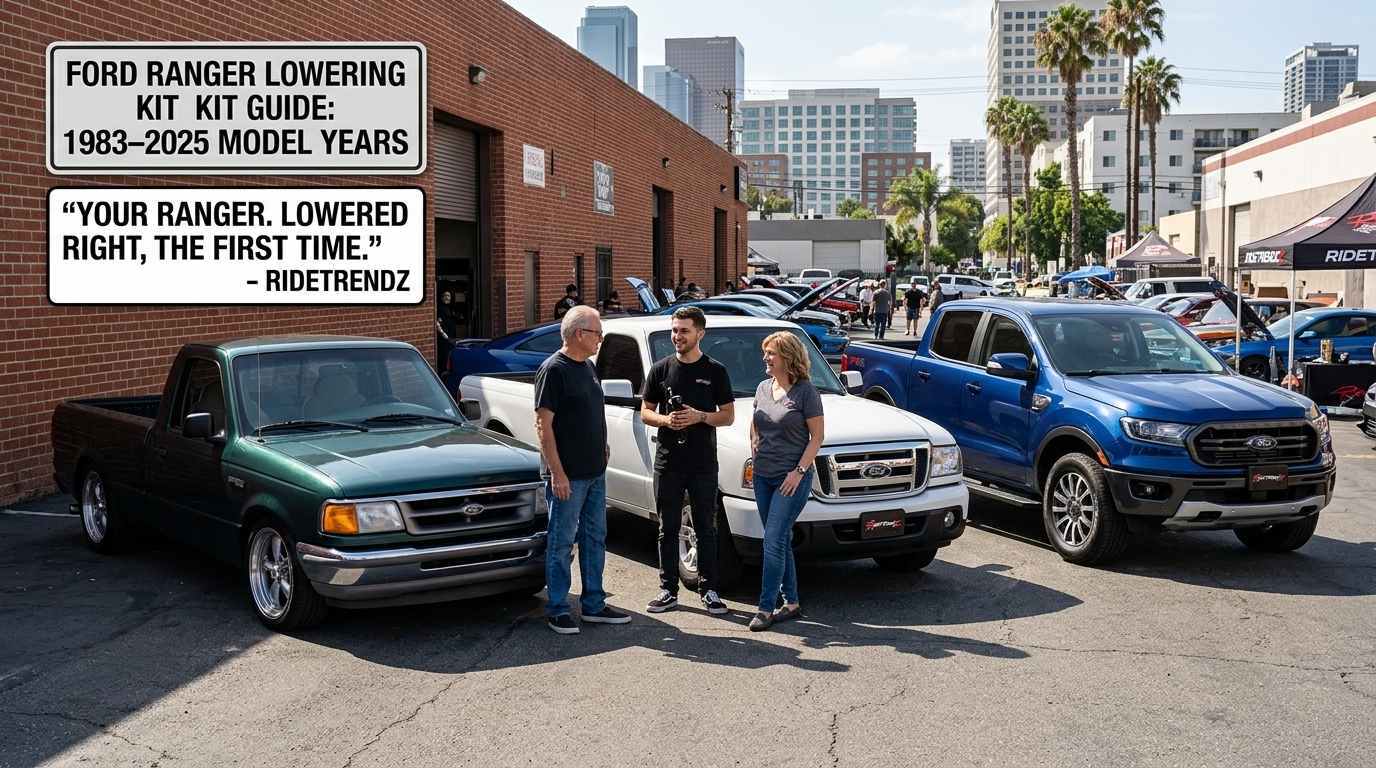
The second-gen Ranger is the most common build we see. Ford sold millions of these trucks; they're everywhere, and the aftermarket for Ranger 2WD lowering components is deep and well-developed.
2WD vs. 4WD: Critical Difference
Before you buy a single part, confirm whether your Ranger is Ranger 4WD lowering or Ranger 2WD lowering territory.
- 2WD Rangers can use drop spindles, lowering coil springs, lowering blocks, and flip kits
- 4WD Rangers are limited primarily to rear lowering; front geometry on 4WD units is not spindle-drop compatible without significant modification
This guide focuses on Ranger 2WD lowering since it's the correct platform for a full front-and-rear Ford Ranger drop kit.
Front Lowering on 98–13: Coil Springs First
The 1998–2013 Ranger uses a short-long arm (SLA) front suspension. The front drop on this platform is best achieved with lowering springs, specifically coil springs engineered to drop the front 1.5 to 3 inches while maintaining factory geometry.
Key specs to match:
- Spring rate (lbs/in) appropriate for your trim level
- Free height and compressed height compatible with your strut
- Drop measurement matching your rear drop target
Ranger 2/3 drop kit (2" front / 3" rear) is the most popular configuration of this generation. It levels the factory rake, drops the overall stance, and still allows for daily driving without scraping.
Ranger 3/4 drop kit (3" front / 4" rear) is the next step, better for show builds or trucks not driven on rough roads regularly.
Rear Lowering on 98–13: Leaf Springs and Flip Kits
Like the Gen 1, the 98–13 Ranger uses leaf springs in the rear. The lowering options are the same: leaf spring lowering blocks, drop blocks, or a full Ranger rear flip kit.
For a 2/3 drop kit:
- Front: 2" lowering coil springs
- Rear: 3" leaf spring lowering blocks (tapered, for pinion correction)
- Shocks: Ranger lowering shock kit matched to each end
For a 3/4 drop kit:
- Front: 3" lowering springs
- Rear: Ranger rear flip kit (delivers 4–5" of rear drop)
- Shocks: Extended-travel nitrogen lowering shocks front and rear
Lowering Hangers and Shackles for Extra Rear Drop
If you want rear drop without a full flip kit, lowering hangers and shackles are your option. They relocate the spring mount points to lower the axle. A Ranger leveling drop kit using hangers and shackles typically delivers 2–3 inches of rear drop with a simpler installation than a flip kit.
Hanger and shackle kits are ideal when:
- You want to keep the axle under the spring (not flip it)
- You need to drop the rear to match a mild front drop
- Installation time or tools are limited
This combo is often used in a suspension lowering kit that includes hangers, shackles, and a matching set of rear shocks, everything tuned to work together.
Want to see how this compares to lift hardware? Our guide Lift Kit vs. Leveling Kit: Which One Does Your Truck Actually Need explains both sides clearly.
Ford Ranger Lower Control Arms: When You Need Them
Ranger lower control arms come into play on builds with aggressive front drops, typically 3 inches or more. At that drop level, the factory control arms create excessive negative camber, and the ball joint angle reaches its limit.
Tubular lower control arms with extended geometry correct for:
- Camber at low ride height
- Caster alignment
- Ball joint angle and wear life
If you're running a Ranger 3/4 drop kit or more on a 98–13 Ranger, budget for control arms. They're the difference between a truck that drives straight and one that eats tires every 10,000 miles.
2019–2025 Ford Ranger, Modern Platform, Different Approach
The third-gen Ranger is a global platform with a fully independent front suspension and modern rear leaf setup. Lowering options are more limited than older trucks, but options exist.
What Works on the New Ranger
- Lowering springs (front coils and rear leaf springs), available in 1–2 inch drop
- Rear lowering blocks, mild drops only (1–1.5")
- Sport-tuned replacement shocks matched to lowered springs
What Doesn't Work
- Drop spindles, modern SLA geometry doesn't benefit from spindle drops the same way
- Aggressive flip kits, the rear suspension design on 19–25 makes full flips impractical
The 2019–2025 Ranger is best lowered modestly, 1–2 inches, for a cleaner street look without compromising the factory ride quality the platform was designed around.
Complete Drop Kit Configurations by Model Year
Here's a clean summary of the most popular Ford Ranger lowering kit builds at RideTrendz:
|
Year Range |
Front Drop |
Rear Drop |
Kit Type |
Notes |
|
1983–1997 |
Drop spindles (2–3") |
Flip kit (4–5") |
2/4 or 3/5 drop |
Classic mini-truck stance |
|
1983–1997 |
Drop spindles (2") |
Leaf spring lowering blocks (3") |
2/3 drop |
Daily driver build |
|
1998–2013 |
Lowering coil springs (2") |
Lowering blocks (3") |
2/3 drop |
Most popular build |
|
1998–2013 |
Lowering coil springs (3") |
Rear flip kit (4") |
3/4 drop |
Show and street |
|
1998–2013 |
Lowering coil springs (2") |
Shackles + hangers (2–3") |
Leveling drop |
Budget-friendly build |
|
2019–2025 |
Lowering springs (1–1.5") |
Lowering blocks (1–1.5") |
Street tuck |
Mild, daily-driver friendly |
How Much Does Lowering a Car or Truck Cost?
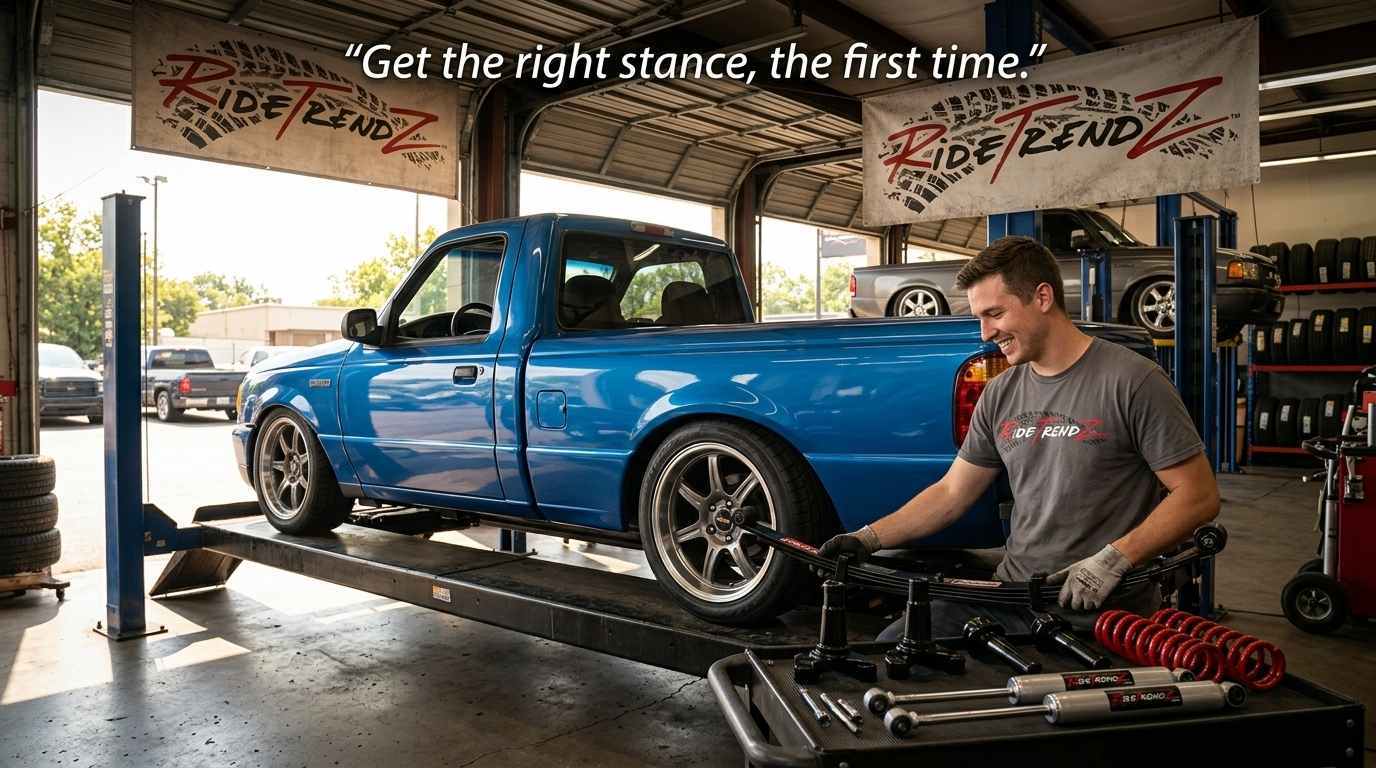
One of the most searched questions we see: how much does lowering a car cost? Here's a realistic breakdown for a Ford Ranger.
|
Component |
Cost Range |
|
Drop spindles (pair) |
$150–$250 |
|
Lowering coil springs (pair) |
$80–$180 |
|
Leaf spring lowering blocks (set) |
$40–$90 |
|
Rear flip kit (complete) |
$120–$220 |
|
Lowering shocks (set of 4) |
$120–$280 |
|
Lowering hangers + shackles |
$60–$140 |
|
Professional installation labor |
$200–$600 |
|
Full build (DIY parts only) |
$350–$800 |
|
Full build (parts + labor) |
$600–$1,400 |
These ranges reflect quality aftermarket parts. Budget brands cut corners on material grade and tolerances, and you'll feel it in ride quality and safety. RideTrendz components are engineered and tested to perform, not just to fit.
For a broader look at truck lowering costs across platforms, our Best Lowering Kit for Ford F150 Guide walks through similar cost breakdowns with F150-specific data.
RideTrendz Ranger Lowering Kit Quality, What Makes Ours Different?
Here's an honest breakdown of why we don't just compete on price:
Materials
Every Ranger lowering kit component we sell is manufactured to tight tolerances. Our drop spindles are forged, not cast from recycled material. Forged steel is stronger, more consistent, and resists cracking under load. You can't see the difference on the shelf. You feel it after 50,000 miles.
Engineering
Our leaf spring lowering blocks use a tapered design as standard. Many competitors sell flat blocks and let you figure out pinion angle correction yourself. We don't do that. The taper is built in because we know what happens to driveshafts when it's not.
Shock Matching
We match our nitrogen gas-charged shocks to specific drop heights. A 3" drop needs a shock valved for that ride height, not a generic "lowered" shock. Our Ranger lowering shock kit options are calibrated per drop range so your truck rides correctly from day one.
Complete Kit Convenience
We don't sell individual parts and leave you guessing what to pair them with. Our complete Ford Ranger drop kit configurations are curated by model year and drop level. Everything in the box works together. Nothing is left to chance.
Customer Support
Got a question about which Ranger 3/4 drop kit works on your specific cab and bed combo? We answer that. We've built internal guides, detailed fitment charts, and responsive support channels because we know buying the wrong parts is expensive and frustrating.
Pros and Cons: Lowering vs. Lifting Your Ford Ranger
Some buyers aren't 100% sure whether to go low or go high. Here's an honest comparison:
|
Factor |
Lowering |
Lifting |
|
Street driving comfort |
✅ Excellent (with quality springs) |
⚠️ Rougher depending on kit |
|
Off-road capability |
❌ Reduced ground clearance |
✅ Improved clearance |
|
Visual impact |
✅ Aggressive, low, wide look |
✅ Tall, commanding presence |
|
Fuel economy |
✅ Slight improvement |
❌ Slight decrease |
|
Towing capacity |
⚠️ No significant change |
✅ Better with lifted axle |
|
Parts availability |
✅ Deep market for Ranger |
✅ Also well-supported |
|
Installation difficulty |
✅ Easier (especially blocks + springs) |
⚠️ Can be complex for full kits |
Want to go the other direction? Our Best Lift Kits for Ford Ranger 1983–2013 guide covers the full lift side of the Ranger platform.
How to Install a Ranger Lowering Kit: What to Expect
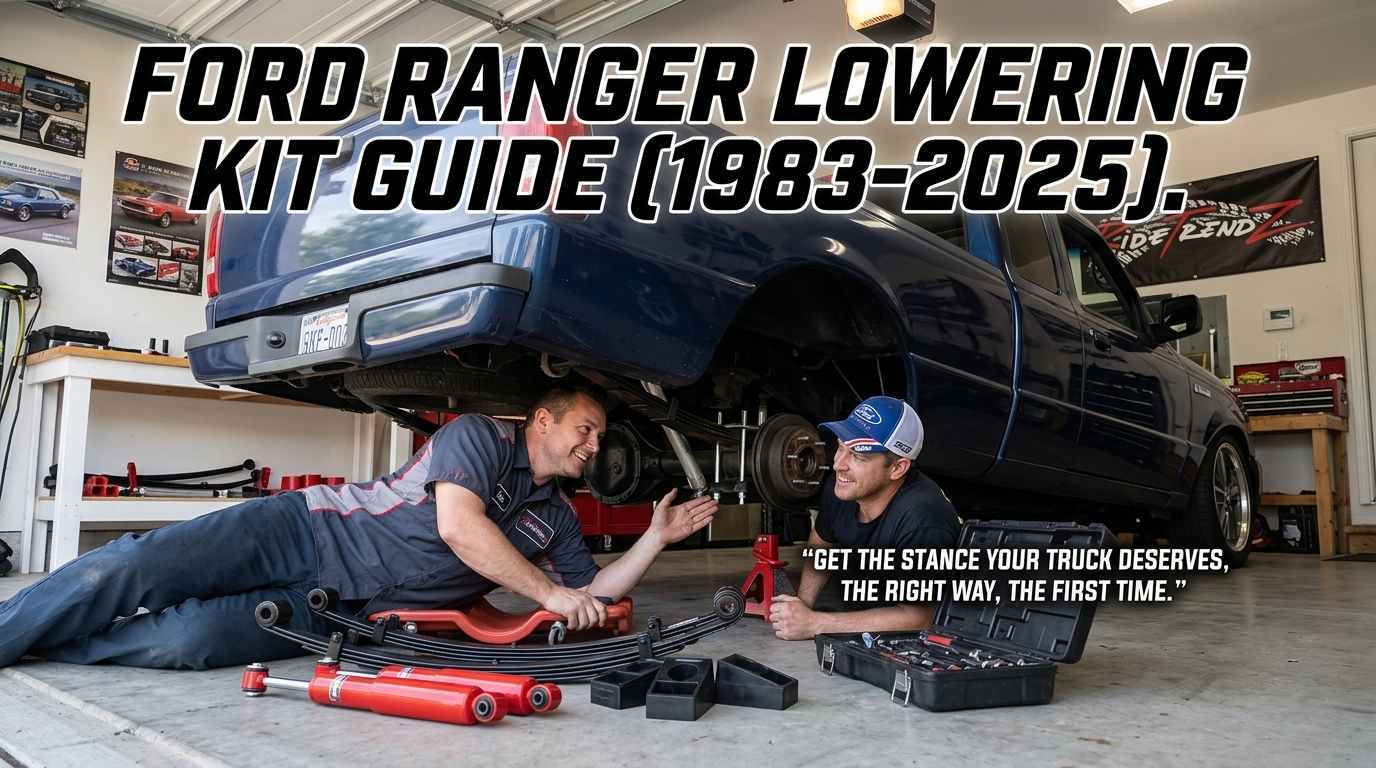
You don't need to be a professional mechanic to install a lowering kit for truck applications like the Ranger. But you do need to be honest about your skill level.
DIY-friendly (beginner to intermediate):
- Lowering blocks and drop blocks, basic hand tools, jack stands, torque wrench
- Rear shackle and hanger kits, same tool requirements
- Lowering springs (coils), requires spring compressor tool
Intermediate to experienced:
- Drop spindle kit, requires brake line disconnect, bearing knowledge
- Flip kit, axle relocation, pinion angle correction, new U-bolts
Professional recommended:
- Anything requiring alignment (all front work should end with a 4-wheel alignment)
- Control arm replacement
Read our full installation walkthrough at How to Install a Lowering Kit on Your Truck for step-by-step guidance on each component type.
Matching Shocks to Your Lowered Ranger, Don't Skip This Step
Lowering shocks are the most overlooked part of a Ford Ranger drop kit build. Here's why they matter:
Stock shocks are designed to work at stock ride height. When you lower your truck 2–3 inches, the shock piston is pushed further into its travel range at rest. This reduces the shock's available compression stroke, which means hard hits and bottoming out over bumps.
A Ranger lowering shock kit with the correct extended length and valving for your drop keeps the piston centered in its travel range. You get full compression and rebound again. The truck rides correctly.
Rule of thumb:
- 2" drop → shocks valved for 2" lowered ride height
- 3" drop → shocks valved for 3" lowered ride height
- Flip kit rear → rear shocks must match the flipped axle position
Our nitrogen gas-charged lowering shocks are matched per application, not sold as a universal fit.
For a deeper explanation of how shocks behave after a lift or drop, our guide Lift Shocks vs. Stock Shocks: What You Really Need After a Lift applies the same principles to lowering.
Ford Ranger Lowering Statistics: What the Numbers Show
- Over 7 million Ford Rangers were sold in the US between 1983 and 2013
- 2WD models account for approximately 65% of total Ranger sales, the primary market for a full Ranger lowering kit
- A proper 2/3 drop kit reduces center-of-gravity height by approximately 8–12% on a stock Ranger
- Proper lowering springs can extend tire life by 15–25% by eliminating factory suspension slop
- A rear flip kit on an 83–97 Ranger delivers up to 5 inches of rear drop in a single installation step
- RideTrendz customers report an average installation time of 4–6 hours for a complete front and rear drop kit on 98–13 Rangers
Best Ranger Lowering Kit Builds by Use Case
Street / Daily Driver
Goal: Smooth ride, clean stance, daily usability
Recommended: 2/3 drop kit, lowering coil springs front, leaf spring lowering blocks rear, matching shocks
Drop: 2" front / 3" rear
Best for: 1998–2013 Ranger 2WD
Show Truck / Static Drop
Goal: Maximum visual impact, occasional driving
Recommended: Drop spindles (3") front, rear flip kit rear, lowered shocks all around
Drop: 3" front / 4–5" rear
Best for: 1983–1997 Ranger 2WD
Budget Build
Goal: Drop the truck without breaking the bank
Recommended: Lowering hangers + shackles rear, lowering coil springs front, stock-length matched shocks
Drop: 2" front / 2–3" rear
Cost estimate: $300–$500 in parts
Performance Street Build
Goal: Lower center of gravity, improved handling, still drivable
Recommended: Lowering springs front, lower control arms, tapered lowering blocks rear, performance valved shocks
Drop: 2–3" front / 2–3" rear
Best for: 1998–2013 Ranger 2WD
More Ranger and Truck Guides
We've built one of the most comprehensive truck suspension knowledge libraries on the web. Here are the resources that connect directly to your Ranger build:
- Best Lowering Kit for Ford Ranger 1983–2013, our dedicated lowering-side Ranger guide
- Truck Suspension Basics for Beginners, start here if you're new to suspension work
- How to Lower a Chevy Silverado, parallel guide for comparison
- Lift Parts vs. Complete Lift Kit: Which to Buy, applies equally to buying lowering parts vs. complete kits
- Top 5 Reasons to Upgrade Truck Suspension in 2025, why now is the right time
Conclusion
A Ford Ranger lowering kit is not a single product; it's a system. Every component needs to match your model year, your drivetrain, your drop target, and your intended use. Get that system right, and you end up with a lowered Ford Ranger that drives better, looks incredible, and holds up for years. Get it wrong, and you're chasing alignment problems and replacing parts early.
RideTrendz exists to make sure you get it right the first time. We engineer complete kits, not generic parts bins. We match lowering shocks to drop heights. We spec tapered blocks as standard. We support our customers before and after the sale.
Your Ranger lowering kit purchase should be the last time you have to think about compatibility issues. That's what we build for.
Frequently Asked Questions
- What is the best Ranger lowering kit for a 1998–2013 Ford Ranger 2WD?
The most popular setup is a 2/3 drop kit: 2-inch lowering coil springs up front with 3-inch leaf spring lowering blocks in the rear, paired with matched lowering shocks. This gives a clean, drivable stance.
- Can I lower a 4WD Ford Ranger?
Ranger 4WD lowering is mostly limited to the rear. Front-end drop options like drop spindles are designed for 2WD platforms. Rear lowering blocks and mild lowering springs work on 4WD units without major modification.
- What is a flip kit and how much does it drop my Ranger?
A flip kit moves the rear axle from below the leaf springs to above them, delivering 4–5 inches of rear drop. It's the most aggressive rear flip kit option available and is ideal for show-truck builds on 1983–1997 Rangers.
- Do I need new shocks after installing a Ranger lowering kit?
Yes. Stock shocks are calibrated for factory ride height. A Ranger lowering shock kit matched to your drop measurement is essential for proper handling, ride quality, and avoiding bottoming out on daily roads.
- How long does it take to install a Ford Ranger drop kit?
A complete front and rear Ford Ranger drop kit installation takes 4–6 hours for an experienced DIYer. Rear lowering blocks alone take 1–2 hours. Any front work involving drop spindles or coil springs should end with a professional 4-wheel alignment.