


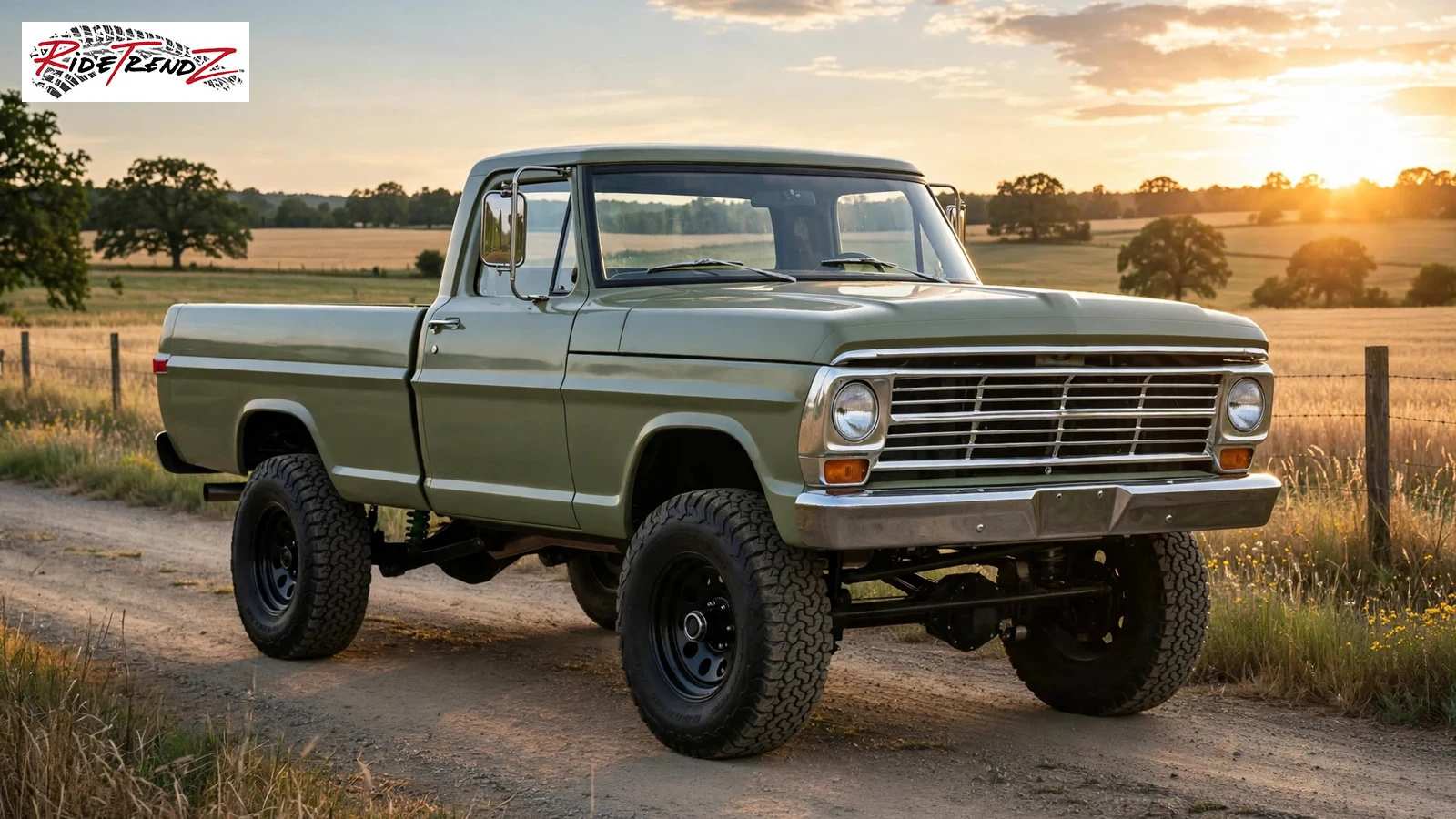
Lifting a Classic Ford F-100/F-200 (1965–1979): 2WD vs. 4WD
Lifting a 1965 to 1979 F-100 starts with one honest question, because the right 1965-1979 Ford F-100 lift kit depends on whether your truck is a 2WD twin I-beam build or a factory 4WD with a live front axle. This guide walks through both front layouts, the spacer, spring, and block options for each, the conversion question from every forum, and the checks that keep a lifted classic safe. If you know your drivetrain, the main F100 and F200 lift kit page shows the fitment split, and picking the right 1965-1979Ford F1000 lift kit gets simpler once the front axle is identified.
Quick Summary
- A 2WD F100 lifts with coil spring spacers up front and blocks at the rear, while a 4WD truck lifts with leaf spring and block combinations.
- The twin I-beam front end changes camber as it lifts, so alignment checks matter more on a 2WD build than on a solid axle build.
- A factory 4WD F-100 already carries a transfer case and a live front axle, which makes its lift far simpler than any 2WD conversion project.
- Converting a 2WD truck to 4WD means a chassis and drivetrain swap, and most owners get better value lifting the truck they own.
- The right 1965-1979 Ford F100 lift kit matches your year, drivetrain, and tire goal, checked part by part before ordering.
Whydo owners lift a classic Ford F100 truck?
Owners lift these trucks for stance, clearance, and tire room, and theFord F1000 world talks about little else once a build thread starts. A mild lift levels the nose, a taller lift clears rough ground, and both change how the truck rides. Knowing which 1965-1979 Ford F100 lift kit fits your drivetrain is the starting point.
Source: Wikipedia, Ford F-Series
Stance and ground clearance gains
A stock F100 sits low by modern standards, and the front end sags further after five decades on tired coil springs or leaf springs. Lifting restores the factory stance, then adds clearance under the front axle and the cab. That clearance helps on rutted lanes, farm tracks and steep driveways where a stock truck scrapes.
Source: Wikipedia, Suspension lift
Room for bigger tires
Tire size drives most lift decisions, because owners want a taller, wider tire under factory arches without rubbing the fender or the steering linkage at full lock. A small lift opens that room honestly. Our guide to how a suspension lift kit works explains the geometry behind that clearance on both drivetrain layouts.
Source: Wikipedia, Suspension lift
Street truck and trail truck goals
A 2WD truck usually becomes a street build with a level stance and tidy tires, while a 4x4 truck heads for dirt with clearance as the priority. Both goals appear daily inFordd truck enthusiast forums build threads. The mistake is copying a parts list across drivetrains, because the front suspension hardware shares almost nothing between layouts.
Source: Wikipedia, Four-wheel drive
Inspect the truck before you order parts.
One afternoon under the truck saves weeks of wrong parts later. Old trucks hide worn bushings, cracked spring perches,s and tired mounts that a lift exposes on the first drive. The Ridetrendz team asks owners to inspect first and order second, and our truck suspension basics guide covers the same checks for newcomers.
Source:e, Wikipedia, Ford F-Series
Check the frame, mounts and crossmember
Start at the frame rails, checking rust around the spring mount points, cab mounts and the trans crossmember. A lift adds leverage to every mount, so a cracked crossmember needs repair before any spacer goes in, and cab work like a bench-to-bucket seat swap waits until mounts are sound. Solid metal makes a 1965-1979 Ford F-100 lift kit feel tight.
Source: Wikipedia, Ford F-Series
Read the axles, springs, and steering
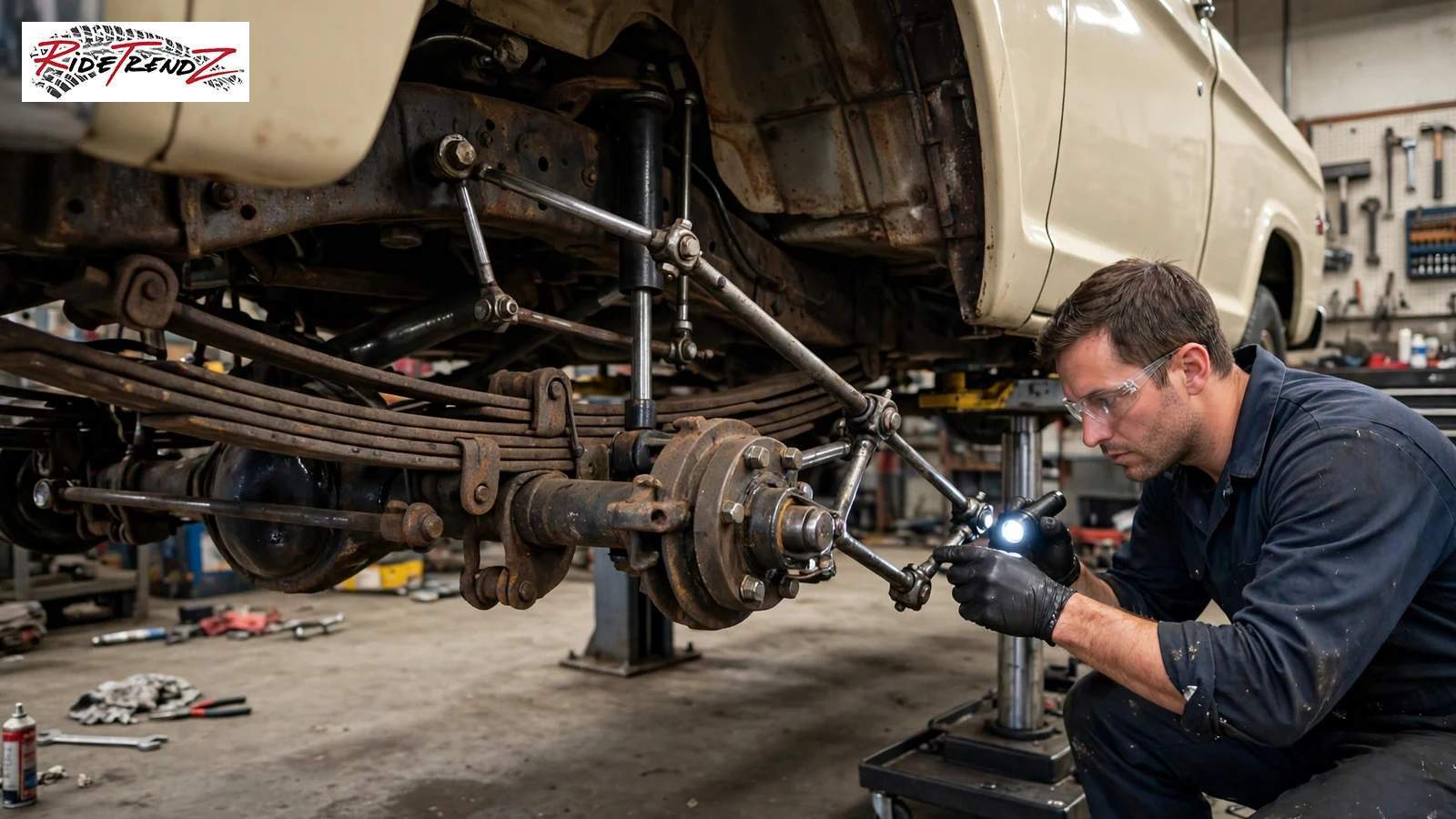
Count the leaf springs, note the axle tag if it survives, and check the front end for play at the tie rods and drag link. Worn parts multiply after a lift because taller tires load the steering harder. Replacing tired bushings and joints during the lift is cheaper than doing the job twice in one season.
Source: Wikipedia, Leaf spring
Measure the stock ride height.
Measure from hub center to arch lip on all four corners and write the numbers down before a single bolt turns. These figures show how much rake the truck carries today and how much lift each end needs. They also give the alignment shop a baseline and prove the result once the truck settles.
Source: Wikipedia, Suspension lift
The 2WD twin I-beam front end explained.
Every 2WD F100 and F200 in this range uses the Ford twin I-beam front suspension, two forged beams pivoting from opposite sides of the chassis. The design is strong, simple, and easy to service, which is why it lasted decades. It also behaves differently under a lift than a solid axle, and that shapes the whole 2WD build.
Source: Wikipedia, Twin I-Beam
How does the twin I-beam suspension work?
Each I-beam carries one front wheel and swings in an arc around its pivot bushing on the opposite frame rail, with a coil spring between the beam and the chassis. The long arc keeps camber change mild at stock height, and the beams shrug off loads that would bend a lighter design. Radius arms locate each beam.
Source: Wikipedia, Twin I-Beam
Camber change when an I-beam truck lifts
Raising an I-beam truck with a taller coil or a spacer steepens the swing arc, and the tire top tips outward as positive camber grows. Small lifts stay inside the alignment range, while taller lifts need camber bushings or beam work. This is the biggest difference between lifting a 2x4 truck and lifting a solid axle 4x4.
Source: Wikipedia, Camber angle
Coil springs and spacers on the 2WD front
The common 2WD lift uses an aluminum coil spring spacer above or below the front coil, paired with longer shocks. Spacer thickness and actual lift differ, because beam geometry multiplies movement at the wheel. The 2WD coil spring spacer options for these trucks group the spacer sizes by height for Rear Wheel Drive trucks.
Source: Wikipedia, Coil spring
The Ford F100 4WD front end explained
A factory Ford F100 4WD uses a different front end, built around a live front axle on leaf springs with a transfer case behind the trans. These trucks have no I-beams or coil springs. The layout is heavier, simpler in geometry, and tolerant of lift height, which is why owners wanting a tall lift hunt a factory 4x4.
Source: Wikipedia, Beam axle
Live front axle and leaf springs.
The live front axle is one solid housing carrying both wheels, located by leaf springs that also set ride height. Adding lift means taller springs, a spacer arrangement or longer shackles, and each change is easy to measure at the spring. There is no camber swing to manage, because the axle holds both wheels at fixed angles.
Source: Wikipedia, Beam axle
Transfer case and drive shaft basics
The transfer case splits drive between the rear axle and the front axle, and the front drive shaft runs from the case to the live front axle. Lifting changes the working angles of both driveshafts, so U-joint condition and slip yoke travel need checking as height grows. Fresh joints keep a lifted 4x4 smooth at road speed.
Source: Wikipedia, Transfer case
How does 4WD change the lift job?
Because the 4WD front end has no pivoting beams, its lift parts are mostly springs, blocks, U-bolts, and shocks, and steering correction is simpler. The parts list differs from a 1965-1979 Ford F100 lift kit for a 2WD truck in almost every line, which is why Ridetrendz sells the drivetrains as separate kits. Order by the truck in your driveway.
Source: Wikipedia, Four-wheel drive
Lifting the 2WD F100 step by step thinking
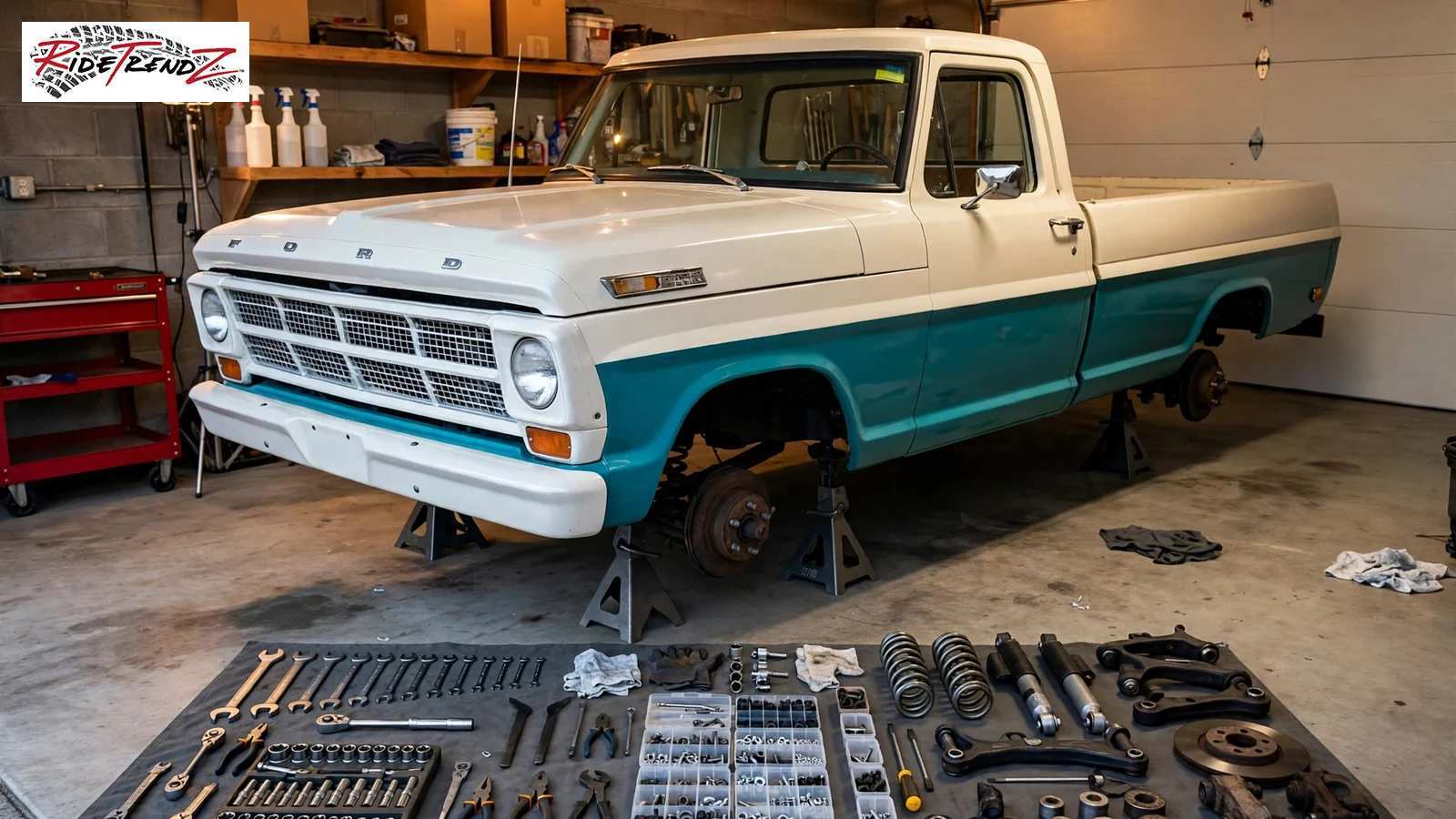
The 2WD recipe is a front coil spring spacer, a rear lift block, and shocks matched to the new height, suiting most street-driven trucks in this range. The main 1965-1979 Ford F100 lift kit for 2WD trucks pairs 3-inch aluminum front spacers with a tapered rear block kit and Doetsch Tech DT9000 nitro shocks, so check fitment for your year and cab first.
Source: Wikipedia, Coil spring
Front coil spring spacers in practice
The spacer lifts the front by extending the coil spring seat, and beam geometry turns that into more lift at the wheel than the spacer measures on the bench. Owners choose heights by tire goal, not looks alone. The 3-inch front spacer set for Rear Wheel Drive trucks is the common pick for a level stance.
Source: Wikipedia, Coil spring
Rear lift blocks and leaf springs
The rear of a 2WD F100 rides on leaf springs over the rear axle, so a tapered steel block between spring and axle raises the rear end cleanly. Taper matters because it keeps the rear end pinion angle close to stock. A 1965-1979 Ford F-100 lift kit with a 2-inch tapered block levels most trucks, while the 3-inch version suits towing rake.
Source: Wikipedia, Leaf spring
Shocks matched to the 2WD lift.
Stock length shocks top out early once a spacer and block go in, and a shock that tops out rides harshly and wears bushings fast. Longer shocks matched to the lift keep travel in both directions and calm the truck over broken pavement. Our comparison of lift shocks and stock shocks explains the length and valving differences.
Source: Wikipedia, Shock absorber
Lifting the 4WD F100 the right way
The 4WD recipe works with the leaf-sprung live axle instead of against beam geometry, so the parts are springs, blocks, U-bolts, and shocks sized for the 4x4 front end. The 4WD version of the 1965-1979Ford F1000 lift kit pairs similar rear hardware with front parts matched to the solid axle truck, so confirm the 4WD listing before checkout.
Source: Wikipedia, Leaf spring
Front leaf spring and spacer choices
Owners lift the 4WD front with replacement leaf springs, add a leaf, or kit front spacers, and each route trades ride quality against budget. The front 2-inch aluminum coil spring spacers for 4WD trucks suit mild builds, while the 3-inch front spacer set serves owners clearing a taller tire.
Source: Wikipedia, Leaf spring
Rear blocks, U-bolts and driveshafts
At the rear, blocks and fresh U-bolts lift the 4WD truck just as they do the 2WD, and reusing stretched U-bolts is a false economy. As height grows, check the rear drive shaft angle, the rear end pinion and slip yoke engagement at full droop. Checking front and rear heights after settling keeps the stance honest.
Source: Wikipedia, Drive shaft
Shocks matched to the 4WD lift.
The 4WD truck needs shocks matched to its heavier front axle and new ride height, and the DT9000 nitro shocks in the 4WD kit are valved for that weight. Owners can check the 4WD kit with matching shocks here and compare listings line by line. A matched 1965-1979Ford F-1000 lift kit rides better than parts guessed from a forum list.
Source:e, Wikipedia, Shock absorber
2WD and 4WD lifts compared side by side
Side by side, the two builds share a goal and almost no hardware. The 2WD lift fights camber change and rewards modest heights, while the 4WD lift works with a fixed geometry axle and tolerates more height. Reading a 1965-1979 Ford F100 lift kit listing means checking which front end every part in the box serves.
|
Part of the job |
2WD twin I-beam truck |
4WD solid axle truck |
|
Front lift method |
Coil spacer on the beam suspension |
Leaf spring change or kit front hardware |
|
Rear lift method |
Tapered block under the leaf spring |
Tapered block under the leaf spring |
|
Alignment concern |
Camber grows as the beams swing |
Caster and steering angle checks |
|
Steering parts |
Tie rods, drag link, camber bushings |
Tie rods, drag link, drop pitman arm on taller lifts |
|
Drivetrain parts touched |
None |
Transfer case angles and both driveshafts |
|
Best use |
Street stance and light duty work |
Trail clearance and four-wheel traction |
Source: Wikipedia, Suspension lift
Cost and effort compared
The 2WD lift is the cheaper weekend, fewer parts and no drivetrain work, while the 4WD lift costs more in hardware and asks for driveshaft checks as height grows. Our price guide to lifting a truck breaks down where the money goes. Neither build needs fabrication at mild heights, which suits owners who want to lift once and do the job properly.
Source: Wikipedia, Ford F-Series
Ride quality and handling compared
.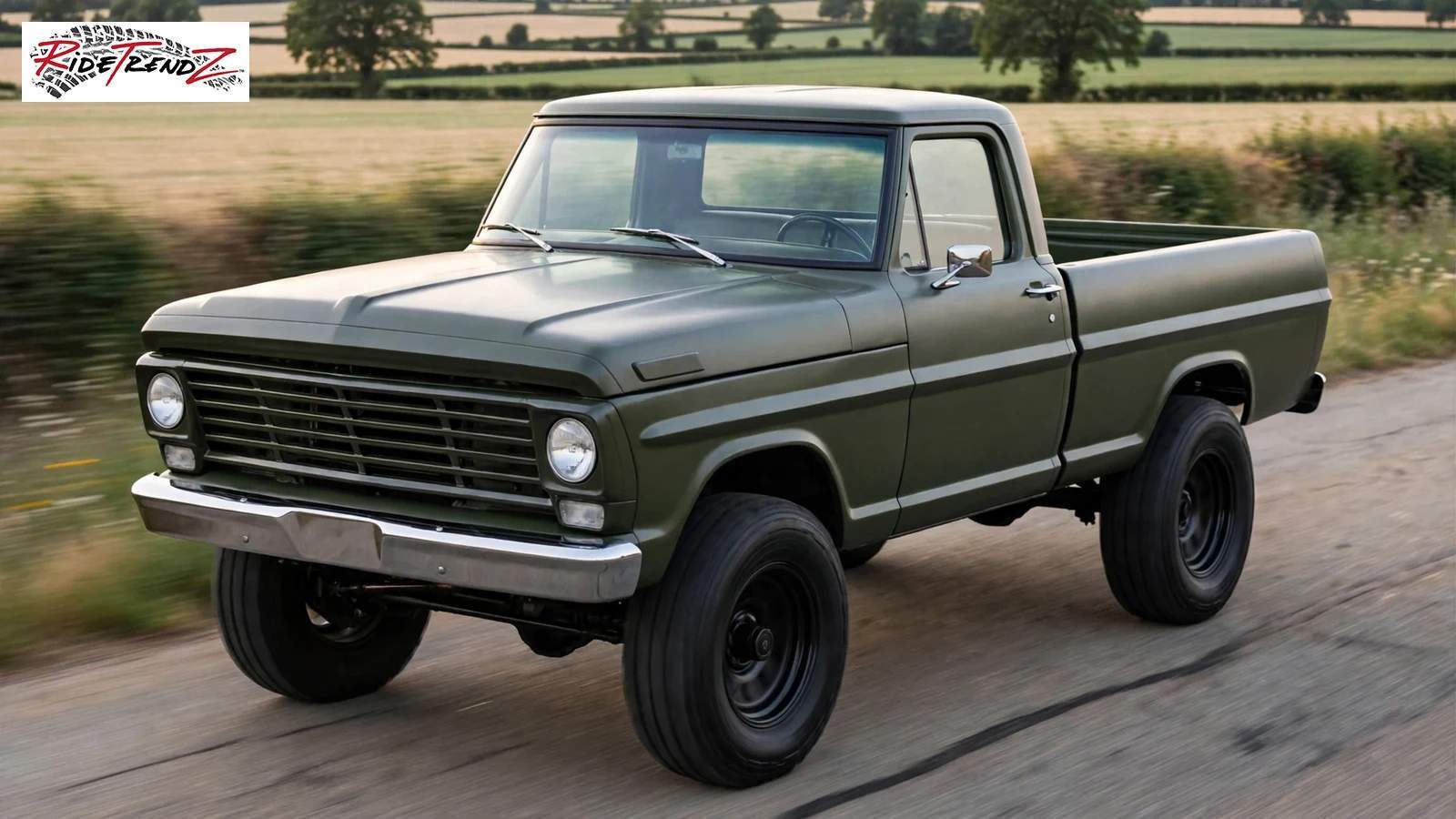
A lifted 2WD keeps its factory steering feel when camber is corrected and rides close to stock on coil springs. A lifted 4WD rides firmer on leaf springs and carries more weight over the front axle. Owners choosing between lift and level should read our lift kit against leveling kit comparison first.
Pros
- A 2WD lift is cheaper, lighter,r and quicker to install
- A 4WD lift clears taller tires with simpler geometry
- Both build bolt-on parts at mild heights
- Matched kits keep shocks and hardware in step
Cons
- A 2WD lift is limited by camber correction range
- A 4WD lift adds driveshaft angle checks
- Neither build fixes worn steering or tired bushings
- Taller lifts on either truck need alignment time
Source: Wikipedia, Suspension lift
Converting a 2WD truck to 4WD, the honest answer
Every week an owner asks whether they can convert it to 4wd, and the honest answer is that a conversion is a chassis project, not a bolt-on modification. The want to convert usually starts after seeing a lifted 4x4 and ends with a parts list longer than the truck. A 1965-1979 Ford F-100 lift kit lifts the truck you own, while a conversion rebuilds it.
Source, Wikipedia, Four-wheel drive
What does a full conversion really involve?
A real conversion needs a 4wd frame or heavy fabrication on the 2WD chassis, a live front axle, leaf spring perches, a transfer case, a trans with the right output, both driveshafts,a nd steering changes. The i-beams, coil springs, and crossmember all come out. Finishers on Ford truck enthusiasts forums describe months of work and advise starting with a donor.
Source: Wikipedia, Transfer case
The donor truck and frame swap route
The easiest way owners finish a conversion is parking a complete 4x4 donor beside the good 2WD truck and moving the cab and bed onto the 4wd frame. A 74 F-100 or a 1966 f100 donor gives the front axle, transfer case,e and 4x4 front end in one purchase. Even a cheap 1965-197Ford F-10000 lift kit costs less than the swap small parts.Sourcee, Wikipedia, Beam axle
When lifting, is the 2WD the smarter build?
If the truck is a clean street-driven 2x4 with a good engine, lifting it as a 2WD is the smarter build for most owners. A 300i6, 390, or 460 powered F100 on a tidy spacer and block lift looks right and keeps its value. Ownersneeding four-wheell traction should find a 4x4 instead of building one.
Source: Wikipedia, Rear-wheel drive
Lift height and tire fitment guide.
Height choice should follow the tire, the use,e and the alignment budget, in that order. A mild 1965-197Ford F10000 lift kit in the 2 to 3 inch range covers most classic trucks, keeps steering geometry friendly, and avoids correction parts taller builds demand. The table below uses owner goals rather than promised sizes, because tire brands and worn springs change results.
|
Owner goal |
Front lift to plan |
Rear lift to plan |
Extra checks |
|
Level the factory rake |
2 to 2.5 inch spacer |
Stock or small block |
Camber check on 2WD trucks |
|
One tire size taller3-inch |
h spacer or spring work2-inch |
h tapered block |
Shock length front and rear |
|
Trail clearance on a 4xSpring-based |
ed front lift |
2 to 3 inch block |
Driveshaft angles and brake lines |
|
Working truck stan2.5-inch |
nch spa3-inch |
inch tapered block |
Rear load and pinion angle |
Source:urce, Wikipedia, Suspension lift
Mild lifts for street and light trail use
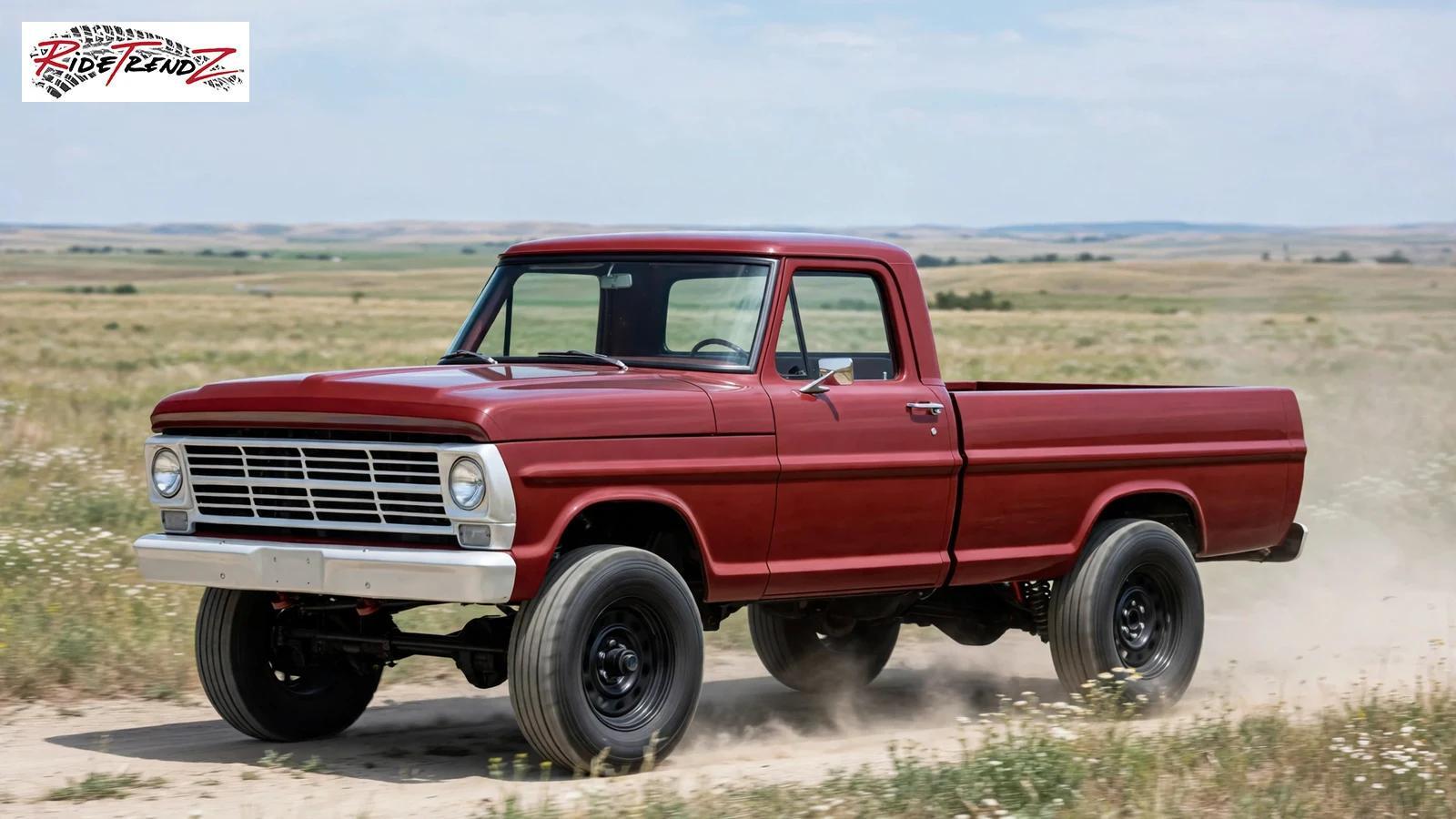
A mild lift is the sweet spot for a classic that still earns its keep, because it levels the truck, clears a sensible tire, and keeps factory adjustments in range. The 1965 to 1979 F100 and F200 lift kit range groups the heights so owners can compare spacer and block combinations in one place. Most owners stop here happily.
Source: Wikipedia, Tire
Taller lifts and their trade-offs
Past the mild range, each extra inch buys clearance and charges interest in steering correction, brake line length, and driveshaft angle. A 1965-1979Ford F1000 lift kit chosen a size too tall is the most common regret in classic builds. Our classic truck lift kit guide shows how the same trade-offs hit a Chevy build.
Source: Wikipedia, Suspension lift
Steering, alignment and safety after the lift
A lift is only finished when the truck steers straight, stops straight, and tracks without wandering. Budget alignment time into every 1965-1979Ford F1000 lift kit install, because taller tires and changed geometry expose every worn steering joint. The checks below separate a truck that feels planted from one that keeps its driver busy at highway speed.
Source: Wikipedia, Camber angle
Camber, caster and bushing checks
On the I-beam truck, ask the alignment shop to set camber with correct bushings and confirm caster stays in range for stable tracking. On the 4WD truck, caster shims at the spring perches do the same job. Worn bushings undo good alignment quickly, so replace tired rubber while the suspension is apart.
Source: Wikipedia, Caster angle
Steering linkage and bump steer
Raising the chassis changes the drag link angle between the steering box and the axle or beam linkage, and a steep angle can tug the wheel over bumps. Inspect tie rod ends, the drag link and the steering box mount for play before blaming the lift. Our guide to lift parts against complete kits shows why matched kits include correction hardware.
Source, Wikipedia, Steering
Brake lines, hoses and hardware checks
Brake lines and rubber hoses were sized for stock travel, and added droop can pull a hose tight at full lock or full droop. Check every line for stretch and chafing, extend brackets where provided, and confirm the parking brake cable runs free. Torque every U-bolt again after the first short drive.
Source: Wikipedia, Brake
Install order for a clean weekend job.
Working in the right order keeps the truck safe on stands and stops parts fighting each other during assembly. Support the chassis, work one end at atimem,e and keep steering and brake hardware connected until each corner is ready. The steps below suit both drivetrains and should make the 1965-197Ford F10000 lift kit install a one-weekend job.
Install steps
- Support the truck on rated stands and chock the remaining wheels
- Measure and record the stock height at all four corners
- Remove the wheels and support the axle or beams before unbolting springs
- Fit the front spacers or spring parts and torque to the kit sheet
- Fit the rear blocks with new U-bolts and the correct taper direction
- Install the longer shocks matched to the new ride height
- Check brake lines, hoses and steering at full lock and full droop
- Settle the truck, torque everything again and book the alignment
Source: Wikipedia, Shock absorber
Tools, prep and safety gear
A floor jack, rated stands, a torque wrench, penetrating oil and a full socket set cover most of this job, and a mechanic friend helps when springs come under tension. Work on flat ground and never under a truck held by a jack alone. Spraying every spring and shackle bolt a day early saves real time.
Source: Wikipedia, Ford F-Series
Mistakes that cost owners time
The classic errors are reusing stretched U-bolts, skipping the alignment, mixing 2WD and 4WD parts in one order, and tightening bolts while the truck hangs at full droop. Each one turns a good kit into a bad review. Owners can also read our notes on how long lift kits last before the first bolt turns.
Source, Wikipedia, Suspension lift
Living with a lifted classic F100
A lifted classic settles during its first weeks, and small checks keep it honest. Recheck U-bolt torque, watch tire wear for alignment drift, and listen for knocks over bumpsA well-chosennn 1965-1979 Ford F100 lift kit asks for nothing exotic after that, just normal old truck attention, and the later F100, F150, and F250 kit range shows the thinking carrying into the next generation.
Source, Wikipedia, Shock absorber
Maintenance checks after the first miles
Put the truck back on stands after the first few hundred miles and go over every fastener the kit touched. Springs settle, blocks seat and bolts relax slightly, and one torque pass restores the clamp load the design expects. Recheck alignment if the steering wheel sits off center, and grease every fitting while you are under there.
Source: Wikipedia, Leaf spring
Ride quality and daily driving notes
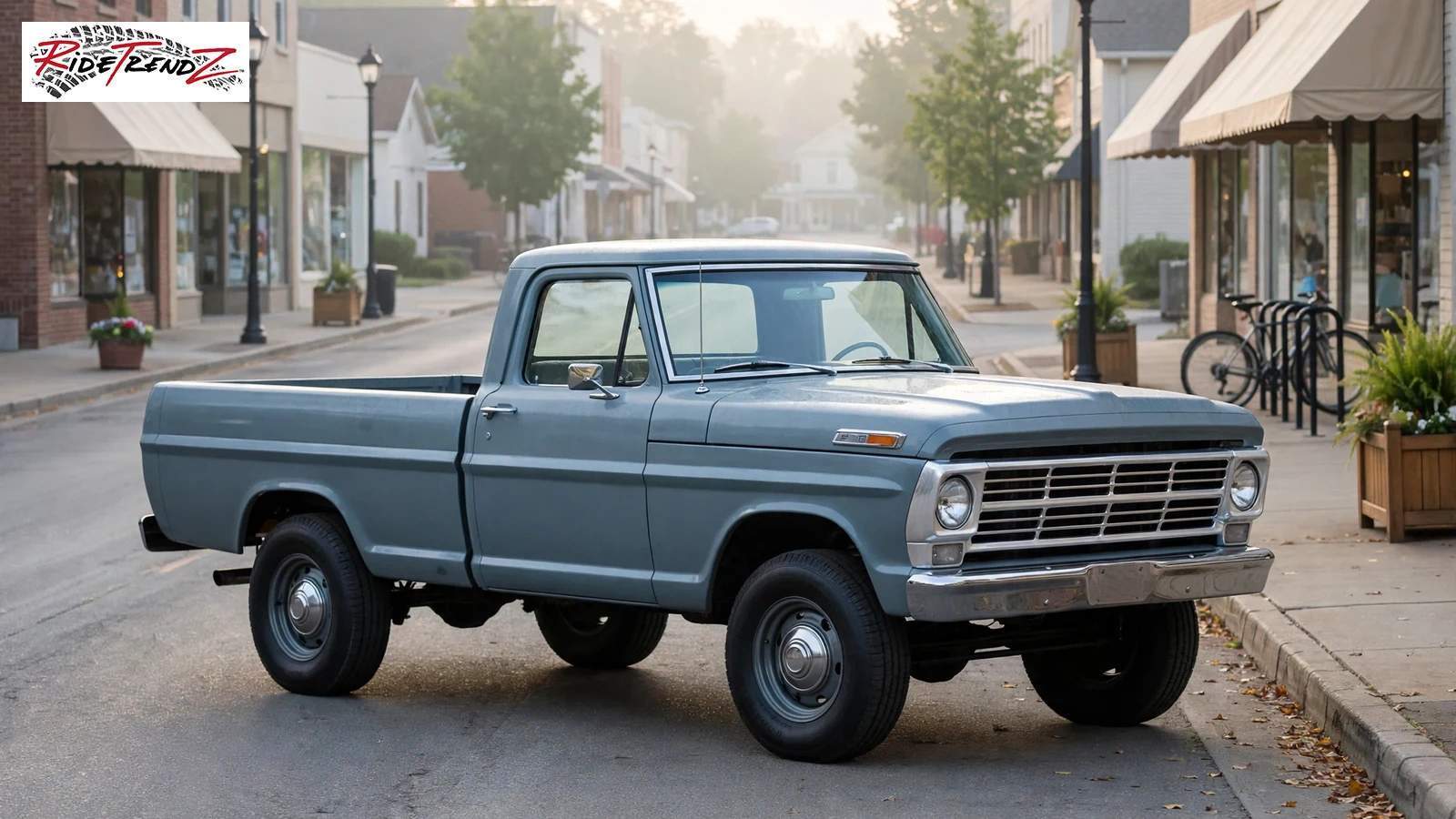
Expect a firmer, more controlled ride than the tired stock springs gave, with less nose dive and a steadier feel under load. Taller tires add road noise and can soften steering response, which is normal with correct pressures. Owners weighing a lifted daily against a lowered one can compare our lifted against lowered truck guide first.
Source: Wikipedia, Ford F-Series
Conclusion
The classic F100 rewards owners who respect the split between its two front ends. Lift a 2WD truck with spacers, blocks, and camber care, lift a 4WD truck with hardware matched to its live axle, and treat a conversion as the frame-deep project it is. Measure everything twice and choose the 1965-1979 Ford F100 lift kit that fits the truck in your driveway. When ready, the Ridetrendz team will check your year, cab, and drivetrain against the right 1965-1979Ford F1000 lift kit before you spend a dollar, because honest fitment advice is why this store exists.
Source: Wikipedia, Ford F-Series
Frequently asked questions
What is the difference between lifting a 2WD and a 4WD F100?
The 2WD truck lifts at its twin I-beam front end with coil spring spacers, and camber changes as the beams swing, so alignment range limits the sensible height. The 4WD truck lifts at a leaf-sprung live front axle with fixed geometry, so it tolerates more height before steering correction, at the cost of driveshaft angle checks.
Can I convert my 2WD F100 to 4WD with a lift kit?
No, a lift kit cannot convert a truck because the 2WD chassis lacks the live front axle, transfer case, leaf spring mounts,a nd front drive shaft that a 4WD truck needs. A conversion means a donor 4x4 frame or serious fabrication work. Most owners get a better result lifting the 2WD truck properly or buying a factory 4WD truck to build.
How much lift can a twin I-beam F100 take before camber becomes a problem?
Mild spacer lifts in the 2 to 3 inch range usually stay inside the adjustment range with the correct camber bushings fitted. Taller lifts push the beams far enough that camber correction runs out, and the truck then needs beam work or a different plan. An alignment shop that knows I-beam trucks should confirm the range for your exact year.
Do I need longer shocks after lifting my F100?
Yes, in almost every case, because stock length shocks reach the end of their travel early once spacers or blocks raise the truck, and a shock that tops out rides harshly. Shocks matched to the new ride height keep travel in both directions, which is why the kits pair lift hardware with longer shocks.
Will a lift kit from a 4WD F100 fit my 2WD truck?
No, the front hardware is built for two different suspensions: a leaf-sprung solid axle on the 4WD truck and a coil-sprung twin I-beam on the 2WD truck. Rear blocks and some hardware can look similar, but the front parts do not interchange. Always order by drivetrain and confirm the listing names your truck before paying.
What tire size works with a mild 2 to 3 inch lift?
Most owners run one size taller than stock and stay inside the factory arches without rubbing at full lock, but exact sizes vary with wheel offset, tire brand, and spring sag. Measure your own truck, compare against the arch space at full lock,k and treat forum sizes as a guide rather than a promise.
Can Ridetrendz help me check fitment before I order?
Yes, and it is the smartest step in the build. Send the team your year, model, cab style,le and drivetrain, and they will match the kit to the truck before you pay. That check catches the common mix-ups between F100 and F200 listings, 2WD and 4WD hardware, and spacer height, before anything ships.
Source: Wikipedia, Ford F-Series