

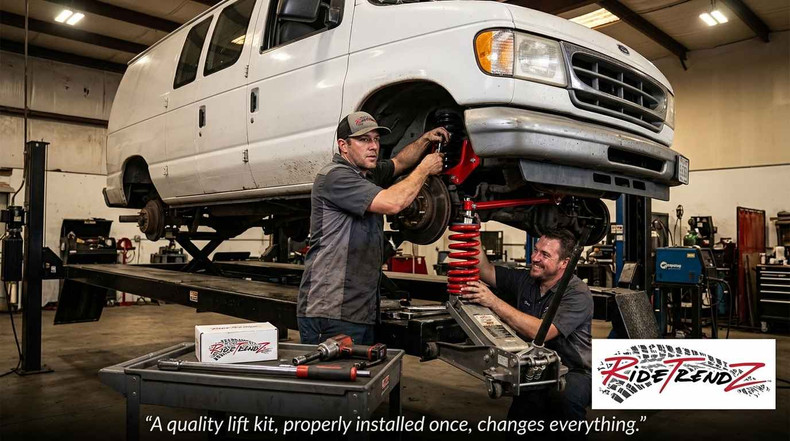
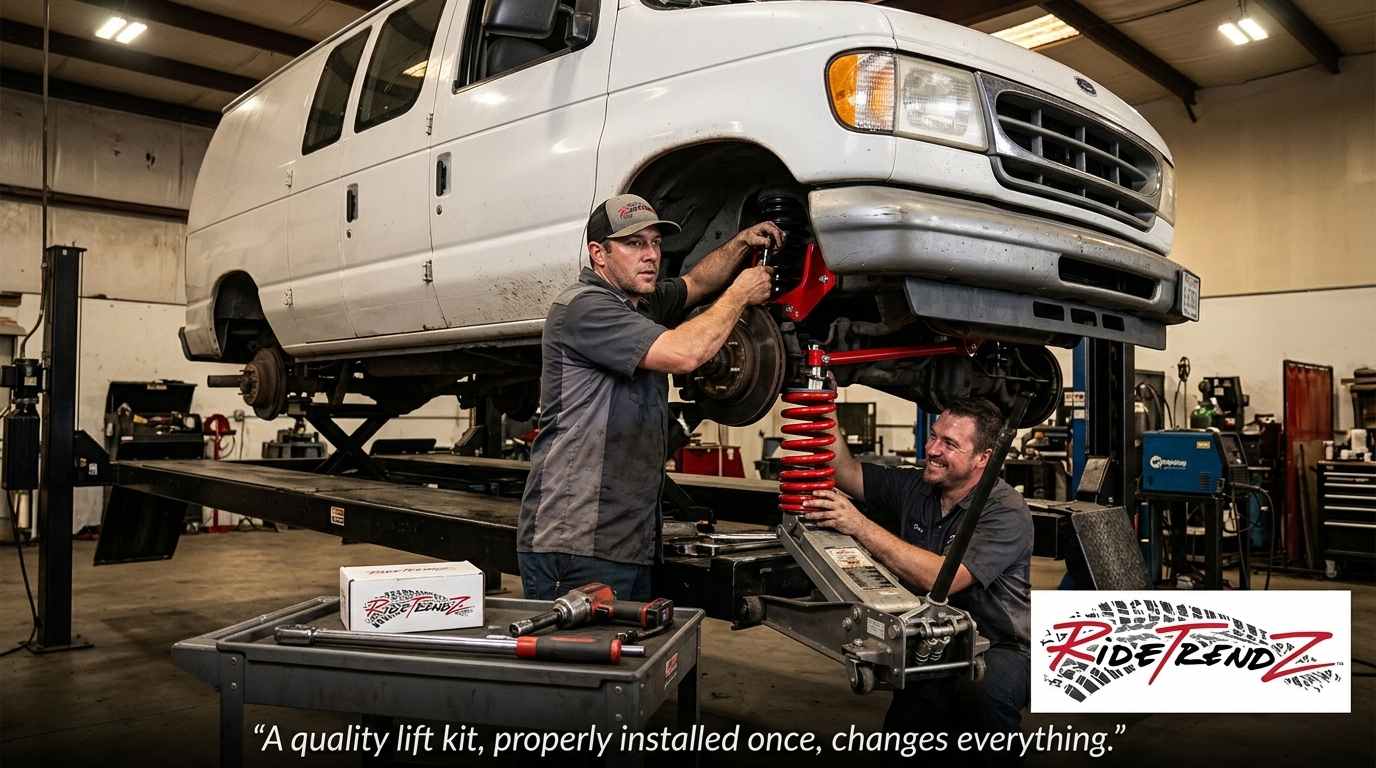
Most guides on lifting a Ford van skip the hard details: vehicle weight differences, axle specs, and what can actually go wrong during a lift kit installation. This guide doesn't. Everything here is grounded in real suspension knowledge built over years of helping truck and van owners upgrade their rides the right way.
Why Are Ford E-Series Van Owners Lifting Their Vans in 2025?
The Ford E-Series has been a workhorse for decades. Whether you drive a Ford E150, a Ford E250, or a heavy-duty Ford E350, one thing is clear: the stock suspension was built for payload, not clearance or presence.
Lifting a Ford Econoline van is no longer a fringe modification. More and more van-lifers, overlanders, tradespeople, and off-road enthusiasts are turning their Econoline vans into capable machines that can handle rough terrain without leaving ground clearance on the pavement.
Here is what the data tells us:
|
Van Modification Trend |
Stats (2023–2025) |
|
Van-life community growth |
+34% in active builds reported on forums |
|
Off-road van conversions |
Up 28% year-over-year |
|
Lift kit searches for Ford van models |
3x increase since 2022 |
|
Average lift height requested |
2 to 4 inches |
|
Most common reason for lifting |
Ground clearance for work sites or trails |
These numbers make sense. The Ford E350 box truck, the cargo van, the passenger van, all of them ride on the same frame family. That platform is solid and proven, which is exactly why a quality suspension lift kit transforms the platform rather than fighting it.
Understanding Your Ford E-Series Van Before You Lift It
Before choosing a lift kit, you need to understand what you are working with. The Ford E-series runs on a body-on-frame platform. This is actually good news for lift kit installation because it gives you room to work with and a stable base.
Key Differences Between E150, E250, and E350
|
Feature |
Ford E150 |
Ford E250 |
Ford E350 |
|
GVWR |
Up to 8,500 lbs |
Up to 8,600 lbs |
Up to 14,050 lbs |
|
Axle Type |
Twin-Beam IFS |
Twin-Beam IFS |
Solid front axle |
|
Typical Use |
Passenger, light cargo |
Cargo, fleet |
Heavy cargo, E350 box truck |
|
Lift Compatibility |
Coil spacer, suspension |
Coil spacer, suspension |
Block kits + suspension |
|
Recommended Lift Height |
2–4 inches |
2–4 inches |
2–3 inches |
The Ford E350 deserves special attention. Because it often runs a solid front axle rather than the twin I-beam setup on lighter Ford E-Series van models, your approach to lift kit installation changes. Always verify your axle configuration before ordering.
Why the Ford Econoline Platform Is Lift-Friendly?
The Ford Econoline body-on-frame design is one of the most forgiving platforms for suspension work. You are not fighting strut towers or complex multi-link geometry from the factory. The twin I-beam front suspension on E150 and E250 models responds well to coil spring spacers and radius arm drop brackets.
If you want to understand the full mechanics of what happens during a suspension lift kit installation, this guide from RideTrendz breaks it down clearly: What Is a Suspension Lift Kit? Types & Benefits
Types of Lift Kits for Ford E-Series Vans

Not every lift kit is the same. Choosing the wrong type for your Ford Econoline van leads to alignment nightmares, premature tire wear, and a rough ride. Here is a breakdown of your options.
1. Coil Spring Spacer Kits (Leveling Kits)
A leveling kit uses aluminum or polyurethane spacers that sit above the existing coil spring. They are the simplest and most budget-friendly entry point. On E150 and E250 models, a 2 to 3-inch spacer kit gives you immediate ground clearance without major modifications.
Pros:
- Affordable (typically $80–$200 installed)
- Minimal installation time (2–4 hours)
- Reversible
- Works well with stock shocks
Cons:
- Limited lift height (usually 2–3 inches max)
- Does not improve off-road articulation
- May require new shock absorbers for taller spacers
2. Full Suspension Lift Kits
A full suspension kit replaces or modifies multiple components: suspension springs, control arms, radius arm brackets, shocks, and sometimes differential drop spacers. This gives you more clearance, better geometry correction, and the ability to run larger tires.
Pros:
- More lift height (3–6 inches)
- Better ride quality and articulation
- Proper geometry correction included
- Supports larger tire fitment
Cons:
- Higher cost ($300–$800+ for parts)
- More complex lift kit installation (4–8+ hours)
- May require professional alignment after install
3. Body Lift Kits (Body Lift vs Suspension Lift)
A body lift adds spacers between the body and frame. It gives you clearance to run bigger tires without changing suspension geometry. However, body lifts do not improve ground clearance under the differentials or axles.
Body Lift vs Suspension Lift, Key Comparison:
|
Factor |
Body Lift |
Suspension Lift |
|
Ground clearance (axle/diff) |
No change |
Improved |
|
Ride quality change |
Minimal |
Improved with good kit |
|
Tire fitment improvement |
Yes |
Yes |
|
Off-road articulation |
No change |
Better |
|
Cost |
Lower |
Moderate to higher |
|
Best for |
Appearance + tire size |
Real off-road use |
For most Ford E-series owners, a suspension lift kit is the better investment. It solves the real problems: clearance, capability, and long-term ride quality.
To understand how lift kits work mechanically before you install anything, read: How Does a Truck Suspension Lift Kit Work? A Simple Explanation
How Much Does It Cost to Lift a Ford E-Series Van?
How much does it cost to lift a truck? It is one of the most common questions we hear. Here is a realistic breakdown for Ford E-Series van models:
|
Lift Type |
Parts Cost |
Labor Cost |
Total Estimate |
|
Leveling kit (2 in) |
$80–$200 |
$100–$200 |
$180–$400 |
|
Suspension lift (3 in) |
$250–$500 |
$200–$400 |
$450–$900 |
|
4-inch lift kit |
$400–$700 |
$250–$500 |
$650–$1,200 |
|
6-inch lift kit |
$700–$1,200 |
$400–$800 |
$1,100–$2,000 |
|
Alignment (always needed) |
— |
$80–$150 |
— |
A few things drive cost up:
- Additional components like suspension springs, shock extenders, or differential drops
- Your labor market (shop rates vary widely)
- Alignment is non-negotiable after any lift kit installation; factor it in
RideTrendz parts are priced to help you stay in the lower half of these ranges without cutting quality. That is the combination most van owners are looking for.
Step-by-Step, Ford E-Series Lift Kit Installation
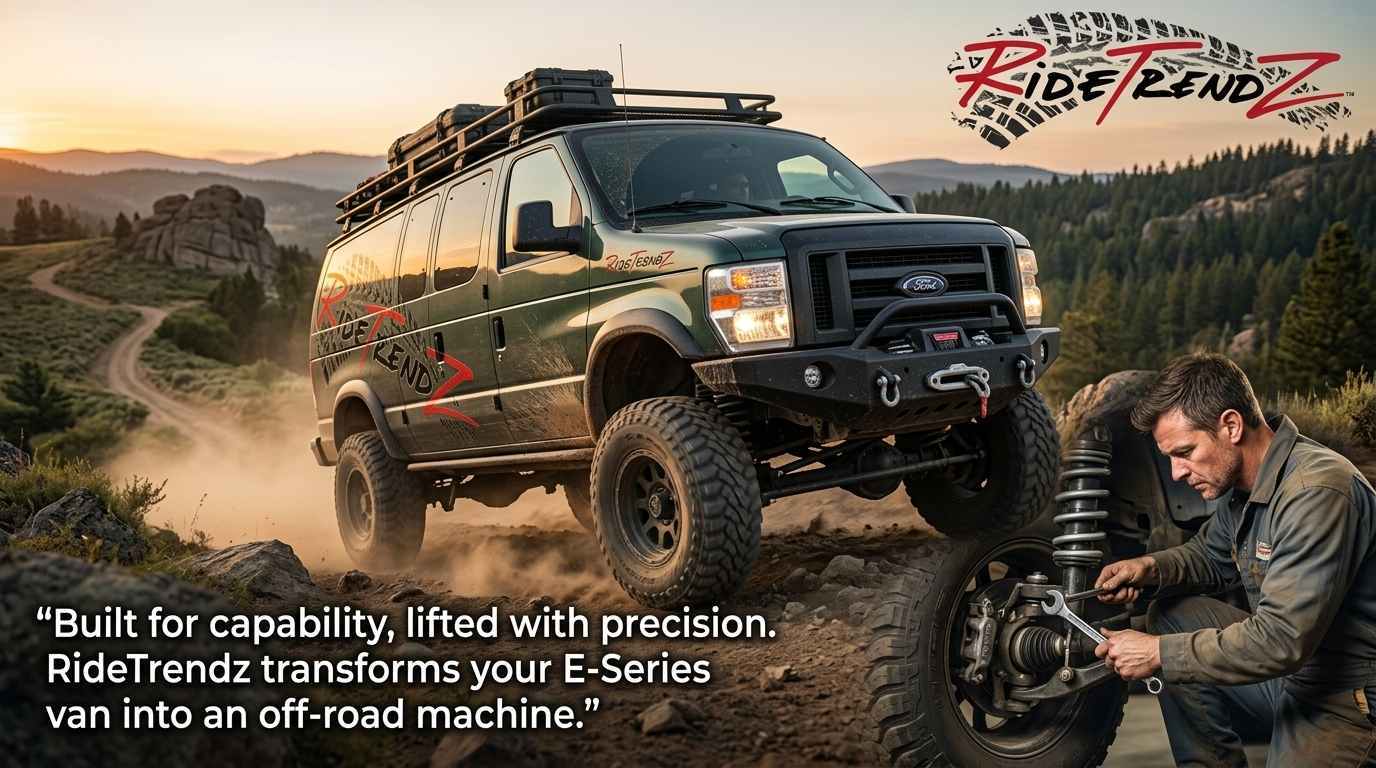
This section covers a standard coil spring spacer or entry-level suspension lift kit installation on a Ford E150, E250, or E350. More complex full suspension lifts follow a similar process but add steps for control arm drops and radius arm relocation.
Tools you will need:
- Floor jack and jack stands (rated for your van's GVWR)
- Torque wrench
- Spring compressor (for full suspension work)
- Socket set (metric and SAE)
- Breaker bar
- Penetrating oil (WD-40 or PB Blaster)
- Alignment gauge or alignment shop appointment post-install
Step 1, Prepare the Vehicle and Workspace
Park on a flat, level surface. Chock the rear wheels. Disconnect the battery's negative terminal as a precaution. Gather all parts and hardware from your suspension kit and lay them out.
Spray every bolt you plan to remove with penetrating oil the night before if possible. Ford van suspension hardware that has lived through winters corrodes fast. Skipping this step adds hours to your lift kit installation.
Step 2, Safely Raise and Support the Front of the Van
Use your floor jack at the manufacturer-specified lift points under the frame. Never lift from the axle or differential on the Ford E150 and E250 twin I-beam setup. Once the van is raised, place jack stands under the frame, not the axle.
For the Ford E350 with a solid front axle, you can support it under the axle housing after the frame is secure. Double-check stability before going under.
Step 3: Remove the Front Wheels and Access the Suspension
With the wheels off, you can clearly see the coil spring, upper spring perch, and radius arm bracket. On Ford E-Series models, the spring sits vertically in a cup between the frame and the upper control arm area.
Photograph everything before you remove a single bolt. Your phone is your best friend during any suspension kit work.
Step 4: Compress or Remove the Coil Spring
For spacer-style leveling kits: you typically do not need to fully remove the spring. You just relieve tension enough to slide the spacer above or below the spring.
For full suspension kit replacement: you will compress the spring using a spring compressor, remove the upper retaining hardware, carefully lower the spring out, and install the new coil spring or suspension springs. Take your time here. A spring under compression stores serious energy; respect it.
Step 5, Install the Lift Spacer or New Springs
Slide the spacer into position on top of the spring perch (for spacer kits). Torque the retaining hardware to spec as listed in your suspension kit instructions. Do not estimate torque by feel.
For full replacement springs, seat the new coil spring properly in the lower cup, compress to align with the upper perch, and secure per spec. Incorrect spring seating is a common mistake that causes noise and premature wear.
Step 6, Reinstall Wheels and Repeat on the Other Side
Always work both sides before dropping the van back to the ground. Uneven height during installation can cause binding in the suspension that makes torque specs unreliable.
Step 7, Complete the Rear Lift (If Applicable)
Full lift kit packages for Ford Econoline van models often include a rear component, usually lift blocks, extended shackles, or add-a-leaf springs depending on the generation. Follow the same methodical process: safely support the rear axle, remove the existing hardware, install the new components, torque to spec.
Step 8: Get a Professional Alignment
This is not optional. A lift kit installation changes your front-end geometry. On Ford E-Series twin I-beam setups, alignment shift is predictable but real. Skipping an alignment after lifting leads to rapid tire wear and wandering handling.
Budget $80–$150 for a quality four-wheel alignment. It is the cheapest insurance for your new setup.
What Size Lift Is Right for Your Ford Van?
|
Goal |
Recommended Lift |
Notes |
|
Level stance, slightly bigger tires |
Leveling kit (1.5–2 in) |
Simplest option, minimal changes |
|
Moderate off-road / work-site clearance |
3-inch suspension lift |
Best balance of ride and capability |
|
4-inch lift kit |
Larger tires, serious trails |
May need extended brake lines |
|
6-inch lift kit |
Maximum clearance, show builds |
Requires significant supporting mods |
Most Ford E150 and Ford E250 drivers are happiest in the 2–4 inch range. The Ford E350, being heavier, often works best with a conservative 2–3 inch lift that does not stress the front axle under load.
Why RideTrendz Lift Kits Are the Right Choice for Your Ford Van?
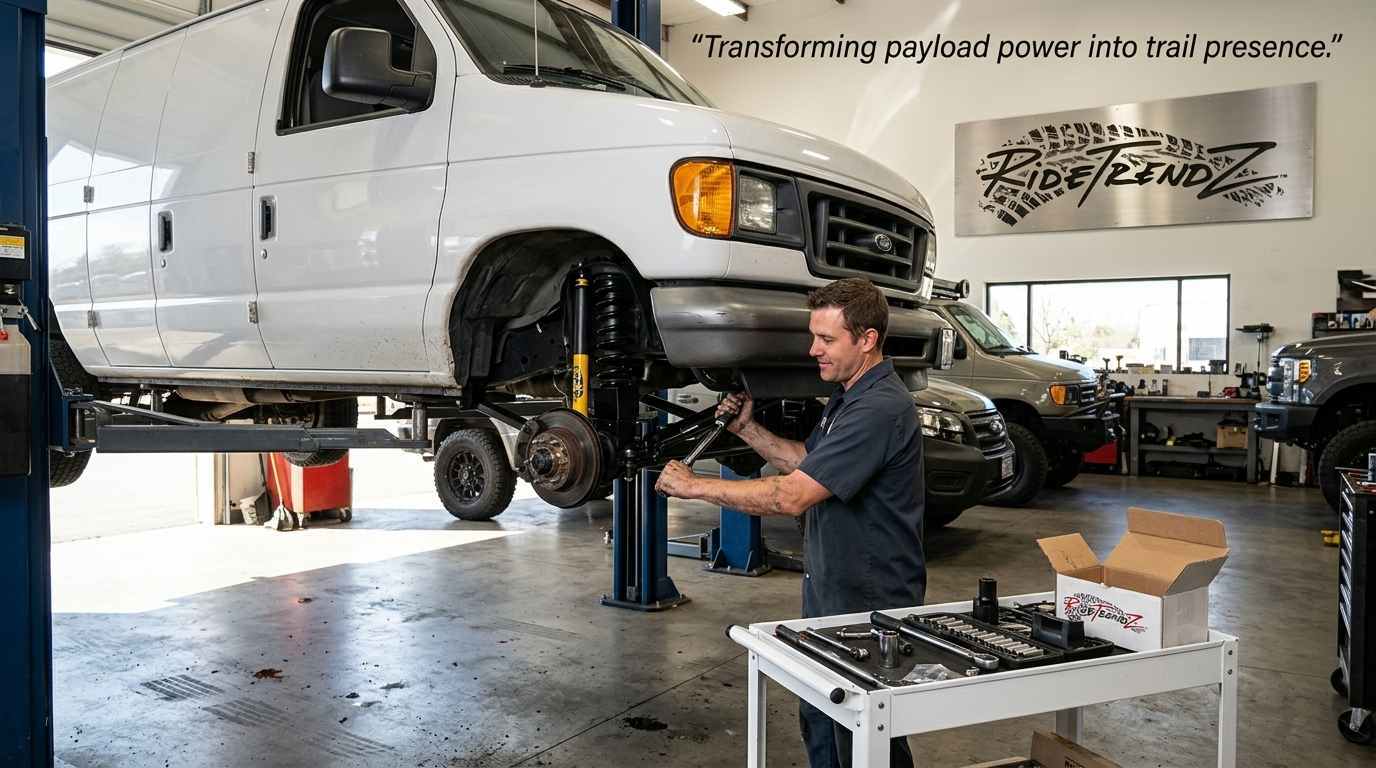
Not all suspension parts are equal. You can find cheap imported spacers on marketplace sites. You can also find them cracking, compressing over time, or arriving with hardware that strips on the first installation attempt.
RideTrendz designs and sources parts with real-world use in mind. Here is what makes the difference:
American-Made Engineering Standards
RideTrendz products meet the engineering standards that matter for heavy vehicles like the Ford E-Series van. Learn more about why that matters: Why Buy USA-Made Suspension Parts vs Generic Brands
Fitment Accuracy
Every suspension kit from RideTrendz is vehicle-specific. The kit built for a Ford E150 is not the same geometry as one for a Ford E350. Fitment matters more than price when you are putting 6,000+ lbs on jack stands.
Complete Kits, Not Puzzle Pieces
RideTrendz offers complete lift kit solutions so you are not hunting for missing hardware. For a side-by-side look at when complete kits make more sense than individual parts: Lift Parts vs Complete Lift Kit: Which to Buy
Customer Support That Actually Knows Suspension
When you call or message RideTrendz with a question about your Ford Econoline build, you get answers from people who understand coil spring rates, I-beam geometry, and load ratings, not a script reader.
Lift Kit vs Leveling Kit, Which Does Your Ford Van Need?
This is genuinely one of the most common points of confusion for first-time buyers. Here is the short answer: if you want both front and rear raised evenly and you plan to go off-road or carry heavy loads regularly, a lift kit is the answer. If you just want to level a slightly nose-low Ford van or gain an inch or two of clearance, a leveling kit gets the job done for less.
For a deeper breakdown: Lift Kit vs Leveling Kit: Which One Does Your Truck Actually Need?
Shocks Matter After Your Lift Kit Installation
Here is something that gets skipped too often: once you complete your lift kit installation, your stock shocks are probably wrong for the new ride height.
Stock shocks are valved and sized for stock ride height. A 3-inch lift puts your stock shocks near or at the edge of their travel. This causes harsh bottoming, reduced damping, and faster wear.
RideTrendz Primo Nitro Gas Charged Shocks are matched to lifted applications. They are available for a range of ford van models and sized to match common lift kit heights.
For the full explanation on this: Lift Shocks vs Stock Shocks: What You Really Need After a Lift
Common Mistakes During Ford Van Lift Kit Installation
Even experienced mechanics make these mistakes on first-time van lifts. Avoid them.
- Skipping penetrating oil on rusty hardware. Rounded or snapped bolts can turn a 3-hour job into a full-day ordeal.
- Not checking brake line length: Taller lifts can stretch or stress brake lines. On Ford E350 models especially, check line length at full droop after installation.
- Installing without a torque wrench: Suspension hardware has precise torque specs. Over-tightened bolts strip threads. Under-tightened hardware loosens on the road.
- Skipping the alignment already mentioned above, but worth repeating. Do not skip it.
- Buying the wrong kit for your axle configuration. The E350 solid axle requires different components than the E150/E250 I-beam setup. Confirm your axle type before purchasing.
- Ignoring load ratings: The Ford E350 box truck configuration carries more weight. Your suspension springs need to be rated for your loaded GVWR, not just the van's base curb weight.
How Long Will Your Lift Kit Last?
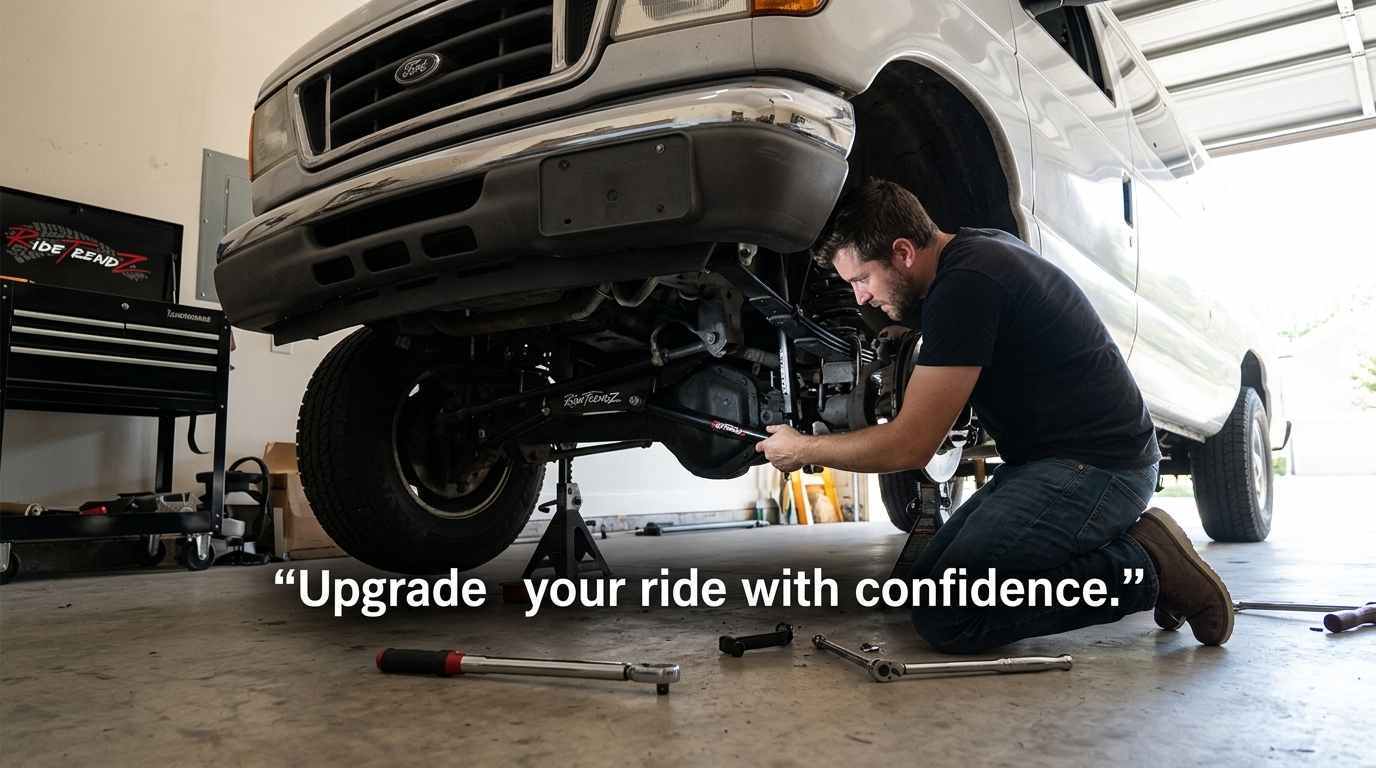
A quality suspension kit from RideTrendz is built to last. Here is what a realistic lifespan looks like:
|
Component |
Expected Lifespan |
What Shortens It |
|
Aluminum spacers |
8–15 years |
Corrosion, overtightening |
|
Coil spring replacements |
80,000–120,000 miles |
Overloading, rough terrain |
|
Lift blocks |
10+ years |
Improper installation |
|
Nitrogen gas shocks |
50,000–70,000 miles |
Leaking seals, lack of inspection |
Inspect your suspension kit components annually. For a full maintenance breakdown: How Long Do Lift Kits Last? Lifespan & Maintenance Guide
Pros and Cons, Lifting Your Ford E-Series Van
Pros
- More ground clearance, Navigate worksites, uneven terrain, and rough trails without scraping
- Bigger tire fitment, Run up to 33+ inch tires depending on lift height
- Better off-road capability, Improved articulation and approach angles
- Improved appearance, An aggressive, purposeful stance
- Utility expansion, Van-life and overlanding builds benefit significantly
Cons
- Higher center of gravity, Handling changes; take corners with more awareness
- Cost of alignment, Required every time you change suspension height
- Fuel economy impact, Larger tires and higher stance increase aerodynamic drag slightly
- Potential brake line extension, Required on 4-inch lift kit and 6-inch lift kit heights
- Void factory warranty, Relevant if the van is newer
Ford E-Series Lift vs Other Popular Van Platforms
|
Platform |
Lift Compatibility |
Common Lift Range |
RideTrendz Support |
|
Ford E150/E250 |
High, I-beam friendly |
2–4 inches |
Yes |
|
Ford E350 |
Moderate, heavier platform |
2–3 inches |
Yes |
|
Ford Transit |
Lower, monocoque body |
1–2 inch spacers only |
Check fitment |
|
Mercedes Sprinter |
Limited, strut-based |
1.5–2 inch max |
Limited |
|
RAM ProMaster |
Limited, FWD platform |
1–2 inch leveling |
Limited |
The Ford E-series van body-on-frame construction genuinely makes it one of the most lift-friendly large vans on the market. The Transit and Sprinter competitors cannot match that flexibility.
Recommended RideTrendz Products for Ford Owners
While specific Ford Econoline spacer kits are in development within the RideTrendz lineup, here are proven RideTrendz kits that demonstrate the engineering approach applied across Ford van models:
- RTZ Ford F150 1997–2003 Front 2.5" Lift Leveling Aluminum Coil Spring Spacers Kit, shows the aluminum spacer quality applied to Ford platforms
- RTZ Ford Expedition/F150 1997–2003 Front 3" Lift Leveling Aluminum Coil Spring Spacers Kit, Higher clearance option for larger Ford vehicles
- RTZ Ford F150 1997–2003 Complete Lowering Kit, Demonstrates complete kit engineering on Ford platforms
- RTZ Ford F150 Pickup Truck Set of Lifted Primo Nitrogen Gas Charged Shocks 4WD for 3/2 Lift Kit, Matched shocks for post-lift performance
Contact the RideTrendz team directly for custom fitment confirmation on your Ford E-Series application. The team will verify compatibility before you order; that is the RideTrendz standard.
Suspension Basics Every Ford Van Owner Should Know
If you are approaching suspension work for the first time, a few foundational concepts will make your entire build process easier and your conversations with parts suppliers more productive.
Coil springs store and release energy as the suspension compresses and rebounds. Stiffer springs carry more load but ride harsher. Softer springs ride better but sag under weight. On a working van like the Ford E250 or Ford E350, spring rate selection is about balancing loaded and unloaded behavior.
Suspension springs and shocks work together. The spring controls ride height and load capacity. The shock controls how fast the spring compresses and rebounds. Neither does its job well when mismatched.
For the full beginner's introduction: Truck Suspension Basics for Beginners
When to Buy Parts vs a Complete Lift Kit?
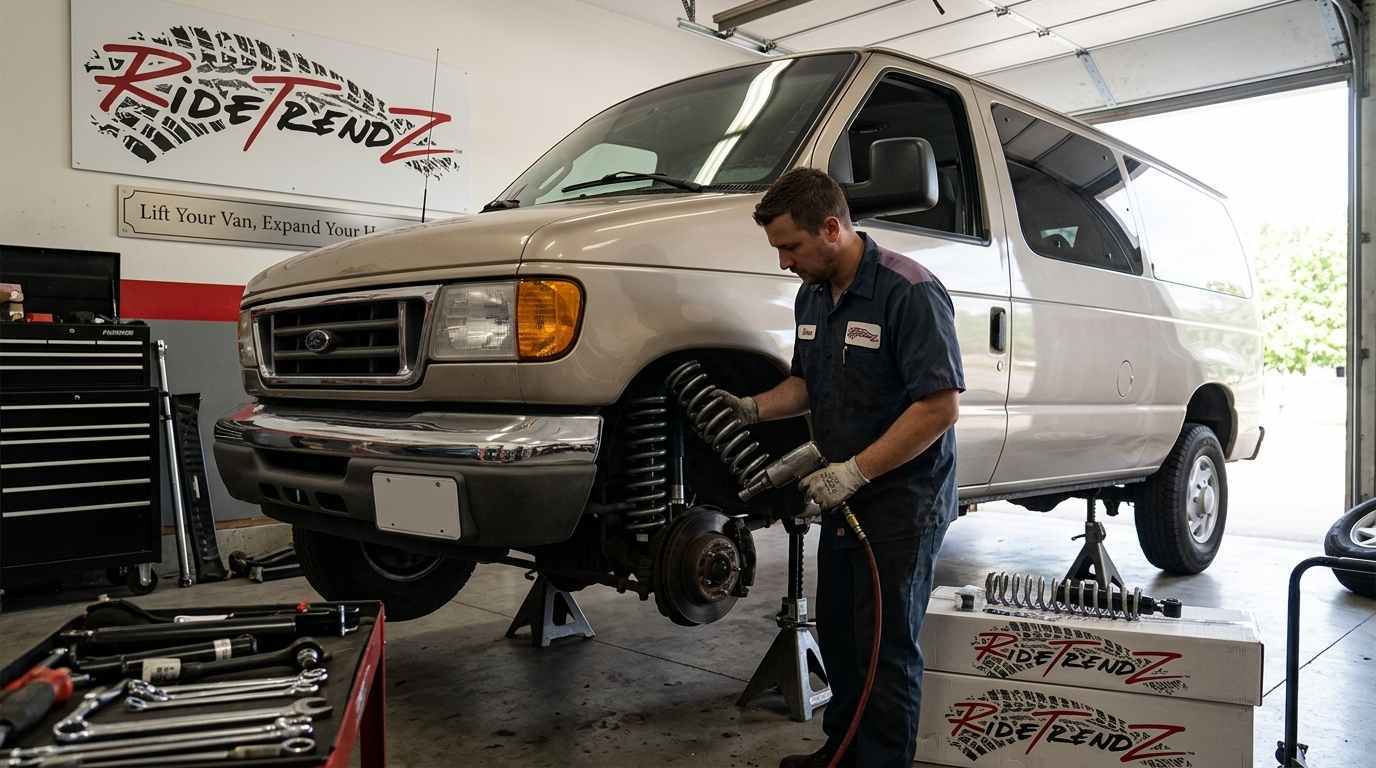
Some owners prefer to piece together their own setup from individual components. Others want a single-box solution. Both approaches work, but they suit different situations.
Buy individual parts when:
- You already have serviceable shocks
- You only need a spacer at one end
- You are building a staged lift over time
Buy a complete suspension kit when:
- You want a single install session
- You are new to lift kit installation
- You want guaranteed component compatibility
More on how to decide: When to Buy Suspension Parts vs Complete Lift Kit
Conclusion
Lifting a Ford E150, Ford E250, or Ford E350 is one of the most rewarding upgrades you can make to these vans. The Ford E-Series platform is built for it: solid, proven, and genuinely compatible with a range of lift kit solutions from basic leveling kits to full 4-inch lift kit and 6-inch lift kit setups.
The key is choosing quality parts, understanding your specific van's suspension configuration, and not skipping the post-install alignment. A proper lift kit installation done once, done right, lasts years and pays you back in capability and confidence every time you hit the road or trail.
RideTrendz is the partner you want for that work. The engineering is right. The fitment is specific. The support is real. Browse the full suspension catalog at ridetrendz.com and reach out with your ford van specs; the team will get you into the right kit.
Frequently Asked Questions
Q1: Can I lift a Ford E350 box truck with a standard suspension lift kit?
Yes, but verify your axle type first. The Ford E350 often has a solid front axle, requiring different components than the twin I-beam Ford E150 setup. Always confirm before ordering a suspension kit.
Q2: How long does a Ford E-series lift kit installation take?
A leveling kit installs in 2–4 hours. A full suspension lift kit with shock replacement takes 5–8 hours. Allow extra time for rusty hardware on older Ford Econoline van models. Budget for same-day alignment.
Q3: Do I need new shocks after a lift kit installation on my Ford van?
For lifts over 2 inches, yes. Stock shocks reach the edge of travel at lifted height and degrade quickly. RideTrendz Primo Nitro shocks are matched to common lift kit heights for Ford van models.
Q4: What is the maximum safe lift height for a Ford E250 or E350?
Most experts recommend 3–4 inches for the Ford E250 and 2–3 inches for the Ford E350. Taller 4-inch lift kit or 6-inch lift kit heights require supporting mods, brake line extensions, geometry correction.
Q5: How much does it cost to lift a Ford E-series van?
A basic leveling kit runs $180–$400 installed. A full suspension lift kit costs $450–$1,200 depending on lift height. Always add $80–$150 for a professional alignment after any lift kit installation.