


 How to Lower a Dodge Dakota: 2WD V6 vs. V8 Drop Guide (1987–2004)
If you want to lower your Dodge Dakota and get that clean street-truck stance, a Dodge Dakota lowering kit is the proven way to lower a 2WD truck without cutting corners, literally. The Dakota (1987–2004) is one of the best pickup trucks to drop: it is light, simple, and responds beautifully to a proper static drop with matched shocks.
The best Dodge Dakota lowering kit for a 1987–2004 2WD Dakota is a complete 2/3 or 3/4 kit with lowering springs or drop spindles up front, blocks or a hanger kit out back, and shorter shocks at all four corners. Belltech lowering kit components set the benchmark, and Ridetrendz bundles the same proven suspension parts coils, blocks, and gas-charged shocks- into complete kits for both V6 and V8 trucks.
This guide walks you through every option: coil vs. spindle front drops, leaf spring rear methods, 2nd gen vs. early-truck differences, V6 vs. V8 spring rates, and the install tips that separate a truck that rides great from one that rattles. Every recommendation below is one Ridetrendz actually stocks and supports.
Lower Your Dakota Pickup the Smart Way, Ride Height, Center of Gravity & Ride Quality
Why lower a Dakota pickup at all? Three reasons: looks, handling, and drivability. Dropping the ride height 2–4 inches slams the visual stance, lowers the center of gravity, and cuts body roll so the truck feels planted instead of floaty. A quality Dodge Dakota lowering kit also tightens up the soggy factory tune without punishing you on daily roads.
Pros of lowering your Dakota
- Sharper steering response and flatter cornering
- Better aerodynamics and a tougher street-truck look
- Easier loading, the bed sits closer to the ground
- A lower center of gravity improves emergency handling
Cons to plan for
- Less ground clearance on steep driveways and speed bumps
- You must budget for shorter shocks; factory shocks will top out and ride harshly
- Deep drops need bump stops trimming and an alignment
The golden rule: drop it with a complete system, not a shortcut. Cutting springs and heated coils save money once and cost you ride quality forever. A proper kit keeps suspension travel where it belongs and keeps the truck safe at front and rear. For a proven starting point, look at these front lowered shocks for 1997–04 2WD (3-inch drop coils) and this breakdown of lowering your truck: benefits, risks, and choosing the right lowering kit.
Belltech vs. Other Dodge Dakota Lowering Kits, Which Suspension Setup Wins?
Belltech built its name on dropped trucks, and a Belltech lowering kit remains the reference point every other kit is judged against. But "Belltech-style" complete kits, like the ones Ridetrendz assembles with Doestch Tech nitro shocks and precision coil springs, deliver the same drop architecture at a friendlier price. When owners and enthusiasts compare a Dodge Dakota lowering kit built on proven geometry against a generic aftermarket bundle, the difference shows up in three places: spring rate accuracy, bushing quality, and whether the shocks are actually valved for a lowered truck.
|
Kit approach |
Typical drop |
Ride quality |
Alignment friendliness |
Best for |
|
Complete 2/3 or 3/4 kit (coils + blocks + shocks) |
2–4 in. |
Excellent, matched rates |
Good with alignment |
Daily-driven street trucks |
|
Drop spindles + rear blocks |
2 in. front |
Near-stock, keeps factory spring rate |
Excellent |
Owners who want OEM comfort |
|
Budget coil-cut / heated springs |
Unpredictable |
Poor, stiffer in the wrong places |
Bad |
Nobody, avoid this |
|
Piecemeal parts from mixed brands |
Varies |
Hit or miss |
Extra shop time |
Builders who enjoy troubleshooting |
The takeaway: buy the drop as a system. Ridetrendz's complete kits are curated so the coils, blocks, and shocks work together, no guesswork, no mixed-brand surprises. Compare a 2/3 complete lowering kit for the V8 2WD with Doetsch Tech nitro shocks with our Dodge Ram lowering kit guide to see how the same system thinking applies across Dodge trucks. A well-matched Dodge Dakota lowering kit rides better than stock while looking twice as mean.
Front Drops, Coil Springs, Drop Spindles & Control Arms for Your Dodge Dakota
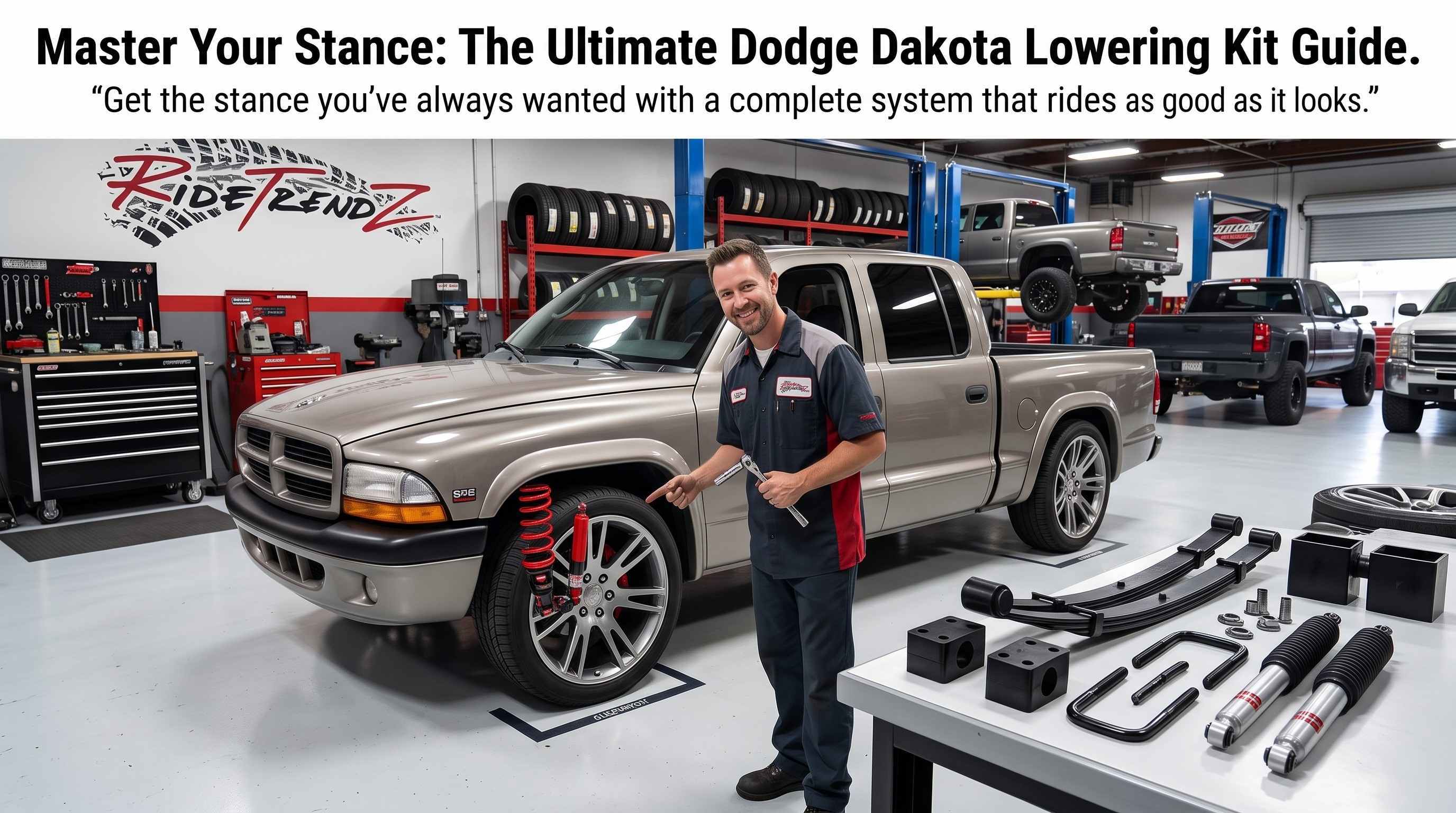
Up front, a Dodge Dakota lowering kit for the 2WD Dakota uses one of three methods, and the right pick depends on how low you want to go.
- Lowering springs (coil springs). A shorter, higher-rate coil replaces the factory spring for a 2–3 inch drop. Simple, affordable, and effective. The spring rate must match your engine: a V8 needs a firmer coil than the 3.9L V6, or the nose will sit low and crash over bumps.
- Drop spindles. A drop lower control arms alternative that purists love: the spindle itself is redesigned so the wheel mounts 2 inches higher while the spring, shock, and suspension travel stay stock. Because each lower control arm, bushing, and ball joint keeps its factory geometry, alignment stays easy and the ride stays factory-smooth.
- Drop lower control arms. Tubular arms that reposition the ball joint and spring pocket for a 3-inch drop with corrected geometry. Each lower control arm in a good set is jig-welded and uses fresh bushings.
Whichever route you take, fresh hardware matters: worn ball joints and tired bushings will make even the best kit feel sloppy. Set the front tires to the alignment shop's spec immediately after the install; a lowered truck with toe-out will chew tires in weeks. See our front lowered shocks for 1997–04 (4-inch drop with coils and lower control arms) and the Ford Ranger lowering kit guide for how coil-spring trucks are dropped across brands. If your Dodge Dakota lowering kit uses lowering springs alone, keep the drop at 2–3 inches to protect ball-joint angles.
Rear Lowering Kit Options, Leaf Spring Hangers, Shackles & Blocks
Out back, a Dodge Dakota lowering kit for the Dakota works with the factory leaf spring pack, no expensive four-link needed. Four methods dominate, and a complete Dodge Dakota lowering kit usually pairs one of the first three with shorter shocks.
|
Rear method |
Drop |
Cost |
Ride effect |
Notes |
|
Steel lowering blocks |
2–4 in. |
$ |
Near-stock |
Sits between axle and spring; check pinion angle past 3 in. |
|
Drop shackles |
1–2 in. |
$ |
Near-stock |
A longer shackle swings the spring eye down |
|
Hanger kit |
2 in. |
$$ |
Near-stock |
Replaces the front spring hanger; moves the mount higher on the frame |
|
Axle flip kit |
5–6 in. |
$$$ |
Firmer |
Needs a C-notch and bump stops work |
The hanger kit deserves special attention: factory hangers are rivet-mounted to the frame, so installation means drilling out rivets and bolting the new hanger in place, a Saturday job with basic tools. Blocks are the simplest rear lowering kit of all: unbolt the U-bolts, slide the block between the rear leaf pack and the axle, and torque everything to spec.
For drops beyond 4 inches, a C-notch cut into the frame rail restores suspension travel so the axle never slams the frame, and trimmed bump stops keep the last inch of travel progressive instead of harsh. Pair the rear drop with rear lowered shocks for 1997–04 2WD (3-inch drop blocks) and read how to install a lowering kit on your truck before you start.
Shock Absorbers & Suspension Travel, Matching Dampers to Your Drop
Here is the step everyone wants to skip: every Dodge Dakota lowering kit needs shorter shock absorbers. A shock controls the spring, and when you remove 2–4 inches of ride height, the stock damper runs out of stroke. The result is topping out over dips, bottoming over bumps, and suspension travel that feels violent instead of controlled.
What to look for in lowering shocks
- Shortened body and shaft matched to your exact drop (2 in., 3 in., or 4 in.)
- Nitrogen gas-charged design to resist fade, Ridetrendz specs Doestch Tech DT9000 and RTZ Primo units
- Stiffer-than-stock valving that still rides comfortably; the valving is the difference between a good kit and a bad one.
- Correct extended/collapsed lengths so the shock never becomes the travel limit.r
Running factory shocks on a lowered Dakota is the number-one cause of "my drop rides terrible" complaints. The stock units are simply too long: they hold the suspension near full droop at rest and slam through their remaining stroke on every bump.
A 3 in (3-inch) drop with proper short shocks will ride better than a 2-inch drop on worn factory dampers; length matters more than the drop number. Complete the system with a 2/3 complete lowering kit for the V6 2WD with Doetsch Tech nitro shocks and learn what lowering shocks are and whether you need them. If your Dodge Dakota lowering kit still rides harshly after fresh shocks, suspect worn bushings or bump stops that need trimming- classic troubleshooting territory.
2nd Gen vs. 91-96, Year-by-Year Lowering Kit Differences
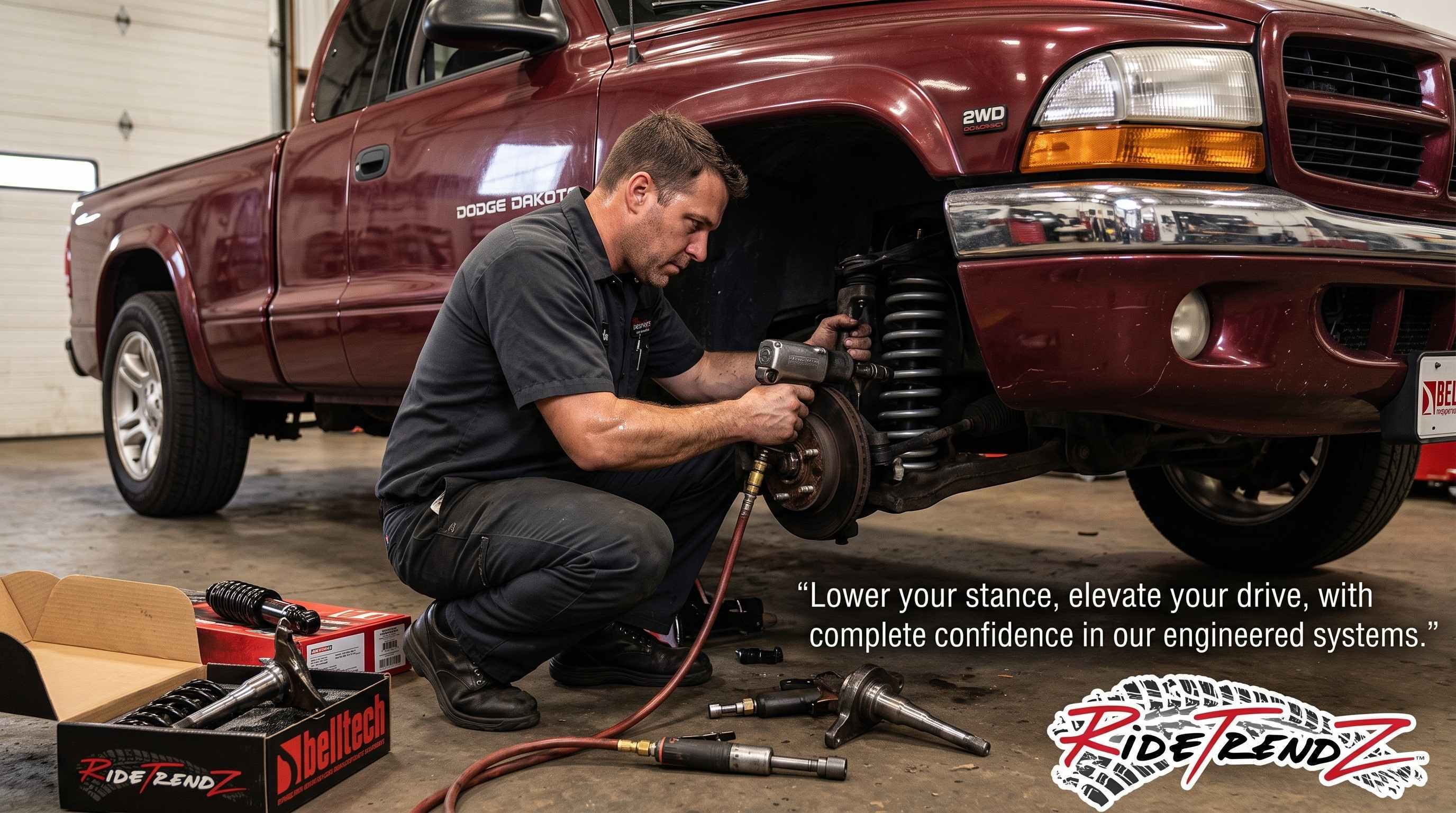
Choosing a Dodge Dakota lowering kit starts with knowing your generation, because the two Dakota eras differ in the details that matter.
|
Feature |
1st Gen (1987–1996, 91-96) |
2nd Gen (1997- 2004) |
|
Front suspension |
Coil springs + shocks |
Coil springs + shocks (revised geometry) |
|
Rear suspension |
Leaf spring + blocks/shackles |
Leaf spring + blocks/shackles |
|
Steering |
Recirculating ball |
Rack and pinion (1997+) |
|
Cabs |
Standard Cab, Club Cab |
Reg (standard cab), Club Cab, QC (Quad Cab) |
|
Common engines |
3.9L V6, 5.2L (318) V8 |
3.9L V6, 5.2L, 5.9L, 4.7L V8 |
The 91-96 trucks are refreshingly simple: fewer electronics, lighter front ends, and huge aftermarket support. The 1997-2004 2nd gen brought rack-and-pinion steering and the 5.9L and 4.7L V8; a 2000 Dakota with the 5.9L is a popular street-truck starting point, while the Dodge Dakota Sport and Dakota SLT trims just change trim and options, not suspension parts.
Note the SLT badge or Club Cab body never changes which kit you order; year, drivetrain, and engine do. Manual-transmission fans: trucks with the NV3500 five-speed lower exactly like their automatic siblings. One boundary note: this guide covers 1987–2004 only. If you drive a 2008 Dodge Dakota, the third generation uses different front suspension and needs its own kit.
For the early trucks, grab front lowered shocks for 1987–96 2WD (2-inch drop coils) and compare notes with our Dodge Dakota lift-kit guide: torsion keys vs. coil spacers; it explains why 2WD Dakotas use coils while 4x4 trucks use torsion bars, which is exactly why lowering kits are 2WD-only.
How Can Lowering Improve the Ride Quality and Corner Grip on Pickup Trucks?
It sounds backwards, but a properly engineered Dodge Dakota lowering kit can improve the ride quality over stock. Here is why: factory pickup trucks are sprung soft and tall, so they lean hard in every corner and float over highway joints. A quality drop swaps those soggy rates for progressive springs, adds gas-charged shocks, and drops the center of gravity; the truck stops wallowing and starts tracking.
What changes behind the wheel
- Steering: less body roll means the front tires bite sooner and more predictably
- Braking: reduced dive keeps weight transfer controlled and stops shorter
- Highway manners: a lower center of gravity kills the floaty, windy-day wander
- Ride: matched shocks absorb sharp edges instead of bouncing through them
The keyword is matched. A 3in drop on cut springs with worn shocks rides terribly; the same drop on a complete system with fresh dampers rides better than the day the truck left the dealer. If better road manners are the goal, start with a 3/3 complete lowering kit for the V8 2WD with DDoetschTech nitro shocks and skim lifted truck vs. lowered truck: which is right for you to confirm a street setup matches how you actually drive.
Strut-Style Myths, Aftermarket Wheels & Stance, Dialing In Your Dodge Dakota Pickup
Two myths need busting. First, the Dakota does not use a strut, unlike strut-based cars; your Dodge Dakota pickup rides on coil springs with separate shocks, which is exactly why drop spindles and lowering springs both work so well. Second, wheels are not just jewelry: the right aftermarket wheels complete the stance your Dodge Dakota lowering kit started.
Dialing in stance after the drop
- Wheel diameter: 17–20 in. aftermarket wheels fill the arches without hurting ride.
- Offset: stick near factory offset so the front tires do not rub the fenders at loc.k
- Tire height: keep overall diameter close to stock so gearing and speedo stay honest
- Rear: set the rear end ride height about 0.5 in. higher than the front for a level look with a load
A 2WD Dakota on a 2/3 drop with 18s and the right offset looks factory-engineered, not hacked, exactly the stance a dialed-iDodge Dakotata lowering kit delivers. Finish the package with a 2/4 complete lowering kit for the V6 2WD with Doetsch Tech nitro shocks and browse the best lowering kit for the Ford Ranger (1983–2013) to see how wheel and drop choices translate across compact pickup trucks.
V6 vs. V8 Drops & Install Troubleshooting, Lessons From the Forum Community Dedicated to Dodge
On the forum community dedicated to Dodge trucks, the most common post starts with "I wanted to lower my Dakota, and now it rides rough", and the answer is almost always one of three things.
First, engine weight: every Dakota truck needs springs rated for its motor, from the 3.9L V6 to the 318 (5.2L) and the big 5.9L. If you grew up wrenching on a classic 340 small-block, think of it the same wa:, spring rate follows nose weight. Order the V6 or V8 kit to match your truck and the stance will sit right the first time.
Second, alignment, non-negotiable after any front drop. Third, the small stuff: trim the bump stops, torque every bushing bolt at ride height (not on jack stands), and recheck U-bolt torque after 500 miles. When owners and enthusiasts follow that checklist, troubleshooting threads end fast. For deep rear drops, grab rear lowered shocks for 1987–96 2WD (4-inch drop blocks) and compare with how to lower a Chevy Silverado (1988–2013); the block-and-shock logic is identical across brands.
Why is Ridetrendz the Best Place to Buy Dodge Dakota Lowering Kits?
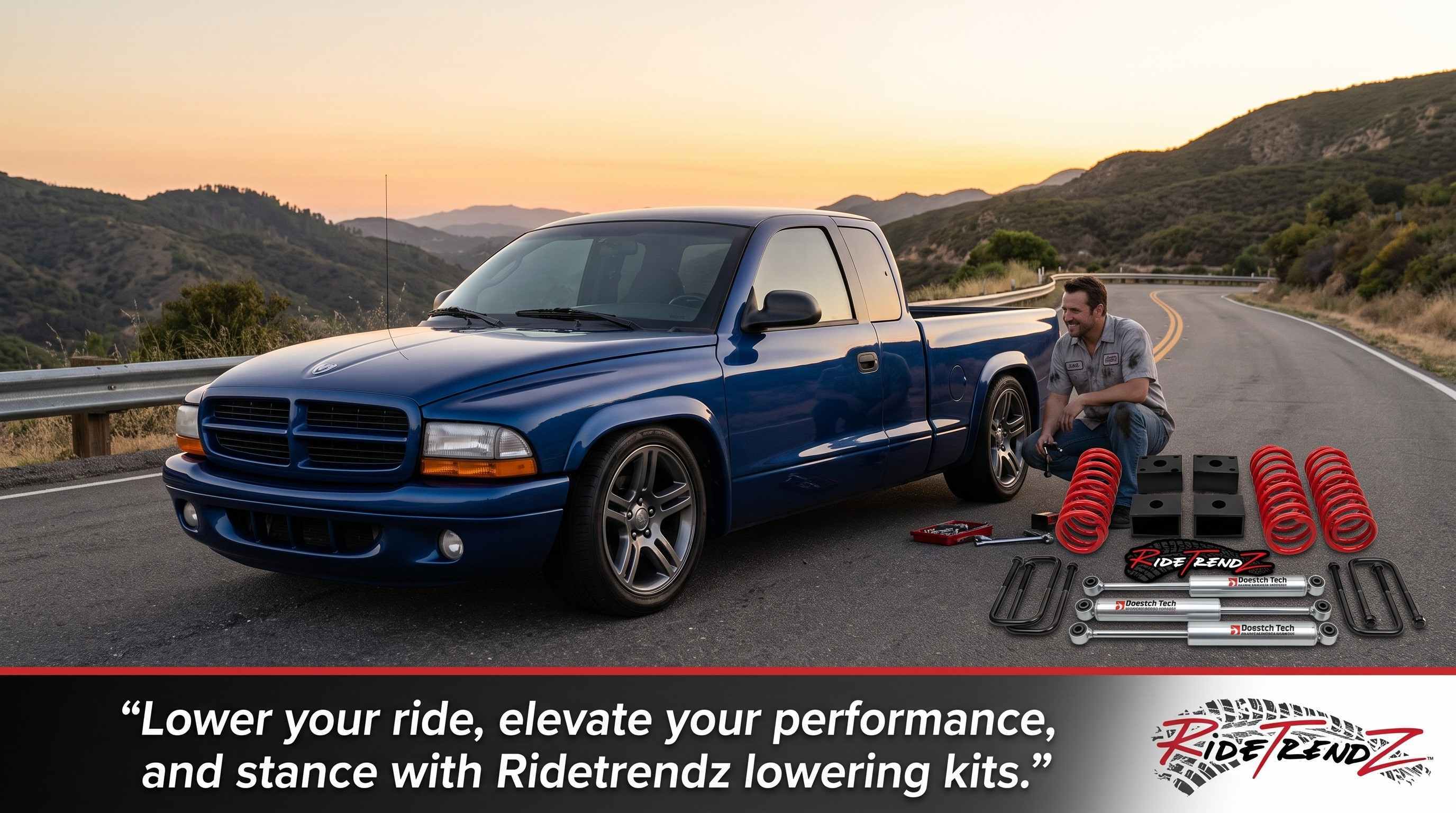
When you buy a Dodge Dakota lowering kit from Ridetrendz, you are not gambling on a mystery box of mixed-brand parts. Every Dodge Dakota lowering kit we list is a curated system: coils or spindles up front, blocks or hangers out back, and gas-charged shocks valved for the drop, so everything arrives ready to bolt on.
Our Dodge Dakota lowering kits cover 1987–2004 2WD trucks in both V6 and V8 configurations, with fitment help from real suspension people before you buy and support after the install.
Why owners keep coming back to Ridetrendz
- Complete systems, not puzzles; every kit bundles matched suspension parts that work together.
- Real fitment guidance, year, cab, and engine matched before you order, so a QC 5.9L never gets V6 springs.
- Quality shocks include: Doetschh Tech and RTZ Primo gas-charged units, not no-name dampers.
- Support that answer:, install questions go to people who have actually lowered these trucks.
Ready to drop yours? Start with the 3/4 complete lowering kit for the V8 2WD withDoetschh Tech nitro shocks or explore the best lowering kit for Silverado guide to see the Ridetrendz approach applied across truck lines.
Conclusion
Lowering a Dodge Dakota is one of the most rewarding mods in the truck world: a 2/3 or 3/4 static drop transforms the look, sharpens the handling, and, done right, rides better than stock. Pick your generation, match the kit to your engine, never skip the shocks, and buy a complete system from a seller who stands behind it. Do that, and your Dakota will turn heads for all the right reasons.
FAQs
How much does it cost to lower a Dodge Dakota?
A complete 2/3 or 3/4 kit with shocks typically runs a few hundred dollars; check Ridetrendz product pages for current pricing and bundle deals.
Will a lowering kit fit my 4x4 Dakota?
No. These kits are engineered for 2WD Dakotas only; 4x4 trucks use torsion bars and need a different approach entirely.
Do I need new shocks with drop springs?
Yes. Shorter shocks match the reduced travel; factory shocks bottom out and ruin ride quality on any lowered truck.
How low can I go on a 2nd gen Dakota?
A 2/3 or 3/4 static drop works with bolt-ons; beyond four inches, add a C-notch and trim the bump stops.
Will lowering hurt towing or hauling?
A mild drop keeps most utility; heavy towing favors conservative rear drops and helper air springs.