

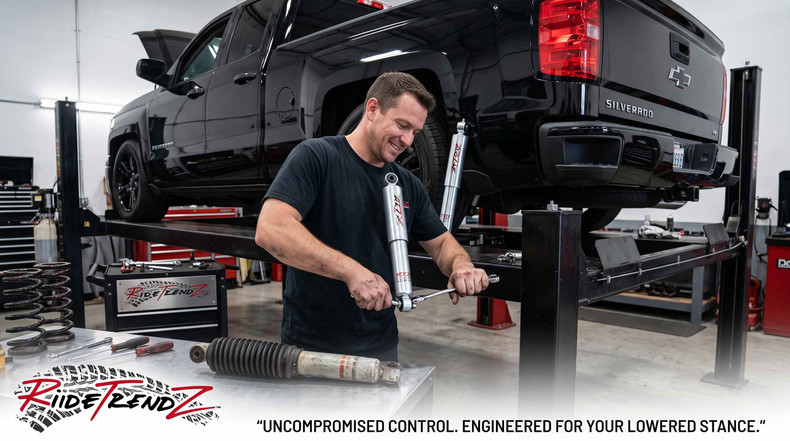
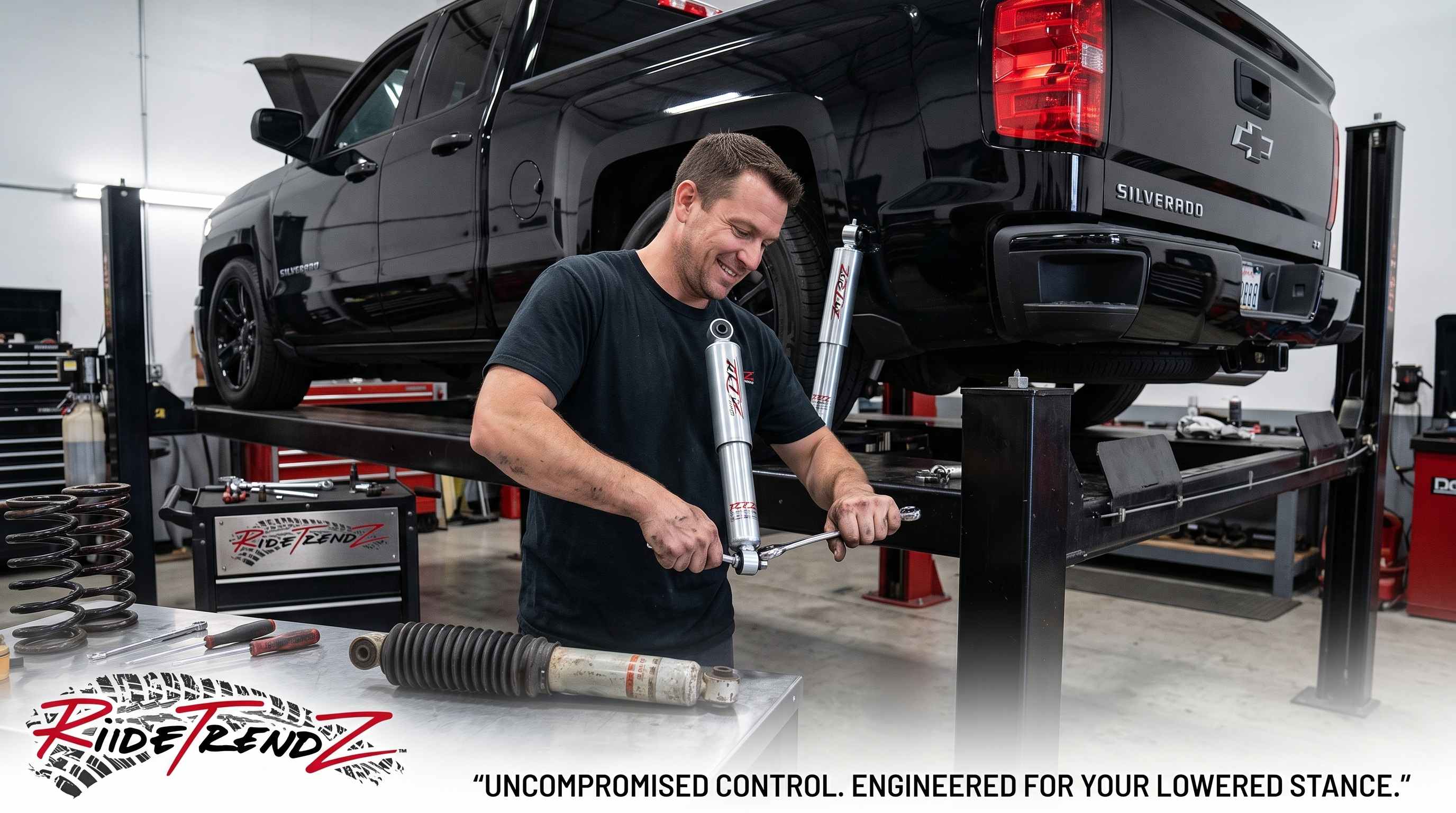
 If you have ever lowered your truck and wondered whether your suspension is still set up right, you are not alone. Thousands of truck owners ask the same question every year. Understanding what lowering shocks are and whether you need them is the first step to building a suspension that rides right and looks great.
This guide breaks it all down in plain language. You will learn exactly what lowering shocks are, how they work, and whether you actually need them. You will also see why RideTrendz is the trusted name for lowering suspension shocks across the country.
What Are Lowering Shocks? A Clear Definition
Let us start with the basics. What are lowering shocks? They are shock absorbers built specifically for lowered vehicles. A standard shock absorber is designed to work within the factory ride height range. When you lower your truck, the suspension geometry changes. Your stock shocks end up operating outside their designed travel zone.
Lowering shocks, also called drop shocks, are built shorter and tuned for the reduced ride height. They keep the suspension controlled at the new lowered stance. Without them, your ride feels harsh, bouncy, or completely unpredictable.
Think of it this way. Every shock has a sweet spot in its travel range. That sweet spot is where the valving is calibrated for smooth control. Lowered shocks are engineered so that sweet spot lines up perfectly with your truck's new lower ride height.
At RideTrendz, every lowering shock we produce goes through strict quality checks. Our RTZ Primo Nitrogen Gas Charged Shocks are a perfect example of precision-built drop shocks that deliver exactly the control you need after a drop.
How Do Lowering Shocks Work?
Understanding how lowering shocks work helps you make a smarter buying decision.
A shock absorber controls the movement of your suspension. When your wheel hits a bump, the shock compresses. When the wheel drops back down, the shock extends. This is called the compression and rebound cycle.
Here is the key point. Lowering shocks have:
- Shorter overall length, matches the lowered ride height
- Revised valving, tuned for the reduced suspension travel
- Nitrogen gas charging, prevents foaming and maintains consistent damping
- Reinforced seals, handle the tighter operating range without premature wear
Our RTZ Primo Nitrogen Gas Charged Shocks use these exact principles. The nitrogen gas charge keeps the fluid from aerating. This means you get consistent damping performance whether you are on the highway or navigating a rough parking lot.
What are drop shocks doing differently from a regular shock? A regular shock expects more travel. A drop shock compresses and extends within a narrower band, and it is calibrated to do that perfectly.
Do Lowering Springs Ruin Stock Shocks?
This is one of the most common questions we hear. Do lowering springs ruin stock shocks?
The honest answer is yes, over time, they can.
Here is what happens. When you install lowering springs on stock shocks, the shock is forced to operate near the bottom of its travel range. Stock shocks are calibrated for full factory ride height travel. Running them compressed most of the time causes:
|
Problem |
Cause |
Effect |
|
Premature seal failure |
Constant low travel operation |
Leaking shock fluid |
|
Poor damping control |
Shock outside calibrated range |
Harsh or bouncy ride |
|
Shortened shock lifespan |
Excessive heat and wear |
Early replacement needed |
|
Handling instability |
Loss of controlled rebound |
Unsafe cornering |
Do lowering springs ruin shocks faster than normal use? Studies show that lowering springs on stock shocks can reduce shock life by 30–50% compared to using matched lowering shocks and struts. That means you could be replacing shocks far sooner than expected, and paying more in the long run.
This is exactly why RideTrendz packages our lowering suspension shocks together with our lowering spring kits. We match the components so everything works as a system, not just individual parts thrown together.
Do I Need Lowering Shocks With Lowering Springs?
Let us answer the big question directly. Do I need lowering shocks with lowering springs?
Yes. In most cases, you do.
Here is a simple breakdown to help you decide:
When You Absolutely Need Lowering Shocks
- Your stock shocks have more than 40,000 miles on them
- You are dropping your truck 2 inches or more
- You want a smooth, controlled ride after the drop
- You drive on highways at higher speeds regularly
- You want your suspension to last without early failure
When You Might Get By Temporarily
- You are doing a very mild 1-inch drop
- Your stock shocks are brand new (under 10,000 miles)
- You plan to upgrade shocks within the next few months
Even in the "might get by" cases, we always recommend proper lowered shocks. The performance difference is immediate and significant.
Do I need shorter shocks with lowering springs?
Yes, this is the same question phrased differently. Shorter, properly valved shocks designed for your drop height are the correct solution.
Check out this guide on lowering your truck: benefits, risks, and the right lowering kit to buy for a full breakdown of what the lowering process involves.
Do I Need New Shocks With Lowering Springs?
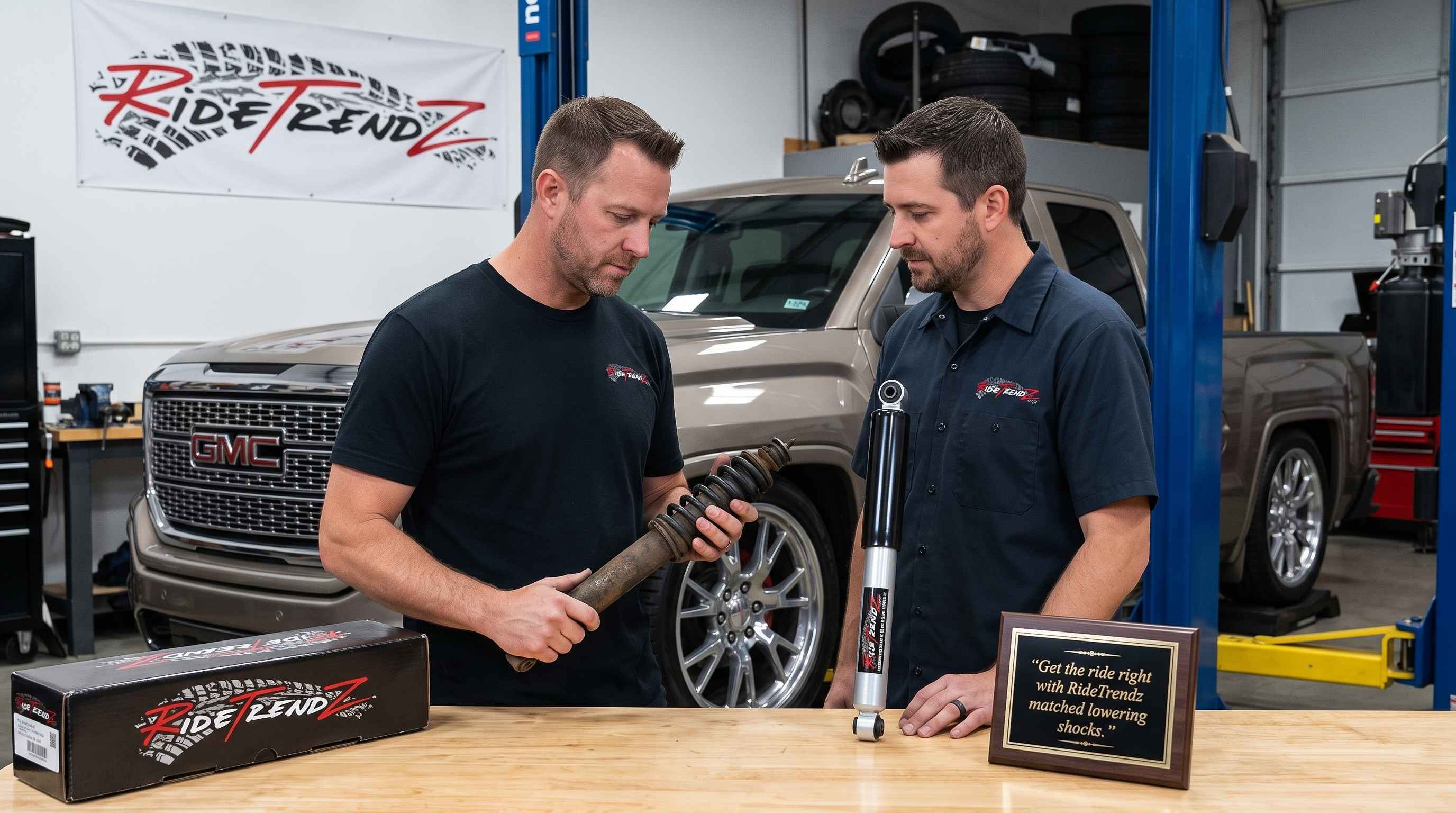
Do I need new shocks with lowering springs? If your current shocks are not rated for lowered applications, then yes, you need new shocks.
Here is a quick decision table:
|
Scenario |
Recommendation |
|
Stock shocks, mild 1" drop |
Replace soon, monitor ride quality |
|
Stock shocks, 2"+ drop |
Replace immediately with drop shocks |
|
Worn stock shocks, any drop |
Replace before or during the drop |
|
New RTZ drop shocks installed |
Optimized, you are set |
The RTZ Primo Nitrogen Gas Charged Shocks are specifically matched to our lowering kits. When you buy a complete lowering kit from RideTrendz, the shocks are already spec'd for the exact drop you are making. No guesswork. No mismatched components.
If you drive a Silverado, our RTZ Chevy Silverado Lowering Kit with RTZ Primo Nitrogen Gas Charged Shocks is a complete, matched system that eliminates all the uncertainty.
Lowering Shocks vs Regular Shocks, What Is the Real Difference?
Understanding lowering shocks vs regular shocks helps you see why the upgrade matters.
Side-by-Side Comparison
|
Feature |
Regular Shocks |
Lowering Shocks |
|
Designed ride height |
Factory/stock height |
Lowered ride height |
|
Travel range |
Full factory travel |
Reduced, matched travel |
|
Valving calibration |
Factory suspension geometry |
Drop-specific geometry |
|
Gas charging |
Varies |
Nitrogen gas charged (RTZ) |
|
Lifespan with lowering springs |
Reduced 30–50% |
Full expected lifespan |
|
Ride quality after drop |
Harsh or bouncy |
Smooth and controlled |
|
Cornering stability |
Compromised |
Maintained |
Drop shocks vs regular shocks comes down to calibration. A regular shock is not wrong; it is just wrong for your application. When you lower your truck, you need a shock that is right for the new geometry.
Lowering shocks and struts from RideTrendz are engineered to close that gap completely. Our nitrogen gas charge prevents fade under repeated compression. Our matched valving keeps the ride controlled at the lower stance.
What Are Drop Shocks and Are They the Same as Lowering Shocks?
What are drop shocks? Drop shocks are another name for lowering shocks. Both terms describe the same product, a shock absorber built to operate correctly at a lowered ride height.
Some manufacturers use the terms interchangeably. At RideTrendz, we use both. Whether you search for drop shocks or lowering shocks, you will find products built to the same standard.
The key characteristics of a quality drop shock:
- Shorter body length than OEM shocks
- Tuned internal valving for reduced travel
- Nitrogen gas pressurization for consistent performance
- Compatibility with common lowering spring drops (1"–6" range)
- Heavy-duty seals for long service life
Our RTZ Primo line covers all of these. We also offer our Doetsch Tech DT9000 Nitro Shocks for applications that need premium-level damping performance. Both are trusted by thousands of RTZ customers nationwide.
Lowering Suspension Shocks, Performance and Ride Quality
The right lowering suspension shocks do more than just fit under your lowered truck. They actively improve how your truck drives.
Here is what proper lowering suspension shocks deliver:
Improved ride quality: No more harsh impacts from every bump. The calibrated valving absorbs road irregularities smoothly.
Better handling: Your tires stay in contact with the road through corners. You feel more connected and in control.
Reduced body roll: Stiffer-than-stock valving in lowered shocks resists the lateral movement that makes trucks feel tippy in corners.
Consistent performance: Nitrogen gas charging means the shocks perform the same on lap one and lap one thousand.
Extended component life: Matched lowering shocks and struts protect your springs, tires, and chassis from the stress that mismatched components create.
Real Numbers: What Matched Lowering Shocks Deliver
|
Metric |
Stock Shocks on Lowered Truck |
RTZ Lowering Shocks |
|
Estimated shock lifespan |
20,000–30,000 miles |
50,000–70,000 miles |
|
Ride harshness rating |
High |
Low to moderate |
|
Body roll reduction |
None |
15–25% improvement |
|
Tire wear consistency |
Uneven |
Even |
|
Handling confidence |
Reduced |
Restored or improved |
These numbers reflect the difference between mismatched and matched suspension systems. RideTrendz builds complete kits specifically to hit the right numbers every time.
Lowering Shocks and Struts, Complete System Thinking
When you think about lowering shocks and struts, think about the whole system, not just one part.
Your suspension is a network. The springs carry the weight. The shocks control the motion. The struts (on strut-based suspensions) do both. Every component affects how the others perform.
This is why RideTrendz builds and sells complete lowering kits, not just individual parts. Our kits include:
- Drop coil springs, calibrated spring rate for the target drop
- RTZ Primo Nitrogen Gas Charged Shocks, matched to the spring drop
- Hanger and shackle kits, adjustable rear geometry correction
- Flip kits, for trucks needing significant rear drop correction
When you order from us, you are not guessing whether the parts will work together. We have already done that engineering work. That is a core part of what makes RideTrendz different.
For Dodge Ram owners, our RTZ Dodge Ram 1500 Lowering Kit with RTZ Primo Nitrogen Gas Charged Shocks is a complete system engineered specifically for the Ram platform.
Signs Your Stock Shocks Are Failing Under Lowered Springs
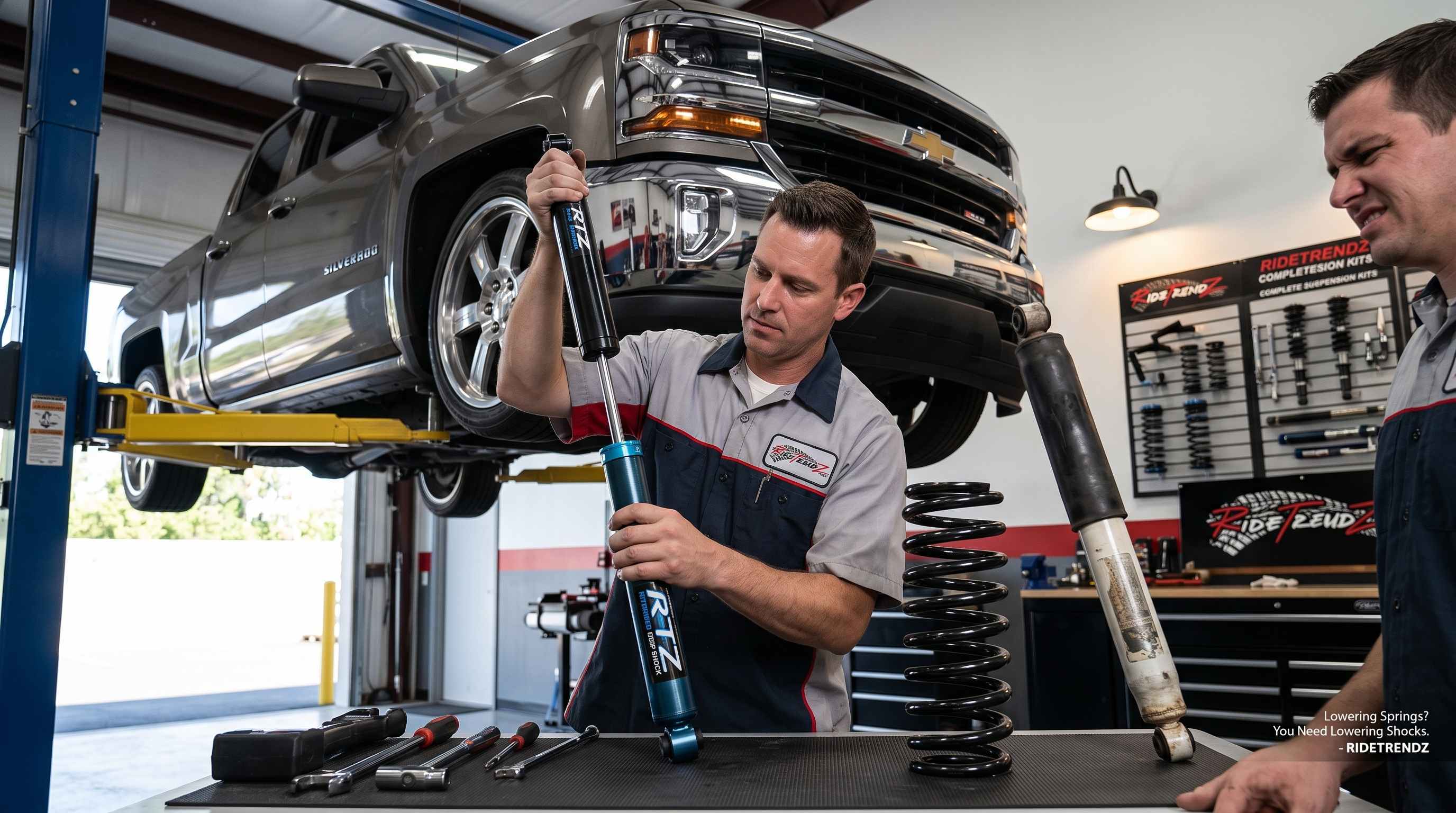
Knowing what lowering shocks are and whether you need them also means recognizing when your current setup is hurting your truck.
Watch for these warning signs:
- Bouncy ride; the truck does not settle after bumps
- Nose dive under braking, Excessive forward dip when stopping
- Rear squat under acceleration, The back end drops too much
- Uneven tire wear, Cupping or scalloping on the tread surface
- Clunking sounds, Shock is bottoming out or topping out
- Fluid leaks on shocks, Seals have failed from excess stress
- Poor straight-line tracking, Truck wanders or drifts
If you see two or more of these signs, your suspension needs attention. The longer you wait, the more wear spreads to other components: springs, bushings, control arms, and tires.
RideTrendz stocks replacement drop shocks for a wide range of trucks. Our team can help you identify the right lowering shocks for your specific vehicle and drop height.
How to Choose the Right Lowering Shocks for Your Truck
Choosing the right lowering suspension shocks comes down to four factors:
1. Drop Height
Match your shocks to your spring drop. A 3-inch drop needs shocks calibrated for 3 inches, not 2, not 4.
2. Vehicle Application
Different platforms have different geometry. Silverado lowered shocks are not interchangeable with F-150 drop shocks. Always buy vehicle-specific parts.
3. Drive Type (2WD vs 4WD)
Front and rear shock specs differ between 2WD and 4WD configurations. RideTrendz offers separate applications for each.
4. Motor and Weight
Heavier motors (V8 vs V6) affect spring rates and shock tuning. Our kits are separated by engine type to make this easy.
RTZ Product Selection Guide
|
Truck |
Drop |
Recommended RTZ Product |
|
Chevy Silverado 1500 (99–06), 2WD V8 |
3F / 3R |
RTZ Primo Nitrogen Gas Charged Shocks |
|
Dodge Ram 1500 (02–08), 2WD V8 |
3F / 4R |
RTZ Primo Nitrogen Gas Charged Shocks |
|
Ford F-150 (97–03), 2WD V8 |
2F / 4R |
RTZ Primo Nitrogen Gas Charged Shocks |
|
GMC Sierra 1500 (99–06), 2WD V6 |
3F / 3R |
RTZ Primo Nitrogen Gas Charged Shocks |
Every RTZ lowering kit is pre-engineered for the exact vehicle. When you shop at RideTrendz, you select your truck, and the system does the rest.
Why RideTrendz Is the Right Source for Lowering Shocks?
There are plenty of places to buy suspension parts. Here is why RideTrendz stands apart from the crowd.
Deep Product Knowledge
We do not just sell parts. We understand what lowering shocks are and whether you need them at the engineering level. Every product description on our site reflects real application knowledge.
Complete Kit Approach
We build complete systems. Our kits pair lowering shocks and struts with matched springs, hangers, and hardware. You get a solution, not a collection of parts.
USA-Based Quality Standards
Our RTZ Primo and Doestch Tech DT9000 shock lines meet strict quality standards. Nitrogen gas charging, precision seals, and application-specific valving are built into every unit.
Proven Track Record
Thousands of truck owners have lowered their vehicles with RideTrendz kits. Our customer base spans Silverados, Rams, F-150s, Rangers, Tacomas, Tundras, and more. That breadth of experience shows in how our products are built.
Transparent, Specific Fitment
We list exact year ranges, motor types, and drive configurations for every product. You never have to guess whether something fits. This saves you time, money, and frustration.
Pricing That Makes Sense
We offer complete lowering kits at competitive prices because we manufacture and source efficiently. You get premium lowering suspension shocks without the premium markup that other brands charge.
Lowering Shocks Pros and Cons: An Honest Assessment
We believe in giving you straight information. Here is an honest pros and cons look at lowering shocks.
Pros
- Correct ride quality after lowering; shocks are calibrated for the drop
- Extended suspension component life, no mismatched wear
- Better handling and cornering, matched damping improves road feel
- Consistent performance, nitrogen gas prevents fade
- Complete system compatibility, works with matched springs and hardware
- Peace of mind, no worrying about stock shocks failing early
Cons
- Additional cost, vs running stock shocks (though cheaper long-term)
- Installation required, same labor as any shock replacement
- Must match to drop height; buying the wrong spec creates problems
The cons are minor compared to the benefits. And the "additional cost" argument falls apart quickly when you factor in the shortened lifespan of stock shocks on lowered springs.
Running stock shocks on lowered springs is like buying quality tires and then refusing to balance them. The whole system suffers.
How Long Do Lowering Shocks Last?
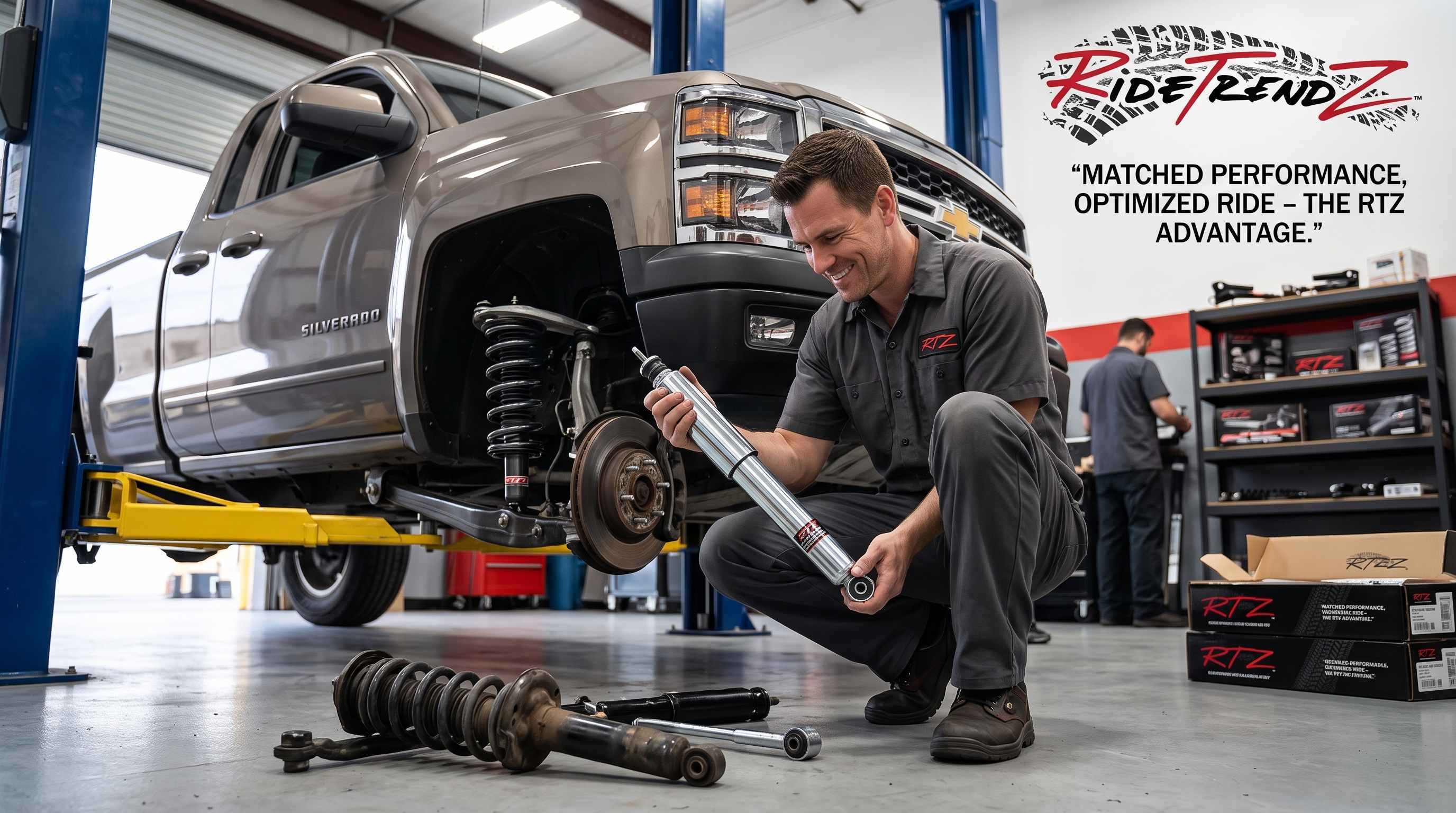
When you invest in proper lowering suspension shocks, you want to know how long they will hold up. This is another reason people ask what lowering shocks are and whether you need them; they want to know the long-term value.
The lifespan of lowering shocks depends on several factors:
- Driving conditions: Rough roads wear shocks faster than smooth highways
- Shock quality: RTZ Primo nitrogen gas shocks outlast budget alternatives significantly
- Drop height, Extreme drops (5"+) stress shocks more than moderate drops (2"–3")
- Vehicle weight, Heavier trucks put more demand on shocks
- Maintenance, Keeping hardware tight and bushings fresh extends shock life
Expected Lifespan by Scenario
|
Setup |
Expected Shock Lifespan |
|
Stock shocks on lowering springs |
20,000–30,000 miles |
|
Budget aftermarket drop shocks |
30,000–45,000 miles |
|
RTZ Primo Nitrogen Gas Charged Shocks |
50,000–70,000 miles |
|
Doetsch Tech DT9000 Nitro Shocks |
55,000–75,000 miles |
RTZ shocks last longer because of three design advantages. First, the nitrogen gas charge prevents fluid aeration under hard use. Second, the precision seals are rated for the tighter operating range of lowered suspension. Third, the internal valving is calibrated to work within, not against, the suspension geometry of a lowered truck.
The bottom line: quality drop shocks from RideTrendz cost more up front than stock shocks, but they cost far less over time. That is real value.
Lowering Shocks and Vehicle Safety
Some truck owners hesitate on the question of what lowering shocks are and whether you need them because they assume lowering hurts safety. That assumption is wrong when the job is done correctly.
A properly lowered truck with matched lowering shocks and struts can actually be safer than a stock truck in certain ways:
- Lower center of gravity, reduces rollover risk in corners
- More aerodynamic stance, Less wind resistance at highway speed
- Tighter cornering, Less body roll with properly valved drop shocks
- Better road feel, Improved driver feedback through the steering
The safety risk comes from doing the job wrong. Running lowering springs on stock shocks creates unpredictable rebound. The truck can feel out of control over bumps. It can bounce erratically under braking. These are real safety issues, and they are entirely avoidable.
When you choose the right lowering suspension shocks for your application, you eliminate those risks. RideTrendz builds its kits with safety-first engineering. Every drop height, vehicle platform, and motor configuration is accounted for.
This is another core reason to understand what lowering shocks are and whether you need them before you start any lowering project. The answer protects both your truck and the people in it.
Common Mistakes When Lowering a Truck
People who skip lowering shocks often make these mistakes. Knowing them helps you avoid the same errors.
Mistake 1: Installing lowering springs on stock shocks and calling it done. This is the most common error. The ride feels acceptable for a few months, then degrades fast as the stock shocks wear prematurely.
Mistake 2: Buying the wrong drop height shock.s A 2-inch drop shock on a 4-inch spring drop will not perform correctly. Always match the shock to the spring.
Mistake 3: Mixing brands without checking compatibility.ty Not all lowering springs and shocks are cross-compatible. RideTrendz kits eliminate this problem by designing everything together.
Mistake 4: Ignoring rear suspension.ion. Many people focus on the front drop and neglect the rear. A complete front and rear system is critical for level stance and ride balance.
Mistake 5: Skipping an alignment after lowering.Lowering changes your alignment angles. Always get a four-wheel alignment after any suspension modification.
Read more about choosing the right setup in our guide on the best lowering kit for the Ford F-150 to see how a complete kit approach prevents these mistakes.
What Are Lowering Shocks and Do You Need Them? Summary Checklist
Let us wrap up with a clear checklist. What are lowering shocks and do you need them?
You need lowering shocks if:
- You are installing lowering springs (any amount)
- Your stock shocks have 40,000+ miles
- You are dropping 2 inches or more
- You want the best possible ride quality after your drop
- You want your suspension to last
- You drive at highway speeds regularly
- You corner hard or tow occasionally
You may delay (but should still plan to upgrade) if:
- Your drop is under 1 inch
- Your stock shocks are brand new (under 10,000 miles)
- You are planning a full kit upgrade within 3 months
The answer to lowering shocks arehocks and whether you need them is simple. If you are lowering your truck, you need drop shocks that are matched to your drop. RideTrendz makes that process straightforward with complete kits built for your exact application.
The RideTrendz Advantage: Why Our Customers Keep Coming Back
When you start researching what lowering shocks are and whether you need them, you quickly realize the answer depends heavily on who is building your parts. Not all lowering shocks are equal. The quality of materials, the precision of valving, and the accuracy of vehicle fitment all determine whether you get a great result or a frustrating one.
RideTrendz has built our reputation by getting these details right, consistently.
What Sets RTZ Shocks Apart
Application-Specific Engineering: We do not sell one-size-fits-all shocks. Every RTZ shock product is listed by exact vehicle, year range, motor type, and drive configuration. If you have a 2001 Silverado 1500 2WD V8 and you want a 3-inch drop, we have a kit engineered precisely for that truck and that drop.
Nitrogen Gas Technology: All RTZ Primo shocks use nitrogen gas charging. This prevents fluid foaming under repeated compression and rebound cycles. The result is consistent damping performance across thousands of miles and all driving conditions.
Complete Kit Packaging: Our lowering shocks come packaged with matched springs, hangers, shackles, and hardware. You are not chasing down compatible parts from three different sources. Everything comes together, from us, already matched.
Doestch Tech DT9000 Premium Line: For drivers who want the highest level of performance, our DT9000 Nitro Shocks deliver premium nitrogen gas damping with an upgraded internal build. These are the shocks we include in our top-tier complete lowering kits.
Customer Support That Knows Trucks: Have a question about whether you need drop shocks for your specific application? Our team understands these products at the technical level. We give you real answers, not generic scripts.
People return to RideTrendz because the parts work the first time. That consistency is what what are lowering shocks and do you need them comes down to in practice, not just knowing the theory, but finding a supplier who delivers the right product, every time.
Installing Lowering Shocks: What to Expect
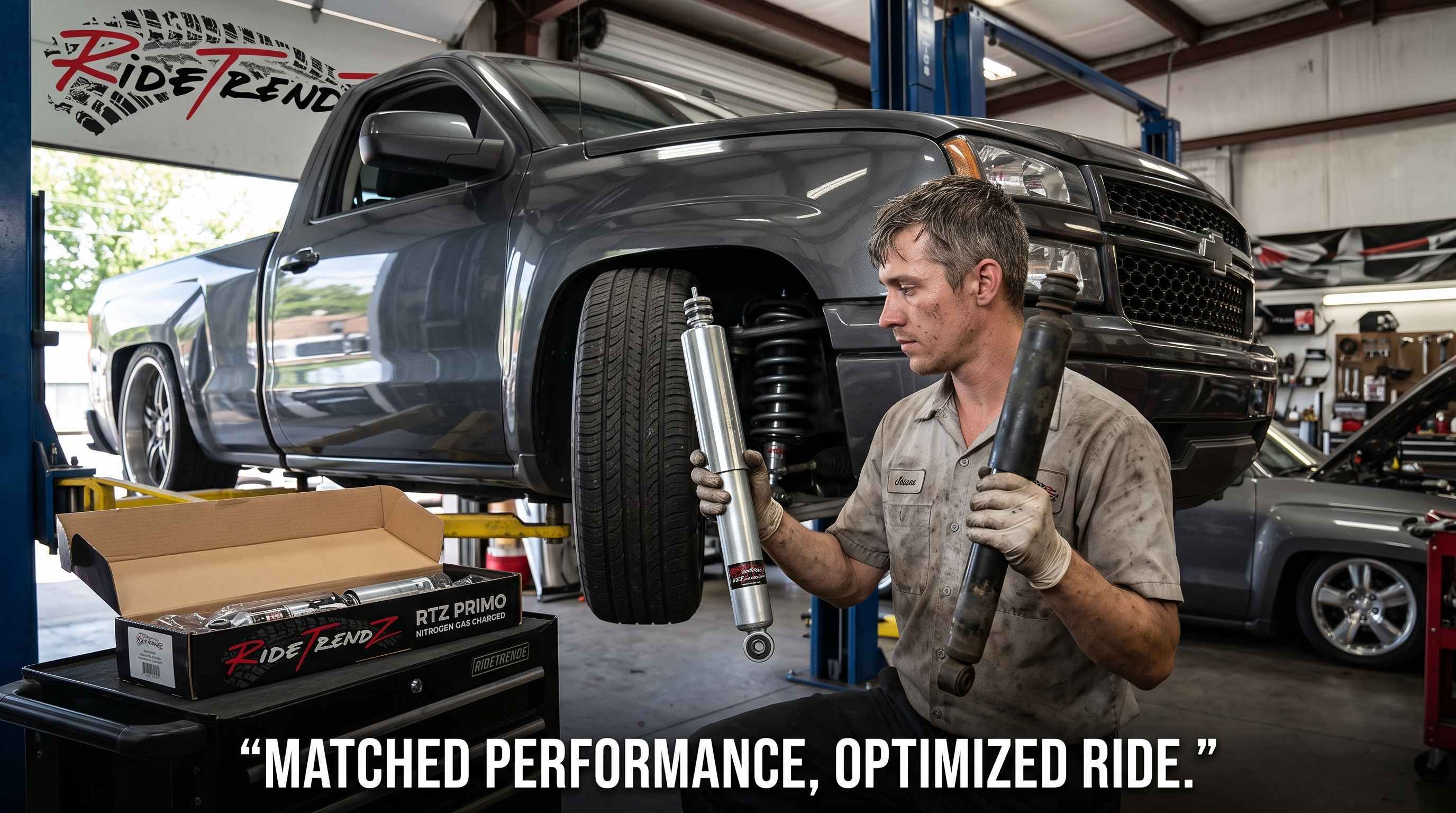
Understanding what lowering shocks are and whether you need them also means knowing what the installation process involves.
Installing lowering shocks is similar to replacing any shock absorber. The process typically involves:
- Lifting and securing the vehicle. Always use proper jack stands
- Removing the wheels, providing access to the shock mounting points
- Disconnecting the old shocks, Upper and lower mounting bolts
- Installing the new drop shocks, Torque to spec per the RTZ instructions
- Reinstalling wheels and lowering the vehicle
- Getting a four-wheel alignment. This is mandatory after any suspension change
Most experienced DIY mechanics can complete a full set of lowering shocks in 3–5 hours. Shops typically charge 2–4 hours of labor depending on the vehicle.
RideTrendz includes clear installation notes with every kit. The fitment specifics, including exact bolt sizes, torque specs, and any special considerations for your application, are documented so you can work with confidence.
One important note: always complete the alignment after installing your lowering suspension shocks and springs. Lowering changes your camber, caster, and toe settings. Skipping the alignment leads to uneven tire wear and compromised handling, negating much of the benefit you just paid for.
Conclusion
Lowering shocks are not optional accessories. They are a critical part of any proper lowering setup. Understanding what lowering shocks are and whether you need them protects your investment, your ride quality, and your safety.
Do lowering springs ruin stock shocks? Over time, yes, they do. Do I need new shocks with lowering springs? In most cases, absolutely. The solution is simple: choose the right lowering suspension shocks matched to your specific vehicle and drop height.
RideTrendz has built a reputation on exactly this kind of matched, complete-system thinking. Our RTZ Primo Nitrogen Gas Charged Shocks and Doestch Tech DT9000 Nitro Shocks represent the best drop shocks for lowered trucks. Our complete kits take the guesswork out entirely.
When you are ready to lower your truck the right way, with matched lowering shocks and struts, quality springs, and proven hardware, RideTrendz is the partner you can trust.
Frequently Asked Questions
Q1: What are lowering shocks and do you need them for a mild 1-inch drop?
Yes. Even a small drop shifts shock travel. Matched drop shocks improve ride quality and extend component life, even at 1 inch.
Q2: Do lowering springs ruin stock shocks quickly?
Stock shocks on lowering springs wear 30–50% faster. They operate outside their calibrated range, causing premature seal failure and poor damping.
Q3: What are drop shocks versus regular shocks?
Drop shocks are shorter and revalved for lowered geometry. Regular shocks are calibrated for factory ride height and perform poorly after a drop.
Q4: Do I need shorter shocks with lowering springs installed on my truck?
Yes. Shorter, application-matched lowering shocks are required to maintain proper suspension travel and ride quality after lowering.
Q5: How do lowering shocks work differently from stock shocks?
They use a shorter body and revised internal valving tuned for reduced suspension travel, keeping damping performance consistent at the lowered ride height.