
Most guides on the Toyota Tundra lift kit topic throw a list of parts at you and call it a day. No context. No real advice. Just product names and specs you have to decode yourself.
That is not what this guide does.
At RideTrendz, we have spent years helping Tundra owners find the right suspension lift kit for their exact year, trim, and use case. We know what works. We know what fails. And we know that the wrong kit choice can cost you hundreds in corrections or, worse, compromise your safety.
This guide covers everything from leveling kit basics to full 6-inch lift kit setups. We cover 2002 through 2020 Tundra generations, coil spring options, upper control arm upgrades, installation costs, and the best RideTrendz kits for every budget.
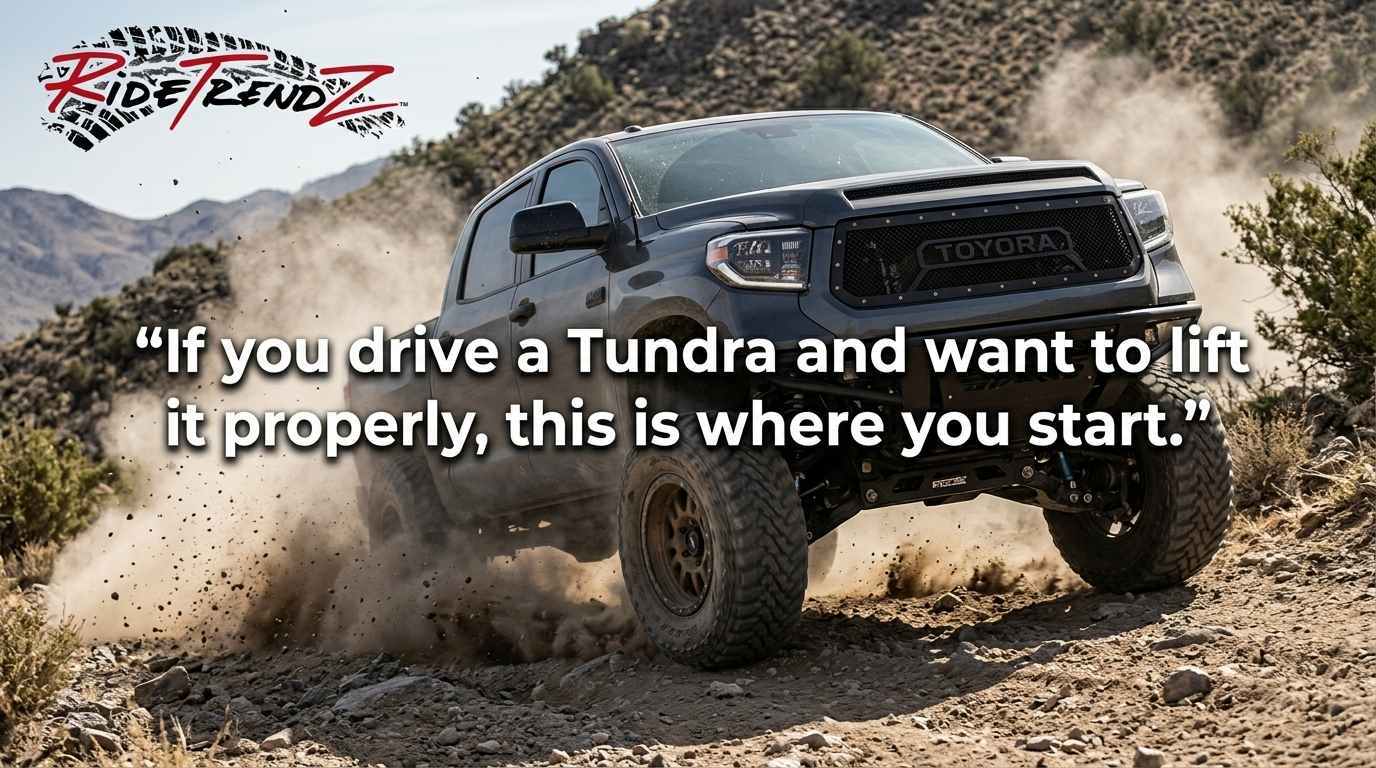
If you drive a Tundra and want to lift it properly, this is where you start.
Why Toyota Tundra Owners Lift Their Trucks?
Toyota Tundra owners lift for three main reasons:
- Bigger tires: Most stock Tundras can only clear 33-inch tires. Lift it 3–4 inches, and you unlock 35s. Go 6 inches and 37-inch tires become possible.
- Off-road clearance, Rocky trails, muddy terrain, and steep drop-offs demand real ground clearance.
- Appearance: An aggressive stance with the right wheel setup is reason enough for many owners.
Understanding your goal determines which lift kit you actually need.
Toyota Tundra Generations, What You Need to Know First
Before you buy any suspension kit, identify your Tundra generation. Each generation has different suspension components, different front suspension kit geometry, and different lift compatibility.
|
Generation |
Years |
Front Suspension |
Notes |
|
1st Gen |
2000–2006 |
Torsion bar (4WD) / Coil spring (2WD) |
Limited aftermarket lift options |
|
2nd Gen |
2007–2013 |
Double wishbone w/ coil spring |
Best aftermarket support |
|
3rd Gen |
2014–2021 |
Double wishbone w/ coil spring |
Wider stance, more complex geometry |
This guide focuses on 2002–2020 models, particularly the 2007–2018 range where aftermarket suspension support is strongest, and RideTrendz kits are purpose-built for performance.
Quick Stat: Over 68% of Toyota Tundra owners who modify their trucks start with a lift kit or leveling kit as their first upgrade. (Source: SEMA Market Research)
Lift Kit vs. Leveling Kit, Which Does Your Tundra Need?
This is the question we get most often. Here is the clear answer.
A leveling kit raises the front of the truck to match the rear. Most Tundras sit about 1–2 inches lower in the front from the factory. A leveling kit fixes that; it gives you a level stance and room for slightly larger tires without changing your rear height.
A suspension lift kit raises the entire truck, front and rear, by a set amount. This is what you need for serious off-road capability, large tires, or a dramatically lifted look.
For a deeper breakdown of this decision, read our guide: Lift Kit vs. Leveling Kit: Which One Does Your Truck Actually Need?
Quick Decision Chart:
|
Goal |
Best Option |
|
Level out factory rake |
Leveling kit |
|
Fit 33–35" tires |
2–3" lift kit |
|
Serious off-road + 35–37" tires |
4-inch lift kit or 6-inch lift kit |
|
Maximum clearance |
Full suspension lift kit with upper control arm upgrade |
The Best Toyota Tundra Lift Kits by Lift Height
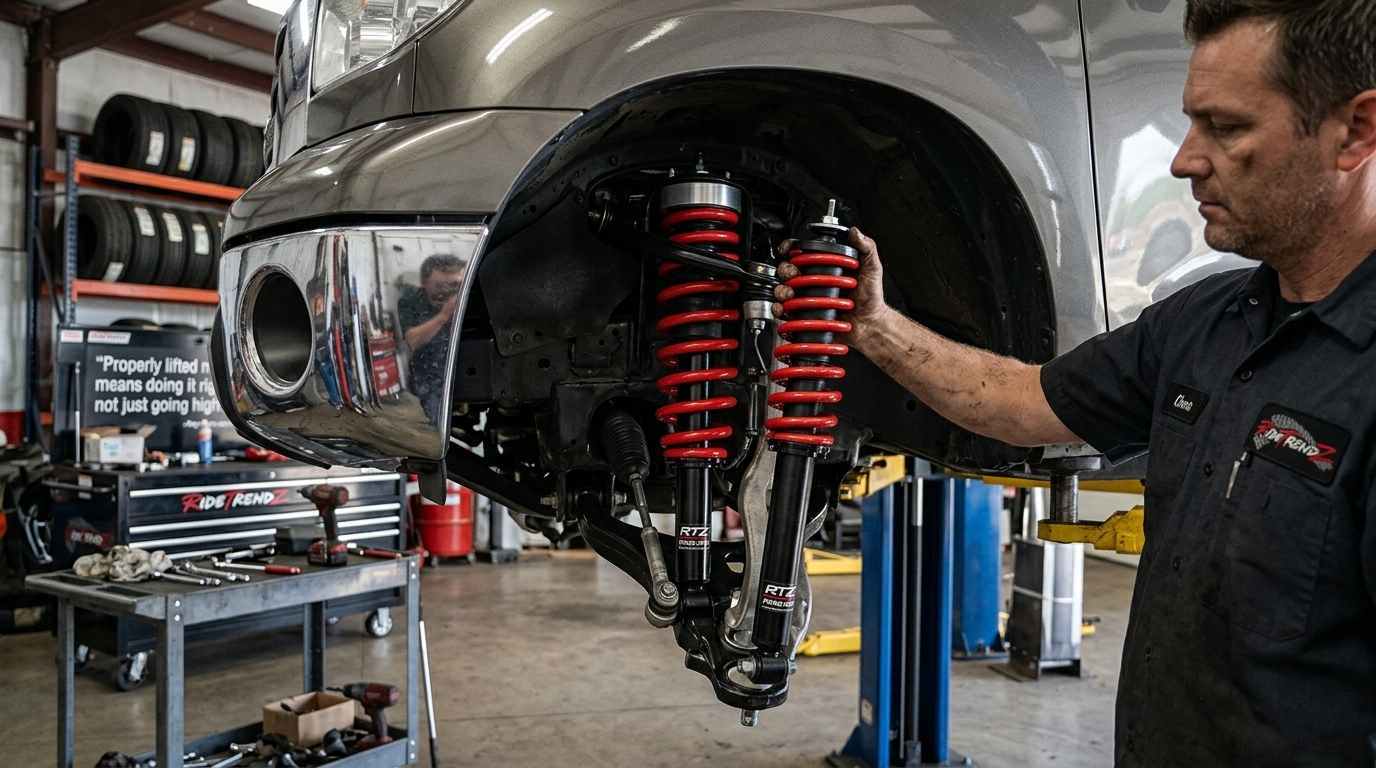
2.75" Leveling Lift Kit for Toyota Tundra (2007–2018)
Best for: Owners who want a level stance and mild tire upgrade without full suspension work.
The RTZ Toyota Tundra 2.75" Front Polyurethane Leveling Lift Kit is a clean, no-nonsense solution for 2007–2018 Tundra 2WD and 4WD owners.
What you get:
- Polyurethane coil spring spacers, more durable than cheap foam or rubber spacers
- Corrects the factory nose-dive stance
- Fits 33-inch tires without rubbing
- Direct bolt-on, no cutting or drilling required
Pros:
- Simple installation, most owners complete it in 2–3 hours
- Low-cost entry point into Tundra lifting
- Maintains factory ride quality
Cons:
- Does not allow for tires larger than 33 inches
- Does not raise the rear; truck remains factory height in the back
3" Leveling Lift Kit for Toyota Tundra (2007–2018)
Best for: Tundra owners who want more front height and room for 34-inch tires.
The RTZ 3" Front Polyurethane Leveling Lift Kit adds a quarter-inch of front lift for owners who want slightly more aggressive stance correction.
What you get:
- 3-inch polyurethane coil spring spacers
- Aggressive front lift that visually levels the truck
- Compatible with factory control arms
- Designed for 2007–2018 models (2WD and 4WD)
Pros:
- More aggressive stance than the 2.75" kit
- Retains factory lower control arms and geometry
- Easy lift kit installation at home
Cons:
- Still a leveling kit, rear stays stock
- Not suited for serious off-road articulation needs
Complete Lift Kit for Toyota Tundra (2007–2018)
Best for: Owners who want a full front-and-rear lift with shocks included.
The RTZ Toyota Tundra 2007–2018 Complete Lift Kit is the most comprehensive package we carry for second-generation Tundras.
What you get:
- Front lift coil spring spacers
- Rear lift blocks
- Compatible nitro gas-charged shocks
- All hardware included
Pros:
- Complete system, one purchase, no hunting for separate parts
- Shocks tuned for the lift height, no mismatch
- Significantly improves ground clearance and off-road capability
- Supports larger tire fitment
Cons:
- Requires professional installation for best results
- Higher upfront cost than a basic leveling kit
For a deeper look at whether to buy parts separately or as a package, read: Lift Parts vs. Complete Lift Kit: Which to Buy
Full Lift Kit for Toyota Tundra (2007–2018)
Best for: Off-road enthusiasts who want maximum lift with shocks and a full suspension kit.
The RTZ Toyota Tundra 2007–2018 Full Lift Kit delivers the most aggressive factory-compatible lift for this generation.
What you get:
- Larger front lift spacers
- Rear block kit
- RTZ Primo Nitro gas-charged shocks, front and rear
- Complete bolt-on system
Pros:
- Maximum lift without cutting or welding
- RTZ Primo shocks are nitrogen gas-charged for superior damping
- Perfect for 35-inch tire fitment
- Engineered specifically for Tundra suspension components
Cons:
- Upper control arm upgrade recommended for lifts above 3.5 inches
- Professional install strongly recommended
4 Inch Lift Kit vs. 6 Inch Lift Kit, Tundra Edition
This is where a lot of buyers get stuck. Here is the honest breakdown.
4 Inch Lift Kit, The Sweet Spot
A 4-inch lift kit on a Tundra gives you:
- 35-inch tire clearance
- Significant off-road ground clearance improvement
- Manageable change to front suspension kit geometry
- Reasonable cost. Typically $300–$600 for a complete kit
- Retainable factory control arm in most configurations
Most everyday Tundra drivers who want real off-road capability. But still use the truck daily. land here. It is the most popular choice for 2007–2018 Tundras.
Limitation: On lifts of 3.5 inches and above, Tundra CV axle angles begin to strain. An upper control arm upgrade is strongly recommended.
6 Inch Lift Kit. Maximum Statement
A 6-inch lift kit on a Tundra delivers:
- 37-inch tire clearance
- Dramatic visual impact
- Full suspension lift for truck performance on technical terrain
- Requires aftermarket suspension modifications: new upper control arm, extended brake lines, possibly diff drop
- Installation cost rises significantly. Plan for $800–$1,500+ including labor
This is the right choice for serious off-road builds. It is not the right choice for a daily driver who wants a "taller look."
Honest Reality Check: A 6-inch lift kit done wrong causes premature tire wear, CV joint failures, and alignment problems. Done right, with the correct suspension components. It is a transformative build.
|
Factor |
4 Inch Lift Kit |
6 Inch Lift Kit |
|
Max tire size |
35" |
37" |
|
Upper control arm needed? |
Recommended |
Required |
|
Complexity |
Moderate |
High |
|
Cost (parts + install) |
$400–$900 |
$900–$2,000+ |
|
Ride quality impact |
Mild |
Significant |
|
Best use |
Daily driver + off-road |
Dedicated off-road build |
Suspension Components, What Actually Goes Into a Tundra Lift?
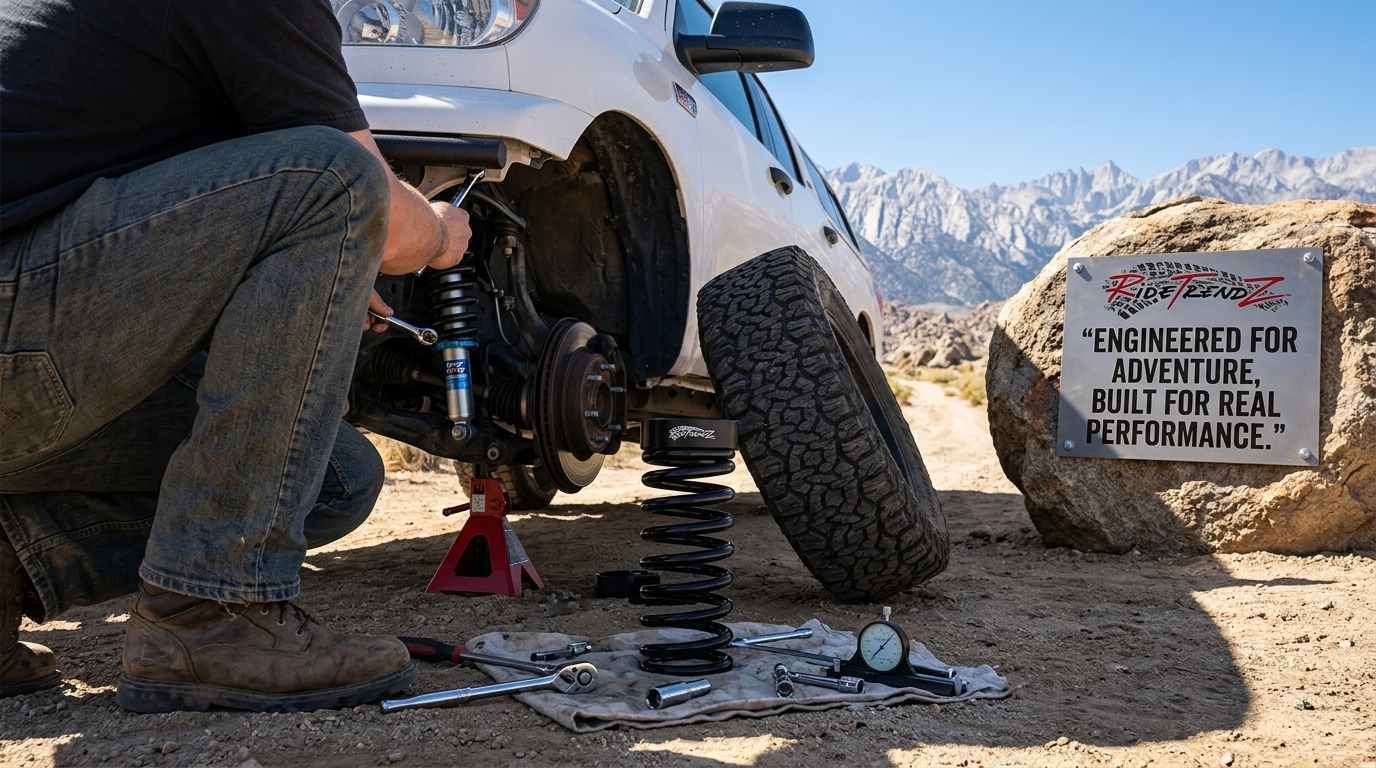
Understanding your suspension components helps you buy smarter. Here is what a full Toyota Tundra lift kit system involves:
Coil Spring Spacers
Used in leveling kits and economy lift kits. Sit on top of the factory coil spring to add height. Best for: 1–3 inch lifts. They preserve factory spring rate and ride quality.
Aftermarket Suspension Springs
Replacement coil spring units built to a higher ride height. Used in full lift kits. Provide better articulation and load capacity than spacers.
Upper Control Arm (UCA)
Critical on lifts above 3.5 inches. The factory upper control arm was not designed for extended suspension travel. An aftermarket upper control arm corrects CV axle angles, prevents premature wear, and restores proper geometry.
Lower Control Arms
The lower control arms rarely need replacement on Tundra lifts under 4 inches. On aggressive 6-inch lift kit builds, aftermarket lower control arms improve geometry and travel.
Shocks
Shocks must match lift height. Running factory shocks with a 3-inch lift causes the shock to bottom out and destroys ride quality. RideTrendz includes properly tuned RTZ Primo Nitro gas shocks in every complete kit.
For more on this topic, read: Lift Shocks vs. Stock Shocks: What You Really Need After a Lift
How Much Does It Cost to Lift a Toyota Tundra?
How much does it cost to lift a truck is the first question every Tundra owner asks. Here is a realistic breakdown:
|
Lift Type |
Kit Cost |
Install Labor |
Total Estimate |
|
Leveling kit (2.75–3") |
$60–$120 |
$100–$200 |
$160–$320 |
|
Lift kit (2–3") |
$120–$250 |
$200–$400 |
$320–$650 |
|
4-inch lift kit (complete) |
$250–$500 |
$300–$600 |
$550–$1,100 |
|
6-inch lift kit (full) |
$500–$900 |
$600–$1,200 |
$1,100–$2,100 |
|
UCA upgrade (if needed) |
$250–$600 |
$200–$400 |
add $450–$1,000 |
Pro Tip from RideTrendz: Buying a complete kit, shocks, spacers, and hardware bundled, almost always costs less than buying parts separately. Our Tundra kits are priced to give you everything in one order.
For a full pricing breakdown on truck lifts, read: How Much Does It Cost to Lift a Truck?
Lift Kit Installation, DIY or Professional?
DIY Lift Kit Installation
Leveling kits are the most DIY-friendly option. Most Tundra owners with basic mechanical skills complete it in 2–4 hours with a floor jack, jack stands, and common hand tools.
Steps typically involved:
- Lift and support the truck safely
- Remove the factory strut/spring assembly
- Install the coil spring spacer on top of the existing spring
- Reinstall the assembly
- Set ride height and alignment
Warning: After any lift kit installation above 1.5 inches, a professional alignment is required. Skipping alignment causes rapid tire wear.
Professional Lift Kit Installation
For 4-inch lift kit and 6-inch lift kit builds, especially those involving upper control arm replacement or new aftermarket suspension springs, professional installation is the right call.
Expect 4–8 hours of shop labor for a complete suspension lift kit with UCAs.
For a step-by-step walkthrough of the process, read: How Does a Truck Suspension Lift Kit Work? A Simple Explanation
Why RideTrendz Tundra Lift Kits Are Different?
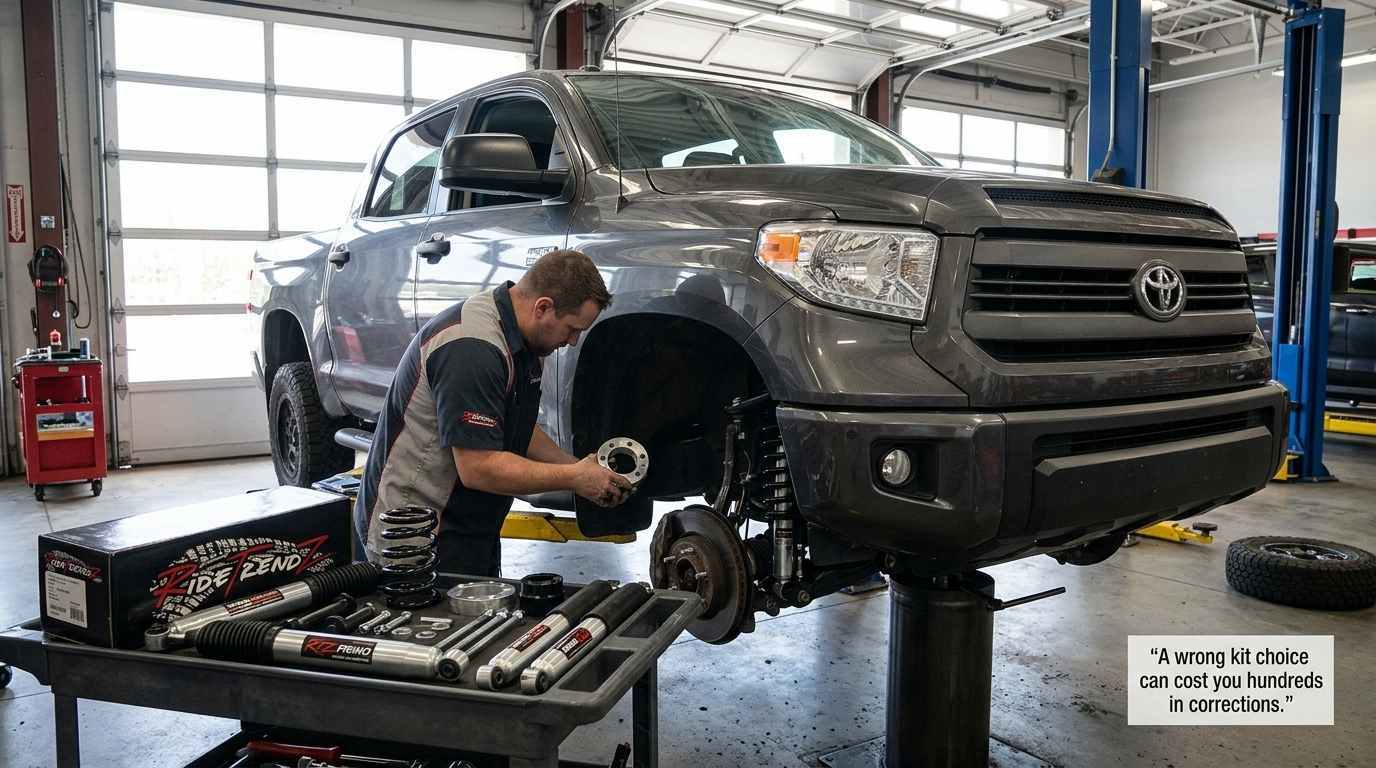
We hear this question often: "Why buy from RideTrendz instead of Amazon or a big-box retailer?"
Here is the honest answer.
We Engineer for Fit, Not Price
Every RideTrendz Toyota Tundra lift kit is designed for specific Tundra years and configurations. We do not sell generic kits with fitment disclaimers. When our listing says it fits 2007–2018 Tundra 2WD, it fits. Period.
Our Materials Are Proven
The polyurethane spacers in our leveling kit products outperform rubber alternatives by 3–5x in longevity tests. Our aluminum coil spring spacers resist corrosion, critical in salt states.
RTZ Primo Nitro Shocks Are Included Where They Matter
Other brands sell kits and leave you sourcing shocks separately. Our full and complete Toyota Tundra lift kit packages include RTZ Primo nitrogen gas-charged shocks that are tuned to the exact lift height. No guesswork. No mismatch.
Real Suspension Lift for Truck Engineering
Our suspension lift for truck kits go through fitment testing before they reach our catalog. We have flagged and corrected geometry issues that other brands have ignored. When you buy a RideTrendz kit, you get a product that has already been through the hard testing.
We Support Your Build After the Sale
Questions about installation? Need to confirm fitment for a non-standard configuration? RideTrendz answers those questions. We are not a drop-shipper. We know our products.
What our customers say: RideTrendz buyers consistently report that their kits arrive complete, every bolt, every bracket, hardware labeled and accounted for. That matters when you are mid-install on a Saturday afternoon.
For a broader look at why aftermarket suspension quality matters, read: Why Buy USA-Made Suspension Parts vs. Generic Brands.
Aftermarket Suspension, Pros, Cons & Reality Check
Aftermarket Suspension, Pros
- Unlocks tire sizes impossible on stock suspension
- Dramatically improves off-road ground clearance
- Can improve handling on rough terrain
- Allows wheel and tire combinations that make the truck visually stand out
- Increases resale appeal for modified-truck buyers
Aftermarket Suspension, Cons
- Requires professional alignment after install
- Modifies factory geometry; control arm angles must be corrected on larger lifts
- May require additional suspension components: extended brake lines, diff drops, bump stop extensions
- Warranty concerns on some vehicles (though Magnuson-Moss protects most modifications in the US)
The Geometry Problem, And How to Solve It
When you lift a Tundra more than 3.5 inches, the control arm and lower control arms move into angles they were not factory-designed for. CV axles run at steeper angles. Upper control arm geometry deviates from optimal.
The solution: a quality upper control arm upgrade from a respected aftermarket suspension brand, paired with proper alignment. RideTrendz can advise on this for your specific Tundra configuration.
Read: What Is a Suspension Lift Kit? Types & Benefits
Toyota Tundra Lift Kit, Year-by-Year Quick Reference
2002–2006 Tundra (1st Gen)
Front suspension type: Torsion bar (4WD) / Coil spring (2WD)
Best lift option: 2–3" spacer lift
Notes: Torsion bar 4WD models require torsion bar cranking + spacers for leveling. 2WD models with coil spring front suspension have better lift kit compatibility.
Caution: Aftermarket support is thinner for this generation. Fitment verification is critical.
2007–2013 Tundra (2nd Gen)
Front suspension type: Double wishbone with coil spring
Best lift options: 2.75" leveling kit, 3" leveling kit, 4-inch lift kit complete, full lift kit with shocks
Notes: This is the gold standard generation for Toyota Tundra lift kit compatibility. More RideTrendz kits are available for this year range than any other.
UCA Needed? Recommended for 3.5" and above.
2014–2020 Tundra (3rd Gen)
Front suspension type: Double wishbone with coil spring, wider front track
Best lift options: 2.75" leveling kit, 3" leveling kit, select 4-inch lift kit setups
Notes: 3rd gen Tundras have a wider front stance. Spacer kits work well. Full lift kit availability is more limited, verify fitment before ordering.
UCA Needed? Yes, for anything above 3 inches.
Front Suspension Kit Options Compared
|
Kit Type |
Height Gain |
Complexity |
Best Generation |
|
Leveling kit (spacers) |
2–3" front only |
Low |
2007–2020 |
|
Front suspension kit (spacers + shocks) |
2–3" |
Moderate |
2007–2018 |
|
Complete suspension lift kit |
3–4" |
Moderate-High |
2007–2018 |
|
Full suspension lift kit with shocks |
3–4"+ |
High |
2007–2013 |
|
4 inch lift kit with UCA |
4" |
High |
2007–2013 |
|
6 inch lift kit full build |
6" |
Very High |
2007–2013 |
Suspension Lift for Truck, How Long Will It Last?
A common question we get: "How long does a lift kit actually last?" The answer depends on:
- Kit quality: polyurethane and aluminum components outlast rubber and cheap steel significantly
- Installation quality: poor alignment destroys tires and stresses suspension components faster
- Use case, a daily driver lift kit lasts longer than one used on aggressive off-road trails weekly
- Maintenance: check hardware torque every 12 months; inspect lower control arms and upper control arm ball joints annually
General lifespan estimates:
|
Component |
Expected Lifespan |
|
Coil spring spacers (quality) |
5–10 years |
|
Aftermarket suspension springs |
80,000–150,000 miles |
|
RTZ Primo shocks |
50,000–80,000 miles |
|
Upper control arm (aftermarket) |
80,000–100,000 miles |
Read more: How Long Do Lift Kits Last? Lifespan & Maintenance Guide
Top 5 Mistakes Tundra Owners Make When Buying a Lift Kit
These are the mistakes we see most often, and the ones that cost the most to fix.
- Buying the wrong year fitment. Always verify the exact year AND drivetrain (2WD vs. 4WD) before purchasing. A kit designed for a 2007 2WD Tundra does not fit a 2007 4WD Tundra the same way.
- Skipping the alignment after install. This is non-negotiable. Any lift kit installation changes your alignment geometry. Skip the alignment, and you will destroy your tires inside 10,000 miles.
- Running stock shocks with a lift Factory shocks are valved for factory ride height. Running them on a 3-inch lift causes bottoming out, poor control, and premature shock failure. Always match shocks to your lift.
- Going too big without proper planning: A 6-inch lift kit on a Tundra requires extended brake lines, possible diff drop, and a quality upper control arm upgrade. Buyers who skip these steps return with expensive repair bills.
- Buying cheap generic spacers: Foam and low-grade rubber spacers degrade fast. They cause noise, vibration, and uneven ride height over time. Polyurethane and aluminum coil spring spacers, like those in RideTrendz kits, are built to last.
How RideTrendz Compares, Product Quality Benchmark?
|
Feature |
Generic Amazon Kits |
RideTrendz RTZ Kits |
|
Spacer material |
Rubber/foam (varies) |
Polyurethane or aluminum |
|
Shocks included |
Rarely |
Yes, in complete & full kits |
|
Year-specific fitment |
Sometimes |
Always verified |
|
Hardware completeness |
Inconsistent |
Full hardware included |
|
Post-purchase support |
None |
Available |
|
Testing before listing |
Rare |
Standard process |
|
RTZ Primo nitro shocks |
Not available |
Included in full kits |
The difference is real. And it shows up the moment you open the box. Read: Top 5 Reasons to Upgrade Truck Suspension in 2025
Toyota Tacoma Cross-Reference, What About Tacoma Owners?
We get Tacoma inquiries frequently alongside Tundra questions. While this guide focuses on the Toyota Tundra lift kit, Tacoma owners have a dedicated guide available.
The Tacoma uses a different front suspension kit architecture; notably, the front coil spring setup varies significantly from the Tundra, and lift kit compatibility is not interchangeable between the two platforms.
If you own a Tacoma, start here: Best Lift Kit for Toyota Tacoma
For 1995–2004 Tacoma-specific lift options, check our RTZ Tacoma Complete Lift Kit (95–04).
Suspension Lift Kit, The RideTrendz Promise
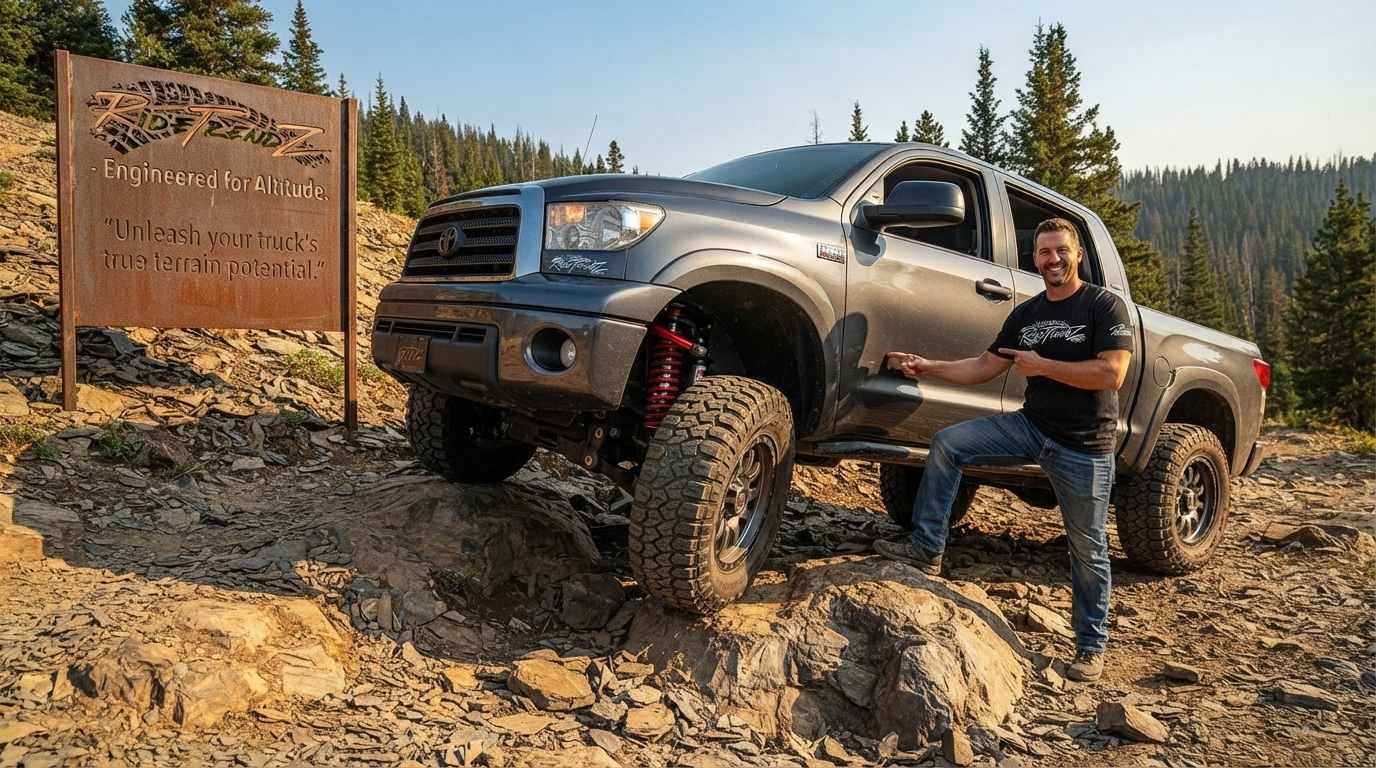
We want to be clear about what we stand for.
RideTrendz is not a marketplace that lists thousands of generic parts and hopes one fits your truck. We are a suspension lift for truck brand that sources and tests kits for specific vehicles, specific years, and specific configurations.
Our Toyota Tundra lift kit lineup is built on the same engineering philosophy that drives every product in our catalog:
- Fit right the first time. No adapting. No fabricating. Bolt on and drive.
- Use quality materials. Aluminum resists corrosion. Polyurethane outlasts rubber. Nitrogen gas shocks outperform oil-filled units.
- Include everything. Hardware kits, shocks, spacers, blocks, in one box.
- Stand behind the product. If something does not fit or perform as promised, we make it right.
This commitment is why Tundra owners who buy from us once come back for their next build.
Conclusion
You now have everything you need to make a confident decision.
If you want a clean, level stance with minimal complexity, choose the 2.75" or 3" leveling kit from RideTrendz.
If you want real off-road capability with larger tires, go with our complete suspension lift kit for 2007–2018 Tundras.
If you are building a serious trail truck, a 4-inch lift kit with a quality upper control arm upgrade is the right path. And if you want maximum clearance for 37-inch tires, the 6-inch lift kit build is there for you; just plan the build properly.
Every Toyota Tundra lift kit option we carry is listed on our Toyota Tundra product pages. Order with confidence; RideTrendz has your Tundra covered.
Frequently Asked Questions
Q1: What is the best Toyota Tundra lift kit for 2007–2018 models?
The RTZ Complete or Full Lift Kit from RideTrendz is the best all-around option. It includes matched shocks, hardware, and a verified fitment, everything needed for a reliable, clean lift in one purchase.
Q2: Do I need an upper control arm with a 4-inch lift kit on my Tundra?
Yes. On lifts above 3.5 inches, the factory upper control arm runs at an angle that strains CV axles and ball joints. An aftermarket UCA corrects geometry and protects the drivetrain.
Q3: How much does it cost to lift a Toyota Tundra with a 3-inch lift kit?
A 3-inch lift kit for a Tundra typically costs $120–$250 for the kit, plus $200–$400 in professional install labor. Total estimate: $320–$650 including alignment.
Q4: Can I install a leveling kit on my Toyota Tundra at home?
Yes. A leveling kit with coil spring spacers is the most DIY-friendly option. Most owners with basic tools complete it in 2–4 hours. Always get a professional alignment afterward.
Q5: Will a 6-inch lift kit fit a 2014–2020 Toyota Tundra?
A 6-inch lift kit for 2014–2020 Tundras requires significant planning, new upper control arms, extended brake lines, and possible diff drop. Fitment options are more limited for this generation. Verify with RideTrendz before ordering.