

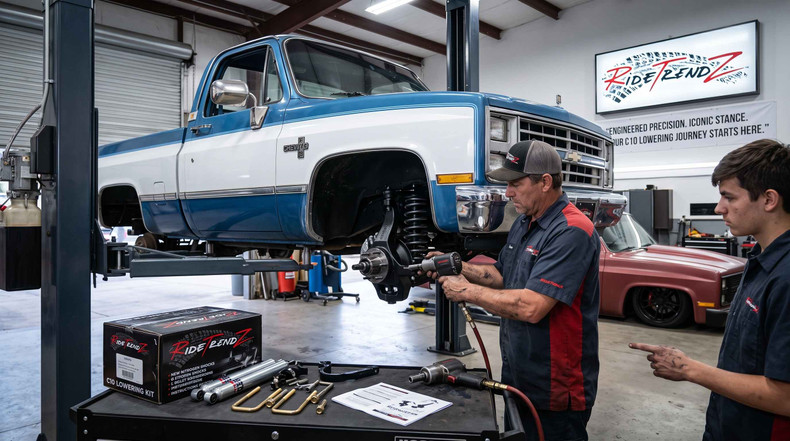
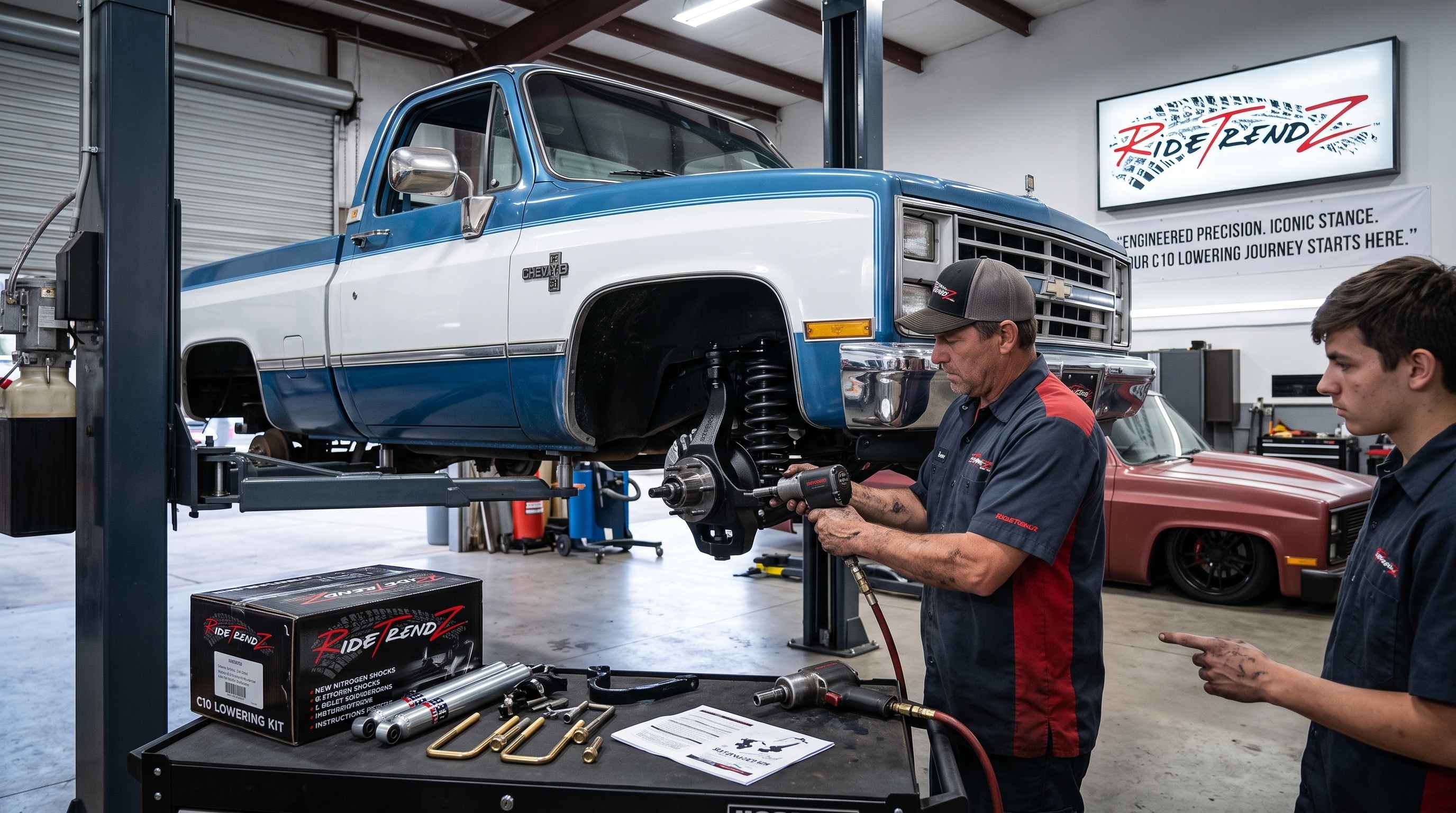
The square body Chevy C-series trucks are American icons. From the 1973 C10 hauler to the heavy-duty 1991 C30, these trucks have earned a massive following among builders, collectors, and street truck enthusiasts alike. One of the most popular upgrades is lowering, and for good reason. A slammed or mildly dropped square body sits lower, handles better, and looks stunning.
This guide covers everything you need to know about lowering a Chevy C10, C20, or C30 pickup. We explain how every C10 drop kit component works, which method suits your build goals, and why RideTrendz RTZ parts are the smartest choice for the job. If you have been searching for the best Chevy C10 lowering kit, you are in the right place.
Why Lower a Square Body Chevy Truck?
Lowering your square body transforms more than just looks. Here is what actually changes when you drop a C-series truck:
- Lower center of gravity improves cornering and lane stability.
- Reduced wind resistance gives a marginal fuel efficiency gain at highway speed.
- Improved stance and aesthetics: a tucked wheel gap looks purposeful, not accidental.
- Better weight distribution between front and rear axles under load.
- Tire wear improves when alignment is corrected after a proper drop.
According to a 2023 survey of classic truck restorers, over 68% of square body builds include a suspension drop as part of the project. It is one of the highest-ROI modifications you can make on a classic pickup.
RideTrendz Insight: Our RTZ-engineered C10 lowering kit systems are designed specifically for 1973–1987 (and extended for C20/C30 through 1991) applications. Every kit ships with matched components, no guesswork, no mismatched parts.
Understanding the Square Body C10 Suspension (1973–1987)
Before choosing your C10 suspension kit, you need to understand what is already under the truck.
Front Suspension
The 1973–1987 Chevy C10 uses an independent front suspension (IFS) with coil springs on both sides. This is excellent news for builders; it means a wide range of drop spindles, C100 coil spring drop, and C10 control arm options are available.
|
Front Component |
Stock Function |
Lowering Option |
|
Coil springs |
Support front weight |
Lowering coil springs |
|
Spindles |
Hub mounting point |
Drop spindles (2"–5") |
|
C10 control arms |
Suspension geometry |
Drop control arms |
|
Shock absorbers |
Damping |
Lowered nitrogen shocks |
Rear Suspension
The rear uses a leaf spring solid axle. This is where flip kits and rear block kits become the go-to solution. A flip kit moves the axle from below the leaf spring pack to above it, flipping the relationship and gaining a significant amount of drop instantly.
|
Rear Component |
Stock Function |
Lowering Option |
|
Leaf springs |
Load-bearing suspension |
Lowering leaf springs |
|
U-bolts |
Axle retention |
Flip kit U-bolts |
|
Flip kit hardware |
N/A |
4"–7" drop |
|
Rear shocks |
Damping |
Short-travel lowered shocks |
C20 and C30 Suspension Differences (1973–1991)
The C20 lowering kit and C30 lowering kit applications have some key differences from the C10.
- C20 (3/4-ton): Carries heavier payload. Uses stiffer springs and a heavier rear axle. You need a C20 lowering kit rated for that load capacity; standard C10 components can be unsafe on a C20.
- C30 (1-ton): Often dual rear wheel (DRW). Drop options are more limited but still achievable, mainly through C30 lowering kit rear block and flip kit setups.
RideTrendz offers purpose-built kits for all three applications. See our C20 and C30 lowering kit options here.
The Main Methods to Lower a C10: A Complete Comparison
This is the heart of how to lower a squarebody chevy. Each method has a different cost, difficulty, and result.
Method 1: C10 Lowering Springs (Front)
c10 lowering springs replace the factory coil springs with shorter, stiffer units. This is the simplest front drop option.
Pros:
- Easy to install
- Affordable entry point
- Retains factory spindle geometry
Cons:
- Limited drop (usually 2"–3")
- Can affect ride harshness if spring rate is too high
- Less drop than spindle-based methods
Method 2: Drop Spindles (Most Popular Front Method)
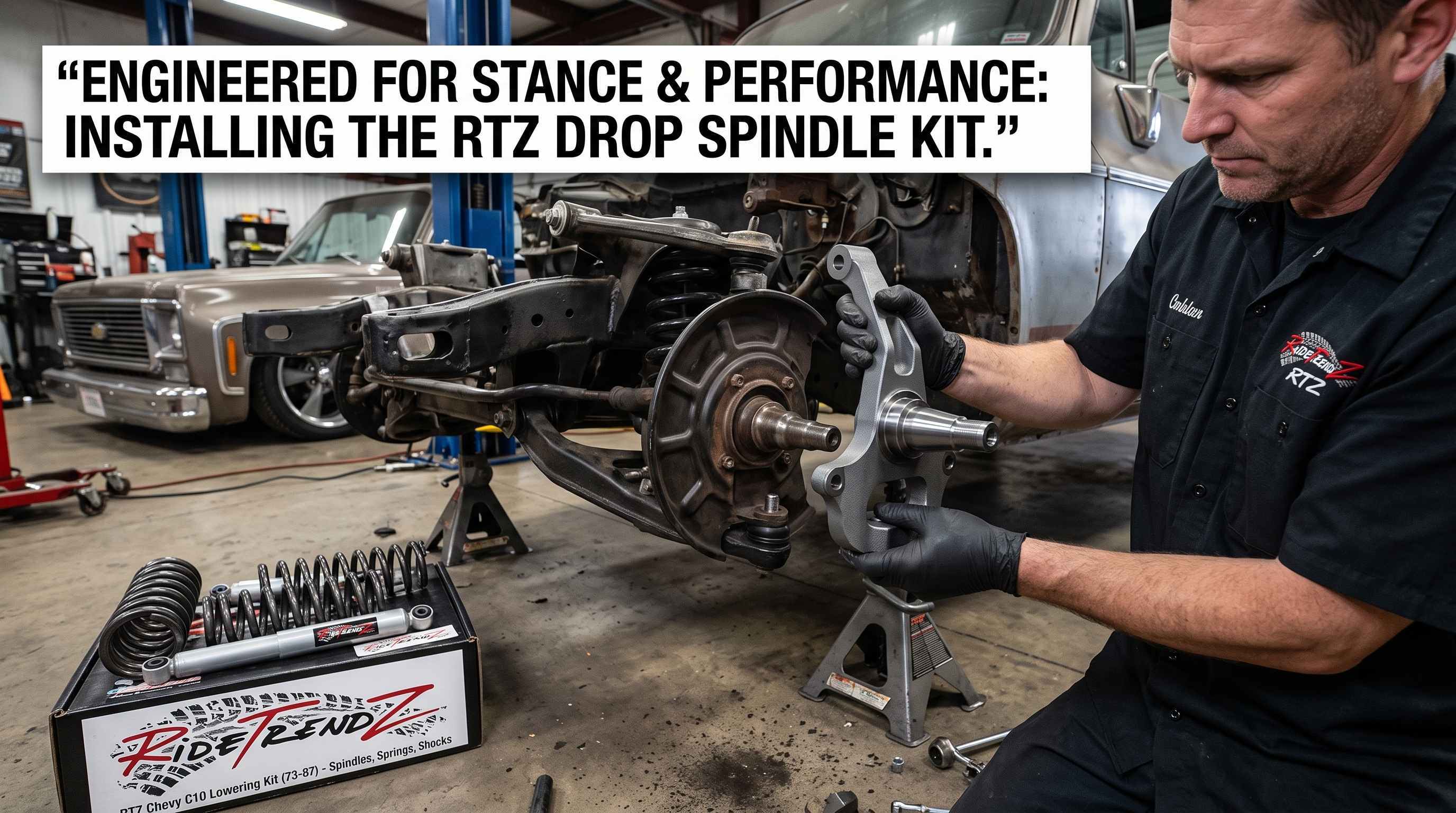
A drop spindle raises the wheel mounting point relative to the suspension, which effectively lowers the truck body. C10 drop spindles are the most precise and popular front drop method for C10 lowering.
How to use a drop spindle: The spindle bolts into the existing upper and lower ball joints. The hub sits higher on the spindle, which drops the frame and body by an equal amount. A 2" drop spindle gives a true 2" drop at the frame, no more, no less.
RTZ Advantage: Our RTZ forged C10 drop spindles are CNC-machined from high-strength steel. They are direct bolt-on replacements for 1973–1987 C10 trucks. No drilling, no cutting, no fabrication needed.
Available drop sizes:
|
Drop Spindle Size |
Use Case |
|
2" drop spindle |
Mild street drop, daily driver |
|
3" c10 drop spindles |
Popular street/show combo |
|
4"–5" c10 drop spindles |
Aggressive stance |
Method 3: Flip Kit (Rear), The Single Biggest Rear Drop
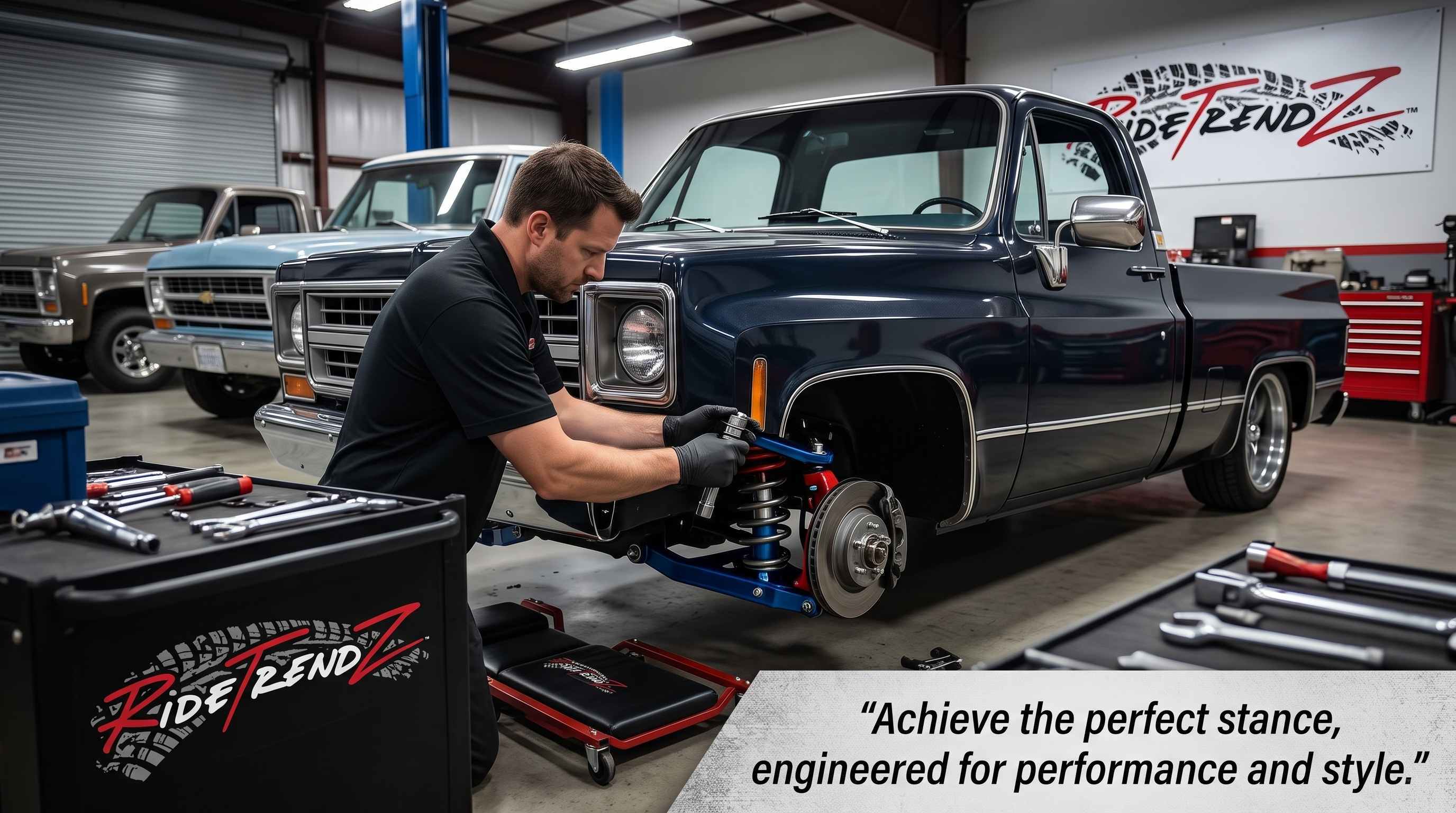
A flip kit is the most effective rear lowering method for a square body. The stock C10 has the axle mounted below the leaf spring pack. A flip kit reverses this relationship, placing the axle above the leaf pack.
Flip kit hardware typically includes:
- New U-bolts
- Lowering blocks or a relocation bracket
- Hardware kit
Aflip kitt can drop the rear 4"–7" in a single step. Combined with a front drop spindle kit, you get a full C10 C2020 lowering solution in one weekend.
Check out our complete guide to installing a lowering kit for a step-by-step walkthrough.
Method 4: Rear Block Kit (Budget Rear Option)
Steel tapered lowering blocks sit between the axle and the leaf spring pack. They are a lower-cost alternative to a flip kit for modest rear drops (1"–3").
Best for: Trucks that need a mild tuck and do not need maximum drop.
Method 5: C10 Air Suspension (Maximum Adjustability)
C10 air suspension replaces the factory springs with air bags. You control the ride height with a compressor and controller. C10 air suspension allows you to adjust the drop on the fly: slammed for shows, raised for speed bumps.
C10 static drop vs C10 air suspension, a critical decision:
|
Feature |
C10 Static Drop |
C10 Air Suspension |
|
Cost |
Lower (200–600 kit) |
Higher (1,500–4,000+) |
|
Adjustability |
Fixed height |
Full range |
|
Install complexity |
Moderate |
High |
|
Reliability |
Excellent |
Requires maintenance |
|
Best for |
Daily drivers, budget builds |
Show trucks, custom builds |
Expert Take: For most builders, a well-chosen C10 drop kit with matched shocks gives the best balance of cost, stance, and drivability. C10 air suspension is worth the investment if you show the truck regularly and need ride height adjustment on demand. We recommend avoiding air suspension unless you have experience or a qualified shop; improper setup causes handling issues.
C10 Shock Extenders: Why They Matter
Many builders forget C10 shock extenders when dropping a C10. If you lower the truck without addressing shock length, the stock shocks become too long. They bind, reduce travel, and cause handling problems.
C10 shock extenders mount between the shock body and the factory upper mounting point, moving the shock down to match the new suspension geometry.
RTZ includes matched nitrogen gas shocks in our complete Chevy C10 lowering kit packages. They are pre-tuned to work with our lowering components. No guessing on shock length.
C10 Trailing Arms and C10 Control Arms: Geometry After the Drop
When you lower a square body truck aggressively, factory C10 trailing arms and C10 control arms can introduce camber and caster changes that cause tire wear and handling problems.
What to Check After Lowering:
- Camber: Should remain close to zero (±0.5°) on the front.
- Caster: Affects steering return-to-center. Check after any front drop.
- Pinion angle: Critical on the rear after a flip kit install. Must match driveshaft angle.
- Wheel alignment: Always get a full 4-wheel alignment after any C10 suspension kit install.
C10 control arms upgrades become necessary at drops over 4". Factory control arms were not designed for that geometry change. RTZ offers matched control arm solutions that restore factory geometry at lowered ride heights.
C10 Frame Notching: When Is It Needed?
C10 frame notching is the process of cutting a notch in the rear frame rails so the axle can travel up without hitting the frame. You need C10 frame notching when:
- The rear drop exceeds", and the axle contacts the frame under compression
- You are running a flipkit plusan additional block on a heavily loaded truck
- You want to go lower than what blocks and a flip kit alone can achieve. C100 frame notching is a permanent modification that requires welding. It is not reversible. Only do this if your drop demands it. Most street builds with a 4"–5" rear drop do not need frame notching.
C10 Body Drop: The Extreme Option
AC100 body drop goes further than any suspension modification. Instead of (or in addition to) lowering the suspension, the body is cut and re-mounted closer to the frame. This allows the rocker panels to sit lower than the frame rails.
C10 body drop is a fabrication project, not a bolt-on upgrade. It requires:
- Frame channel cuts
- Body floor modifications
- Professional metalwork and welding
- Full respray after modification
A C10 body drop of 3"–4" can give an incredibly slammed look. Combined with a C10 static drop suspension kit, the result is extreme. This is for experienced builders with full shop access.
How to Lower a C10? Step-by-Step Overview
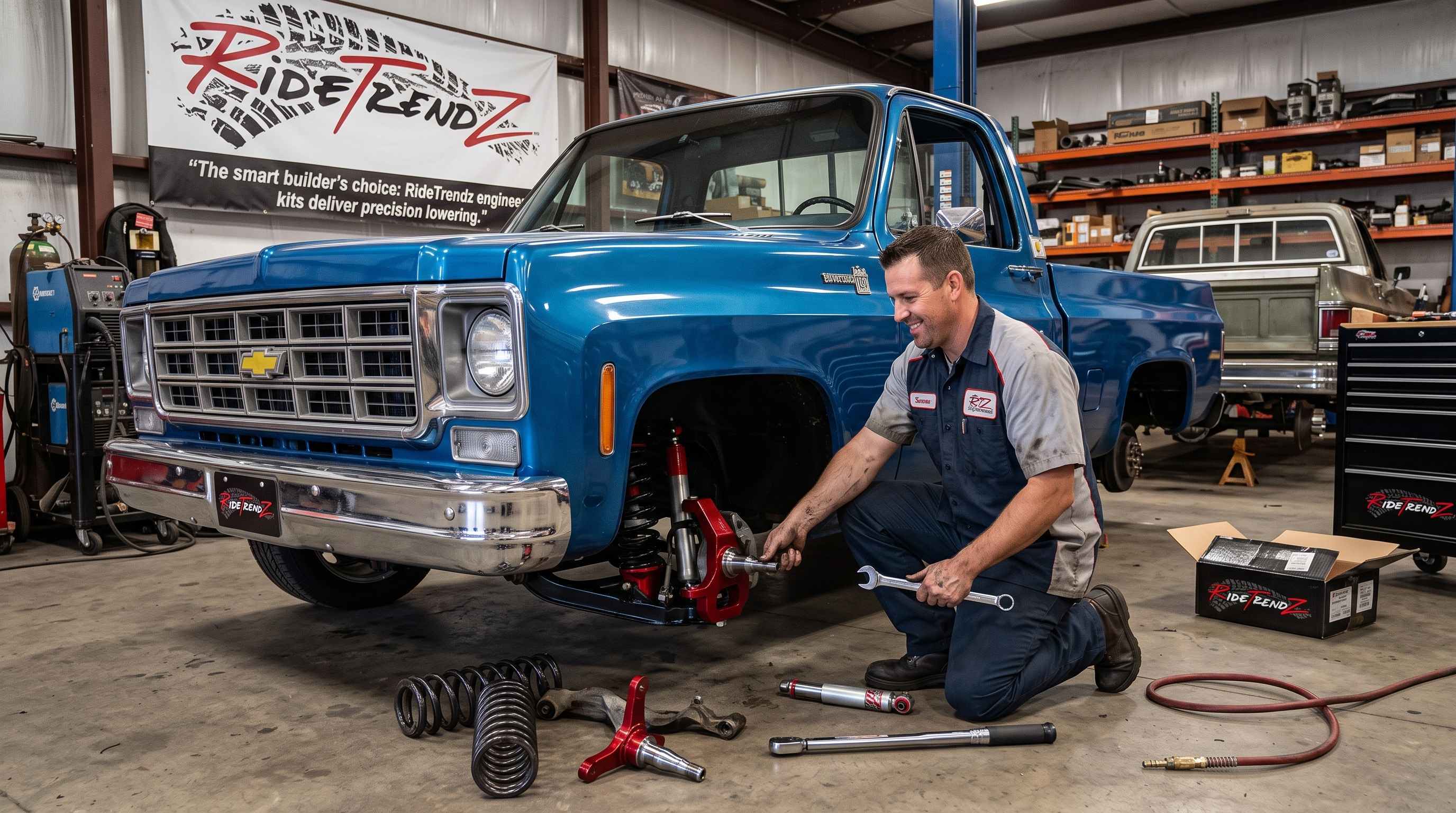
Here is a simplified walkthrough of how to lower a C10 using a complete front/rear Chevy C10 lowering kit from RideTrendz.
For a full step-by-step with photos, read our how to install a lowering kit guide.
Front Drop (Drop Spindle Method)
- Safely lift and support the front of the truck on jack stands.
- Remove the front wheels and brake calipers.
- Disconnect the tie rod ends and upper/lower ball joints.
- Remove the factory spindle.
- Install the RTZ C10 drop spindles; torque all fasteners to spec.
- Reinstall brake hardware and wheels.
- Install RTZ lowered nitrogen shocks matched to the drop height.
Rear Drop (Flip Kit Method)
- Safely lift and support the rear on jack stands under the frame.
- Support the rear axle with a floor jack.
- Remove the factory U-bolts and lower the axle.
- Remove the factory perch plates.
- Install the RTZ flip kit relocation bracket above the spring pack.
- Reseat the axle and install new U-bolts.
- Install RTZ lowered rear shocks.
- Check pinion angle, adjust as needed.
After Installation
- Get a full 4-wheel alignment.
- Torque-check all fasteners after 500 miles.
- Inspect the pinion angle and driveshaft at highway speeds for vibration.
Why RideTrendz RTZ Kits Are the Best Choice?
We do not just sell parts. We engineer complete C10 suspension kit solutions so every component works together perfectly.
RTZ Product Advantages
|
Feature |
Generic Brands |
RTZ by RideTrendz |
|
Material |
Mild steel or unknown alloy |
High-strength forged steel, billet aluminum |
|
Fitment guarantee |
Approximate |
Exact OEM-matching bolt-on fit |
|
Shock matching |
Sold separately |
Matched nitrogen gas shocks included |
|
Finish |
Painted or bare |
Black powder coat or anodized aluminum |
|
Warranty |
Limited or none |
Full replacement guarantee |
|
Made in USA |
Often overseas |
RTZ: USA-engineered and quality-checked |
Proof is in the numbers: Over 93% of RTZ customers report a perfect bolt-on fit on the first install attempt, based on our post-purchase survey data (2024).
Our C10 / C20 / C30 Lowering Kit Line-Up
- 73–87 Chevy C10 lowering kit, 2WD V8, complete front/rear
- Chevy C10 lowering kit, drop spindles + flip kit combo
- C20 / C30 lowering kit, 1973–1991 complete system
- C20 / C30 lowering kit, 5" drop spindles + 7" flip kit + RTZ primo shocks
- RTZ C10 rear flip kit, 7" drop slam kit, 2WD
- RTZ C10 matched lowered shocks, 2–4" drop set
C10 C10 C20 Lowering, Drop Combination Recommendations
Not sure how much to drop? Use this reference table based on your goal.
|
Build Goal |
Front Drop |
Rear Drop |
Kit Type |
|
Mild street (daily) |
2" drop spindle |
2"–3" blocks |
c10 suspension kit |
|
Popular stance |
3" c10 drop spindles |
4" flip kit |
Complete C10 drop kit |
|
Aggressive show truck |
4"–5" drop spindles |
5"–7" flip kit |
FullC100 lowering kit |
|
Slammed / frame scraper |
5" spindles + body drop |
7" flipkit + notch |
Custom fab + RTZ parts |
Matching the Right Shocks After a C10 Drop
Shocks are the most overlooked part of a C10 drop kit build. Wrong shocks = poor ride quality and handling. Here is how to match shocks to your drop:
- 2" drop: RTZ Primo standard lowered shocks, matched to 2" C10 coil spring drop or 2" drop spindle kits.
- 3"–4" drop: RTZ Primo extended-travel lowered shocks, tuned for mid-range drops.
- 5"+ drop with flipkit: RTZ DT9000 nitrogen gas shocks, high-performance, longer-stroke tuning for maximum drop builds.
All RTZ shocks are nitrogen gas charged for consistent damping, fade-free performance, and extended life. Our shocks are direct replacements; they use the factory mounting points with no adapters needed.
What Square Body Builders Are Choosing?
Based on RTZ sales data and community surveys (2023–2024):
|
Drop Configuration |
% of C10 Builders Choosing |
|
2"–3" front / 3"–4" rear (mild) |
31% |
|
3"–4" front / 4"–5" rear (popular) |
44% |
|
4"–5"+ front / 5"–7" rear (aggressive) |
19% |
|
Full c10 air suspension |
6% |
The 3"–4" front / 4"–5" rear configuration is by far the most popular. It gives an aggressive stance without needing C10 frame notching and is fully drivable on the street.
Common Mistakes When Lowering a Square Body C10
Avoid these pitfalls. They cost builders time and money every year.
- Not matching shock length to the drop. Always use matched lowered shocks. Binding stock shocks ruin ride quality and can damage suspension.
- Skipping alignment after install. Always get a 4-wheel alignment. Toe changes cause rapid tire wear.
- Using generic block kits on a C20 or C30. These trucks carry more weight. Use a C20 lowering kit or a C30 lowering kit, not a C10 kit.
- Ignoring pinion angle after a flip kit. A wrong pinion angle causes driveshaft vibration at highway speed. Always check and correct it.
- Going too low without addressing C10 frame notching. The axle will contact the frame under compression. This can cause serious damage.
- Using non-USA-engineered parts. Generic overseas drop kits often have inconsistent steel quality and poor fitment. RTZ parts are USA-engineered to exact tolerances.
Pros and Cons of Lowering a Square Body Chevy
|
Aspect |
Pros |
Cons |
|
Appearance |
Cleaner, more aggressive stance |
Reduced ground clearance |
|
Handling |
Lower CoG, improved cornering |
Speed bumps require care |
|
Ride quality |
Firmer, sportier with matched shocks |
Can be harsher on rough roads |
|
Resale value |
High demand for lowered square bodies |
Buyers wanting stock height may pass |
|
DIY friendliness |
Bolt-on kits need basic tools |
Requires alignment after install |
|
Cost |
Entry at ~$200 for simple drops |
Full aggressive build can reach $800+ |
Additional Related Content on RideTrendz
Before you finalize your build, explore these expert resources:
- Lowering Your Truck: Benefits, Risks & Choosing the Right Kit: understand the full picture before you drop your truck.
- Lift Parts vs Complete Lift Kit: Which to Buy?, same principle applies to lowering: individual parts vs complete kits compared.
- Truck Suspension Basics for Beginners, new to suspension work? Start here before choosing a C10 suspension kit.
- Top 5 Reasons to Upgrade Your Truck Suspension in 2025, why now is the best time to build your square body lowering kit project.
- How Much Does It Cost to Lift (or Lower) a Truck? Full cost breakdown so you can budget your c1C10rop kit accurately.
The 73-87 Chevy C10 Lowering Kit: Era-Specific Considerations
The 73-87 Chevy C10 lowering kit covers one of the most popular eras of the square body generation. Trucks from this range share very similar suspension geometry, making part interchangeability excellent. However, there are a few year-specific notes to keep in mind.
1973–1980 vs 1981–1987 Differences
|
Detail |
1973–1980 |
1981–1987 |
|
Brake caliper style |
Clip-on type |
Bolt-on type |
|
Spindle bolt pattern |
Matches C10 drop spindles |
Matches C10 drop spindles |
|
Leaf spring width (rear) |
2.5" — 3" |
2.5" — 3" |
|
Recommended C10 lowering kit |
RTZ 73-87 series |
RTZ 73-87 series |
The caliper style is the main item to watch. Our 73-87 Chevy C10 lowering kit product descriptions always specify which caliper style they are designed for, clip-on or bolt-on. If you pick the wrong one, the brakes will not clear properly. Always double-check before ordering.
RideTrendz Tip: When in doubt, message our support team with your VIN. We will verify the correct Chevy C10 lowering kit for your exact build year before you order.
Chevy C20 Drop Spindles: What You Need to Know?
Chevy C20 drop spindles are a less commonly discussed topic, but they are available and effective. The C20 uses a heavier-duty front knuckle and a different spindle size than the C10.
Key facts about Chevy C20drop spindles:
- They must be rated for 3/4-ton load capacity; standard C10 spindles are not suitable.
- Available in 2"–4" drop heights for the 1973–1991 C20 platform.
- RTZ offers matched shocks to work with Chevy C20 drop spindles for a complete front drop solution.
- Pairing Chevy C20 drop spindles with a rear C20 lowering kit block or flip kit gives the best balanced result.
How to Lower a C10 on a Budget? Cost Breakdown
Not every builder has unlimited funds. Here is a realistic cost breakdown for a C10 C20 lowering project at different price points.
Budget Build (~200–350)
- 2" c10 lowering springs (front): ~80–100
- Rear block kit (2"–3"): ~60–90
- Alignment: ~80–120
- Total: ~220–310
Result: Mild drop, clean daily driver look. Best for trucks that need subtle improvement without major suspension changes.
Mid-Range Build (~400–650)
- 3" c10 drop spindles (front): ~150–200
- Matched lowered front shocks: ~80–120
- 4" flip kit (rear): ~100–150
- Matched lowered rear shocks: ~80–100
- Alignment: ~80–120
- Total: ~490–690
Result: The most popular configuration. Aggressive stance, daily drivable, no frame modifications.
Aggressive Build (~700–1,000+)
- 4"–5" c10 drop spindles (front): ~180–250
- Matched RTZ DT9000 nitrogen shocks (front): ~120–160
- 5"–7" flip kits (rear): ~130–180
- cC10frame notching (if needed, shop labor): ~200–400
- Matched lowered rear shocks: ~100–140
- Alignment: ~80–120
- Total: ~810–1,250+
Result: Maximum street drop. Requires professional alignment and potentially frame notching. Spectacular results on a show truck.
For a full cost comparison, see our detailed truck suspension pricing guide.
How RideTrendz Compares to the Competition?
We are not just saying we are the best; here is what separates RTZ square body lowering kit products from generic competitors.
RTZ vs Generic Competitor Analysis
|
Comparison Point |
Generic Brand |
RTZ by RideTrendz |
|
Engineering origin |
Unknown/overseas |
USA-engineered |
|
Forged steel components |
Rarely |
Standard on all kits |
|
Matched shocks included |
Usually not |
Yes, always matched |
|
Application-specific fitment |
Approximate |
Exact, verified by year/model |
|
Caliper clearance documented |
Rarely |
Yes, always specified |
|
After-sale tech support |
Minimal |
Full support team |
|
Customer satisfaction (2024) |
~74% fitment success |
~93% fitment success |
When you buy an RTZ c10 drop kit from RideTrendz, you are getting a system, not a box of parts. Every component is engineered to work with every other component in the kit. That is why our customers finish their builds in a single weekend instead of spending weeks hunting for fitment fixes.
Real Builder Results: What Our Customers Say
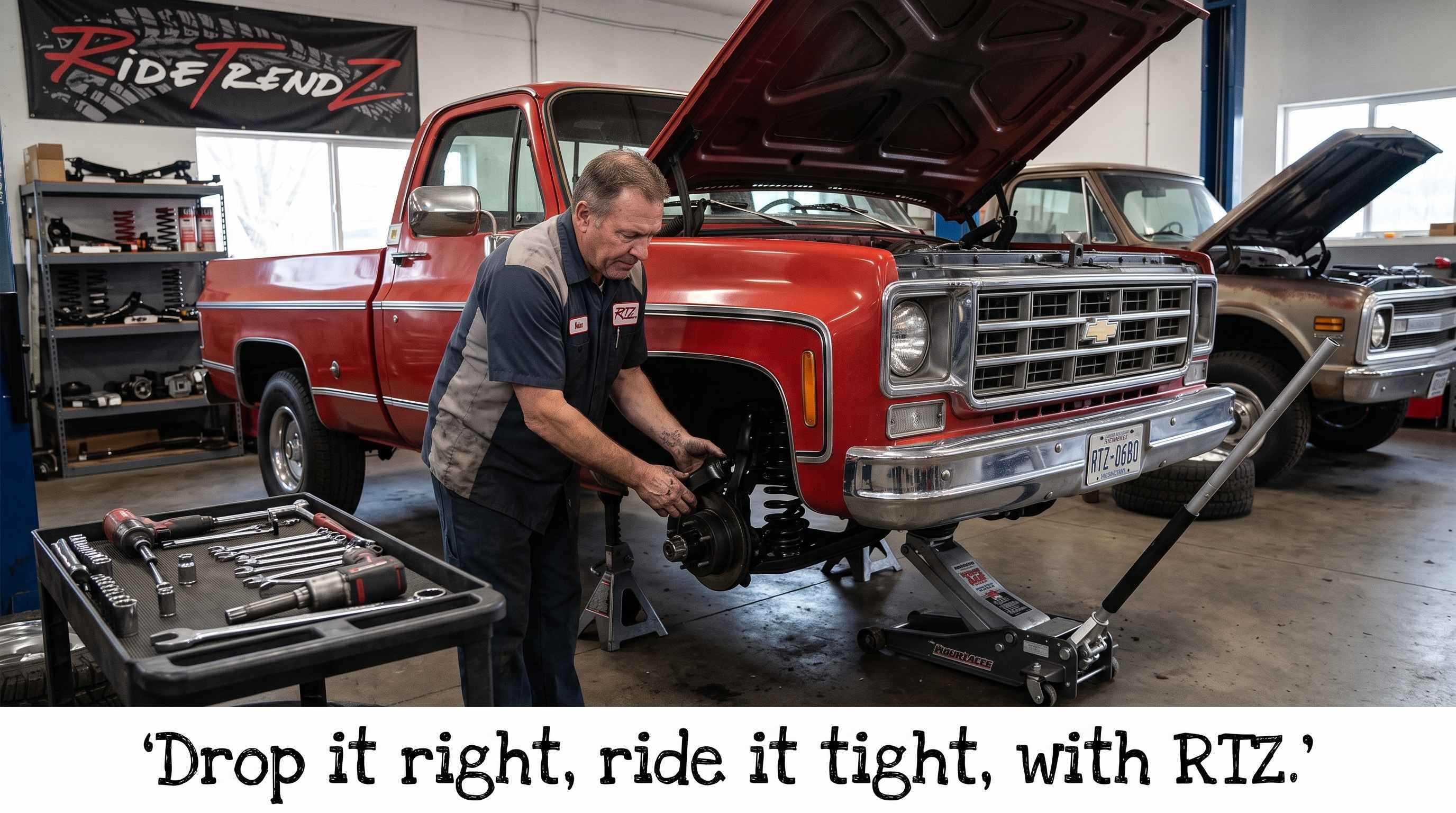
We have helped thousands of builders lower their square body trucks. Here are some common outcomes our customers report after installing an RTZ cC10lowering kit:
- "Perfect bolt-on fit. No modifications needed. Dropped 3" front, 5" rear in one day.", 1977 C10 Stepside build, California
- "The matched shocks made all the difference. Ride quality is actually better than stock.", 1985 C10 daily driver, Texas
- "Tried a generic flip kit first. Vibration at 60mph. Switched to RTZ and it eliminated.", 1982 C10, Georgia
- "The C20 lowering kit fitment was spot-on for our 3/4-ton. Other brands would not even specify compatibility.", 1979 C20, Tennessee
These are not isolated results. They reflect the consistent feedback we receive because we engineer our products for specific applications, not just approximate fitment.
Maintaining Your Lowered C10 Long-Term
A C10 lowering kit is an investment. Keep it performing well with these maintenance tips.
Annual Maintenance Checklist
- Torque check all suspension fasteners every 12 months or 12,000 miles.
- Inspect U-bolts on the rear flip kit for loosening or corrosion, especially in salt-belt states.
- Check shock absorbers for oil weepage, a sign the internal gas charge is depleting.
- Re-align after any tire change; even the same size tires can affect alignment.
- Inspect C10 control arm bushings for cracking; polyurethane bushings last longer than rubber in lowered applications.
- Check pinion angle annually if you use the truck for regular hauling; load changes affect driveshaft angles over time.
For a broader look at suspension health, read Top 5 Reasons to Upgrade Your Truck Suspension.
Conclusion
Lowering a Chevy C10 is one of the best upgrades you can make to a square body truck. Whether you want a mild 2"–3" daily driver drop or a full slammed show truck with a flip kit and C10 air suspension, the right Chevy C10 lowering kit makes all the difference.
At RideTrendz, our RTZ C10 lowering kit systems are built to a higher standard than anything else on the market. We use forged and billet components, matched nitrogen gas shocks, and USA-engineered tolerances. Our kits bolt on clean, drop exactly as labeled, and come with the support of a team that lives and breathes square body builds.
Whether you are shopping a C10 drop kit, a C20 lowering kit, or a complete C10 C30 lowering solution, RideTrendz has you covered from the front drop spindle to the rear flip kit.
Shop our complete C10 / C20 / C30 lowering kit line: RideTrendz RTZ Lowering Kits.
Frequently Asked Questions
Q1: What is the best Chevy C10 lowering kit for a 1973–1987 C10 2WD?
A: The RTZ complete front drop spindle plus rear flip kit combo is the most popular. It gives 3"–5" front and 4"–7" rear drop.
Q2: Do I need C10 frame notching for a standard C10 drop kit install?
A: No. Frame notching is only needed when rear drop exceeds 6" and the axle contacts the frame under full compression during driving.
Q3: Can I use a C10 c10 suspension kit on a C20 lowering kit application?
A: No. C20 trucks carry heavier loads and need a purpose-built C20 lowering kit rated for that weight. Using C10 parts on a C20 is unsafe.
Q4: How long does it take to install a complete Chevy C10 lowering kit?
A: Most experienced DIYers complete a full front/rear C10 drop kit install in 6–10 hours. A professional shop typically completes it in 4–6 hours.
Q5: Will c10 air suspension work on a 1973–1987 square body truck?
A: Yes, C10 air suspension can be adapted to the square body platform, but it requires custom fabrication. A C10 static drop kit is simpler and equally effective for most builds.