
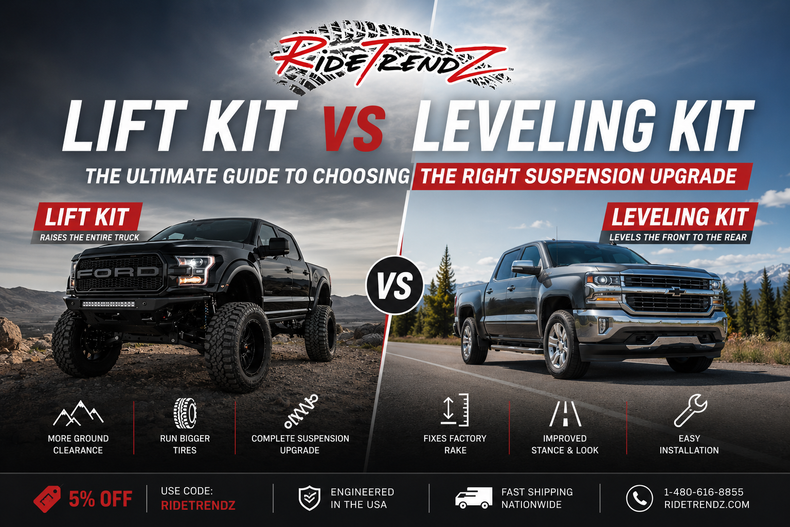
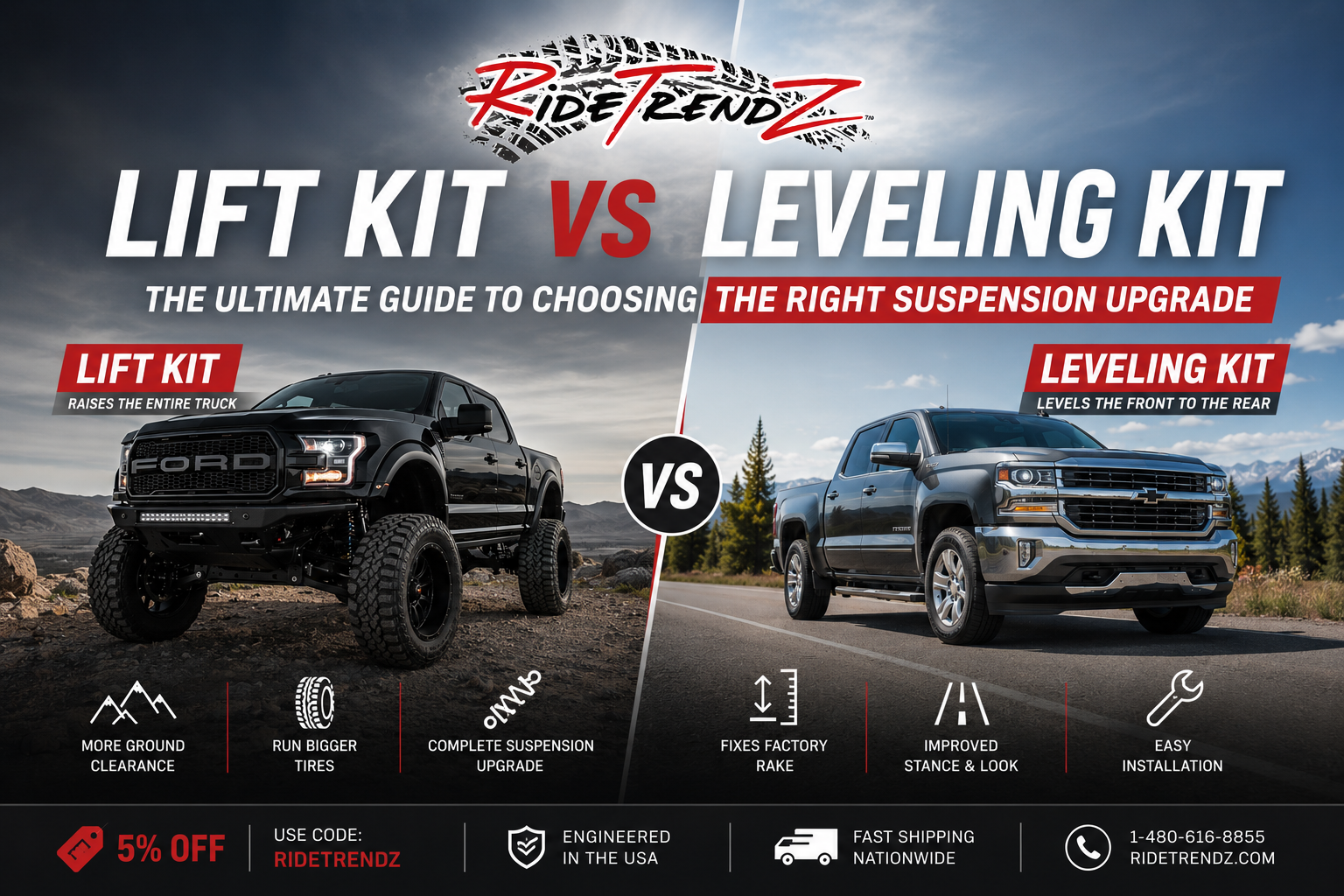
You want your truck to sit differently. Maybe you want more ground clearance for off-road trails. Maybe you just hate the way the front end dips lower than the rear. Whatever the reason, you've started looking at suspension upgrades — and now you're staring at two options: a lift kit or a leveling kit.
Both change how your truck sits. Both let you run bigger tires. But they are very different products that solve very different problems — and buying the wrong one is an expensive mistake.
In this guide, we break down exactly what a lift kit is, what a leveling kit is, how they compare, which vehicles they work best for, and most importantly, which one your truck actually needs.
Quick Answer: A leveling kit fixes factory rake (front sits lower than rear). A lift kit raises the entire truck for serious ground clearance and off-road capability. If you want to go off-road or run large tires, you need a lift kit.
What Is a Leveling Kit?
A leveling kit is exactly what it sounds like — it levels your truck. Most factory trucks come with a slight forward rake, meaning the front sits 1 to 2.5 inches lower than the rear. Manufacturers do this intentionally to compensate for payload weight in the truck bed. When the bed is loaded, the truck levels out.
A leveling kit lifts the front of the truck up to match the rear. That's it. It doesn't lift the whole truck — just the front end.
What Does a Leveling Kit Include?
Leveling kits are simple by design. They typically include:
- Spacers or torsion keys — installed on top of the factory strut to add height to the front end
- Coil spacers — sit between the spring and mount to raise the front
- Strut extensions — bolt on to extend the front suspension height
Because they use the factory suspension components, leveling kits are less invasive and usually cheaper to install. Most leveling kits add between 1 and 2.5 inches of lift to the front only.
What Vehicles Benefit Most from a Leveling Kit?
Leveling kits work best for:
- Trucks used primarily on the street or highway
- Owners who want a more aggressive, even stance without major modifications
- Trucks that will run slightly larger tires (up to 33 inches on most applications)
- Daily drivers where minimal suspension change is preferred
Leveling kits are the most popular choice for Ford F-150, Chevy Silverado 1500, and GMC Sierra 1500 owners who want a cleaner look without spending a lot of money.
What Is a Lift Kit?
A lift kit raises the entire truck — both front and rear — off the ground. Unlike a leveling kit, a complete lift kit replaces or modifies your factory suspension components to achieve a much larger increase in ride height and ground clearance.
Lift kits are the go-to choice for serious off-road builds, trucks that need to clear large rocks and obstacles, and anyone who wants to run tires 35 inches or larger.
Types of Lift Kits
There are two main types of lift kits:
1. Body Lift Kits
Body lift kits use spacers (called body lift blocks) to raise the body of the truck off the frame, without changing the suspension at all. They are cheaper than suspension lift kits, but do not improve ground clearance under the axles or suspension. They mostly just create room to run bigger tires.
2. Suspension Lift Kits
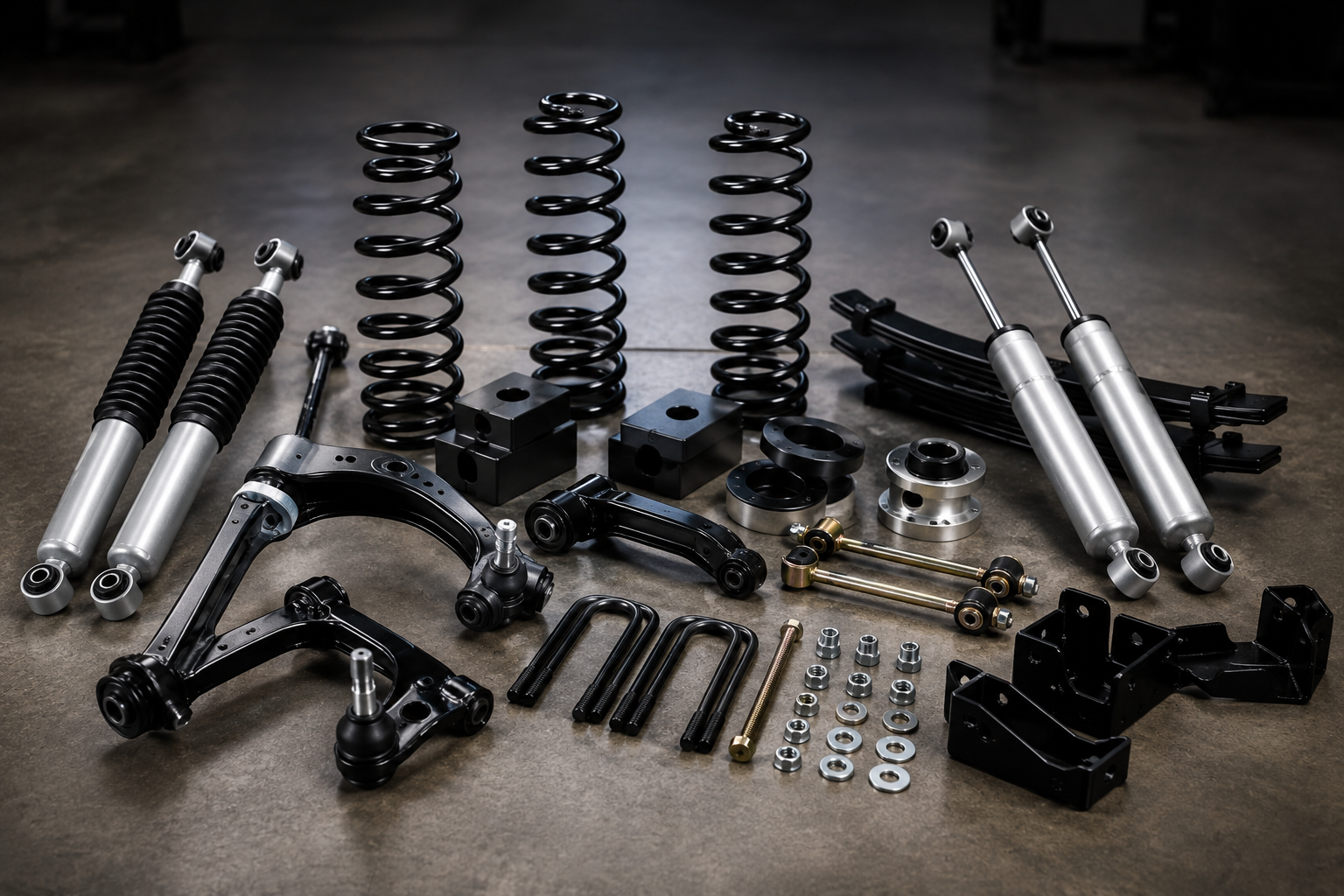
Suspension lift kits are the real deal. They replace or modify the actual suspension components — control arms, leaf springs, shocks, struts — to raise the entire truck higher off the ground. Suspension lifts improve ground clearance, approach angle, departure angle, and off-road capability significantly.
At Ridetrendz, we specialize in complete suspension lift kits for trucks, vans, and SUVs. Our kits are engineered for specific makes, models, and year ranges — not generic fits.
What Does a Lift Kit Include?
A complete suspension lift kit from Ridetrendz typically includes:
- Lift parts— control arms, drop brackets, crossmembers
- Lift shocks— performance shock absorbers matched to your lift height
- Lift struts— for front suspension applications that use struts
- Leaf spring add-a-leafs or replacement springs for the rear lift
- All necessary hardware for a complete installation
How Much Lift Do Lift Kits Provide?
Suspension lift kits typically range from 2 inches all the way to 8 inches or more, depending on the vehicle. Common lift heights are:
- 2-inch lift — minimal change, great for fitting slightly bigger tires
- 4-inch lift — most popular for a balanced street and off-road build
- 6-inch lift — serious off-road capability, 35"+ tires
- 8-inch+ lift — extreme off-road builds, maximum clearance
Lift Kit vs Leveling Kit: Direct Comparison
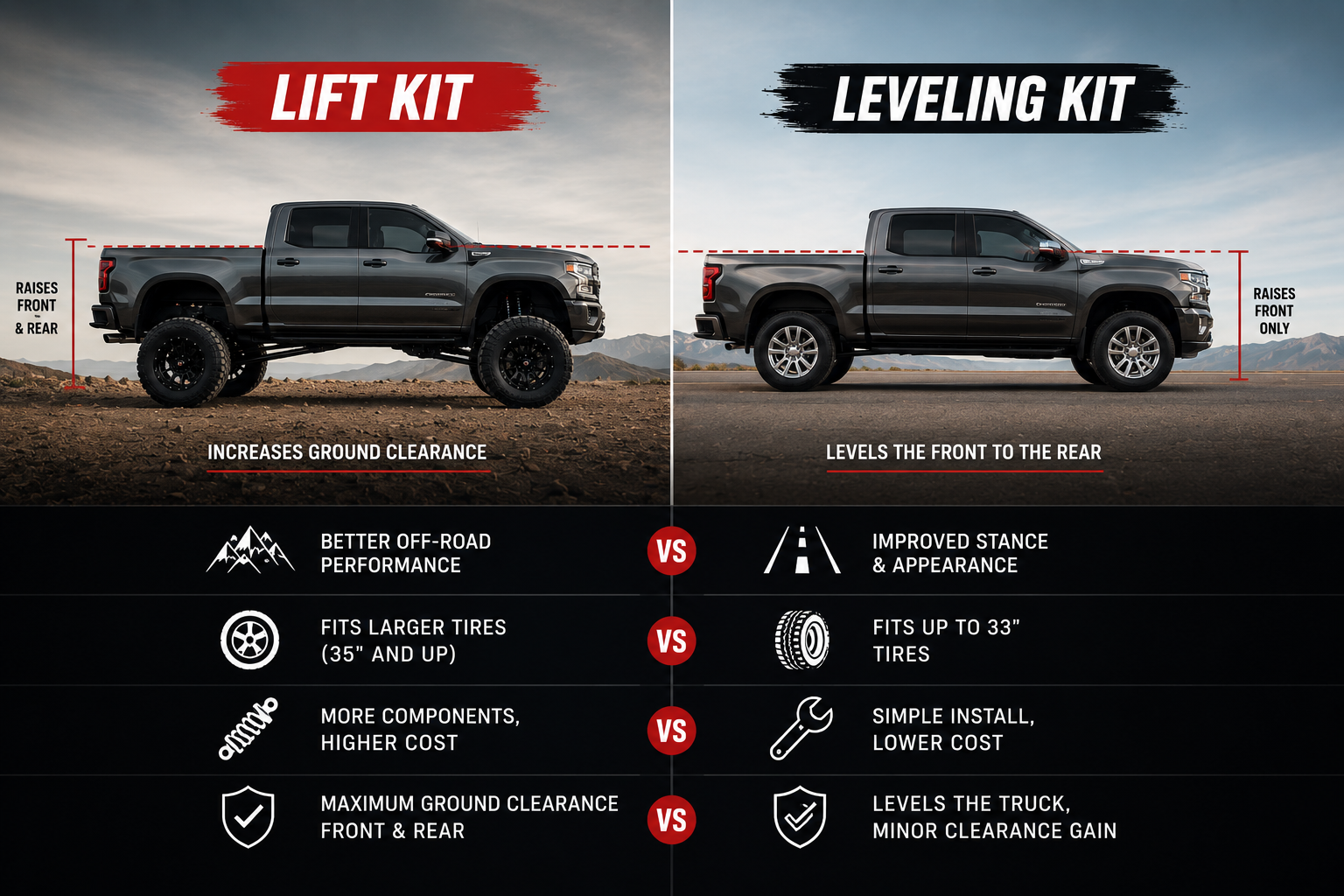
Here is a side-by-side breakdown of the key differences:
Lift Height:
- Leveling Kit: 1 to 2.5 inches — front only
- Lift Kit: 2 to 8+ inches — front and rear
Cost:
- Leveling Kit: $50 to $300 — affordable, minimal parts
- Lift Kit: $200 to $2,000+ — more components, more engineering
Installation Complexity:
- Leveling Kit: Simpler — uses factory suspension components
- Lift Kit: More involved — replaces suspension components
Ground Clearance:
- Leveling Kit: Minor improvement in front clearance only
- Lift Kit: Significant improvement — front and rear axle clearance
Tire Size:
- Leveling Kit: Up to 33" tires on most trucks
- Lift Kit: Up to 35", 37", 40"+ depending on lift height
Off-Road Capability:
- Leveling Kit: Minor improvement
- Lift Kit: Major improvement — better approach/departure angles
Ride Quality:
- Leveling Kit: Minimal change from stock
- Lift Kit: Changes ride quality — improved with quality shocks and struts
Bottom line: If you just want your truck to look level and fit slightly bigger tires — get a leveling kit. If you want real off-road capability, bigger tires, and a commanding presence — get a lift kit.
Which Vehicles Work Best With a Leveling Kit?
Leveling kits are a great choice for half-ton trucks and SUVs that come with significant factory rake. Some of the most popular applications include:
Chevrolet Silverado & GMC Sierra 1500
The Silverado and Sierra are among the most leveled trucks in America. Factory rake on these trucks is typically 1.5 to 2 inches. A simple spacer-style leveling kit corrects this perfectly, giving the truck a more aggressive, level stance. If you own a 1999-2006 Silverado Sierra 1500 or a 2007-2016 Silverado Sierra 1500, a leveling kit is one of the most popular first modifications.
Ford F-150 & Ford Ranger
Ford trucks also have notable factory rake, especially the F-150. A leveling kit for the F-150 is one of the most searched truck modifications online. For the Ford Ranger, a leveling kit or small lift kit gives the truck a much more capable look without breaking the budget.
Dodge Ram 1500
The Dodge Ram 1500 has significant factory rake that many owners want to correct. A leveling kit is the quickest way to achieve a balanced, aggressive stance on these trucks.
Which Vehicles Work Best With a Full Lift Kit?
Lift kits shine on trucks and SUVs that are used for off-road driving, towing in rough terrain, or building a head-turning lifted truck. Here are the most popular applications:
Chevrolet Silverado & GMC Sierra — Classic and Modern
From the 1963-1972 Chevy C10 to the 1973-1987 Chevy C10, classic Chevy trucks look incredible with a suspension lift. For modern trucks, the 2004-2019 Colorado Canyon is one of the most popular mid-size lift builds.
Ford Ranger & Ford Expedition
The Ford Ranger (1983-2013) is a legendary platform for lift builds. With a 4-inch lift and 33" tires, a Ranger transforms into a capable off-road machine. The Ford Expedition (1997-2003) is also a popular full-size SUV lift application.
Toyota Tacoma & Tundra
Toyota trucks are off-road royalty. The 1995-2004 Toyota Tacoma is one of the most lifted trucks in America, and for good reason. The 2007-2018 Toyota Tundra also takes a lift kit beautifully, improving its already capable off-road character.
Nissan Frontier & Xterra
Nissan's off-road trucks are underrated lift platforms. The Nissan Frontier (2005-2017) and Nissan Xterra (2005-2014) both respond extremely well to a 3 to 4-inch suspension lift.
Hummer H3
The Hummer H3 (2006-2010) is an incredible lift platform with a solid off-road base from the factory. Adding a lift kit unlocks its full potential on the trails.
Do You Need New Shocks With a Lift Kit?
This is one of the most common questions we get. The short answer: yes, if you are doing a suspension lift kit, you need shocks and struts matched to your lift height.
Running a 4-inch lift with stock shocks causes the shocks to bottom out or overextend, leading to poor ride quality, premature wear, and potential damage. That's why Ridetrendz offers lift shocks and lift struts specifically engineered for lifted applications.
For leveling kits, your factory shocks are usually fine — since you're only lifting the front 1 to 2 inches, the stock shocks can handle the small change in travel.
? Always match your shocks to your lift height. Mismatched shocks are one of the most common (and expensive) mistakes truck owners make after a lift.
Lift Kit vs Leveling Kit: Which Is Right for You?
Use this simple decision guide:
Choose a Leveling Kit If:
- Your truck's front sits noticeably lower than the rear
- You want a cleaner, more aggressive stance
- You want to fit slightly bigger tires (up to 33 inches)
- You drive mostly on highways and streets
- You want a budget-friendly modification
- You don't want to change your ride quality significantly
Choose a Lift Kit If:
- You want serious ground clearance for off-road trails
- You want to run 35-inch tires or larger
- You want to lift both the front and rear of your truck
- You do any off-road driving — rocks, mud, trails, sand
- You want a truly lifted, commanding truck presence
- You are building a show truck or dedicated off-road rig
Not sure which kit fits your specific truck? Browse our complete lift kit catalog or our lowering kit catalog to find vehicle-specific solutions for your make, model, and year.
Does a Lift Kit or Leveling Kit Affect Gas Mileage?
Yes — both can affect fuel economy, but to different degrees.
Leveling kit: Minimal impact. Because you're only adding 1 to 2 inches to the front, and most owners don't change tire size significantly, gas mileage stays close to stock.
Lift kit: More noticeable impact. A significant lift kit combined with larger, heavier tires adds rotational mass and wind resistance, which can reduce fuel economy by 1 to 3 mpg depending on the lift height and tire size.
The key factor is tire size — bigger tires are the main mpg killer, not the lift itself.
How Much Does a Lift Kit or Leveling Kit Cost?
Costs vary significantly depending on the type of kit, the vehicle, and the quality of parts:
Leveling Kit Cost
- Budget kits: $50 to $100 — basic spacers, minimal parts
- Mid-range kits: $100 to $200 — better quality spacers or coil spacers
- Premium kits: $200 to $400 — includes upgraded components for better performance
Lift Kit Cost
- 2-inch suspension lift: $200 to $500 for parts
- 4-inch suspension lift: $400 to $1,000 for parts
- 6-inch suspension lift: $800 to $2,000+ for parts
Installation costs vary by shop and location. A leveling kit install can take 1 to 2 hours. A full suspension lift can take 4 to 8 hours or more.
? Ridetrendz manufactures suspension lift kits and parts in the USA. Our kits are vehicle-specific, guaranteed quality, and priced competitively. Use code RIDETRENDZ at checkout to save 5%.
Frequently Asked Questions
Can I install a leveling kit and lift kit at the same time?
Not really — a lift kit already addresses the leveling issue as part of the overall lift. If your kit lifts the rear more than the front, you can add front lift components, but a separate leveling kit on top of a lift kit is unnecessary.
Will a leveling kit or lift kit void my truck's warranty?
Leveling kits and lift kits can affect your factory warranty under the Magnuson-Moss Warranty Act. However, a dealer must prove the modification caused the specific problem to deny a warranty claim. Always check with your dealer before modifying.
Do I need an alignment after installing a leveling kit or lift kit?
Yes — always. Changing the height of your suspension changes the geometry of your wheels and steering. A proper alignment after any suspension modification is essential for safe driving, even tire wear, and handling.
What is the biggest tire I can fit with a leveling kit?
On most half-ton trucks, a leveling kit allows you to fit up to 33-inch tires without rubbing. Some applications may need a slight trim of the factory plastic bumper fender liner. For 35 inches and larger, you need a full lift kit.
Where can I buy lift kits and leveling kits for my truck?
Ridetrendz carries a complete range of lift kits, lift parts, lift shocks, and lift struts for Chevrolet, GMC, Ford, Dodge, Toyota, Nissan, Jeep, and Hummer. All kits are vehicle-specific and manufactured in the USA.
Final Verdict: Lift Kit vs Leveling Kit
If your only goal is to fix the factory rake and get a cleaner look, a leveling kit is a cost-effective, simple solution that gets the job done. It's a popular choice for daily drivers who want a better stance without major changes.
But if you want real off-road capability, the ability to run large tires, and a truck that truly commands attention — a suspension lift kit is the right investment. It transforms your truck into what it was always meant to be.
At Ridetrendz, we've been engineering suspension solutions for over 28 years. Our lift kits are designed specifically for your truck's make, model, and year range — not generic fits. Whether you drive a Chevy Silverado, Ford Ranger, Dodge Ram, or Toyota Tacoma — we have the right kit waiting for you.
Ready to transform your ride? Browse our complete lift kit catalog or call us at 1-480-616-8855 and our suspension experts will help you find the perfect setup for your truck.
Use discount code RIDETRENDZ at checkout to save 5% on your order.