
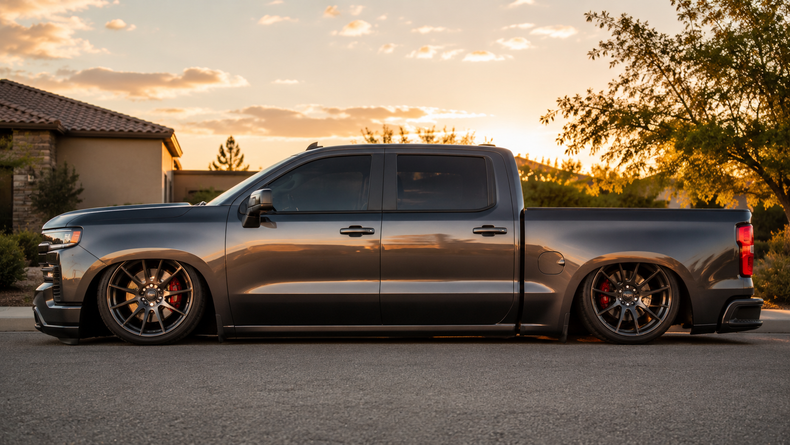
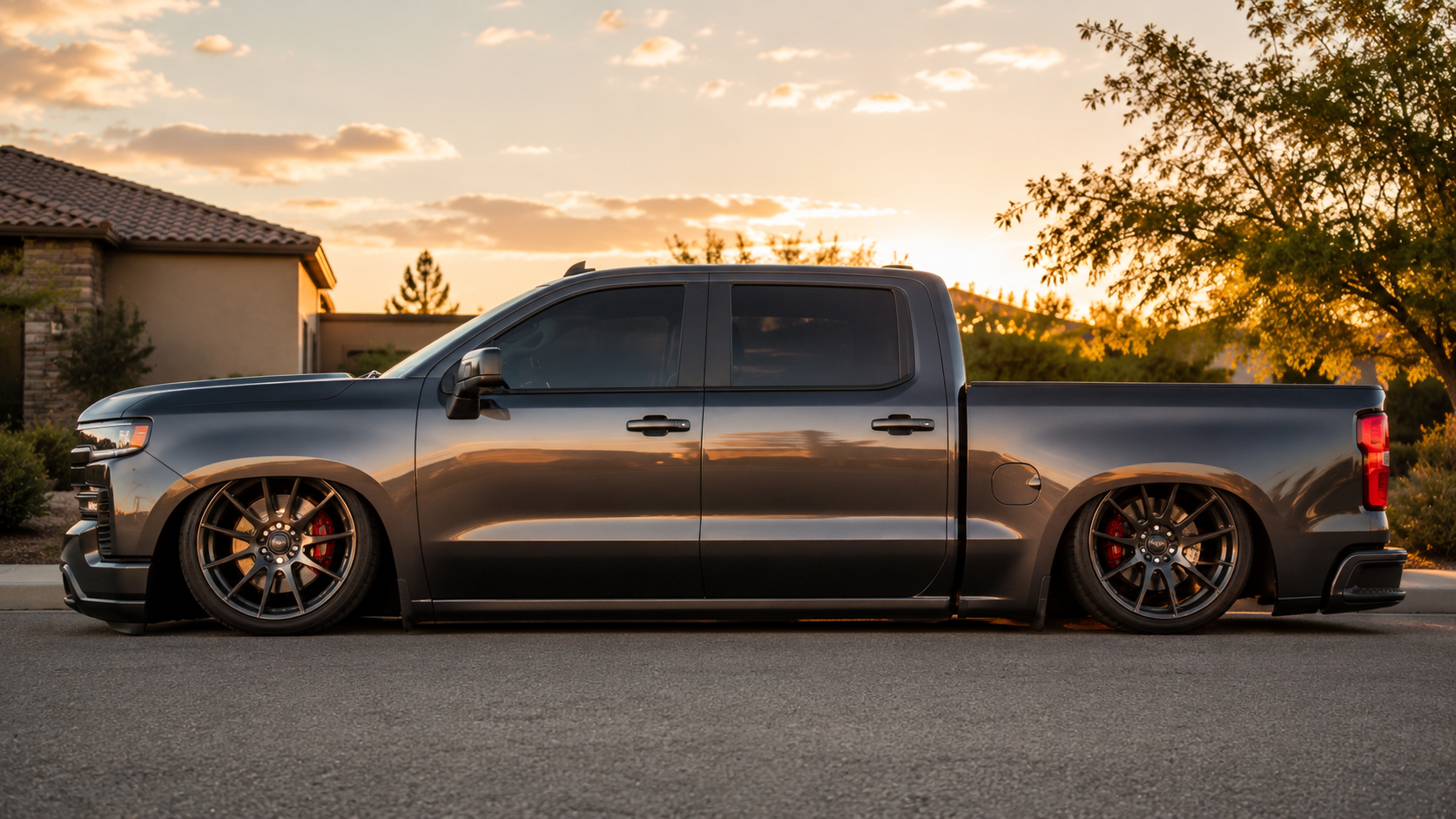
If you have been staring at your Silverado's factory wheel gap and wishing it sat lower to the ground, you are not alone. The Chevy Silverado is one of the most popular street truck platforms in America, and lowering it the right way can completely transform how it looks and drives.
Lowering a Chevy Silverado means reducing the vehicle's ride height using a purpose-built lowering kit that replaces or modifies factory suspension components. A properly matched kit lowers the front and rear of the truck while maintaining safe suspension geometry, good ride quality, and correct wheel fitment, all without cutting springs or guessing.
In this guide, you will learn exactly how to lower a Chevy Silverado across the 1988–2013 model range, which components you need, how different drop configurations compare, what the installation process involves, and what to watch for after the build is complete.
Summary
- Lowering a Chevy Silverado requires a vehicle-specific kit, not universal parts
- Popular drop configurations include 2/4, 3/5, and 4/6 inch front/rear drops
- Front lowering uses drop spindles or lowering springs; rear uses flip kits, shackles, or hangers
- Matched lowering shocks are essential; factory shocks will bottom out on a lowered truck
- A professional wheel alignment is mandatory after any lowering kit installation
- Three Silverado generations (1988–1998, 1999–2006, 2007–2013) each require their own specific kits
What Does It Mean to Lower a Chevy Silverado?
Lowering a Chevy Silverado refers to reducing the truck's ride height by replacing or modifying its front and rear suspension components. The goal is to move the truck body and frame closer to the ground while maintaining proper suspension travel, safe handling geometry, and correct shock absorber function.
This is different from simply cutting factory springs, a shortcut that destroys ride quality, creates dangerous suspension geometry, and ultimately costs more to fix. A quality Silverado lowering kit is engineered specifically for the truck's platform and drop height, so every component works together as a system.
The Chevy Silverado spans three distinct generations in the 1988–2013 range, and each requires its own generation-specific kit. Using the wrong generation's parts will cause fitment issues, misalignment, and unsafe handling.
Quick Summary: Lowering a Chevy Silverado means swapping factory suspension for drop-specific components engineered to reduce ride height safely. It is a platform-specific modification, not a universal fix.
For a broader overview of how truck lowering kits work across all platforms, see our complete guide to lowering your truck — benefits, risks, and what to buy.
Why Do Silverado Owners Lower Their Trucks?
Thousands of Silverado owners lower their trucks every year. The reasons are consistent across builds, large and small.
The most common motivation is appearance. Factory Silverados leave the plant with a significant wheel gap, a wide space between the tire and the fender lip that makes the truck look tall and top-heavy. A proper drop fills that gap and gives the Silverado a planted, muscular, performance-oriented stance that looks nothing like a stock truck.
Beyond looks, there are real driving advantages. Lowering reduces the truck's center of gravity, which reduces body roll during cornering and makes the Silverado feel more responsive on the highway. Many drivers notice improved steering feel and reduced wander after a proper drop.
Practical benefits round out the list. A lower truck is easier to enter and exit, easier to load in the bed, and may have marginally better aerodynamics at highway speeds. For daily drivers, these gains matter.
The bottom line is this: the Silverado is an ideal platform for lowering because its body-on-frame construction, coil-spring front suspension, and leaf-spring rear suspension are well-supported by an established aftermarket with decades of development behind it.
Quick Summary: Silverado owners lower their trucks to improve street appearance, reduce body roll, lower the center of gravity, and make the truck easier to live with daily. The platform supports all of these goals well.
What Components Are in a Chevy Silverado Lowering Kit?
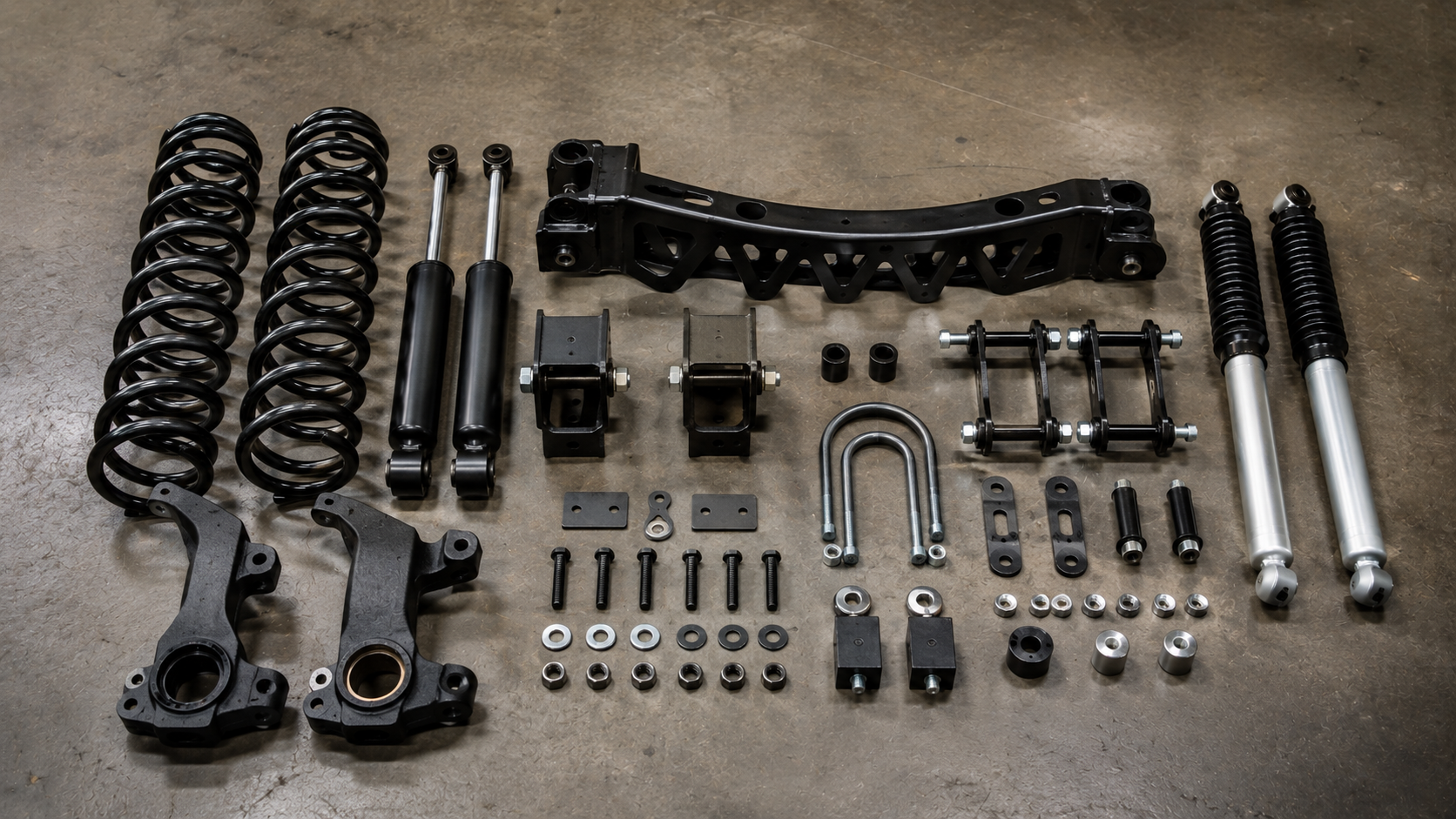
A Chevy Silverado lowering kit is not a single part; it is a collection of components working together to safely reduce ride height front and rear. The exact contents depend on the generation, drop height, and whether the front, rear, or both are being addressed.
Front Lowering Components
For the 1988–2006 Silverado generations, the front suspension uses an upper and lower control arm design with coil springs. The two most common approaches to lowering the front are:
Drop Spindles are replacement steering knuckles that reposition the wheel hub lower relative to the control arm pivot points. Drop spindles lower the front without changing spring rate or suspension travel, which makes them a popular choice for daily-driver builds seeking 2 inches of front drop. They maintain excellent geometry because the suspension kinematics remain largely unchanged.
Lowering Springs replacement coil springs wound to a shorter free height than factory. They are often used together with drop spindles for additional drop, or alone for mild 1–2 inch reductions. Spring rate matters here: quality kits use a carefully selected rate that lowers the truck without destroying ride quality or limiting suspension travel.
For the 2007–2013 generation, which uses a different front suspension architecture, lowering struts or geometry-specific spring packages are the primary tools.
Rear Lowering Components
The Silverado uses a leaf-spring rear suspension across all three generations in this range. Leaf-spring lowering has several approaches:
Flip Kit the most common rear lowering method for the Silverado. It involves relocating the rear axle from beneath the leaf spring pack to above it using a flip bracket. This repositioning alone provides 4–5 inches of rear drop. Flip kits are the standard solution in 3/5 and 4/6 configurations.
Lowering Shackles and Hangers: Shackles replace the rear spring eye mount and can provide 1–3 inches of drop. Replacement hangers reposition the front spring mount. These are often used together for moderate 2–4 inch rear drops or combined with a flip kit for maximum results.
Lowering Leaf Springs: complete replacement leaf packs wound shorter than stock. These provide excellent ride quality and are often preferred for builds that need to maintain some towing capacity.
Lowering Shocks
This is the component that most first-time builders overlook. Factory shocks are calibrated for factory ride height. Once the truck is lowered, the shock absorber's stroke range no longer matches the suspension travel. Stock shocks on a lowered truck will bottom out over bumps, causing harsh impacts, premature shock wear, and unpredictable handling.
Matched lowering shocks are shorter, with a stroke calibrated for the reduced suspension travel of a lowered application. They are not optional; they are as essential as the springs and spindles themselves.
Explore the full range of Chevy Silverado lowering kits at RideTrendz to find the exact components for your year and drop height.
Quick Summary: A complete Silverado lowering kit includes front drop spindles or springs, rear flip kits or shackles, and matched lowering shocks. Each component is generation-specific and must be correctly paired for safe results.
How Low Can You Go? Common Drop Heights for the Silverado
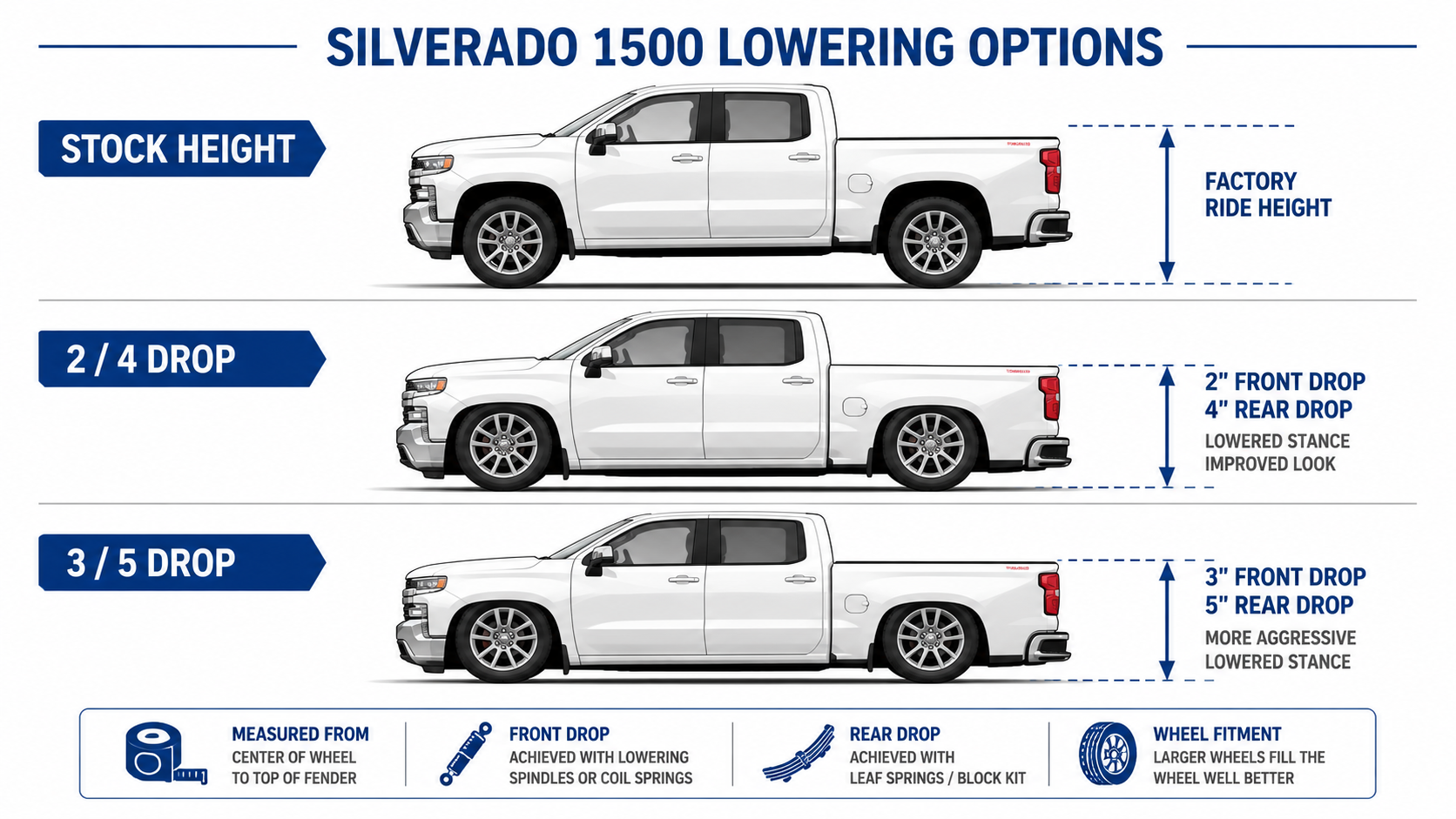
The Chevy Silverado supports a wide range of drop configurations, from mild street-truck builds to aggressive show-level lows. Understanding what each setup delivers helps you choose the right fit for your goals.
|
Drop Configuration |
Front Drop |
Rear Drop |
Best For |
|
2/4 Drop |
2 inches |
4 inches |
Daily driver, mild street truck |
|
3/5 Drop |
3 inches |
5 inches |
Balanced stance, most popular setup |
|
4/6 Drop |
4 inches |
6 inches |
Aggressive street, custom builds |
|
5/7 Drop |
5 inches |
7 inches |
Show trucks, extreme builds |
2/4 Drop
This is the entry point for most Silverado street builds. Two inches of front drop and four inches of rear drop create a noticeably improved stance over factory while keeping the truck highly drivable daily. Speed bumps, steep driveways, and uneven surfaces are manageable. This is a popular setup for 1988–2006 Silverados that see regular use.
3/5 Drop
The 3/5 drop is the single most popular configuration for the Chevy Silverado. It delivers a genuinely aggressive stance; the truck looks dramatically different from stock while remaining practical as a daily driver. Wheel fitment improves significantly, and the truck's profile becomes much more proportional. Most complete kits on the market are built around this configuration.
4/6 Drop
Four inches front and six inches rear push the Silverado into serious custom territory. The stance is commanding, and the wheel gap essentially disappears. This setup requires careful wheel and tire planning to avoid rubbing, and the truck becomes more sensitive to road imperfections. It is ideal for builds where appearance and weekend use are the priority.
5/7 Drop and Beyond
Extreme drops of 5/7 or greater are show-truck territory. Additional suspension modifications, mini-tub work, and custom fabrication may be needed. These builds are not intended for daily driving.
Quick Summary: The 3/5 drop is the sweet spot for most Silverado builds, aggressive enough to look great, practical enough to drive daily. The 2/4 is milder, and the 4/6 is for dedicated custom builds.
Generation Breakdown: Which Silverado Are You Working With?
The Chevy Silverado changed significantly across its three generations between 1988 and 2013. Each uses a different suspension architecture, which means different lowering kits are required. Using the wrong kit will cause fitment problems, alignment issues, and unsafe handling.
1988–1998 Silverado / Sierra 1500 (GMT400 Platform)
This generation uses a traditional control arm front suspension with coil springs and a leaf-spring rear. It is one of the most well-supported platforms in the lowering aftermarket. Drop spindles, lowering springs, and flip kits are all widely available. The 1988–1998 generation responds beautifully to a 3/5 setup and is popular for both daily drivers and show builds.
Browse 1988–1998 Silverado/Sierra 1500 lowering kits for generation-specific options.
1999–2006 Silverado / Sierra 1500 (GMT800 Platform)
The GMT800 brought a refined front suspension system, a more modern cab design, and updated geometry. Lowering kits for this generation use the same general approach: drop spindles up front, flip kits in the rear, but the components are different and not interchangeable with the earlier generation. The 3/5 and 4/6 drops are extremely popular for this platform.
Find 1999–2006 Silverado/Sierra 1500 lowering kits here.
2007–2013 Silverado (GMT900 Platform)
The GMT900 introduced a significantly updated independent front suspension that changed the lowering approach. This generation typically uses geometry-specific lowering components rather than drop spindles, and the rear flip kit setup is updated to match. The 2007–2013 Silverado is a widely lowered truck with strong aftermarket support.
See 2007–2013 Silverado lowering kit options at RideTrendz.
Quick Summary: Three Silverado generations (1988–1998, 1999–2006, 2007–2013) each require their own specific lowering components. Kits are never interchangeable between generations.
Step-by-Step: How the Lowering Kit Installation Works
Understanding the installation process helps you plan the build, talk to your installer with confidence, and know what to expect before and after. Here is how a standard Chevy Silverado lowering kit installation unfolds.
Step 1: Gather Your Components
Before the truck goes on the lift, confirm you have every component for your specific configuration. A typical 3/5 drop on a 1999–2006 Silverado will include drop spindles (front), a rear flip kit crossmember and U-bolts, and matched lowering shocks for front and rear. Missing any single component will halt the job.
Step 2: Raise the Vehicle and Secure It Safely
The truck is raised on a two-post or four-post lift and secured on jack stands. Wheel alignment will be needed after the job, so plan to drive the truck directly to an alignment shop when the installation is complete.
Step 3: Front Suspension - Remove Stock Components
The front wheels are removed. The brake caliper, rotor, and ABS sensor wire are carefully set aside. The stock spindle or steering knuckle is unbolted from the upper and lower control arm ball joints. On spring-only builds, the front coil springs are also removed and replaced at this stage.
Step 4: Front Suspension - Install Drop Spindles
The drop spindles are installed in place of the stock units, connecting to the same upper and lower ball joints. All brake components, tie rod ends, and ABS hardware are reinstalled on the new spindle. The front drops immediately once the vehicle is lowered off the jack stands.
Step 5: Rear Suspension - Prepare the Axle
The rear wheels and brake hardware are cleared. The leaf spring pack is unloaded by supporting the rear axle on a jack. The stock U-bolts are removed, freeing the axle from the spring pack.
Step 6: Rear Suspension - Install the Flip Kit
The flip kit crossmember (perch) is installed on top of the rear axle housing, relocating the spring mount from beneath the axle to above it. New U-bolts are used to clamp the spring and crossmember securely together. The axle is now positioned above the springs rather than below, which provides the dramatic rear drop.
Step 7: Install Lowering Shocks
Factory shocks are removed at all four corners and replaced with matched lowering shocks calibrated for the new ride height. This step is essential; running factory shocks on a lowered truck will cause bottoming out and premature wear.
Step 8: Torque All Hardware to Specification
All bolts are torqued to the manufacturer's specification. U-bolts, ball joint nuts, and spindle hardware are critical safety points that must be properly torqued.
Step 9: Lower the Vehicle and Inspect
The truck is lowered off the lift and inspected for clearance issues, brake line tension, ABS wire routing, and tire-to-fender proximity. The truck is driven slowly to check for rubbing before heading to alignment.
Step 10: Wheel Alignment
A professional four-wheel alignment is mandatory after any Silverado lowering kit installation. See the next section for details on why this step cannot be skipped.
Quick Summary: Silverado lowering kit installation covers front spindle/spring replacement, rear flip kit and U-bolt work, and shock replacement at all four corners. A professional alignment is the final required step.
Do You Need an Alignment After Lowering a Chevy Silverado?
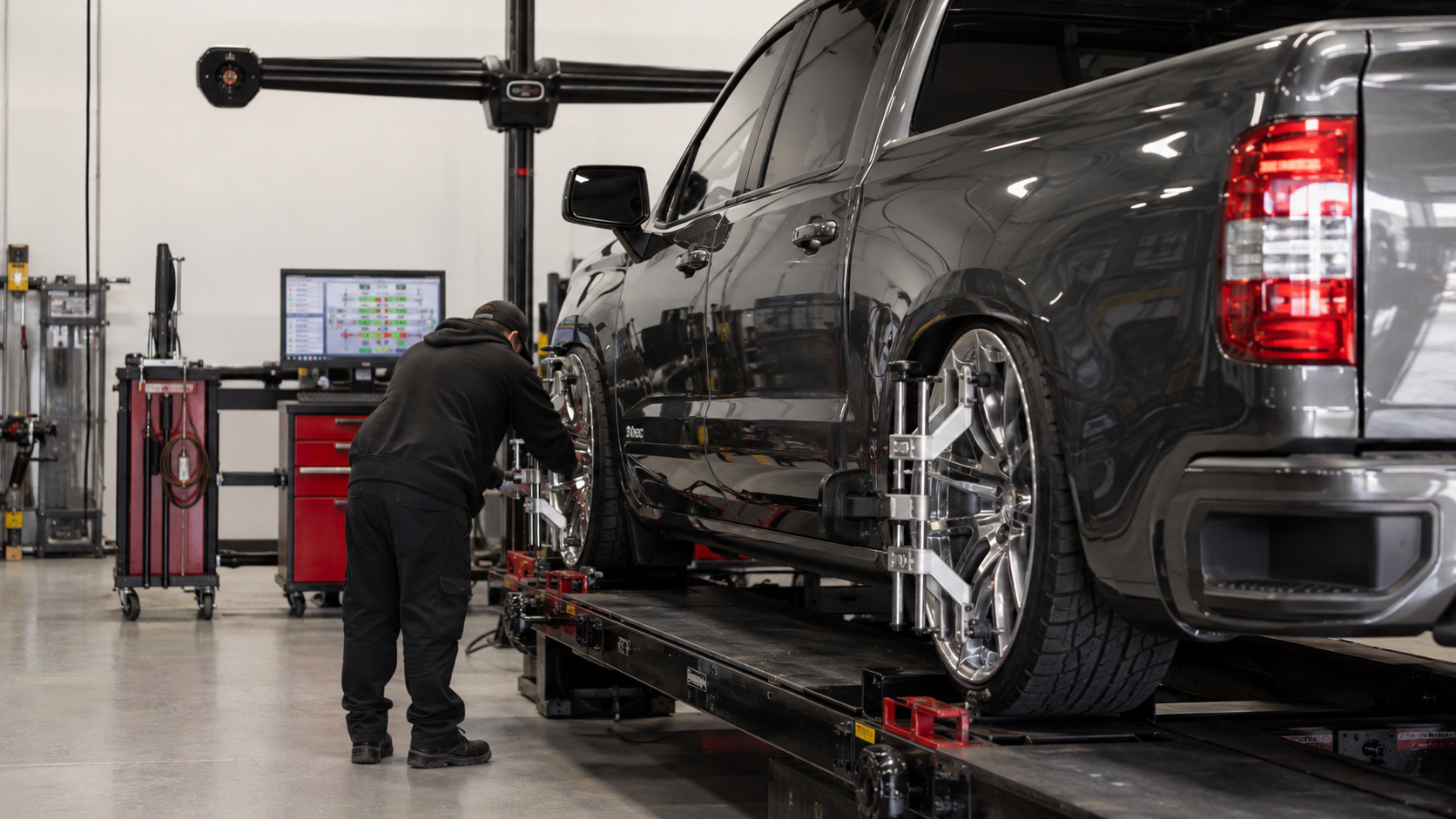
Yes, without exception. A professional four-wheel alignment is required after installing any Chevy Silverado lowering kit, and it is one of the most important steps in the entire build.
Here is why. Every time the suspension geometry changes, the angles at which the tires contact the road change with it. Caster, camber, and toe are all affected by lowering. Even a well-designed, geometry-corrected lowering kit will shift these values outside factory specifications to some degree, and those deviations must be measured and corrected on a proper alignment rack.
Skipping the alignment means your tires will wear unevenly and rapidly. It means the truck will pull to one side, handle poorly, and potentially create a hazardous driving condition. In performance terms, misaligned front tires also reduce braking effectiveness and steering precision.
The alignment shop needs to know the truck has been lowered, so they can set the angles appropriately for the new ride height. Some lowering setups allow the factory alignment targets to be met exactly. Others, particularly larger drops, may require aftermarket adjustable control arms or alignment cams to bring the geometry fully within specification. Your kit documentation or installer can advise on this.
Budget $80–$150 for a professional four-wheel alignment. It is money well spent and a mandatory part of every proper lowering build.
Quick Summary: Never skip the alignment after lowering. All four suspension geometry angles shift when ride height changes, and an uncorrected alignment causes rapid tire wear, poor handling, and unsafe driving conditions.
Is Lowering a Chevy Silverado Legal? What You Should Know
In most U.S. states, lowering a truck for street use is legal as long as the vehicle remains above minimum ground clearance thresholds and the modifications do not create unsafe operating conditions. However, regulations vary by state, and some states have specific ride height minimums.
The key legal concerns are typically frame height clearance, headlight aim (which can shift when the truck is lowered), and brake line/fuel line clearance. A properly engineered lowering kit from a reputable manufacturer addresses all of these concerns at the component design level.
If your Silverado will be inspected regularly — which it will in most states — choosing a kit from a well-known manufacturer with a strong reputation helps ensure the vehicle will pass. Extreme drops (5/7 and beyond) are more likely to create compliance issues than moderate 2/4 or 3/5 setups.
When in doubt, confirm your state's vehicle modification regulations with your local DMV before committing to a specific drop height.
Quick Summary: Lowering a Silverado is legal in most states for moderate drop heights. Verify your state's minimum ground clearance rules if you are planning a 4/6 or larger drop.
Can You Lower a 2WD and 4WD Chevy Silverado?
The short answer is yes, but with important differences.
2WD Silverado lowering is straightforward and well-supported across all three generations. The absence of front CV axles and a front differential makes the front suspension simpler and gives more room for drop spindles and lowering hardware. A 2WD Silverado can typically achieve a larger front drop with fewer clearance concerns.
4WD Silverado lowering is more complex. The front drive axle, CV joints, and differential housing all limit how much the front suspension can be lowered before geometry and clearance issues arise. Most 4WD Silverado builds achieve a 2–3 inch front drop rather than the 3–4 inches possible on a 2WD.
Additionally, many 4WD lowering setups require suspension components that allow the front axle to maintain proper CV joint operating angle. Kits designed specifically for 4WD applications address this, but they are more limited in drop height than their 2WD counterparts.
If you have a 4WD Silverado and want to lower it, confirm the kit you choose is explicitly rated for 4WD applications. Never install a 2WD lowering kit on a 4WD truck.
Quick Summary: Both 2WD and 4WD Silverados can be lowered, but 4WD builds have smaller front drop limits due to CV axle geometry. Always use a kit rated for your drivetrain.
Lowering vs. Lifting: Which Is Right for Your Silverado?
Not every Silverado owner wants to go lower. Some want more ground clearance, bigger tires, or off-road capability. Here is a clear comparison to help you decide which direction fits your goals.
|
Goal |
Lowering Kit |
Lift Kit |
|
Street-truck appearance |
Best choice |
Not applicable |
|
Improved road handling |
Yes |
Reduces handling |
|
Off-road capability |
Not applicable |
Best choice |
|
Larger tire fitment |
Possible with correct offset |
Yes |
|
Better gas mileage |
Mild improvement |
Slight reduction |
|
Easier bed access |
Yes |
No |
|
More ground clearance |
No |
Yes |
If your Silverado is a street truck, a daily driver, or a show build, lowering is the right direction. If you need mud capability, rock crawling clearance, or larger off-road tires, a lift kit is the correct choice.
For a deeper look at the lift vs. lowering decision, see our guide comparing lift kits and leveling kits for trucks.
What Wheels and Tires Work Best on a Lowered Silverado?
Lowering changes how wheels and tires fit inside the fender openings. Getting the combination right prevents rubbing and makes the most of the truck's new stance.
Wheel Offset is the most critical spec. A positive offset moves the wheel inward toward the truck's centerline. A negative offset pushes the wheel outward toward the fender. On a lowered Silverado, a neutral to slightly negative offset is typically ideal — it fills the fender gap and gives a wider, more planted appearance without causing rubbing.
Wheel Width matters alongside offset. A wider wheel fills the fender opening more completely, which is the aesthetic goal for most street builds. However, going too wide on a heavily lowered truck risks contact with the inner fender or suspension components under full suspension travel.
Tire Size affects fender clearance directly. Reducing tire height (lower profile tires) is common on lowered trucks because it reduces the overall rolling diameter and creates more vertical clearance within the fender. Many Silverado lowering builds run 20 or 22 inch wheels with lower-profile tires.
A good rule of thumb: test-fit your wheel and tire combination before final installation on a lowered truck. Suspension travel varies, and what looks clear at ride height may rub over a bump.
According to the technical resource at Tire Rack's wheel and fitment guide, proper offset and backspacing selection is the single most important factor in preventing fitment issues on lowered vehicles before tire size is even considered.
Quick Summary: Wheel offset is the most important fitment spec on a lowered Silverado. A neutral to slightly negative offset fills the fender properly. Always confirm clearance with your specific drop height before finalizing wheel and tire selection.
How Much Does It Cost to Lower a Chevy Silverado?
Budget planning for a Silverado lowering build involves three categories: parts, installation labor, and post-installation alignment.
Parts Cost
|
Kit Type |
Typical Price Range |
|
Rear-only flip kit |
$80–$200 |
|
Front-only spindle kit |
$100–$250 |
|
Complete 2/4 or 3/5 kit |
$250–$600 |
|
Complete kit with shocks included |
$450–$900 |
Parts quality matters significantly. Cheaper kits may use inferior steel, looser tolerances, or mismatched components that compromise the build. A properly engineered kit from a reputable manufacturer is worth the investment.
Installation Labor
Professional installation at a trusted suspension shop typically runs $300–$700 for a complete kit, depending on complexity and local market rates. A 3/5 drop with flip kit and front spindles is a full-day job at most shops.
Alignment
Budget $80–$150 for a professional four-wheel alignment. Some shops bundle the alignment into the installation quote.
Total Budget Estimate
For a quality 3/5 drop on a 1999–2006 Silverado with parts, labor, and alignment, expect to spend $700–$1,400 depending on kit selection and shop rates. This is a one-time investment in a modification that lasts the life of the truck.
Quick Summary: A complete 3/5 Silverado lowering build including parts, labor, and alignment typically runs $700–$1,400. Do not cut corners on parts quality or skip the alignment to save money.
Common Mistakes to Avoid When Lowering a Chevy Silverado
Even experienced builders make preventable mistakes on lowering builds. Here are the ones to watch for.
Skipping the Lowering Shocks
This is the most common and most costly mistake. Factory shocks will bottom out on a lowered truck, causing harsh rides, accelerated shock wear, and potential handling issues. Matched lowering shocks are not an optional upgrade — they are a required component of every lowering build.
Using a Non-Generation-Specific Kit
A kit designed for a 1999–2006 Silverado will not fit correctly on a 1988–1998 model, even though the trucks look similar. Suspension geometry, spring perch locations, and spindle dimensions all differ between generations. Always confirm your kit is built for your exact generation.
Not Planning for Wheel and Tire Fitment
Buying wheels and tires before confirming fitment on a lowered truck is a gamble. Measure fender clearance and confirm offset specs before purchasing.
Cutting Factory Springs
Never cut coil or leaf springs as a substitute for a proper lowering kit. Cutting changes the spring rate unpredictably, damages the spring steel, and creates dangerous suspension geometry. It is not a shortcut — it is a safety hazard.
Skipping the Alignment
No matter how clean the installation looks, always get a professional four-wheel alignment afterward. Suspension geometry shifts are invisible to the eye but devastating to tires and handling if left uncorrected.
Installing on a Truck That Needs Other Repairs First
Worn ball joints, tired control arm bushings, or a bent sway bar end link will all be amplified after lowering. Address any existing suspension wear before dropping the truck.
Quick Summary: The biggest lowering mistakes are skipping shocks, using wrong-generation parts, cutting springs, and skipping alignment. Avoid all four and the build will be clean and safe.
Shop Chevy Silverado Lowering Kits at RideTrendz
RideTrendz carries a full range of Chevy Silverado lowering kits for every generation from 1988 through 2013, including complete front-and-rear systems, spindle kits, flip kits, shackle sets, and matched lowering shocks. Every kit is generation-specific and engineered to deliver proper fitment, safe geometry, and the stance your Silverado deserves.
Use our complete Chevy Silverado lowering kit catalog to find the right kit for your year, drop height, and drivetrain.
FAQ — How to Lower a Chevy Silverado
Can I lower a Chevy Silverado without a kit?
Technically, some builders attempt to lower with only U-bolt flip brackets or spring shackles, but this approach addresses the rear only and often misses critical components like matched shocks. A complete, engineered kit is always the correct approach — it ensures all components are matched, safe, and purpose-built for your specific drop height.
How much drop does a 3/5 kit give a Silverado?
A 3/5 kit lowers the front of your Silverado by 3 inches and the rear by 5 inches. This is the most popular configuration for the platform and delivers a dramatic improvement in stance while keeping the truck drivable on a daily basis.
Can I lower a Chevy Silverado myself?
A mechanically experienced builder with the right tools — a two-post lift or quality jack stands, a torque wrench, and basic hand tools — can install a Silverado lowering kit. However, the wheel alignment afterward must be performed by a professional on a proper alignment rack. DIY alignment is not an option.
Will lowering a Silverado affect towing capacity?
Yes, lowering can affect towing capacity depending on the setup. Rear leaf spring replacement with lowered springs may reduce the spring rate, which affects load carrying. If you regularly tow or haul, confirm your kit choice with the manufacturer before purchasing.
Do I need new brake lines when lowering a Silverado?
In most cases, no. A moderate drop of 2–4 inches typically does not require brake line extensions because factory brake line length allows for the changed suspension geometry. Extreme drops of 5 inches or more may require brake line inspection and possible extension.
How long does a Silverado lowering kit installation take?
A complete front and rear lowering kit on a 1999–2006 Silverado typically takes 4–7 hours at a professional shop, plus alignment time. A rear-only flip kit is faster at 2–3 hours.
Will lowering affect my Silverado's warranty?
If your Silverado is still under a factory warranty, suspension modifications can affect warranty coverage for related components. Consult your dealer before modifying. For older out-of-warranty trucks, this is not a concern.
Final Takeaway
Lowering a Chevy Silverado is one of the most impactful modifications you can make to the truck. It changes the appearance dramatically, improves handling feel, and creates a more planted, purposeful driving experience — all without sacrificing daily usability when done correctly.
The key is doing it right: choosing a generation-specific kit, pairing it with matched lowering shocks, planning your wheel and tire fitment, and always following up with a professional four-wheel alignment.
Whether you are building a clean daily driver on a 2/4 drop or an aggressive street truck on a 3/5 or 4/6 setup, the Silverado platform supports it all with excellent aftermarket depth.
Learn more about how truck suspension systems work before you buy in our guide on how a truck suspension lift kit works — the same principles apply to lowering in reverse.
Shop the complete Chevy Silverado lowering kit collection at RideTrendz and find the exact setup for your build.