
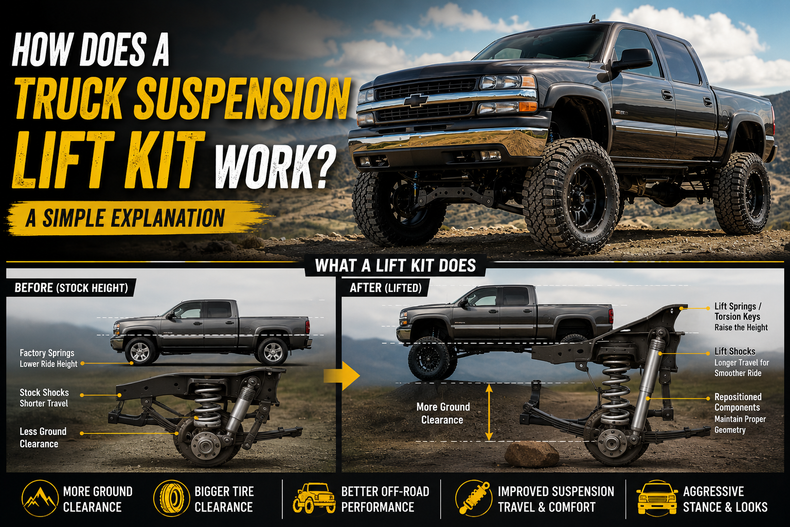
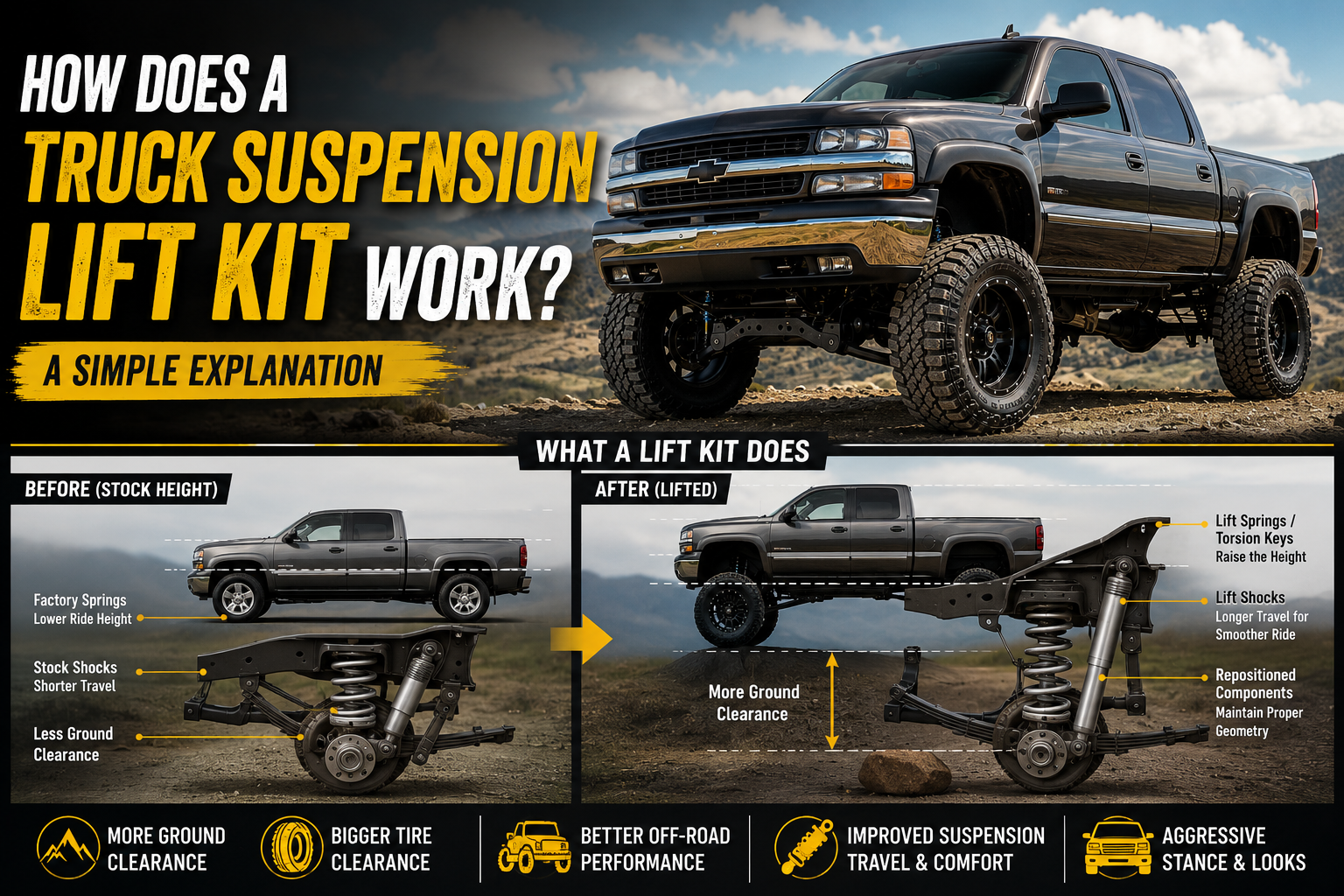
If you've ever seen a lifted truck rolling down the road and wondered, “How exactly does a suspension lift kit work?” you're not alone. Suspension lift kits are one of the most popular upgrades for truck owners because they dramatically change both the appearance and performance of a truck.
But despite how common lift kits are, many people still don't fully understand what they actually do underneath the truck.
In this guide, we'll break down how a truck suspension lift kit works in simple terms, no complicated engineering jargon. Whether you're new to lifted trucks or considering your first suspension upgrade, this article will help you understand exactly what happens when you install a lift kit.
What Is a Suspension Lift Kit?
A suspension lift kit is a collection of components that raises your truck higher off the ground by modifying the suspension system.
Unlike a body lift kit, which only lifts the body away from the frame, a suspension lift actually increases the distance between the axles and the truck frame. This provides:
-
More ground clearance
-
Increased suspension travel
-
Better off-road capability
-
Room for larger tires
-
A more aggressive appearance
Suspension lift kits are commonly installed on:
-
Chevy Silverado
-
GMC Sierra
-
Ford F-150
-
Toyota Tacoma
-
Ram 1500
-
Nissan Frontier
-
Jeep Wrangler
-
SUVs and off-road trucks
At Ridetrendz, we specialize in vehicle-specific suspension lift kits engineered for trucks and SUVs across all major brands.
How the Factory Suspension Works
To understand how a lift kit works, you first need to understand how your factory suspension works.
Your truck's suspension system is designed to:
-
Support the weight of the vehicle
-
Absorb bumps and road impacts
-
Keep the tires connected to the ground
-
Maintain steering and handling stability
The main suspension components include:
-
Springs or torsion bars
-
Shocks and struts
-
Control arms
-
Leaf springs
-
Axles
-
Steering components
From the factory, trucks sit at a specific ride height determined by these suspension components.
A suspension lift kit changes the geometry and positioning of these parts to raise the truck higher.
What Actually Happens When You Install a Lift Kit?
A suspension lift kit works by repositioning suspension components lower or farther away from the truck frame.
This creates additional space between the ground and the truck body.
Think of it like this:
The wheels and axles stay closer to the ground while the truck body and frame move upward.
That extra distance is what creates lift.
Depending on the truck and lift height, the kit may:
-
Lower suspension mounting points
-
Add taller springs
-
Add lift blocks
-
Replace control arms
-
Use longer shocks and struts
-
Reposition steering components
The result is increased ride height without overstressing suspension geometry.
Main Components of a Suspension Lift Kit
1. Lift Springs or Torsion Keys
These are responsible for adding height to the suspension.
Depending on your truck, the kit may use:
-
Coil springs
-
Coil spacers
-
Torsion keys
-
Leaf spring add-a-leafs
On many Chevy and GMC trucks, upgraded torsion keys help raise the front suspension safely.
2. Lift Shocks
When you raise a truck, the suspension gains additional travel.
Factory shocks are too short for this new range of motion.
Lift shocks are specifically designed for lifted trucks and allow the suspension to move correctly without bottoming out or overextending.
Good lift shocks improve:
-
Ride comfort
-
Off-road performance
-
Suspension control
-
Stability
3. Lift Struts
Some modern trucks use strut-style front suspension systems.
Lift struts are longer or specially engineered to support the increased ride height while maintaining proper suspension geometry.
4. Drop Brackets & Crossmembers
On larger lift kits (typically 4-inch and higher), drop brackets reposition suspension mounting points lower on the frame.
This helps maintain proper:
-
CV axle angles
-
Steering geometry
-
Suspension alignment
Without these components, lifted trucks would suffer from severe suspension wear and poor drivability.
5. Rear Lift Blocks or Leaf Springs
The rear of the truck also needs to be lifted to keep the vehicle level.
Rear lift is usually achieved using:
-
Lift blocks
-
Add-a-leaf kits
-
Replacement leaf springs
These components raise the rear axle farther from the frame.
Why Lift Kits Need Longer Shocks
One of the biggest mistakes truck owners make is using factory shocks with a suspension lift.
When the truck sits higher, the suspension travels farther during movement.
Stock shocks are too short for this extra movement.
This can cause:
-
Shock damage
-
Bottoming out
-
Poor ride quality
-
Unsafe handling
That's why quality lift kits always include properly matched lift shocks.
At Ridetrendz, our lift shocks are engineered specifically for the suspension travel of your lift height.
How Lift Kits Improve Off-Road Performance
One of the biggest benefits of a suspension lift kit is improved off-road capability.
A lifted truck gains:
More Ground Clearance
The truck sits higher, helping avoid rocks, mud, and obstacles underneath the vehicle.
Better Approach Angle
The front bumper sits higher, making it easier to climb steep obstacles.
Better Departure Angle
The rear bumper has more clearance, leaving obstacles.
Larger Tire Clearance
Lift kits allow larger tires, which improve traction and obstacle clearance.
Increased Suspension Travel
The suspension can move farther during off-road articulation.
This helps keep tires on uneven terrain for better grip.
Does a Lift Kit Change Ride Quality?
Yes — but the quality of the lift kit matters.
Cheap lift kits often create:
-
Rough ride quality
-
Poor handling
-
Excessive bouncing
-
Steering problems
A properly engineered suspension lift kit with matched shocks and quality components can maintain a ride quality very close to stock.
In some cases, new shocks and suspension components can actually improve ride comfort compared to worn factory suspension.
How Much Lift Do Most Trucks Get?
Common suspension lift heights include:
2-Inch Lift
-
Mild lift
-
Fits slightly larger tires
-
Minimal ride change
4-Inch Lift
-
Most popular size
-
Fits 35-inch tires on many trucks
-
Great balance of appearance and off-road capability
6-Inch Lift
-
Aggressive stance
-
Serious off-road capability
-
Fits large tires
8-Inch+ Lift
-
Extreme builds
-
Show trucks
-
Maximum clearance
The best lift height depends on:
-
Tire size goals
-
Driving style
-
Off-road use
-
Budget
Does a Suspension Lift Kit Affect Fuel Economy?
Yes — especially when combined with larger tires.
Lifted trucks experience:
-
Increased wind resistance
-
Heavier rotating mass from larger tires
-
Different gearing loads
Most trucks lose around 1–3 MPG after a significant lift and tire upgrade.
The bigger the tires, the larger the fuel economy impact.
Is a Suspension Lift Kit Safe?
Yes — when installed correctly using quality components.
A properly engineered lift kit maintains:
-
Suspension geometry
-
Steering angles
-
CV axle angles
-
Vehicle stability
Problems usually happen when:
-
Cheap universal kits are used
-
Installations are done incorrectly
-
Alignment is skipped
-
Stock shocks are reused improperly
Always use vehicle-specific lift kits designed for your exact make and model.
Do You Need an Alignment After Installing a Lift Kit?
Absolutely.
Changing suspension height changes:
-
Camber
-
Caster
-
Toe angle
-
Steering geometry
Without an alignment, you may experience:
-
Uneven tire wear
-
Pulling while driving
-
Poor handling
-
Unsafe steering
Every suspension lift installation should be followed by a professional alignment.
Suspension Lift Kit vs Body Lift Kit
Many people confuse suspension lifts and body lifts.
Here's the difference:
Suspension Lift Kit
-
Raises the entire truck
-
Improves ground clearance
-
Improves off-road capability
-
Changes to suspension components
Body Lift Kit
-
Raises only the truck body
-
Uses body spacers
-
Does NOT improve suspension clearance
-
Mostly cosmetic
For serious off-road use, suspension lifts are the preferred option.
Is a Suspension Lift Kit Worth It?
For many truck owners, absolutely.
A suspension lift kit transforms both the look and capability of a truck.
Benefits include:
-
Aggressive appearance
-
Larger tire fitment
-
Better off-road performance
-
Increased ground clearance
-
Improved trail capability
Whether you drive a Silverado, F-150, Tacoma, or Ram, a properly engineered lift kit can completely change how your truck looks and performs.
Final Thoughts
A truck suspension lift kit works by modifying and repositioning suspension components to raise the truck higher off the ground while maintaining proper suspension geometry.
It's far more than just making a truck look taller.
A quality suspension lift improves:
-
Ground clearance
-
Off-road performance
-
Tire clearance
-
Suspension travel
-
Overall truck stance
At Ridetrendz, we've been engineering suspension lift kits, lift shocks, and lift parts for trucks and SUVs for over 28 years.
Our vehicle-specific suspension systems are built for performance, reliability, and proper fitment.
Ready to upgrade your truck?
Browse our complete selection of lift kits, lift shocks, and suspension parts at Ridetrendz and transform your ride today.
Use discount code RIDETRENDZ at checkout to save 5% on your order.